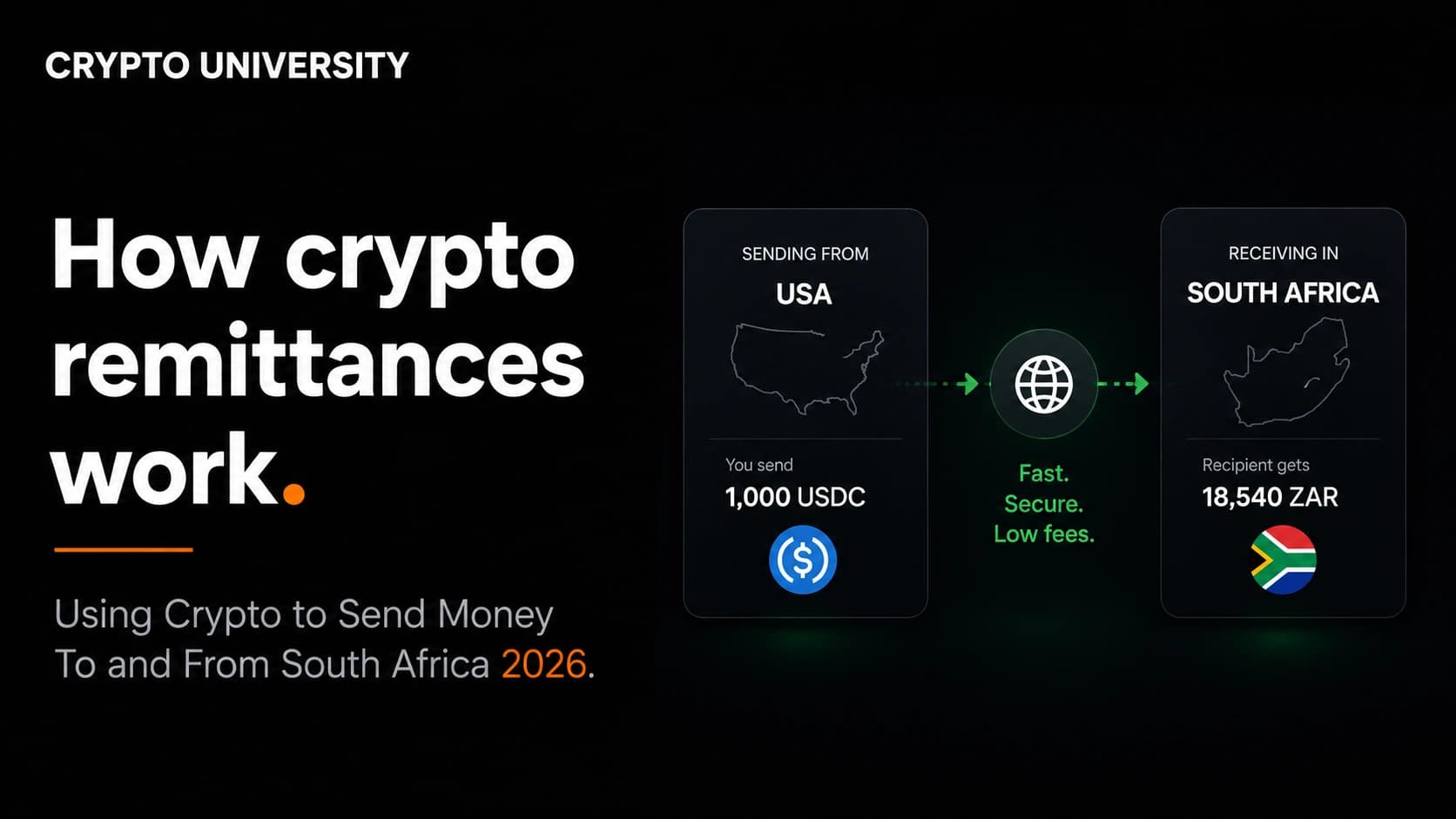
Key takeaways
- Stablecoins are becoming more important in South Africa. SARB reported almost R27 billion in Tether transactions across Luno, VALR and AltCoinTrader in the year to 30 April 2026.
- USDT and USDC are not legal tender. SARB said it is unlikely to treat foreign-currency stablecoins as domestic payment instruments because of dollarisation risk.
- ZARU is different. The rand-backed stablecoin launched in February 2026 through Luno, Sanlam Specialised Asset Management, EasyEquities and Lesaka.
Crypto University helps beginners understand crypto clearly before they risk money.
What are stablecoins?
A stablecoin is a crypto asset designed to maintain a relatively stable value by tracking another asset, usually a national currency.
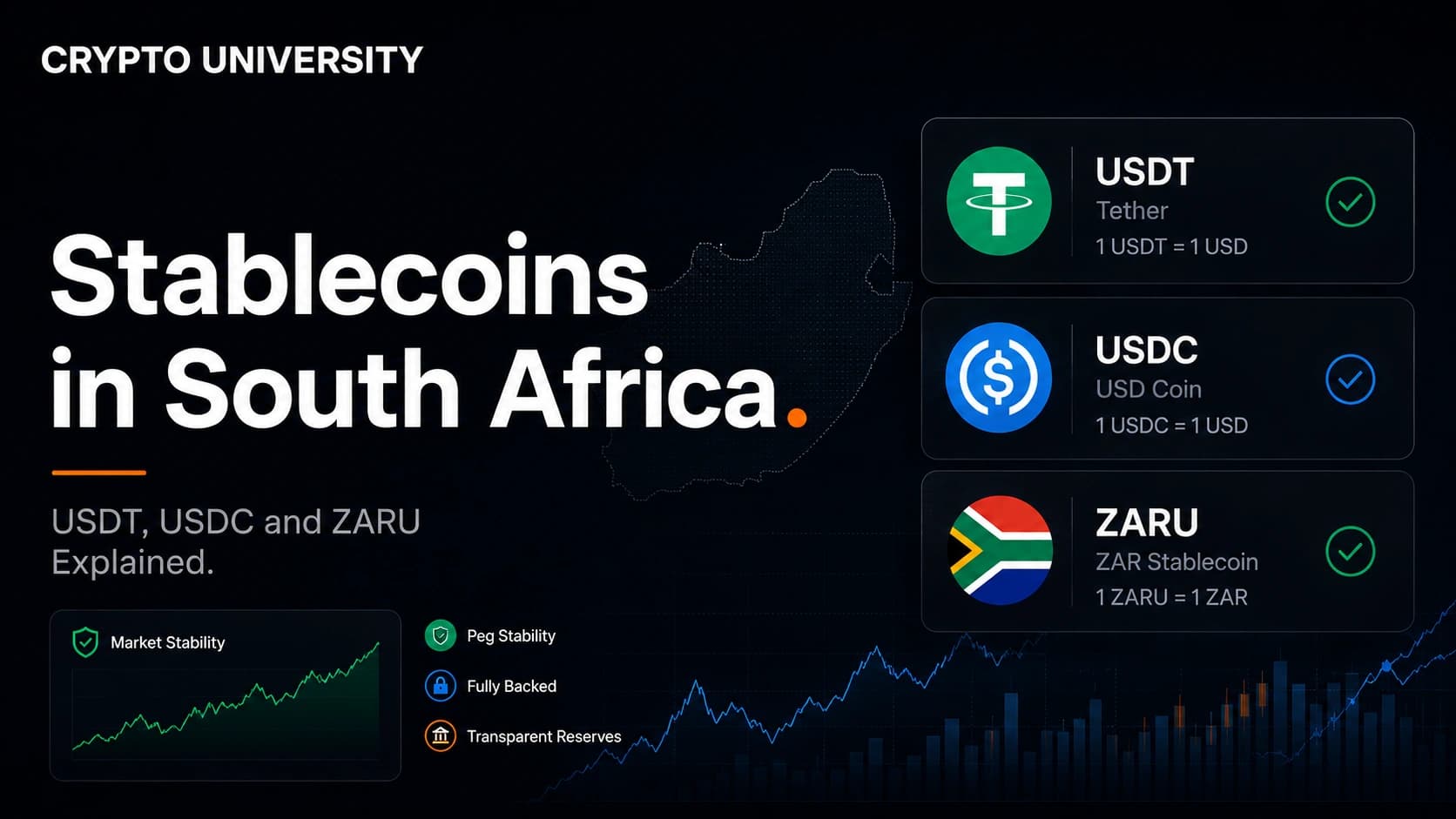
USDT and USDC aim to track the US dollar. ZARU aims to track the South African rand. Unlike Bitcoin or Ether, stablecoins are not primarily designed to move freely with market demand. Their main purpose is to move or hold digital value with less price volatility against a chosen reference currency.
That does not make them risk-free. Stablecoins still depend on issuers, reserves, liquidity, redemption systems and blockchain infrastructure.
Main types of stablecoins
| Type | How it stays stable | Examples | Main risk |
|---|---|---|---|
| Fiat-backed | Uses reserves such as cash or government securities | USDT, USDC, ZARU | Issuer and reserve risk |
| Crypto-backed | Uses other crypto assets as collateral | DAI and similar designs | Collateral and smart contract risk |
| Algorithmic | Uses software and market incentives | Experimental designs | The mechanism can fail |
For most South African beginners, the practical conversation is about USDT, USDC and ZARU.
Why are stablecoins growing in South Africa?
SARB's First Edition 2026 Financial Stability Review says Tether remained the preferred stablecoin domestically. On-chain Tether activity across Luno, VALR and AltCoinTrader reached almost R27 billion in the year to 30 April 2026.
There are several reasons stablecoins are useful.
Dollar-linked digital value
USDT and USDC give users access to a crypto asset whose target value is linked to the US dollar. This is not the same as holding dollars in a bank account. The user still depends on the stablecoin issuer and its reserve and redemption structure.
Moving between crypto assets
Stablecoins are commonly used as a bridge between more volatile crypto assets. A user might sell Bitcoin for USDT instead of immediately converting back to rand.
Beginners should remember that exchanging one crypto asset for another can still have tax consequences.
Cross-border and 24/7 settlement
Stablecoins can move on blockchain networks outside normal banking hours. This can make them useful for some settlement and international transfer use cases.
However, a fast blockchain transfer does not remove South African tax, exchange-control or financial-services rules.
Are stablecoins legal in South Africa?
Stablecoins are not legal tender in South Africa.
On 28 May 2026, the South African Reserve Bank's National Payment System Department and the Financial Sector Conduct Authority issued a joint communication covering crypto assets used for domestic payments.
It confirmed that crypto assets, including stablecoins:
- are not considered payments under the current National Payment System Act;
- currently fall outside that Act;
- are neither "money" nor "funds" under that framework; and
- do not have legal tender status.
This does not mean that owning or trading a stablecoin is automatically illegal.
South Africa regulates certain crypto-related financial services under the Financial Advisory and Intermediary Services Act. SARB reported that the FSCA had licensed 310 crypto asset service providers by the end of March 2026.
The key distinction is between owning a crypto asset, providing regulated services and having it recognised as a domestic payment instrument.
What does SARB say about USDT and USDC?
The May 2026 communication makes a clear distinction between rand-pegged and foreign-currency stablecoins.
SARB said foreign-currency stablecoins can create currency substitution, also called dollarisation. If people increasingly save and transact in a foreign currency, domestic monetary policy can become less effective.
For that reason, SARB said it is unlikely to consider foreign-currency-pegged stablecoins as payment instruments for domestic transactions.
That is more accurate than saying USDT or USDC has been banned. These tokens can still be held or traded, but their status as officially regulated domestic payment instruments is a separate issue.
What is ZARU?
ZARU, short for ZAR Universal, is a stablecoin designed to track the South African rand.
It launched in February 2026 through a collaboration involving Luno, Sanlam Specialised Asset Management, EasyEquities and Lesaka.
The launch partners said each ZARU would be backed by high-quality rand-denominated assets including cash, bank deposits and South African government bonds. Standard Bank was named as banker, with Moore Johannesburg providing monthly reserve audits.
Luno says ZARU operates on the Solana blockchain.
USDT vs USDC vs ZARU
| Feature | USDT | USDC | ZARU |
|---|---|---|---|
| Target value | US dollar | US dollar | South African rand |
| Issuer or initiative | Tether | Circle | ZAR Universal initiative |
| Main purpose | Dollar-linked liquidity and transfers | Dollar-linked settlement and liquidity | Rand-linked digital settlement |
| Domestic payment outlook | SARB unlikely to treat foreign-currency stablecoins as domestic payment instruments | Same concern as USDT | Rand stablecoin use cases are being studied |
| Currency exposure for SA users | USD/ZAR | USD/ZAR | Designed to track ZAR |
In August 2026, Luno also introduced ZARU/USDT and ZARU/USDC trading pairs. That gives users a direct market between the rand-backed token and two major dollar stablecoins.
USDT vs USDC: what should beginners compare?
USDT and USDC both aim to track one US dollar, but beginners should look beyond the ticker.
Reserve disclosure: Tether publishes reserve information and independent assurance reports. Circle publishes USDC reserve information, weekly disclosures and monthly third-party assurance.
Liquidity: SARB's 2026 data shows Tether is the preferred stablecoin in the South African market covered by its review.
Supported networks: Both tokens can exist on multiple blockchains. Before withdrawing, confirm that the sending platform and receiving wallet support the same token on the same network.
Stablecoin risks beginners should understand
The word "stable" can create a false sense of safety. Stablecoins reduce one type of risk, price volatility against their reference currency, but introduce others.
Depegging risk
A stablecoin can move away from its target price. Reserve concerns, market stress, redemption problems or technical failures can all contribute.
Issuer and counterparty risk
Fiat-backed stablecoins depend on private issuers and financial institutions. They are not ordinary South African bank deposits and do not carry the same protections.
Custody risk
Holding stablecoins on an exchange creates exchange custody risk. Holding them in a self-custody wallet makes the user responsible for private keys, seed phrase security and transaction accuracy.
Network mistakes
Stablecoins can be issued on several networks. Sending a token on an unsupported network can make funds difficult or impossible to recover.
Before sending:
- Check the token.
- Check the network.
- Check the destination address.
- Confirm the receiving service supports that network.
- Consider a small test transaction.
Regulatory risk
South Africa's framework is still developing. SARB is studying rand-pegged stablecoin use cases and possible future regulation of crypto payment instruments.
How are stablecoins taxed in South Africa?
SARS applies South Africa's normal tax rules to crypto assets.
SARS says crypto gains or losses must be declared and may be treated as revenue or capital depending on the facts and circumstances.
That means a transaction should not automatically be ignored because a stablecoin stayed near one dollar. For example, exchanging Bitcoin for USDT is still an exchange of one crypto asset for another.
South Africa's Crypto-Asset Reporting Framework took effect on 2 March 2026, creating reporting requirements for crypto asset service providers.
Keep records of dates, amounts, rand values and fees. Tax treatment can be fact-specific, so professional advice may be appropriate for complex cases.
How to use stablecoins more carefully
Here is what beginners should check before acting:
- Know the issuer. Find the official reserve and transparency information.
- Know the peg. Confirm what currency or asset the token tracks.
- Verify the contract address. Do not trust only a token name or logo.
- Confirm the network. Make sure both sides support the same blockchain.
- Understand custody. Know whether an exchange or your own wallet controls the assets.
- Check current rules. Tax, payment and cross-border requirements can change.
- Keep records. Save transaction histories and rand values.
If you choose to use an exchange, compare supported networks, fees, spreads, custody terms and licensing. Crypto University may earn a commission from qualifying referrals through Luno or VALR. An affiliate relationship does not change the educational criteria used in this guide.
What this means for South African beginners
Stablecoins are an important part of South Africa's crypto market, but they are not risk-free digital cash.
USDT and USDC provide dollar-linked digital value and crypto-market liquidity. ZARU is a newer rand-backed alternative aimed at digital settlement.
The regulatory direction is becoming clearer. SARB is cautious about foreign-currency stablecoins becoming domestic payment instruments, while rand-pegged stablecoins are being studied as a possible local payment use case.
The practical lesson is simple: understand what backs the token, who issues it, which network you are using and what can go wrong before transferring money.
Frequently asked questions
Is USDT legal in South Africa?
Owning or trading USDT is different from USDT being legal tender. SARB and the FSCA confirmed in May 2026 that crypto assets are not legal tender. SARB also said it is unlikely to consider foreign-currency stablecoins as domestic payment instruments.
Is USDC legal in South Africa?
USDC is also a crypto asset rather than legal tender. The same regulatory concern about foreign-currency stablecoins applies.
What is ZARU?
ZARU is a rand-backed stablecoin launched in February 2026 through a collaboration involving Luno, Sanlam Specialised Asset Management, EasyEquities and Lesaka.
Can stablecoins lose their peg?
Yes. A stablecoin's target price is a design objective, not a guarantee. Reserve concerns, redemption pressure, market stress or technical problems can cause a token to move away from its target.
Do I pay tax when swapping Bitcoin for USDT?
A crypto-to-crypto exchange can have tax consequences under South Africa's normal tax rules. SARS says crypto gains and losses must be declared, with the treatment depending on the facts and circumstances.
Related terms
- Stablecoin: A crypto asset designed to track the value of another asset or currency.
- Fiat-backed stablecoin: A stablecoin supported by reserves such as cash, deposits or government securities.
- Depegging: When a stablecoin moves materially away from its target value.
- Counterparty risk: The risk that an issuer, custodian or other party cannot meet its obligations.
- Crypto Asset Service Provider (CASP): A business providing crypto-related services, some of which require licensing in South Africa.
Sources
- South African Reserve Bank and Financial Sector Conduct Authority, Joint Communication: Crypto assets for domestic payment purposes, 28 May 2026: https://www.resbank.co.za/content/dam/sarb/what-we-do/payments-and-settlements/regulation-oversight-and-supervision/designation-notices/280526%20Joint%20Communication_Crypto%20assets%20for%20domestic%20payment%20purposes.pdf
- South African Reserve Bank, First Edition 2026 Financial Stability Review, June 2026: https://www.resbank.co.za/content/dam/sarb/publications/reviews/finstab-review/2026/first-edition/first-fsr-june.pdf
- South African Revenue Service, Crypto Assets & Tax: https://www.sars.gov.za/individuals/crypto-assets-tax/
- South African Revenue Service, Budget 2026 Frequently Asked Questions: https://www.sars.gov.za/about/sars-tax-and-customs-system/budget/budget-2026-frequently-asked-questions/
- Sanlam, Sanlam launches ZARU Stable Coin with Industry Partners, 5 February 2026: https://www.sanlamonline.co.za/knowledge-hub/zaru
- Luno, What is ZAR Universal Network (ZARU)?: https://guide.luno.com/hc/en-gb/articles/35213166669469-What-is-ZAR-Universal-Network-ZARU
- Luno, Introducing ZARU/USDT and ZARU/USDC, 11 August 2026: https://www.luno.com/en-za/newsroom/introducing-zaru-usdt-and-zaru-usdc-with-launch-fees-reduced-for-90-days
- Tether, Transparency: https://tether.to/en/transparency/
- Circle, Transparency & Stability: https://www.circle.com/transparency
Disclosure: This article is for general educational purposes and is not financial, legal or tax advice. Stablecoins carry issuer, market, regulatory, custody and technical risks. Verify current rules and platform information before acting.
Continue with Stablecoins
Use the South African hub to compare current pathways, supporting evidence and next steps.
OPEN STABLECOINS