
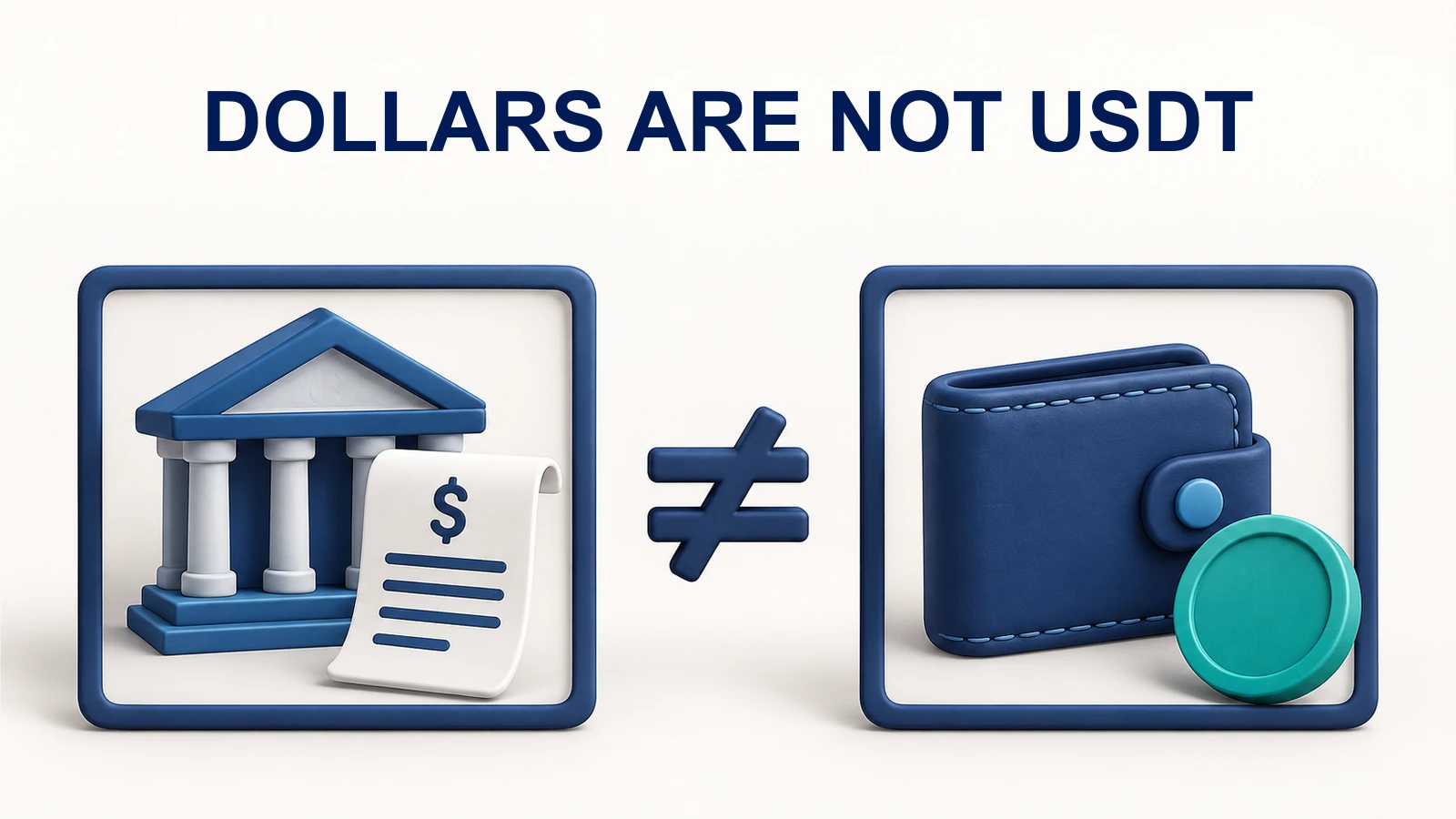
USDT and a US dollar bank deposit can both be affected by the dollar/rand exchange rate, but they give you different rights and different ways to access money. Do not choose between them solely because both display a dollar symbol.
A bank deposit is a claim under the bank's account contract. USDT is a token with issuer terms, network requirements and, if held on an exchange, an additional custody relationship. Your ability to sell a token to another trader is different from a right to withdraw dollars from a bank account.
Compare the legal and operational claim
| Question | USDT | Dollar bank deposit |
|---|---|---|
| Who owes or controls access? | Issuer terms plus any exchange custodian | Named bank under the account contract |
| How do you reach rands? | Eligible market sale and cash-out, or conditional issuer redemption | Bank conversion and transfer under product terms |
| What can interrupt access? | Custody, network, issuer or market restrictions | Bank processing, account or regulatory restrictions |
| Does the displayed dollar value guarantee rand value? | No | No |
| Is deposit protection automatic from the label? | Do not treat a token as an insured deposit | Verify bank, depositor, product and jurisdiction |
Tether's February 2026 information document describes direct redemption subject to verification and a US$100,000 minimum, with fees. A small holder should not assume they can redeem directly with the issuer on the same terms as withdrawing an ordinary bank balance.
For a bank account, determine where the deposit is booked. A local bank's offshore-branded service may involve a different entity and protection scheme. This guide does not establish eligibility or insurance for a named commercial account.
South African deposit protection is conditional
CODI's official FAQ says qualifying foreign-currency deposits booked on a South African bank's balance sheet can be covered, subject to its rules. Its stated limit is R100,000 per qualifying depositor per bank, including other qualifying balances at that bank. Foreign-currency reimbursement is calculated and paid in rands under the applicable rules.
That does not mean every product marketed as a “dollar account” qualifies, and it does not extend that protection to a USDT wallet. Ask the bank for written confirmation of your product's treatment. Do not infer US deposit insurance from a dollar denomination either.
Model the rand exposure separately
Suppose you obtain US$1,000 of bank deposits or 1,000 USDT at an assumed R18 per dollar-equivalent. Ignore fees and assume USDT trades at exactly one dollar for the first part of this illustration.
| Later assumed USD/ZAR | Dollar deposit's gross rand equivalent | USDT's gross rand equivalent at the assumed peg |
|---|---|---|
| R16 | R16,000 | R16,000 |
| R18 | R18,000 | R18,000 |
| R20 | R20,000 | R20,000 |
The same rand movement can affect both. Now assume USDT trades at US$0.97 while USD/ZAR is R18. The token holding's gross value becomes 1,000 × 0.97 × 18 = R17,460, before sale and transfer costs. The R540 difference illustrates token-price risk in addition to currency risk. It is a scenario, not a forecast.
Compare the full access cost
For USDT, request the buy quote, transfer cost, supported network, custody terms and eventual net rand sale quote. For the bank account, request the conversion spread, account charges, transfer costs and any minimum balance or access conditions. Compare the same starting rands and the same desired final bank receipt.
If a provider advertises yield, identify the actual product generating it. A lending or rewards programme can add risks beyond holding the token. Bank interest also depends on the specific account terms; a dollar label does not promise a rate.
Ask what you need the balance to do
For a future dollar invoice, check whether the recipient accepts a bank transfer, a token transfer or neither. For a rand expense, include currency risk and conversion timing. For custody, consider your ability to manage recovery and the consequences of account restrictions.
The stablecoin guide, USDT buying guide and cash-out hub cover adjacent practical tasks. Tax and cross-border treatment still require qualified advice. Holding either option does not by itself establish permission to move funds across borders.
Sources and verification
Primary sources checked on 20 September 2026. Prices, availability and processing arrangements can change.