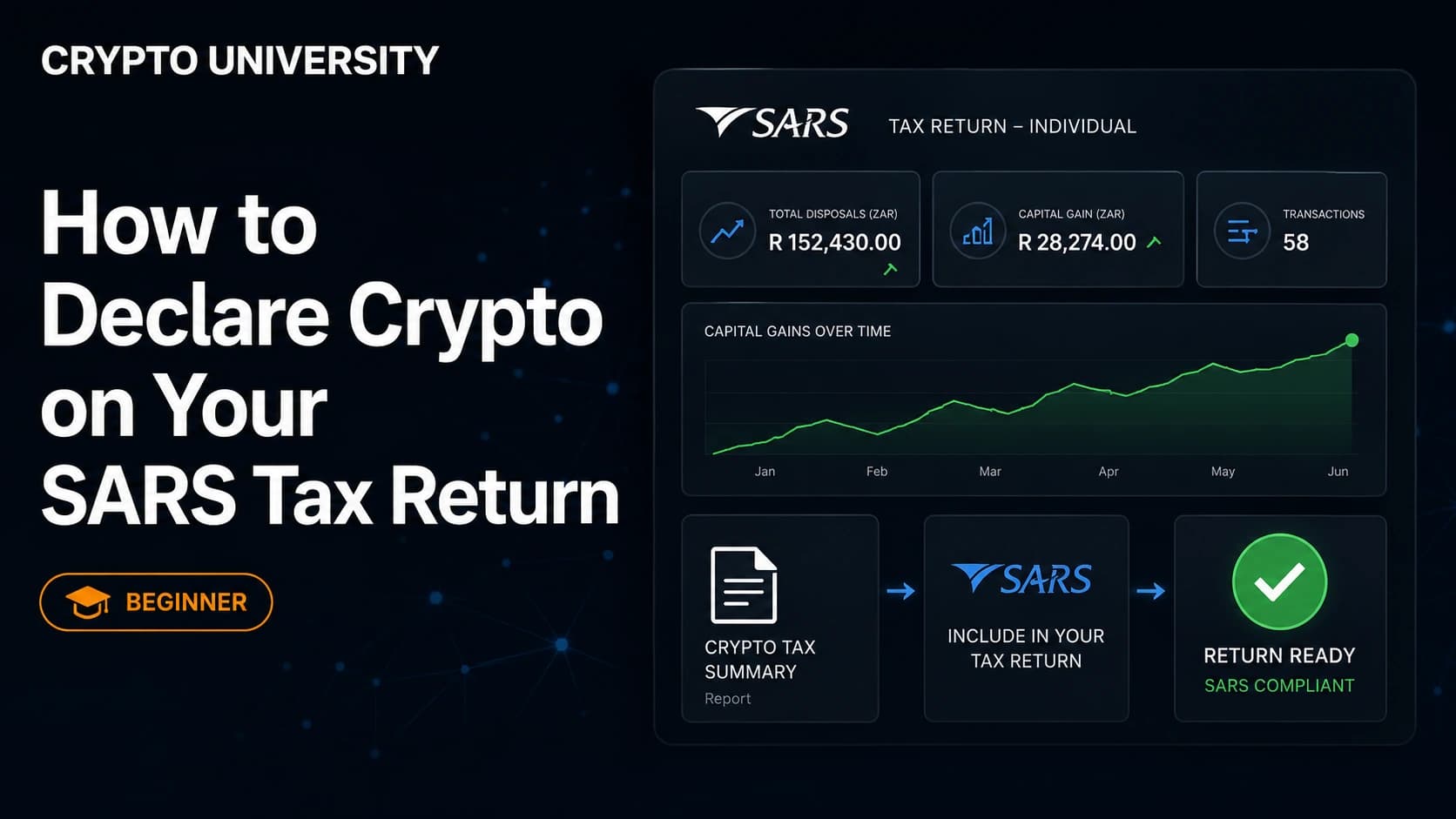

Something changed on 1 March 2026, and a lot of South African crypto holders have not caught up with it.
On that date South Africa implemented the Crypto-Asset Reporting Framework, an OECD standard that requires crypto asset service providers with a South African connection to report user and transaction data directly to SARS. SARS then exchanges that data with more than 120 participating jurisdictions. The first reporting period runs to the end of February 2027.
CARF does not create a new tax. It removes the assumption that SARS cannot see what you did.
This guide covers what is taxable, at what rate, and how to declare it.
The starting point: crypto is an asset, not money
SARS classifies crypto assets as "assets of an intangible nature". Not currency, not legal tender, not a foreign exchange item. In July 2026 SARS published a Draft Guide to the Taxation of Crypto Assets — its first comprehensive statement on the topic — which confirmed that position and applied ordinary tax rules rather than inventing a new regime. The draft was open for public comment until 31 August 2026.
The practical consequence: your crypto is taxed roughly the way shares are. Which means the whole question becomes a familiar one — is this capital or is this revenue?
Capital gains tax or income tax?
This is the single most important distinction in South African crypto tax, and it can more than double what you owe.
If your activity is capital in nature — you bought as a long-term investment and held it — you pay capital gains tax. For individuals in the 2026/27 tax year, the annual capital gains exclusion is R50,000 (raised from R40,000 in the 2026 Budget). Above that, 40% of the net gain is included in your taxable income and taxed at your marginal rate, giving a maximum effective rate of about 18%.
If your activity is revenue in nature — you trade frequently, with the intention of profiting from short-term movements — profits are ordinary income, taxed at your marginal rate of up to 45%.
SARS decides this case by case. There is no bright-line rule about holding periods. The factors that count:
- Intention at acquisition. Why did you buy it? Documented intention matters.
- Holding period. Days and weeks look like trading. Years look like investing.
- Frequency and volume. Hundreds of trades a year is a strong revenue indicator.
- Whether you borrowed to fund it. Leverage suggests a profit-making scheme.
- How you describe yourself. Calling yourself a trader on social media has hurt taxpayers before.
You can be both. A long-held Bitcoin position can be capital while your active altcoin trading is revenue — but you need to be able to demonstrate the split, not just assert it after the fact.
Different entity types face different treatment. Companies face an 80% inclusion rate at 27% corporate tax, giving roughly 21.6% effective. Trusts face 80% inclusion at 45%, giving 36%.
What is actually a taxable event
This is where most South Africans get caught, because several of these involve no rands at all.
Taxable:
- Selling crypto for rands
- Swapping one crypto for another — yes, even ETH to BTC, with no fiat involved
- Spending crypto on goods or services
- Gifting crypto (donations tax may also apply)
- Receiving mining rewards, staking rewards or airdrops — taxed as ordinary income at rand market value on the date of receipt
- Being paid in crypto for work
Not taxable:
- Buying crypto with rands
- Holding it, no matter how much it has gained on paper
- Moving crypto between wallets you own
The crypto-to-crypto swap catches people badly. If you bought Bitcoin at R400,000 and swapped it for Ethereum when Bitcoin was worth R1.2 million, you realised a gain of R800,000 that day. Not when you eventually cash out to rands. That day. And you may owe tax in rands on a gain you never received in rands — which is exactly how people end up with a SARS bill they cannot fund after a market crash.
Working out what you owe
For a capital disposal:
- Proceeds in rands at the date of disposal
- Minus base cost (what you paid, plus allowable acquisition costs like trading fees)
- Equals the capital gain
- Subtract the R50,000 annual exclusion from your total net gains for the year
- Include 40% of the remainder in taxable income
- Tax that at your marginal rate
Worked example. You bought R100,000 of Bitcoin and sold it for R250,000. Your gain is R150,000. After the R50,000 exclusion, R100,000 remains. Included at 40%, that adds R40,000 to your taxable income. At a 39% marginal rate, you owe R15,600 — an effective rate of 10.4% on the gain.
The same R150,000 profit treated as revenue income, at a 39% marginal rate, costs R58,500. That is the whole ballgame.
Losses. Crypto capital losses first offset crypto capital gains in the same tax year. Unused losses carry forward indefinitely against future gains, but cannot be set against salary or interest income. Keep the supporting records — exchange CSVs, wallet logs, rand conversion rates — for at least five years after filing.
Declaring it on your return
Crypto disclosure sits in the ITR12. Practical points:
- Disposals go in the capital gains section or as trading income, depending on classification.
- Mining, staking and airdrop income goes in "other income" at rand value on the date received. That value then becomes your base cost for the later disposal.
- Holdings should be reflected in the assets and liabilities section at market value on the last day of February, even where no taxable event occurred.
- South African tax residents are taxed on worldwide income. Offshore exchange accounts and foreign-held wallets are not a shelter, and CARF is the mechanism that makes this real.
The 2026 filing season, covering 1 March 2025 to 28 February 2026, opened on 1 July 2026. Non-provisional individuals file by 23 October 2026; provisional taxpayers by 22 January 2027.
If you have not declared before
You are not unusual. SARS estimates roughly 5.8 to 6 million South Africans hold or transact in crypto, and historical declaration rates have been poor.
The route back is the Voluntary Disclosure Programme. A VDP application lets you declare previously undisclosed income and gains without the understatement penalties that would otherwise apply. The 2026 Budget further proposed that taxpayers may apply for a separate remission of interest, effective from 1 March 2026.
The critical condition: a VDP application must be voluntary. Once SARS has contacted you about a specific liability, the door closes. With CARF data starting to flow, the window for getting ahead of this is narrowing rather than widening.
Non-compliance penalties are serious — fines up to R1 million or the value of the asset, whichever is greater, and potential imprisonment.
Record-keeping that will save you
Whatever you do, do this from the start:
- Date and time of every transaction
- What was acquired or disposed of, and how much
- Rand value at the time of the transaction
- Fees paid
- Platform or wallet involved
- The counterparty, where relevant
A spreadsheet works for a handful of trades a year. Once you are trading across multiple platforms, crypto tax software that pulls exchange APIs and produces a SARS-ready capital gains report costs less than the accounting hours it saves.
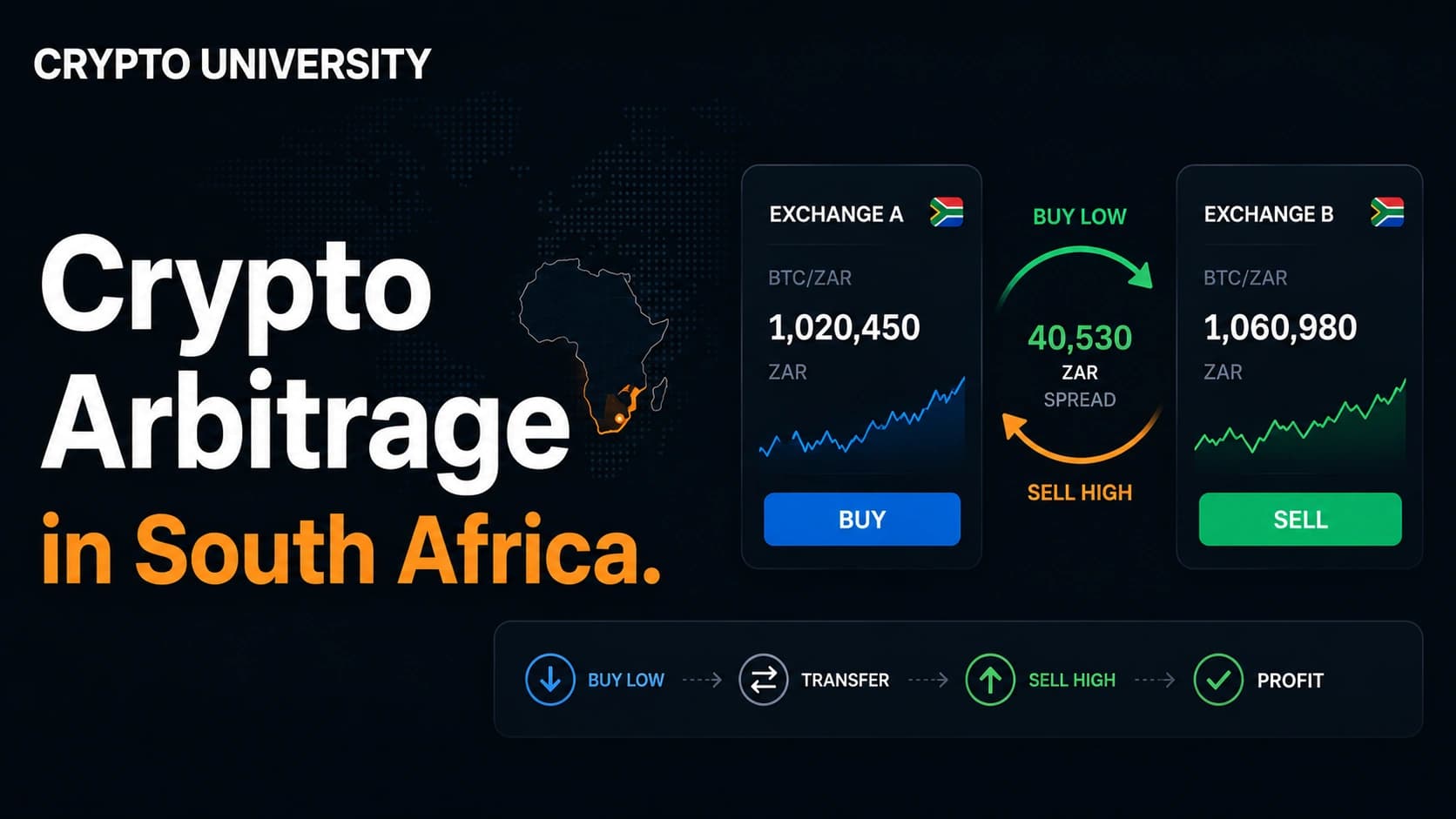
If you were doing arbitrage, the record-keeping burden is heavier again, because exchange control documentation sits on top of the tax position — our guide to crypto arbitrage in South Africa covers that overlap.
Frequently asked questions
Do I have to pay tax on crypto in South Africa? Yes. Normal income tax rules apply to crypto assets, and the onus is on you to declare all crypto-related taxable income in the year it is received or accrued.
How much tax will I pay on crypto profits? Capital gains are taxed at a maximum effective rate of about 18% for individuals after the R50,000 annual exclusion. Revenue profits are taxed at your marginal rate, up to 45%.
Does SARS know about my crypto? Increasingly, yes. Since 1 March 2026, crypto asset service providers with a South African nexus report user and transaction data to SARS under CARF, and that data is exchanged internationally.
Do I pay tax if I only swap coins and never cash out to rands? Yes. A crypto-to-crypto swap is a disposal and a taxable event, valued in rands at the time of the swap.
Is holding crypto taxable? No. Holding is not a taxable event. You should still disclose holdings in the assets and liabilities section of your return.
What about staking and mining rewards? Both are ordinary income, taxed at your marginal rate on the rand market value at the date of receipt.
What if I made a loss? Capital losses offset crypto capital gains in the same year and carry forward indefinitely. They cannot be offset against salary income.
Can I still fix past non-disclosure? Usually, via the Voluntary Disclosure Programme — but only while your disclosure is still voluntary.
This article is general information, not tax advice. Crypto tax classification is fact-specific and the consequences of getting it wrong are expensive. Consult a registered tax practitioner about your own position.
Sources: SARS, Crypto Assets & Tax; SARS Draft Guide to the Taxation of Crypto Assets (July 2026); SARS Crypto-Asset Reporting Framework guidance and External BRS (2026); National Treasury Budget 2026.
Official source links
Continue with SARS and Tax
Use the South African hub to compare current pathways, supporting evidence and next steps.
OPEN SARS AND TAX