
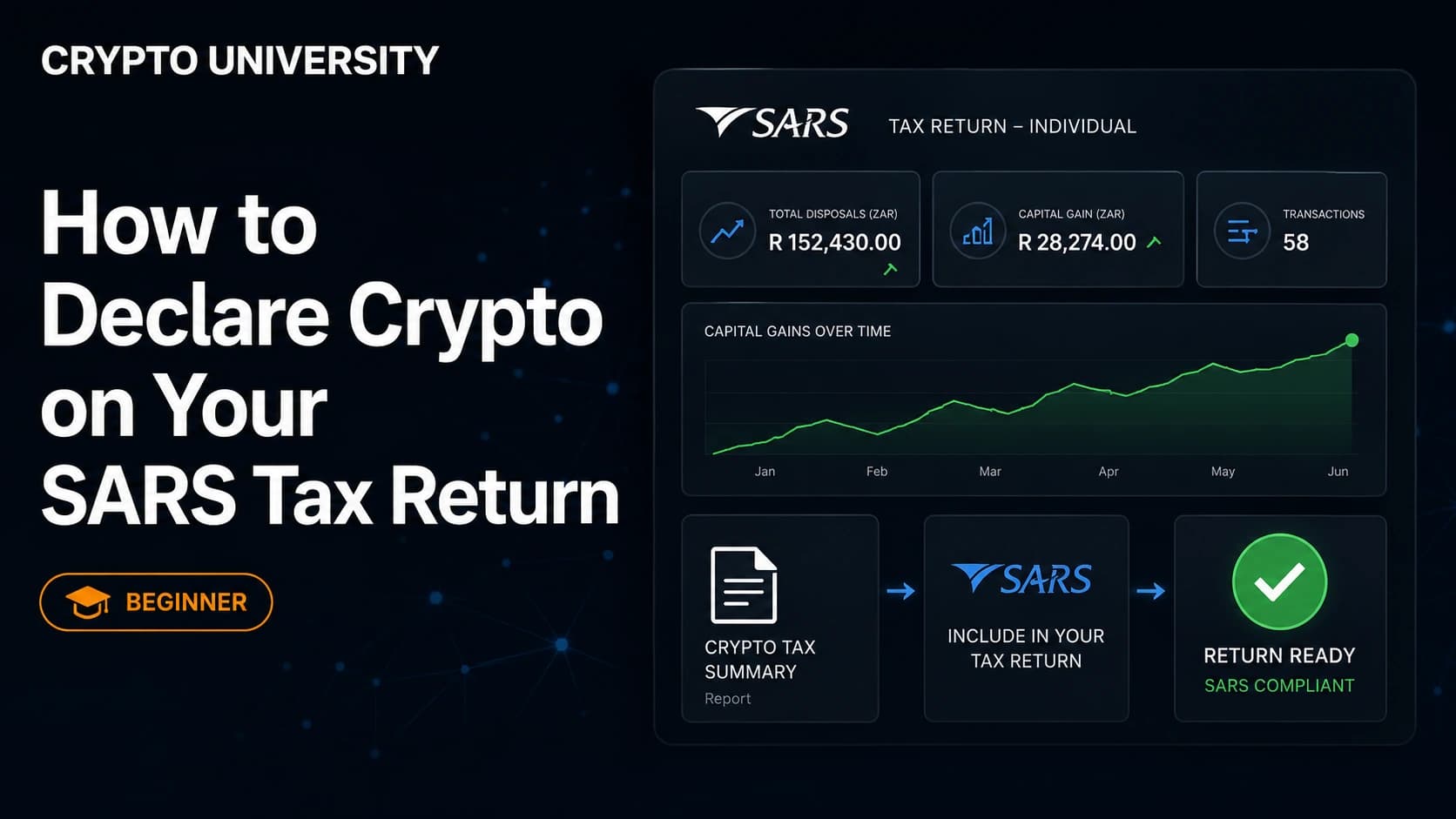
Important: This article is general educational information, not tax advice. Crypto tax treatment depends on your facts and circumstances. Complex portfolios should be reviewed by a registered tax practitioner who understands crypto assets.
Three Key Takeaways
- SARS expects taxpayers to declare taxable crypto gains and losses in the tax year in which they arise. The responsibility remains with the taxpayer.
- Crypto is not automatically taxed as a capital gain. Frequent or business-like trading may be ordinary income, while long-term investment gains may fall under Capital Gains Tax rules.
- Good records are essential. Keep a rand-based ledger showing disposals, acquisition costs, fees, dates and supporting exchange or wallet records.
Crypto University helps beginners understand crypto clearly before they risk money.
Do South Africans Have to Declare Crypto to SARS?
Yes. SARS says normal income tax rules apply to crypto assets and affected taxpayers must declare crypto-related gains or losses.
Tax does not matter only when crypto is converted into rand and withdrawn to a bank account. Selling, swapping, or spending crypto can also create a relevant tax event.
SARS says the onus is on the taxpayer to declare taxable crypto income in the tax year in which it is received or accrued. Failure to do so can lead to interest and penalties.
The practical lesson is simple: track transactions and disposals, not only bank withdrawals.
Capital Gain or Ordinary Income?
The first major question is whether your activity is capital or revenue in nature.
SARS does not use a simple rule such as "hold for one year and it becomes capital." Classification depends on your actual facts and behaviour.
Current SARS guidance says frequent or business-like crypto trading may be taxed as ordinary income. Crypto held as a long-term investment may instead fall under Capital Gains Tax, or CGT.
| Situation | Possible treatment | What SARS may consider |
|---|---|---|
| Long-term investment holding | Capital gain or loss | Intention, holding pattern and conduct |
| Frequent active trading | Ordinary income or trading loss | Frequency, intention and business-like activity |
| Mining | Revenue-related income may arise | Nature and scale of mining activity |
| Staking and similar rewards | May create taxable income depending on facts | How and when the reward was earned or received |
Calling yourself an investor does not automatically make hundreds of short-term trades capital in nature.
If the classification is unclear, use a registered tax practitioner rather than guessing.
Build a Rand Ledger, Not a Memory
For every relevant disposal, keep a transaction record in South African rand.
Capture:
- Date
- Asset and quantity
- Type of transaction
- Proceeds or market value in ZAR
- Base cost or acquisition cost in ZAR
- Fees
- Exchange or wallet
- Transaction ID where available
- Capital or revenue classification, if known
A simple ledger can include the date, transaction type, ZAR proceeds, ZAR base cost, and fees.
If you bought crypto on a South African ZAR pair, the exchange history can provide a useful starting point. If a trade is priced in dollars, stablecoins or another crypto asset, you still need a supportable rand value.
Use a consistent valuation method and keep evidence showing where the exchange rate or market value came from.
Why Crypto-to-Crypto Swaps Matter
One of the most common mistakes is declaring only purchases made with rand and cash-outs back to a bank account.
That can miss taxable events.
If you swap BTC for ETH, you have disposed of BTC and acquired ETH. SARS lists an exchange as one of the events that can trigger a disposal under CGT principles.
Likewise, using crypto to buy goods or services can fall under barter rules.
Bank statements alone are not enough. Keep exchange CSV exports, wallet histories, trade confirmations, fee records, and proof of transfers between your own wallets.
How Capital Gains Tax Works for Crypto
Where a crypto gain is capital in nature, CGT rules may apply.
The basic calculation starts with:
Proceeds minus base cost = capital gain
For the 2027 South African year of assessment, which runs from 1 March 2026 to 28 February 2027, SARS lists an annual CGT exclusion of R50,000 for natural persons.
This exclusion is not a special crypto allowance. It applies across relevant capital gains and losses for the year.
SARS also lists a maximum effective CGT rate of 18 percent for individuals for the 2027 year of assessment. That does not mean every crypto capital gain is taxed at 18 percent. The actual result depends on the CGT calculation and the taxpayer's overall taxable income.
Always use the rules and thresholds for the specific tax year you are filing.
Where Crypto Appears on the ITR12
The exact ITR12 screens can change, so follow the return presented in SARS eFiling or the SARS MobiApp for the relevant year.
SARS currently states that crypto trading must be declared on the ITR12. Its 2026 Budget FAQ identifies source code 4522 for income from crypto trading.
Conceptually, organise your records before filing:
| Crypto activity | Tax area to consider |
|---|---|
| Long-term investment disposal | Capital gains |
| Frequent trading profit or loss | Ordinary or trading income |
| Mining receipts | Revenue income, depending on facts |
| Staking or similar rewards | Possible income when received or accrued |
| Later sale of rewarded crypto | Separate disposal calculation may arise |
Do not combine every crypto activity into one number simply because it happened on one exchange.
What About Mining and Staking?
SARS has specifically addressed mining. It says successful mining can create an immediate receipt or accrual, with further tax consequences when the crypto is later realised.
Staking is more fact-specific because arrangements differ. Rewards may come from direct protocol staking, exchange products, liquid staking systems or other structures.
For staking and similar rewards, record:
- Date received or credited
- Token and quantity
- Rand value at the relevant time
- Platform or wallet
- Supporting transaction record
- What happened to the asset later
If the amount is material or the structure is complicated, get professional tax advice.
Common Mistakes That Create Problems
Declaring Only Rand Cash-Outs
Tax events can happen before money reaches your bank account.
Ignoring Crypto-to-Crypto Swaps
Swapping one asset for another may involve a disposal that needs to be recorded.
Using USD Values Without Converting to Rand
Your records should support the ZAR amounts used for South African tax reporting.
Having No Base Cost Records
Without purchase records, it becomes difficult to support a gain or loss calculation.
Assuming Every Gain Is CGT
Frequency, intention and business-like conduct can affect whether profits are capital or ordinary income.
Treating Transfers Between Your Own Wallets as Sales
Label your own wallet addresses clearly. Moving crypto between wallets you control is economically different from selling it.
Trusting Tax Software Without Checking It
Software can help, especially with hundreds of transactions, but missing prices, wallet transfers and token migrations can create errors. Review the output before filing.
A Practical Monthly Recordkeeping Habit
Each month:
- Export CSV files from every exchange you used.
- Save bank statements and trade confirmations.
- Record wallet addresses you control.
- Reconcile transfers between your own accounts and wallets.
- Add missing rand valuations.
- Save evidence of fees and unusual transactions.
- Store everything in a folder for that tax year.
SARS generally requires supporting documents used for an income tax return to be kept for at least five years after submission.
This habit means that year-end filing becomes a reconciliation exercise rather than an attempt to rebuild a year of activity from memory.
What CARF Means for Crypto Taxpayers
South Africa has implemented the Crypto-Asset Reporting Framework, or CARF, to increase tax transparency.
SARS says relevant crypto service providers can be required to report customer details and categories of activity including crypto-to-crypto exchanges, fiat purchases, disposals and wallet transfers.
Individual taxpayers do not file a separate CARF report. They still declare crypto through the normal tax system.
The broader lesson is that assuming crypto activity is invisible to SARS is increasingly risky.
Pre-Filing Checklist
Before submitting your return, check:
- Have you included every exchange and wallet relevant to the calculation?
- Have you identified crypto-to-crypto disposals?
- Are values converted into rand?
- Can you support your base costs?
- Have fees been recorded?
- Have trading and investment activity been separated where appropriate?
- Have mining, staking and other rewards been reviewed?
- Can you explain large deposits and withdrawals?
- Have you kept the supporting documents?
- Does anything need professional review?
For a simple portfolio, a spreadsheet may be enough. For high transaction volumes, crypto tax software can make reconciliation easier, but the calculations should still be checked.
Final Thought
Declaring crypto to SARS is mainly a recordkeeping and classification exercise.
Keep a rand-based ledger from the beginning, record relevant disposals, preserve acquisition costs and fees, and distinguish long-term investing from active trading where the facts support that distinction.
SARS expects affected taxpayers to declare crypto-related taxable income and gains. Good records make it easier to complete the ITR12 accurately and respond if SARS later asks for supporting information.
This article is educational and does not constitute tax advice. Complex DeFi activity, mining, staking, derivatives, offshore exchanges, missing records or large portfolios should be reviewed by a tax professional.
FAQ
Do I declare crypto if I made a loss?
Potentially, yes. SARS says affected taxpayers must declare crypto gains or losses. The treatment depends on whether the activity is capital or revenue in nature, and proper records are needed to support the loss.
Do small crypto amounts count?
There is no general rule saying a crypto transaction can be ignored simply because it is small. The CGT annual exclusion is part of the overall capital gains calculation, not a blanket exemption from crypto reporting.
Do I need to declare a crypto-to-crypto swap?
A swap can involve the disposal of one crypto asset and the acquisition of another. These transactions should not simply be ignored because no rand entered your bank account.
Is moving crypto to my own wallet taxable?
A genuine transfer between wallets you own is different from selling or swapping the asset. Keep evidence showing that both wallets belong to you.
Should I use crypto tax software?
If you have more than a handful of trades, software can help import exchange and wallet data and identify disposals. Review the results carefully and use a tax practitioner for complex cases.
How long should I keep crypto tax records?
SARS generally requires supporting documents to be retained for at least five years after submission of the return. Keep older acquisition records where they are still needed to establish the base cost of assets you continue to hold.
5 Related Terms
- Capital Gains Tax (CGT): Tax rules that apply when a capital asset is disposed of for a gain.
- Base cost: Qualifying expenditure used when calculating a capital gain or loss.
- Disposal: An event such as a sale or exchange that can trigger a tax calculation.
- ITR12: The South African individual income tax return.
- CARF: The Crypto-Asset Reporting Framework used for tax information reporting and exchange.
Sources
- South African Revenue Service. Crypto Assets & Tax. https://www.sars.gov.za/individuals/crypto-assets-tax/
- South African Revenue Service. Budget 2026 Frequently Asked Questions. https://www.sars.gov.za/about/sars-tax-and-customs-system/budget/budget-2026-frequently-asked-questions/
- South African Revenue Service. Capital Gains Tax (CGT) rates. https://www.sars.gov.za/tax-rates/income-tax/capital-gains-tax-cgt/
- South African Revenue Service. Annual Exclusion. https://www.sars.gov.za/types-of-tax/capital-gains-tax/proceeds/calculation-of-taxable-capital-gains-and-assessed-capital-losses/annual-exclusion/
- South African Revenue Service. Crypto-Asset Reporting Framework (CARF). https://www.sars.gov.za/businesses-and-employers/third-party-data/crypto-asset-reporting-framework-carf/
- South African Revenue Service. Supporting Documents for Filing. https://www.sars.gov.za/types-of-tax/personal-income-tax/filing-season/supporting-documents-for-filing/
- South African Revenue Service. SARS's stance on the tax treatment of cryptocurrencies. https://www.sars.gov.za/media-release/6-april-2018-sarss-stance-on-the-tax-treatment-of-cryptocurrencies/
Continue with SARS and Tax
Use the South African hub to compare current pathways, supporting evidence and next steps.
OPEN SARS AND TAX