Key takeaways
- A professional website, active WhatsApp group, working first withdrawal or celebrity video does not prove that a crypto platform is legitimate.
- South Africans should verify the legal entity and its authorisation with the FSCA before sending money, especially when a service offers crypto investment or financial services.
- If you think you have been scammed, stop sending money, preserve evidence, contact your bank or exchange quickly, report the matter to SAPS and notify the relevant regulator.
Crypto University helps beginners understand crypto clearly before they risk money.
Crypto scams in South Africa are becoming harder to recognise
Crypto scams do not all look like badly designed websites or obvious spam messages anymore. Many now use polished apps, professional social media pages, cloned brands, artificial intelligence, fake testimonials and long conversations designed to build trust.
South Africa is an active crypto market, which also attracts criminals. Chainalysis reported more than $205 billion in total on-chain crypto value across Sub-Saharan Africa between July 2024 and June 2025, up about 52% year over year. This is total activity, not scam proceeds. INTERPOL's 2026 African Cyberthreat Assessment also said AI was enabling 55% of reported cybercrimes across surveyed African countries. Beginners therefore need a verification process, not a feeling. A platform can look legitimate and still be fraudulent.
The most common crypto scam patterns
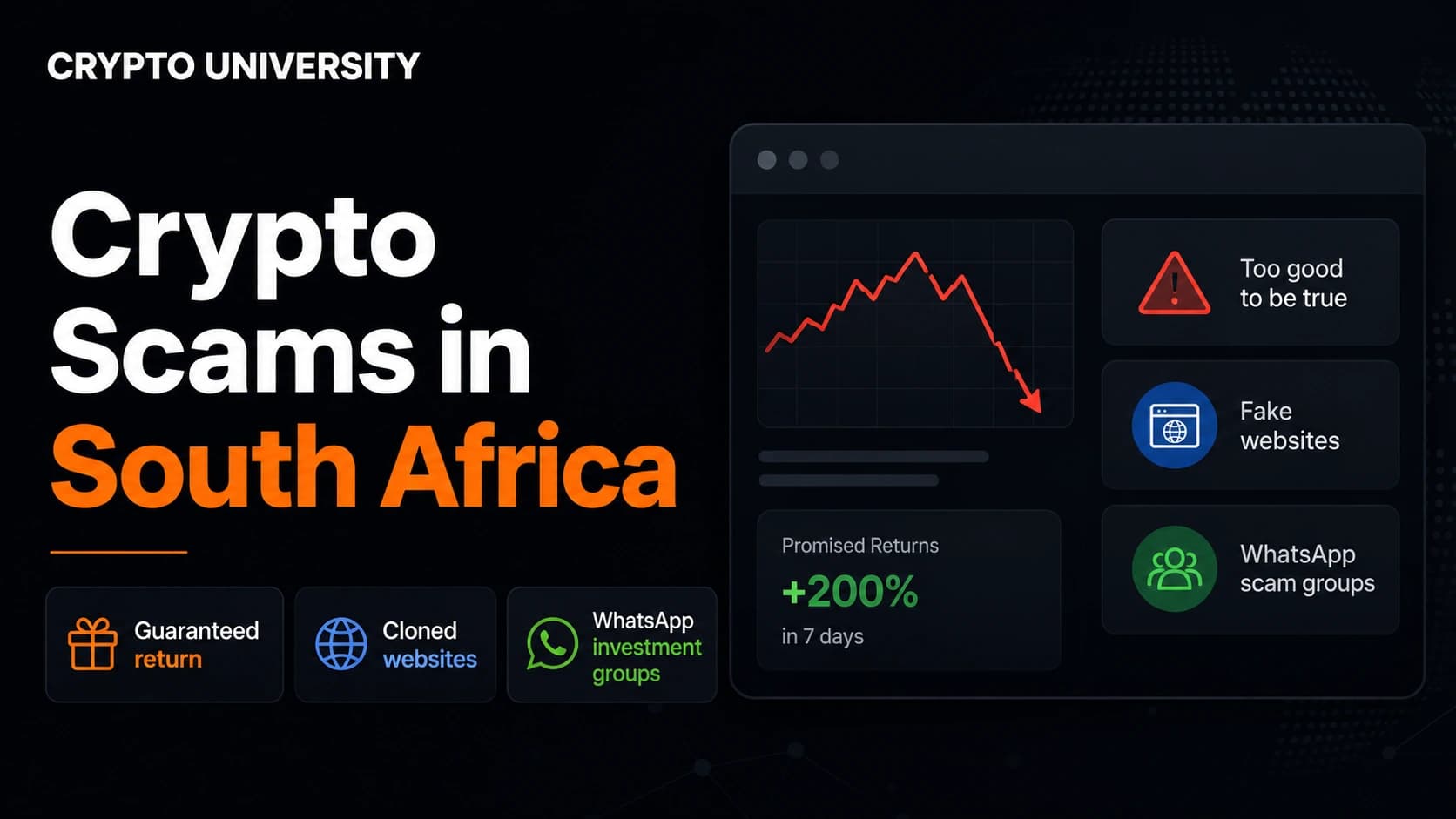
1. Guaranteed return and fixed-profit schemes
A common scam starts with a simple promise: deposit money and receive a fixed daily, weekly or monthly return.
The product may be described as trading, staking, mining, arbitrage or an AI bot. Crypto assets are volatile, so fixed profits with little or no risk should trigger immediate scrutiny. Mirror Trading International, one of South Africa's best-known historical cases, claimed consistent monthly profits. In 2020 the FSCA said the claimed returns appeared unrealistic and that it could not independently confirm key claims about trading activity and client funds.
Beginner rule: if the return is presented as guaranteed, fixed or virtually risk-free, stop and verify before sending money.
2. Fake crypto arbitrage funds
Crypto arbitrage is real, but that does not make every arbitrage investment product legitimate.
Scammers like the arbitrage story because it sounds technical and plausible. Real arbitrage opportunities change with liquidity, fees, exchange limits and execution speed. A fixed return is not proof of a working strategy.
Here is what beginners should check:
| Question | Why it matters |
|---|---|
| Who is the legal company? | A brand name alone is not enough to verify a financial service. |
| Is the provider authorised for the service it offers? | Registration for one activity does not automatically authorise every investment product. |
| Where are customer assets held? | A legitimate provider should explain custody clearly. |
| Can the provider explain fees and risks? | Vague language can hide the absence of a real business model. |
| Are returns guaranteed? | Guaranteed returns are a major fraud warning sign. |
3. WhatsApp and Telegram investment groups
Many scams use WhatsApp or Telegram because group chats create social proof quickly.
You may be added to a group where dozens of accounts post profit screenshots, thank an administrator or claim that withdrawals arrived instantly. Some groups use fake members or coordinated accounts to make the scheme look active.
The victim may even be allowed to withdraw a small amount. Later, after a larger deposit, the platform blocks withdrawals and demands another payment for tax, verification, unlocking or compliance. A demand for more money to release your existing balance is a serious warning sign. A successful first withdrawal is not proof of legitimacy.
4. Impersonation and cloned websites
Impersonation scams copy real companies, financial advisers, exchanges, regulators or public figures.
The criminal may use:
- a domain name that differs by one letter
- a cloned login page
- a fake mobile app
- a copied FSCA number
- a Telegram profile using a real employee's name
- a fake customer-support account
- a social media advertisement using a well-known brand
The FSCA regularly publishes warnings about impersonators of legitimate financial businesses. In 2026 it also warned about individuals impersonating the FSCA and its staff.
Important: finding a real company with a real licence does not prove that the person contacting you actually works for that company.
Verify the domain, phone number and email address through the organisation's official website.
5. AI deepfakes and fake endorsements
Deepfake scams use AI-generated video, audio or images to make it appear that a recognised person supports an investment platform.
In 2026 the FSCA published a warning about a deepfake investment scam involving South African financial media personalities. Older signals such as bad grammar or poor-quality graphics are no longer reliable enough on their own.
Treat every investment endorsement as unverified until you confirm it through the public figure's official channels and the regulator's records.
6. Romance and long-term trust scams
Some scams do not mention crypto at the beginning.
A person may spend days or weeks building a friendship or romantic relationship before introducing an investment opportunity. They may show screenshots of successful trades, explain how a relative or mentor taught them, then guide the victim to a specific platform.
The long conversation is part of the manipulation. Never send money to an investment service simply because someone you met online appears personally trustworthy.
7. Recovery scams after the first loss
Victims are often targeted again.
A recovery scammer may claim to be a lawyer, investigator, regulator or asset-recovery company and promise to retrieve lost crypto for an upfront fee. Be especially careful when a recovery service contacts you without being asked. Criminal groups can share or resell victim details.
How to verify a crypto platform in South Africa
Before depositing money, use this checklist.
Step 1: Identify the exact legal entity
Find the registered company name and the name under which regulated services are provided.
Step 2: Search the FSCA records
Crypto assets were declared financial products under South Africa's FAIS framework in 2022. Businesses that regularly provide covered financial services relating to crypto assets may require FSCA authorisation.
Search the FSCA's authorised financial service provider records and its published list of authorised crypto asset service providers. Confirm that the entity name matches the company you are dealing with.
A licence does not remove investment risk and does not mean every product offered by a company is automatically endorsed by the FSCA.
Step 3: Check the FSCA warning list
Search the regulator's latest public warnings. The FSCA issued 107 public warnings from 1 April 2024 to 31 March 2025, and warnings continued regularly in 2026.
Step 4: Verify the website independently
Do not use the link sent in a WhatsApp message, Telegram group or direct message.
Search for the organisation independently and compare:
- domain name
- support email
- phone number
- company address
- app publisher
- regulator details
Step 5: Understand custody and withdrawals
Ask who controls the crypto, where assets are held, how withdrawals work and what fees apply.
If the explanation is confusing, rushed or designed to prevent questions, do not send more money.
Red flags ranked by severity
| Risk level | Warning sign | What to do |
|---|---|---|
| Stop immediately | Guaranteed profits | Do not deposit. |
| Stop immediately | Request for seed phrase, password or 2FA code | End contact and secure your account. |
| Stop immediately | Extra fee required to unlock a withdrawal | Do not send another payment. |
| Stop immediately | Payment requested to a personal bank account without a clear business reason | Verify the entity independently. |
| Serious concern | Only reachable through WhatsApp or Telegram | Look for official support channels. |
| Serious concern | Pressure to deposit before a deadline | Ignore the urgency and verify first. |
| Serious concern | Celebrity or expert endorsement used as proof | Confirm through official channels. |
| Serious concern | Licence number shown but legal entity does not match | Contact the regulator or company directly. |
| Pause and check | Newly created website or limited company history | Research ownership and registration. |
What to do if you have already sent money
Act quickly. Do not send more money.
- Stop further payments. Do not pay an unlock fee, tax, insurance charge or recovery fee demanded by the same platform.
- Contact your bank or card provider immediately. Explain that the payment may be connected to fraud and ask what options are available.
- Contact the crypto exchange you used. If funds were sent from an exchange, give its fraud or compliance team the transaction details and receiving wallet address.
- Preserve evidence. Save messages, emails, phone numbers, wallet addresses, transaction IDs, bank records, website links and screenshots.
- Open a case with the South African Police Service. Provide the available evidence and keep the case number.
- Report the entity to the FSCA when relevant. Include the legal name, website, contact details and payment information.
- Secure your accounts. Change compromised passwords, reset 2FA where necessary and move unaffected crypto to a safe wallet if you exposed private credentials.
- Ignore unsolicited recovery offers. A second scam often follows the first.
If you shared a wallet seed phrase or private key, assume that wallet is compromised. Create a new wallet using a trusted process and move remaining assets if it is still safe to do so. Never reuse a compromised seed phrase.
Why scam detection now depends on process
AI can produce professional text, cloned voices, realistic images and convincing videos. Criminals can also copy legitimate websites and borrow the identities of regulated firms. The strongest defence is a repeatable verification process:
- identify the legal entity
- check regulatory status
- verify the domain independently
- understand how funds are held
- reject guaranteed returns
- never reveal authentication secrets
- stop when urgency replaces transparency
Frequently asked questions
How do I check if a crypto platform is legitimate in South Africa?
Identify the exact legal entity, search the FSCA's records, confirm the authorisation matches the service being offered, check the FSCA warning list and verify the website independently. A polished app or a licence number shown in a chat is not enough.
Where do I report a crypto scam in South Africa?
Report suspected fraud to SAPS and contact your bank or payment provider quickly. If the matter involves financial services, you can also notify the FSCA. If crypto was sent through an exchange, contact that exchange's fraud or compliance team.
Can stolen crypto be recovered?
Sometimes funds can be frozen or traced, but recovery is not guaranteed. Crypto transfers are generally difficult to reverse once confirmed. Reporting quickly improves the chance that a bank, exchange or law-enforcement agency can act before funds move further.
Is crypto arbitrage a scam?
No. Arbitrage is a legitimate trading method based on price differences between markets. The scam risk appears when someone uses the term to justify guaranteed returns, hides where funds are held or cannot demonstrate a credible business model.
Can I trust an investment platform if a small withdrawal worked?
No. Some scams deliberately allow early withdrawals to build trust before encouraging a much larger deposit. Verify the provider independently even if an initial withdrawal succeeds.
Does an FSCA licence mean an investment is safe?
No. Regulation can help you verify whether a financial service provider is authorised, but it does not guarantee profits or remove market, operational or fraud risk. Always check the exact entity and the scope of its authorisation.
What should I do if someone asks for my crypto seed phrase?
Do not provide it. A seed phrase can give complete control over a self-custody wallet. Legitimate customer support does not need it to help you.
Related terms
- Phishing: A scam that tricks users into revealing passwords, private keys or other sensitive information through fake messages or websites.
- Seed phrase: A set of words used to recover many self-custody wallets. Anyone who obtains it may be able to control the wallet.
- Crypto asset service provider: A business providing certain services involving crypto assets. In South Africa, some crypto-related financial services fall within the FSCA's regulatory framework.
- Impersonation scam: Fraud in which criminals pretend to be a real company, regulator, employee or public figure.
- Recovery scam: A second-stage fraud that targets people who have already lost money and promises recovery in exchange for another payment.
Sources
- Financial Sector Conduct Authority, Latest News and public warnings: https://www.fsca.co.za/Latest-News/
- Financial Sector Conduct Authority, Regulatory Actions Report 2024/2025: https://www2.fsca.co.za/Documents/FSCA%20Regulatory%20Actions%20Report_30%20June%202025.pdf
- Financial Sector Conduct Authority, FSCA Communication 29 of 2023 on crypto asset service provider licensing: https://www.fsca.co.za/Regulatory%20Frameworks/Regulatory%20Frameworks%20Documents/FSCA%20Communication%2029%20of%202023%20%28FAIS%29.pdf
- Financial Sector Conduct Authority, Mirror Trading International statement, 18 August 2020: https://www.fsca.co.za/News%20Documents/FSCA%20Press%20Release%20Mirror%20Trading%20International%2018%20August%202020.pdf
- Chainalysis, Sub-Saharan Africa Emerges as Third-Fastest Growing Crypto Region, 10 September 2025: https://www.chainalysis.com/blog/subsaharan-africa-crypto-adoption-2025/
- INTERPOL, African Cyberthreat Assessment 2026 summary, 3 August 2026: https://www.interpol.int/fr/Actualites-et-evenements/Actualites/2026/INTERPOL-report-finds-AI-linked-to-more-than-half-of-cybercrime-in-Africa
- South African Police Service, Hawks statement on alleged investment scam arrests, 27 January 2026: https://www.saps.gov.za/newsroom/msspeechdetail.php?nid=66541
Editorial note
This article is general educational information and is not financial or legal advice. If you believe you have been defrauded, contact your bank or payment provider and the South African Police Service as soon as possible.
More Reading:
- How to Verify You Are on the Real Website (Not a Clone): A Crypto User Guide: https://cryptouniversity.network/guides/how-to-verify-you-are-on-the-real-website-not-a-clone-a-crypto-user-guide
- The 5-Minute Token Safety Check: How to Use RugCheck, GoPlus and Bubblemaps: https://cryptouniversity.network/guides/the-5-minute-token-safety-check-how-to-use-rugcheck-goplus-and-bubblemaps
Continue with Safety and Regulation
Use the South African hub to compare current pathways, supporting evidence and next steps.
OPEN SAFETY AND REGULATION