Three key takeaways
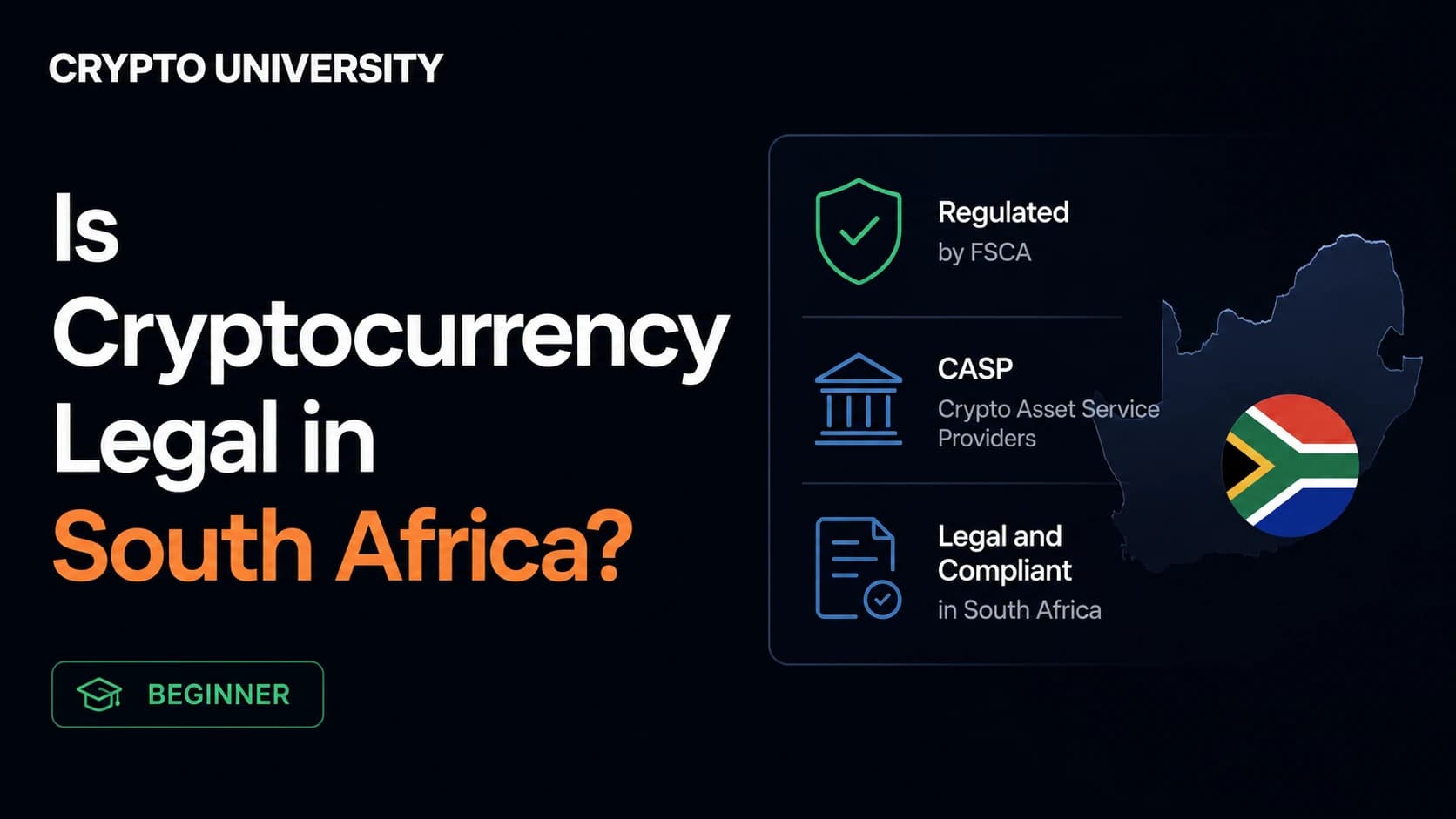
- Crypto is legal in South Africa. Individuals and companies may buy, hold, sell and transfer crypto assets. There is no ban and there has never been one.
- Legal is not the same as legal tender. Regulators have repeatedly confirmed that crypto assets, including stablecoins, are not money under South African payments law. No merchant is obliged to accept them.
- Four bodies share the job. The FSCA licenses firms, the FIC handles anti money laundering, the SARB governs payments and cross-border flows, and SARS collects tax. The cross-border rules are being rewritten during 2026 and are not final yet.
The short answer
Yes, crypto is legal in South Africa. You may open an account on a licensed platform, buy Bitcoin or another crypto asset, hold it in a personal wallet, sell it back into rands, or send it to another person.
What South Africa has done is not ban crypto but wrap it in existing financial law. Crypto assets were formally declared a financial product in October 2022. Since then, the country has built out licensing, anti money laundering rules, tax reporting, and now a proposed cross-border framework. The direction of travel is more oversight, not prohibition.
This article is educational information. It is not legal, tax or financial advice.
Legal, but not legal tender
This is the distinction most people get wrong.
Legal tender is money that must be accepted to settle a debt. In South Africa, that is the rand, issued by the South African Reserve Bank. Crypto does not have that status.
On 28 May 2026, the SARB, the FSCA, the Prudential Authority and the Financial Intelligence Centre issued a joint communication on the use of crypto assets for domestic payments. It confirmed that crypto assets, and stablecoins along with them, are neither money nor funds under the National Payment System Act, do not have legal tender status, and currently fall outside that Act even when used to pay for goods and services.
In practice that means three things:
- A shop may accept Bitcoin if it chooses to. It is a private arrangement between buyer and seller.
- No business is required to accept crypto, and no one can be forced to take it in settlement of a debt.
- If a crypto payment goes wrong, you do not have the protections that apply to regulated payment systems.
Regulators have signalled that this may change for some assets. The Intergovernmental Fintech Working Group is studying rand pegged stablecoins, and proposed reforms to the National Payment System Act would let the SARB designate payment instruments other than money. The SARB has been noticeably cooler on foreign currency stablecoins, citing the risk of currency substitution.
Who regulates what
| Regulator | What it cares about | Key instrument |
|---|---|---|
| FSCA | Market conduct, consumer protection, licensing of firms that advise on or intermediate in crypto | General Notice 1350 of 19 October 2022, issued under the FAIS Act |
| FIC | Money laundering, terrorist financing, information that travels with transfers | FICA Schedule 1 items 12 and 22, plus Directive 9 |
| SARB | Payments, monetary stability, cross-border capital flows | National Payment System Act, Currency and Exchanges Act, draft 2026 rules |
| SARS | Tax on income and gains, third party reporting | Income Tax Act, Crypto Asset Reporting Framework |
| Prudential Authority | Exposure of banks and insurers to crypto | Joint regulatory communications |
The licensing system in practice
The FSCA declared crypto assets a financial product in October 2022. Licensing of crypto asset service providers, usually shortened to CASPs, opened on 1 June 2023, and firms already operating had to apply by 30 November 2023.
The regulator publishes progress updates. As at 31 March 2026, the FSCA reported that it had received 533 CASP licence applications, of which 310 were approved and 17 declined, with a further 124 voluntarily withdrawn after discussions with the regulator. The remainder were still under review. Applications have mostly been declined for weak operational ability, thin business plans, or a lack of crypto expertise.
Who needs a licence and who does not, based on the FSCA position as at the middle of 2026:
| Activity | Licence needed? |
|---|---|
| Exchange, broker or platform serving South African clients | Yes |
| Financial adviser recommending crypto to clients | Yes |
| Crypto investment or portfolio manager | Yes |
| Miner or node operator | Not currently required |
| NFT service provider | Not currently required, under review |
| Crypto derivatives provider | Regulated as securities under the Financial Markets Act instead |
| An individual sending crypto to a friend | No |
A licence tells you the firm has been assessed on honesty, competence and operational capacity. It does not mean the FSCA endorses any crypto asset, and it does not protect you from price falls.
The anti money laundering layer
CASPs are accountable institutions under FICA. That is why platforms ask for your ID, proof of address and source of funds, and why they can freeze accounts pending checks.
Directive 9, issued by the FIC, brought the international travel rule into force on 30 April 2025. Under it, identifying information about the sender and the receiver must accompany a crypto transfer and be shared with the receiving provider. The obligation applies to every transfer regardless of size, with a wider set of information and full verification required at R5,000 and above. In March 2026 the FIC published draft guidance, PCC 123, on how providers should implement it.
There is national context here. South Africa was placed on the Financial Action Task Force grey list in February 2023 and removed on 24 October 2025 after completing a 22 item action plan. Crypto supervision was part of that work, which explains why compliance requirements arrived quickly and are unlikely to loosen.
Tax: legal to own does not mean tax free
SARS treats crypto assets as intangible assets, not currency. Tax is triggered on disposal, not while you simply hold. Whether a disposal is taxed as ordinary income or as a capital gain depends on the facts, including how often you trade, how long you hold, and what your intention was.
On 1 July 2026, SARS published a Draft Guide to the Taxation of Crypto Assets covering trading, mining, staking, airdrops, hard forks, donations and DeFi activity. Public comment closed on 31 August 2026. The guide is an interpretation of existing law rather than a new tax.
Common events and their general treatment:
| Event | Usually a taxable event? |
|---|---|
| Buying crypto with rands | No |
| Holding crypto | No |
| Selling crypto for rands | Yes |
| Swapping one crypto for another | Yes, treated like a barter transaction |
| Spending crypto at a merchant | Yes, treated as a disposal |
| Moving crypto between your own wallets | Generally no |
| Mining or staking rewards | Yes, usually as income |
Reporting has also changed. South Africa implemented the OECD Crypto Asset Reporting Framework on 1 March 2026. Providers must collect prescribed information, the first reporting period runs to 28 February 2027, returns are due to SARS by 31 May 2027, and the first international exchanges of that information are expected in September 2027. Individuals do not report under CARF themselves, but they still declare crypto activity in the normal tax return.
Cross-border transfers: the part still being written
This is the least settled area, so treat it carefully.
South African courts have not spoken with one voice. A May 2025 High Court judgment in a matter involving Standard Bank and the SARB found that crypto fell outside the old exchange control framework. In June 2026, a different High Court judgment in the Mangundhla matter reached a different conclusion on whether Bitcoin counts as money and capital. The legislature is now stepping in.
Two draft instruments matter:
| Draft | Published | What it proposes | Status |
|---|---|---|---|
| Capital Flow Management Regulations, 2026 | 17 April 2026 | Replace the 1961 Exchange Control Regulations and define capital to include crypto assets | Not finalised |
| Crypto Asset Manual for Cross-Border Activities | 3 August 2026 | Operational rules for cross-border crypto through authorised CASPs, including allowance limits and tiered authorisation | Public comment to 30 September 2026 |
Proposals reported in the draft manual include limiting cross-border crypto activity to natural persons rather than companies and trusts, applying the existing R2 million single discretionary allowance and R10 million foreign capital allowance, and capping small remittance activity at R5,000 per transaction per day. National Treasury has stated publicly that it does not intend to criminalise the possession of crypto or apply the rules retrospectively.
Nothing here is law yet. Anyone reading a headline that says cross-border crypto is now banned or capped should check the current status before acting.
What ordinary users can legally do
- Buy crypto on an FSCA licensed platform
- Hold it, including in a self custody wallet you control
- Sell it back into rands
- Transfer it to another person
- Spend it where a merchant agrees to accept it
- Mine it, subject to normal business and tax rules
What gets people into trouble
- Using crypto to hide income from SARS, which is much harder now that CARF reporting has started
- Dealing with unlicensed "agents" who arrange trades over WhatsApp and skip identity checks
- Assuming offshore transfers sit in a rule free zone
- Treating "not legal tender" as if it meant "not taxable"
- Accepting guaranteed return offers, which remain the most common shape of South African crypto fraud
How to check a platform before you use it
- Ask for the firm's FSP licence number.
- Check it against the FSCA's published register of authorised financial services providers.
- Confirm the licence category actually covers crypto asset services.
- Check the FSCA's public warnings list for the entity name.
- Expect full FICA onboarding. A platform that skips identity verification is a warning sign, not a convenience.
FAQ
Is Bitcoin banned in South Africa? No. It has never been banned. It is legal to buy, hold, sell and transfer, but it is not legal tender and it is not issued or backed by the South African Reserve Bank.
Can my bank close my account because I buy crypto? Banks apply their own risk policies and some remain cautious. Using a licensed platform, keeping records, and being able to explain your source of funds reduces friction considerably.
Is crypto mining legal? Yes. Miners and node operators are not currently required to hold a CASP licence. Mining income is taxable, and electricity costs are an ordinary business expense rather than a way around tax.
Do I have to declare crypto if I never converted it to rands? You declare taxable events. Simply holding is not one. Selling, swapping, spending or earning crypto generally is, even where no rands are involved.
Are the new cross-border crypto rules in force? Not as at the time of writing. The Capital Flow Management Regulations and the accompanying cross-border manual were still in draft and open for public comment, with the manual's comment period running to 30 September 2026.
Five related terms
- CASP (crypto asset service provider): a business that offers crypto related financial services and needs FSCA authorisation.
- Legal tender: money that must legally be accepted to settle a debt. In South Africa this is the rand only.
- Travel rule: the requirement that sender and receiver information accompanies a crypto transfer between providers.
- CARF: the OECD Crypto Asset Reporting Framework, the standard behind automatic reporting of crypto data to tax authorities.
- Exchange control: the framework governing the movement of capital across South Africa's borders, now being replaced by capital flow management rules.
Sources
- South African Reserve Bank, FSCA, Prudential Authority and Financial Intelligence Centre, Joint Communication 1 of 2026: Crypto Assets for Domestic Payment Purposes, 28 May 2026
- FSCA, Update on the Licensing and Supervision of Crypto Asset Service Providers, figures as at 31 March 2026
- Financial Intelligence Centre, Directive 9 on the travel rule, effective 30 April 2025, and Draft Public Compliance Communication 123, March 2026
- SARS, Crypto Asset Reporting Framework guidance and Draft Guide to the Taxation of Crypto Assets, 1 July 2026
- National Treasury, Draft Capital Flow Management Regulations, 2026, published 17 April 2026, and SARB draft Crypto Asset Manual for Cross-Border Activities, 3 August 2026
- Financial Action Task Force plenary outcome removing South Africa from the list of jurisdictions under increased monitoring, 24 October 2025
More reading
- SARS, Crypto Assets and Tax at sars.gov.za, for the official position on how crypto is taxed and what must be declared.
- FSCA register of authorised financial services providers at fsca.co.za, to verify whether a platform or adviser is licensed.
- National Treasury, Draft Capital Flow Management Regulations, 2026 at treasury.gov.za, for the full text of the proposed cross-border framework.
Disclaimer: This content is for educational and informational purposes only and is not financial, investment, legal, or tax advice. Nothing here is a recommendation to buy or sell any asset or use any platform. Do your own research and manage your risk. Platform fees, limits, banking rails, and verification requirements can change. Verify current provider terms before publishing specific figures.
Official source links
Continue with Safety and Regulation
Use the South African hub to compare current pathways, supporting evidence and next steps.
OPEN SAFETY AND REGULATION