Three Key Takeaways
- A crypto wallet stores the keys that control your crypto, not the coins themselves. The assets remain recorded on the blockchain.
- The best wallet depends on what you are doing. Exchange wallets are convenient, software wallets give you direct control, and hardware wallets are designed for stronger long-term key protection.
- Most beginner losses come from avoidable mistakes. Wrong networks, exposed seed phrases, fake support agents, and skipping a small test transaction can all create serious problems.
Best Crypto Wallet for South Africans
Choosing a crypto wallet in South Africa is less about finding one app that is "best" for everyone and more about choosing the right type of custody for the job.
A wallet does not literally hold Bitcoin, Ether, or USDT inside your phone. Your crypto remains recorded on a blockchain. The wallet manages the private keys that allow you to control and move those assets.
That distinction matters.
If an exchange holds the private keys, the exchange controls access to the crypto on your behalf. If you use a self-custody wallet, you control the keys yourself. That gives you more independence, but it also gives you more responsibility.
Crypto University helps beginners understand crypto clearly before they risk money.
For most South African beginners, the practical choice comes down to three wallet types: an exchange wallet, a software wallet, or a hardware wallet.
What Is a Crypto Wallet?
A crypto wallet is a tool that helps you manage blockchain addresses and the private keys linked to them.
The wallet can usually:
- Generate receiving addresses
- Show balances
- Sign transactions
- Send crypto
- Connect to blockchain applications
- Restore access using a recovery phrase, depending on the wallet type
Your private key is the critical piece. It proves that you are authorised to move assets from a blockchain address.
Many self-custody wallets use a recovery phrase, also called a seed phrase or Secret Recovery Phrase. This phrase can restore access to the wallet if your device is lost or replaced.
Anyone who gets that phrase can usually control the wallet.
The Three Main Wallet Types
| Wallet type | Who controls the keys? | Best suited for | Main risk |
|---|---|---|---|
| Exchange wallet | The exchange or custodian | Buying, selling, and short-term trading activity | Platform, account, or custody risk |
| Software wallet | You | Everyday self-custody and on-chain use | Device compromise, phishing, seed phrase loss |
| Hardware wallet | You | Longer-term storage and larger balances | Seed phrase loss, physical loss, setup mistakes |
1. Exchange Wallet
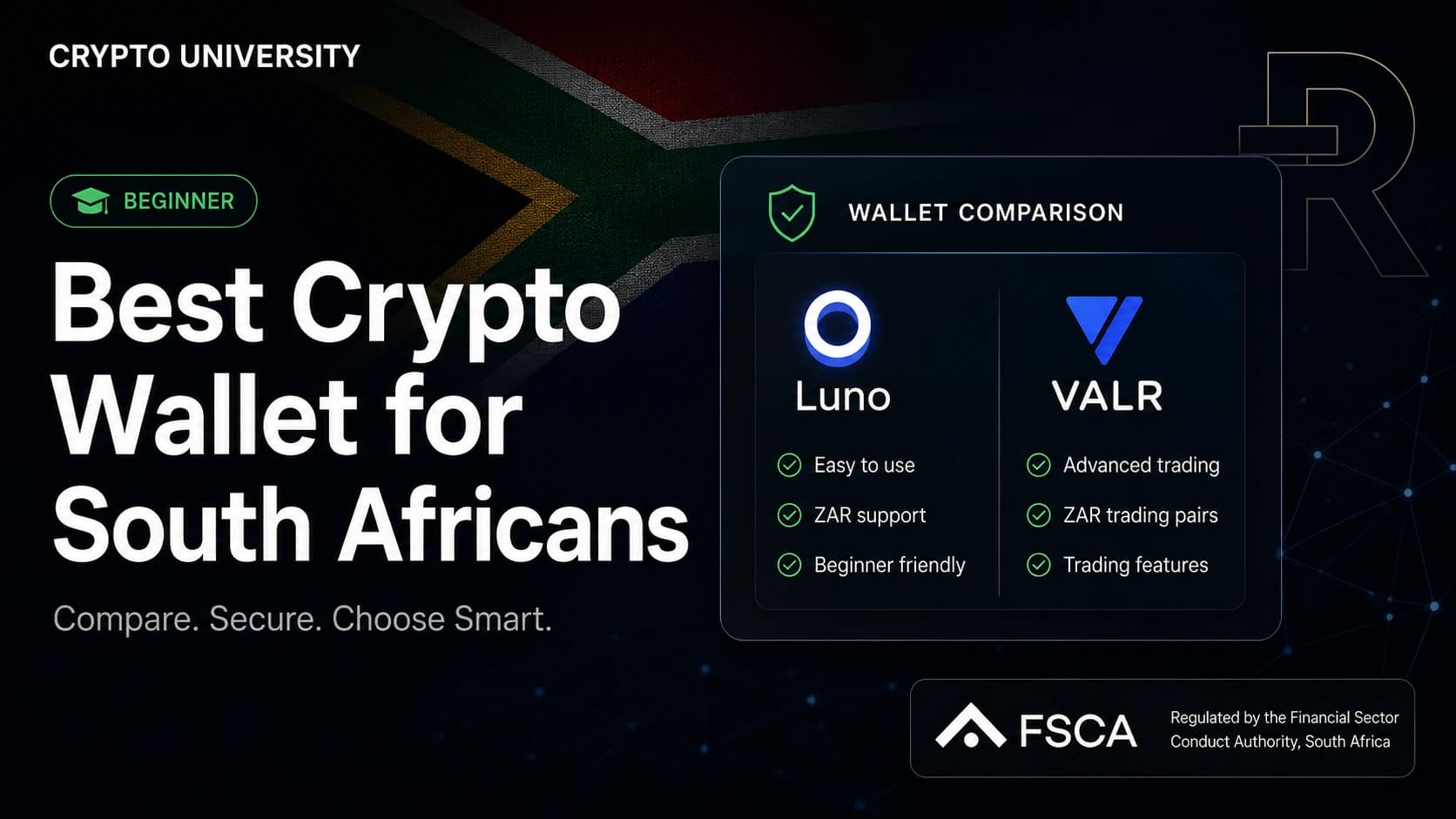
An exchange wallet is the balance you see inside a crypto exchange such as Luno or VALR.
Luno and VALR are both authorised financial services providers in South Africa. This does not make crypto risk-free, but it does mean they operate within South Africa's regulated financial services framework.
Exchange wallets are convenient because you do not normally need to manage a seed phrase yourself.
They can be useful when:
- You are buying crypto with rand
- You plan to sell or trade soon
- You are still learning how blockchain withdrawals work
- You prefer account recovery procedures over self-custody
The trade-off is custody.
If the platform controls the keys, you depend on its security systems, withdrawal rules, account access procedures, and operational stability.
This is why "not your keys, not your coins" is commonly used as a reminder about custodial risk. The phrase can sound dramatic, but the underlying idea is simple: control of the private key determines control of blockchain funds.
2. Software Wallet
A software wallet runs on a phone, computer, or browser.
Examples include wallets designed for Bitcoin, Ethereum-compatible networks, Solana, or multiple chains.
With a standard self-custody software wallet, you normally control the recovery phrase.
That makes software wallets useful for:
- Holding crypto outside an exchange
- Sending and receiving payments
- Using decentralised applications
- Swapping tokens
- Using DeFi services
- Managing NFTs or other blockchain assets
The main risk shifts from the exchange to you.
A fake website, malicious browser extension, compromised phone, phishing message, or leaked recovery phrase can result in loss of funds.
Software wallets are therefore best for users who understand basic wallet security.
3. Hardware Wallet
A hardware wallet is a physical device designed to keep private keys isolated from normal internet-connected devices.
Brands such as Ledger and Trezor are common examples.
A hardware wallet does not make every transaction automatically safe. You can still approve a malicious transaction or send funds to the wrong address. What it does is reduce exposure of the private key to an everyday computer or phone.
Hardware wallets are commonly used for:
- Longer-term holdings
- Larger balances
- Users who do not need constant access
- People who want stronger separation between keys and internet-connected devices
For many long-term holders, a hardware wallet can be a sensible security upgrade once the amount being protected justifies the extra cost and responsibility.
Which Wallet Type Is Best?
The answer depends on your use case.
| If your main goal is... | A practical wallet type to consider |
|---|---|
| Buying your first crypto with rand | Regulated exchange wallet |
| Learning self-custody | Software wallet |
| Using DeFi or blockchain apps | Compatible software wallet |
| Holding for a long period | Hardware wallet |
| Keeping funds ready to trade | Exchange wallet |
| Reducing reliance on an exchange | Software or hardware wallet |
A beginner does not need to choose only one.
Many experienced users separate funds by purpose.
For example, someone might keep a small trading balance on an exchange, a smaller everyday balance in a software wallet, and longer-term holdings in a hardware wallet.
A Simple Wallet Setup for South Africans
A cautious beginner workflow looks like this.
Step 1: Use a regulated South African exchange
Start with an exchange that is authorised to provide crypto-related financial services in South Africa.
Luno and VALR are two examples. Their regulatory status can be checked through official company disclosures and Financial Sector Conduct Authority records.
Regulation does not guarantee that you cannot lose money. It does provide an additional layer of oversight compared with using an unknown platform with no clear local status.
Step 2: Buy the crypto you intend to withdraw
Before buying, confirm that the exchange supports withdrawals for that specific asset and network.
This is important because the same token symbol can exist on several blockchains.
Step 3: Set up your self-custody wallet
Download wallet software only from the official website or verified app store listing.
During setup, the wallet may create a recovery phrase.
Write it down carefully.
Do not:
- Photograph it
- Email it to yourself
- Store it in a cloud document
- Paste it into a support chat
- Send it through WhatsApp or Telegram
- Give it to someone claiming to be wallet support
Legitimate support staff should never need your recovery phrase.
Step 4: Check the receiving network
This is one of the most important steps.
Bitcoin, Ethereum, Solana, XRP Ledger, Tron, and other networks are separate systems.
A token such as USDT can exist on more than one network. That means "USDT" by itself is not enough information.
You must check both:
- The token
- The network
For example, withdrawing USDT on Ethereum is different from withdrawing USDT on Tron or another supported chain.
Step 5: Send a tiny test transaction
Before moving a large amount, send a small amount first.
Check:
- The first and last characters of the address
- The selected network
- Any required destination tag or memo
- The withdrawal fee
- Whether the receiving wallet supports that asset
Wait for the test transfer to arrive.
Step 6: Send the remaining amount
Only after the test transaction is confirmed should you consider sending the rest.
This extra step costs another network fee, but it can prevent a much larger mistake.
Network Mistakes South African Beginners Should Avoid
Wrong-network transfers are among the easiest crypto mistakes to make.
Bitcoin is not Ethereum
A Bitcoin address is not an Ethereum address. A normal Bitcoin transfer should be sent using the Bitcoin network to a compatible Bitcoin address.
XRP may require additional destination information
Some exchanges use shared XRP addresses and require a destination tag. Missing or incorrect destination information can delay recovery and may require support intervention.
Tokens can exist on several chains
USDT, USDC, and other tokens may be available on multiple networks.
Always match the withdrawal network with the network supported by your receiving wallet.
Do not choose a network just because the fee is cheaper
A cheaper withdrawal fee does not help if the receiving wallet does not support that chain.
Verify compatibility first.
How to Protect Your Seed Phrase
For a self-custody wallet, your recovery phrase is often the ultimate backup.
A simple beginner approach is to write it clearly on paper and store it in a secure private location.
For larger holdings, some users choose more durable backup methods such as metal recovery backups, but the security principle remains the same: keep the recovery information private, offline, and protected from theft or destruction.
Never type your seed phrase into a website because a stranger told you that your wallet needs to be "validated," "synchronised," "upgraded," or "repaired."
Those are common scam patterns.
If someone gets your recovery phrase, changing the wallet password usually does not remove their access. The safer response is normally to move assets to a newly created wallet whose recovery phrase has never been exposed.
Is Luno a Wallet?
Yes, Luno includes custodial wallet functionality inside its exchange platform.
That means you can hold supported crypto in your Luno account and send or receive supported assets.
However, this is not the same as a standard self-custody wallet where you personally control the seed phrase.
With custodial exchange storage, the platform manages the underlying keys and account infrastructure.
This can be convenient for beginners, but it carries platform and account risk.
What Happens If You Lose Your Seed Phrase?
Losing a seed phrase does not always mean the assets disappear immediately.
If your wallet is still installed, unlocked, and functioning, you may still be able to move the assets or reveal the recovery phrase, depending on the wallet.
The serious problem happens when you lose both:
- Access to the wallet
- The recovery information needed to restore it
In a normal self-custody wallet, there is no central blockchain help desk that can reset your private key.
This is why seed phrase backup should be completed before you deposit meaningful funds.
Do You Pay Tax When Moving Crypto to Your Own Wallet?
A transfer between wallets that you beneficially own is generally different from selling, exchanging, donating, or spending the crypto because ownership has not changed.
However, South African taxpayers should keep clear records of wallet transfers so they can distinguish internal movements from taxable transactions.
SARS treats crypto assets as assets for tax purposes. Depending on the facts, gains can be taxed as revenue or under capital gains tax rules when a disposal occurs.
Examples of events that may have tax consequences include:
- Selling crypto for rand
- Exchanging one crypto asset for another
- Using crypto to pay for goods or services
- Donating crypto
Tax treatment depends on individual circumstances, so complex cases should be checked with a qualified South African tax professional.
A Practical Beginner Checklist
Before choosing or using a wallet, ask:
- Who controls the private keys?
- Can I recover the wallet if my phone breaks?
- Have I backed up the recovery phrase safely?
- Does the wallet support the exact blockchain I want to use?
- Am I downloading it from the official source?
- Have I enabled strong device and account security?
- Am I sending a test transaction first?
- Have I checked whether a memo or destination tag is required?
- Do I understand what happens if I lose the recovery phrase?
- Am I keeping records for tax and compliance purposes?
FAQ
What is the best crypto wallet for South Africans?
There is no single best wallet. Exchange wallets are convenient for buying and trading, software wallets are useful for everyday self-custody, and hardware wallets are commonly used for longer-term storage.
Is Luno a wallet?
Luno includes a custodial wallet as part of its exchange service. It is convenient, but it is not the same as holding crypto in a self-custody wallet where you control the recovery phrase.
Is VALR a wallet?
VALR provides custodial crypto balances through its exchange platform. The platform controls the custody infrastructure rather than giving each user a standard self-custody seed phrase for exchange balances.
Should beginners use a hardware wallet?
Not necessarily on day one. A hardware wallet adds stronger key isolation but also introduces setup and backup responsibilities. Beginners should understand seed phrases, addresses, and test transactions before moving significant funds.
What if I lose my seed phrase?
If you also lose access to the wallet, a normal self-custody wallet usually cannot be reset by customer support. If the wallet is still accessible, some wallet software may allow you to view or back up the recovery phrase before access is lost.
Can someone recover my wallet if I send them my seed phrase?
Anyone with the seed phrase may be able to control the wallet. Do not share it with recovery services, Telegram accounts, WhatsApp contacts, social media support pages, or anyone claiming they need it to fix your wallet.
Can I lose crypto by choosing the wrong network?
Yes. Sending an asset over an incompatible network can make recovery difficult or impossible. Always check the asset, network, receiving address, and any memo or tag requirements before sending.
Do I pay tax when I withdraw crypto from an exchange to my own wallet?
A transfer between wallets you own is generally not the same as a sale or exchange because beneficial ownership has not changed. Keep transaction records. Selling, swapping, spending, or donating crypto can have different tax consequences under South African tax rules.
5 Related Terms
- Private key: A secret cryptographic key that gives control over assets linked to a blockchain address.
- Seed phrase: A recovery phrase used by many self-custody wallets to restore access.
- Self-custody: A setup where the user controls the wallet keys rather than relying on an exchange or custodian.
- Custodial wallet: A wallet service where a third party controls the private keys on the user's behalf.
- Hardware wallet: A physical device designed to keep private keys isolated from normal internet-connected devices.
Affiliate Disclosure
Some links in this article are affiliate links. Crypto University may earn a commission if you sign up or make a purchase through them, at no extra cost to you. Affiliate relationships do not change our educational standards or the way products and services are explained.
Sources
- Financial Sector Conduct Authority, South Africa, authorised crypto asset service provider records: https://www.fsca.co.za/
- Luno South Africa, regulatory disclosure and platform information: https://www.luno.com/en-za/
- VALR, licences, authorisations and registrations: https://support.valr.com/hc/en-us/articles/14131360968476-Licenses-Authorisations-and-Registrations
- South African Revenue Service, Crypto Assets and Tax: https://www.sars.gov.za/individuals/crypto-assets-tax/
- South African Revenue Service, Capital Gains Tax: https://www.sars.gov.za/tax-rates/income-tax/capital-gains-tax-cgt/
- South African Revenue Service, Crypto-Asset Reporting Framework: https://www.sars.gov.za/businesses-and-employers/third-party-data/crypto-asset-reporting-framework-carf/
- MetaMask Help Center, Secret Recovery Phrase and private key security: https://support.metamask.io/start/user-guide-secret-recovery-phrase-password-and-private-keys
Editorial note: Regulatory status, wallet features, supported networks, and tax rules can change. Verify current information with the relevant provider, the FSCA, and SARS before acting.
More Reading:
- Best Crypto Wallets in 2026: https://cryptouniversity.network/tools/wallets
Continue with Wallets and Security
Use the South African hub to compare current pathways, supporting evidence and next steps.
OPEN WALLETS AND SECURITY