
Three key takeaways
- Protect your cash flow first. Do not use money needed for rent, school fees, debt, emergencies, or near-term expenses.
- Keep the plan simple. Beginners can reduce avoidable mistakes by limiting position size, avoiding leverage, buying on a schedule, and researching every asset.
- Treat security and tax records as part of investing. Verify platforms with the FSCA, learn self-custody before using it, and record transactions for SARS from day one.
Crypto University helps beginners understand crypto clearly before they risk money.
How to invest in crypto in South Africa without turning it into gambling
Buying crypto in South Africa is easy. Managing the risk is harder.
Beginners often lose money because they invest too much, chase fast-moving coins, use leverage, trust fake advisers, or make security mistakes. A useful plan should still make sense when markets are falling.
The objective is not to find a guaranteed winner. There is no such thing. The objective is to build a process that reduces preventable mistakes.
Step 1: Decide how much you can afford to expose to crypto
Before choosing a coin or exchange, decide how much money you can afford to put into a highly volatile asset class.
Do not use money needed for:
- Rent or bond payments
- School fees
- Food and transport
- Debt repayments
- Medical costs
- Emergency savings
- Short-term goals
Crypto can fall sharply. If a 50% drop would force you to sell because you need the money, the position is probably too large for your situation.
A useful test is simple:
If this position lost half its value, could I still pay my normal expenses without selling it?
If the answer is no, reduce the amount.
| Question | Beginner-friendly response |
|---|---|
| Do I need this money soon? | Keep it out of crypto |
| Would a large drop affect essential expenses? | Reduce the position |
| Am I borrowing to invest? | Do not proceed |
| Am I depending on crypto profits for monthly bills? | Reconsider the plan |
Step 2: Keep your first portfolio simple
A common beginner mistake is buying many tokens without understanding what they do.
One simple framework is to use Bitcoin as the core crypto asset while you learn. Bitcoin has the longest operating history among major crypto assets, broad global recognition, and deep market liquidity. That does not make it safe or guarantee future returns.
If you add other coins, be able to answer:
- What problem does this project solve?
- Why does its token need to exist?
- Who controls development or supply?
- How is new supply created?
- What are the main technical and regulatory risks?
- What would make me decide my original idea was wrong?
If you cannot explain an asset in plain English, research it before buying it.
Step 3: Consider rand-cost averaging instead of chasing hype
Rand-cost averaging means buying a fixed rand amount on a regular schedule rather than trying to guess the perfect entry price.
For example, instead of buying R6,000 after a viral video, someone could divide that planned amount into R500 monthly purchases over 12 months.
This approach does not guarantee better returns. Its main benefit is behavioural. A schedule can reduce the pressure to buy after sudden price increases.
| Emotional lump-sum buying | Rand-cost averaging |
|---|---|
| Often triggered by hype | Based on a preset schedule |
| Can encourage FOMO | Encourages consistency |
| Easy to oversize a position | Easier to control spending |
| Depends heavily on timing | Reduces timing pressure |
A schedule is still not a substitute for research.
Step 4: Use a crypto platform you can verify
South Africa brought crypto-related financial services into the Financial Advisory and Intermediary Services framework. Crypto asset service providers that provide regulated financial services need the appropriate FSCA authorisation.
Before depositing money, verify the provider through the FSCA's official search tools.
Do not rely only on a licence screenshot, a PDF sent on WhatsApp, a Telegram administrator, or a social media profile.
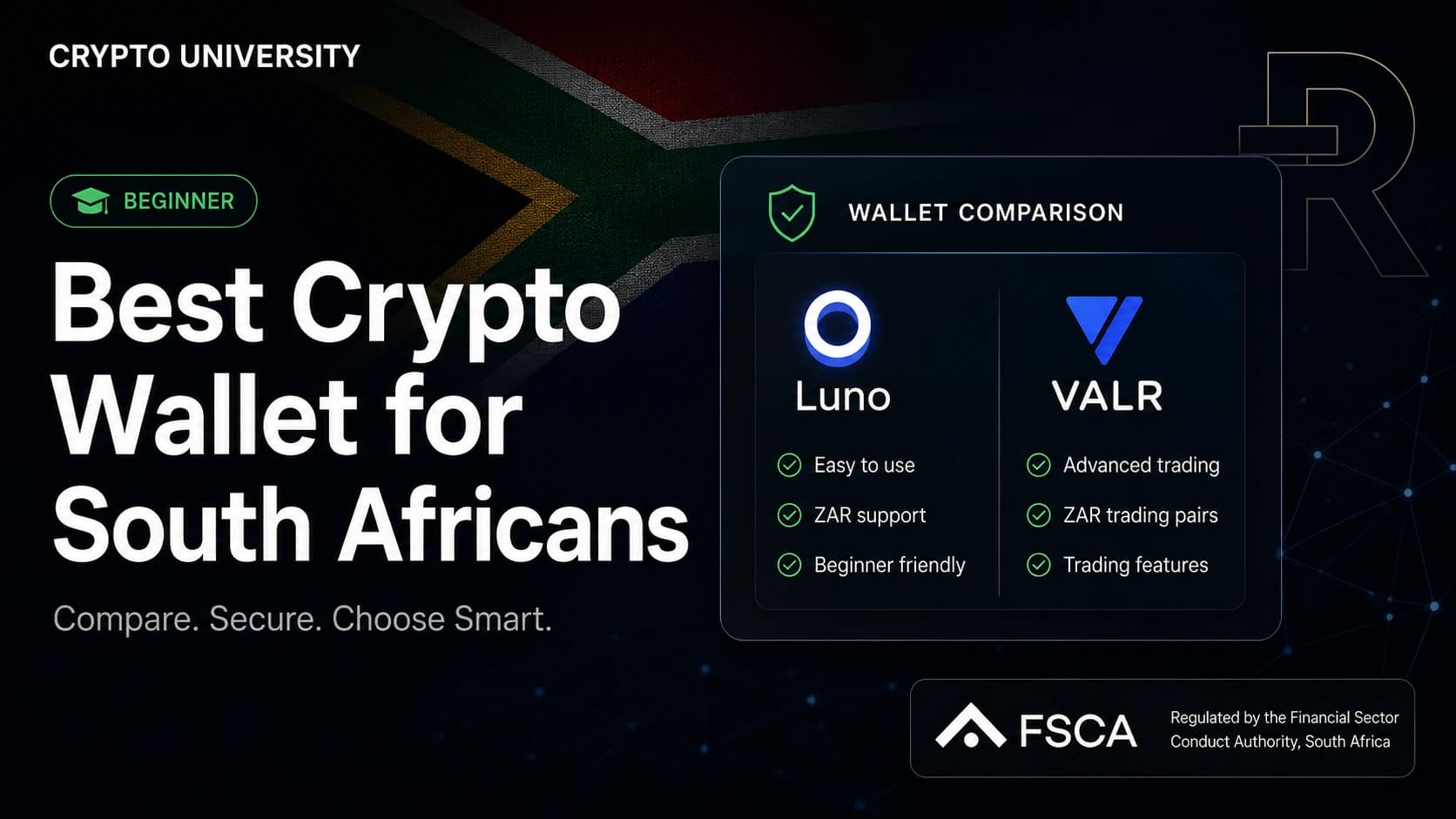
South African users can compare locally licensed platforms such as VALR and Luno. Their inclusion here is for educational comparison, not a recommendation.
International exchanges can have different product availability and regulatory arrangements. If you consider Bybit or Binance, check current South African access, regulatory status, withdrawal rules, and fees before using them.
Affiliate disclosure: Some links in this article are affiliate links. Crypto University may receive a commission if you register through them. This does not change the educational criteria used in this article.
Step 5: Avoid leverage while you are learning
Leverage lets you control a position larger than the cash you put in. It can increase gains, but it also increases losses and can cause liquidation.
Liquidation happens when a platform automatically closes a leveraged position because the remaining collateral is not enough to support it.
Beginners already need to learn about volatility, security, fees, wallets, order types, and taxes. Leverage adds margin, funding rates, liquidation prices, and collateral management.
For a beginner, spot buying is simpler and easier to understand.
Step 6: Learn self-custody before moving long-term holdings
Keeping crypto on an exchange creates exchange custody risk. Moving it to your own wallet creates self-custody risk.
With self-custody, you control the wallet credentials, but you are also responsible for protecting them.
Before withdrawing a meaningful amount:
- Learn how the wallet works.
- Write the recovery phrase down offline.
- Never store the phrase in email, cloud notes, or chat apps.
- Verify the receiving address.
- Confirm the correct blockchain network.
- Send a small test transaction first.
- Make sure you understand wallet recovery.
No legitimate exchange employee or support agent needs your seed phrase or recovery phrase.
Step 7: Keep records for SARS from day one
Crypto is taxable in South Africa under normal tax rules.
SARS says gains or losses from crypto assets must be declared. Depending on the facts, activity may be treated as revenue or capital in nature. Frequent, business-like trading can therefore be treated differently from long-term investing.
South Africa also implemented the Crypto-Asset Reporting Framework, or CARF, from 1 March 2026. Relevant crypto asset service providers must collect and report certain user and transaction information to SARS.
CARF does not remove your responsibility to keep records.
Record:
- Purchase dates
- Rand values
- Crypto quantities
- Fees
- Sales
- Crypto-to-crypto swaps
- Transfers between your wallets
- Staking or other crypto income
- Exchange statements
- Bank deposits and withdrawals
Keeping a spreadsheet from your first transaction is far easier than rebuilding years of activity later.
For personal tax questions, use SARS guidance or speak to a qualified South African tax professional.
Common crypto scams South Africans should ignore
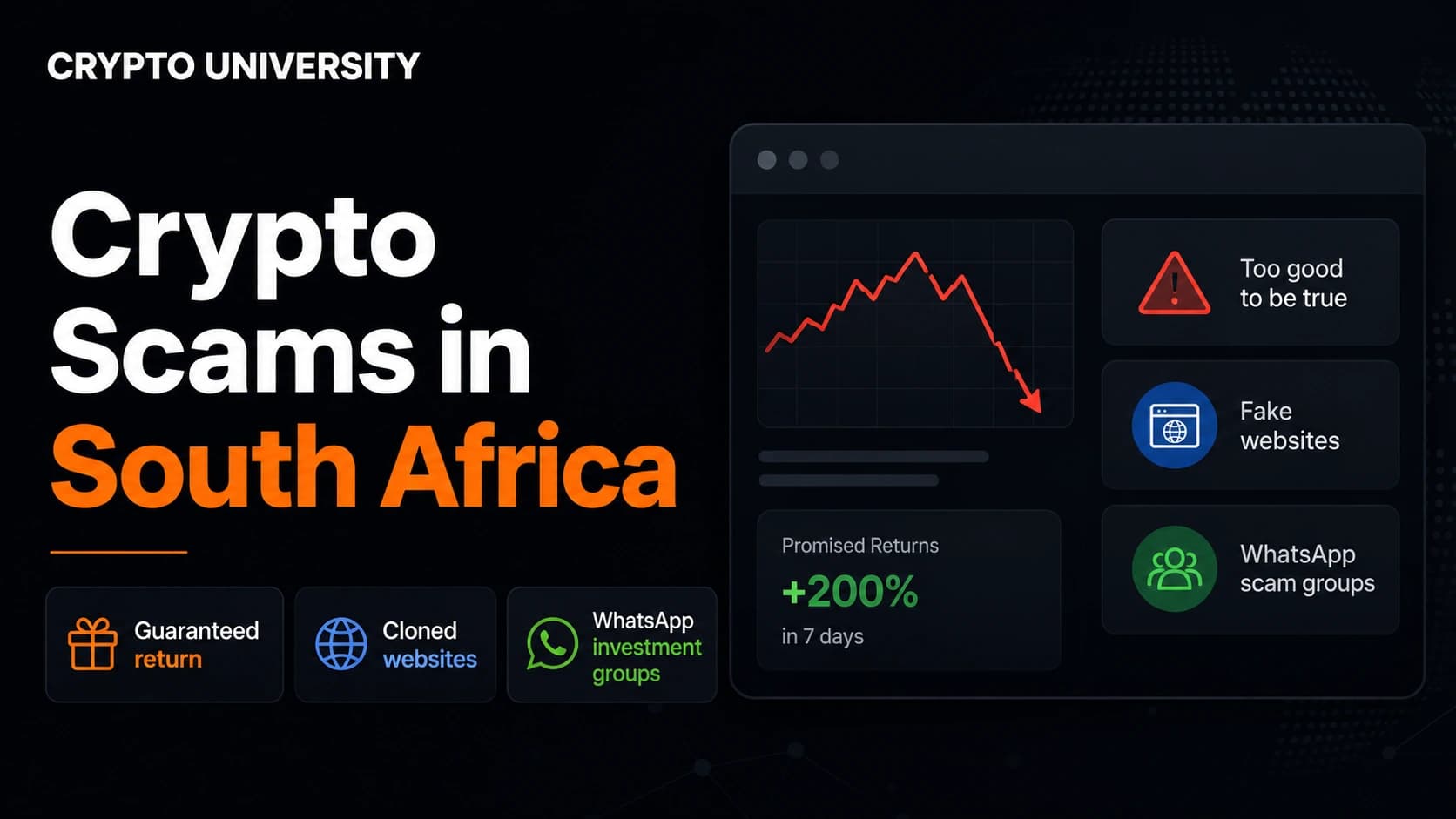
Guaranteed monthly returns
Promises of fixed or guaranteed crypto profits are a major warning sign. A trading bot, AI system, private club, or secret strategy does not remove market risk.
An account manager asking for an OTP
Never give a one-time password to someone who contacts you by phone, WhatsApp, Telegram, or social media. OTPs are used to confirm sensitive account actions.
Fake FSCA documents
A screenshot of a licence is not enough. Search the provider directly on the FSCA website.
Seed phrase pop-ups
Never enter a wallet recovery phrase into a support form or website pop-up. A legitimate support team does not need it.
Romance and WhatsApp investment clubs
Fraud can begin as friendship, romance, mentorship, or an invitation to a private investment group. Scammers may build trust before directing victims to fake platforms or unfamiliar wallet addresses.
Pressure, guaranteed profits, secrecy, and requests to send crypto to strangers are strong warning signs.
A beginner plan that can survive a bad year
A durable plan is usually boring.
It does not require daily trading, leverage, endless Telegram channels, or a portfolio full of new tokens.
| Area | Practical beginner approach |
|---|---|
| Money | Use only money not needed for essential expenses |
| Assets | Keep the portfolio simple and research every asset |
| Buying | Use a preset schedule if it suits your plan |
| Platform | Verify providers with the FSCA |
| Leverage | Avoid while learning |
| Security | Use strong 2FA and learn self-custody carefully |
| Tax | Record every transaction from day one |
| Scams | Ignore guaranteed returns and unsolicited advisers |
Before every purchase, ask whether you understand the asset, can tolerate a large decline, have verified the platform, know how you will store the crypto, and have a record-keeping process.
If several answers are unclear, do more research before acting.
Final thoughts
Investing in crypto in South Africa does not need to be complicated.
Beginners can reduce many common risks by keeping positions manageable, avoiding leverage, using a simple asset framework, following a plan instead of hype, verifying service providers, learning wallet security, and keeping tax records.
Crypto will still be volatile. No process removes market risk.
The purpose of a good beginner plan is to prevent one bad market move, scam, or security mistake from damaging the rest of your financial life.
Crypto University helps beginners understand crypto clearly before they risk money.
FAQ
Is crypto better than a unit trust?
They have different risks and structures. Crypto is generally more volatile and places greater responsibility on the user for security. It should not replace an emergency fund.
Should beginners use leverage?
Leverage adds risk and complexity and can trigger liquidation. Beginners are usually better served by first understanding spot purchases, position sizing, security, and tax records.
Is Bitcoin legal in South Africa?
South Africans can buy, hold, and sell crypto assets, but crypto is not legal tender. Crypto-related financial services are subject to South African regulatory requirements.
Do I need to pay tax on crypto in South Africa?
Crypto transactions can create tax obligations. SARS applies normal income tax rules, and the treatment can depend on whether activity is revenue or capital in nature.
Should I move all crypto off an exchange?
Not automatically. Self-custody can reduce exchange custody risk but creates responsibility for wallet security and recovery. Move assets only when you understand the process.
Related terms
- Bitcoin: The first widely adopted decentralised crypto asset.
- Rand-cost averaging: Investing a fixed rand amount at regular intervals.
- Self-custody: Holding crypto in a wallet where you control the private keys or recovery phrase.
- Leverage: Borrowed exposure that increases both potential gains and potential losses.
- Crypto Asset Service Provider: A business providing certain crypto-related services that may be subject to financial regulation.
Sources
- South African Revenue Service, Crypto Assets and Tax: https://www.sars.gov.za/individuals/crypto-assets-tax/
- South African Revenue Service, Crypto-Asset Reporting Framework: https://www.sars.gov.za/businesses-and-employers/third-party-data/crypto-asset-reporting-framework-carf/
- South African Revenue Service, Budget 2026 Frequently Asked Questions: https://www.sars.gov.za/about/sars-tax-and-customs-system/budget/budget-2026-frequently-asked-questions/
- Financial Sector Conduct Authority, CASP licensing information: https://www.fsca.co.za/New-Financial-Service-Provider/
- Financial Sector Conduct Authority, authorised FSP search: https://www.fsca.co.za/FSB-Search/
- Financial Intelligence Centre, CASP Travel Rule advisory: https://www.fic.gov.za/wp-content/uploads/2025/04/2025.4-GN-Advisory-Travel-Rule-17-April-2025-2.pdf
- VALR, licences and registrations: https://support.valr.com/hc/en-us/articles/14131360968476-Licenses-Authorisations-and-Registrations
- Luno, South Africa FSP information: https://guide.luno.com/hc/en-gb/articles/33691951429405-Blue-Chip-Discretionary-Mandate
Disclaimer: This content is for educational and informational purposes only and is not financial, investment, legal, or tax advice. Nothing here is a recommendation to buy or sell any asset or use any platform. Do your own research and manage your risk. Regulation, platform access, and tax rules can change. Verify current information with the FSCA, SARS, FIC, and the relevant platform before acting.
Continue with Investing
Use the South African hub to compare current pathways, supporting evidence and next steps.
OPEN INVESTING