
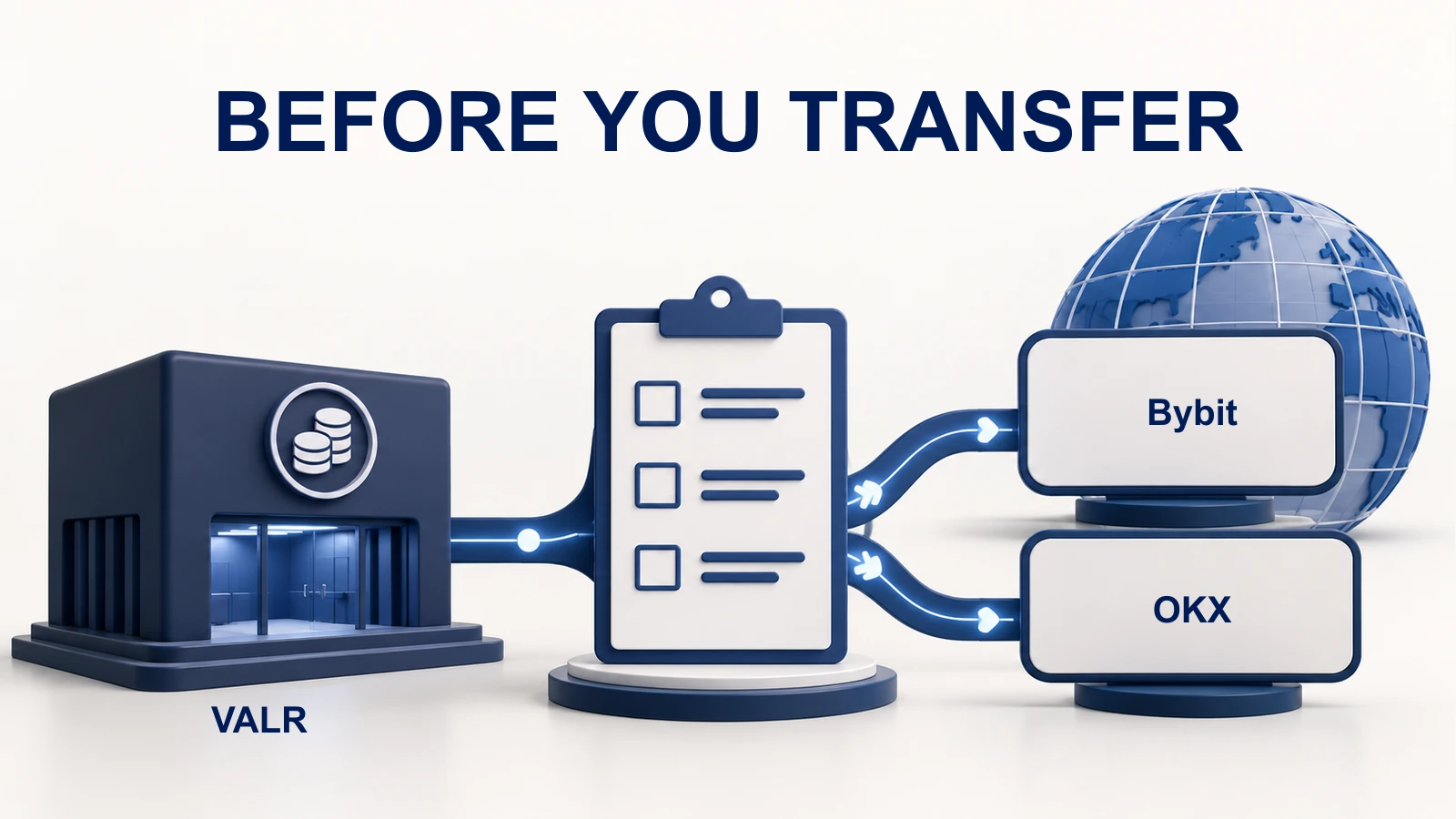
Before moving crypto from VALR to Bybit or OKX, establish that the intended cross-border route and destination product are permitted for your circumstances. Matching a network only proves a technical condition. It does not establish legal permission, South African residence eligibility or the scope of a provider's authorisation.
Use this checklist to identify the evidence needed before a transfer. It does not establish permission for a particular reader or route, and a provider's network list cannot supply that missing legal answer.
Keep proposed rules separate from current permission
SARB and National Treasury's 3 August 2026 statement concerns a draft Crypto Assets Manual for cross-border activities. It describes consultation and a proposed framework. It is not evidence that every proposed allowance or route is already available.
Likewise, a foreign platform accepting an account registration does not resolve South African exchange-control treatment. A local representative relationship does not automatically authorise every product offered by the global brand. Save the actual contracting terms for the service you intend to use.
Compare the two destinations at the right level
| Check | Bybit destination | OKX destination |
|---|---|---|
| Intended activity | Specify holding, spot trading or a separate product | Specify holding, spot trading or a separate product |
| Account entity | Obtain the entity in your current account terms | Review the SA addendum and underlying terms |
| Local regulatory scope | Must be verified for that entity and activity | SA addendum identifies a representative arrangement; scope still needs verification |
| Deposit asset/network | Confirm in the eligible account's deposit screen | Confirm in the eligible account's deposit screen |
| Cross-border permission | Unresolved for this reader and route | Unresolved for this reader and route |
| Current decision | Preparation only | Preparation only |
OKX's South African addendum, checked on 20 September 2026, includes an unresolved placeholder for the dedicated Covered Services website. That is a material reason not to infer full product scope from the page. The exchange hub can provide provider context, but it does not substitute for those contractual checks.
Prepare a technical compatibility record
VALR documents USDT deposits and withdrawals on Ethereum, Tron and Solana. This establishes the source platform's documented options. It does not establish which of them your destination account accepts today.
For each candidate network, record the exact asset, destination deposit status, address, minimum credit, extra identifier if required, source withdrawal fee and expected net delivery. Mark an unavailable or unverified cell as such. Do not choose a network because its name appears on a general international fee page.
No amount should be sent while either the legal or technical check remains unresolved. A successful tiny transfer would not retrospectively establish that the route was lawful.
Budget without treating the budget as permission
Assume a purely hypothetical starting balance of 500 USDT, a source withdrawal deduction of 2 USDT and no receiving charge. The expected credited amount would be 498 USDT. If you later paid 0.10% to trade that entire balance, the modelled fee would be 0.498 USDT, leaving 497.502 in equivalent pre-price-movement value.
At an assumed R18 per USDT, the 2 USDT transfer cost is R36 and the 0.498 USDT trading cost is R8.964, or R8.96 rounded to cents. These inputs are not provider quotes and the example recommends no trade. It simply shows why a transfer fee and a later trading fee are separate. Add conversion, bank exit, funding or other product charges only where they actually apply.
Questions to resolve before moving funds
Provide your residence, source of funds, source account, destination entity, intended use and whether assets will remain custodial. Ask which current rules govern the route, which approvals or reporting duties apply, and which official instrument supports the answer. Do not substitute a draft proposal for an effective rule.
Ask the destination provider to confirm access to the specific service, including restrictions. Preserve its response, date and case number. A generic customer-service assurance should be assessed against the legal terms and official authorisation scope.
Keep an exit plan in the file
Before any later approved transfer, document how you would withdraw the asset and how you could lawfully return proceeds to rands. Account checks, custody restrictions and maintenance can delay that process. Do not assume a reverse transfer will always be available on the same network.
Use the cash-out hub and stablecoin guide to understand the surrounding tasks. Keep the completed evidence file with the transaction records. An unanswered question about permission or product access is a reason to stop the proposed transfer, even when the fee calculation looks favourable.
Sources and verification
Primary sources checked on 20 September 2026. Prices, availability and processing arrangements can change.