
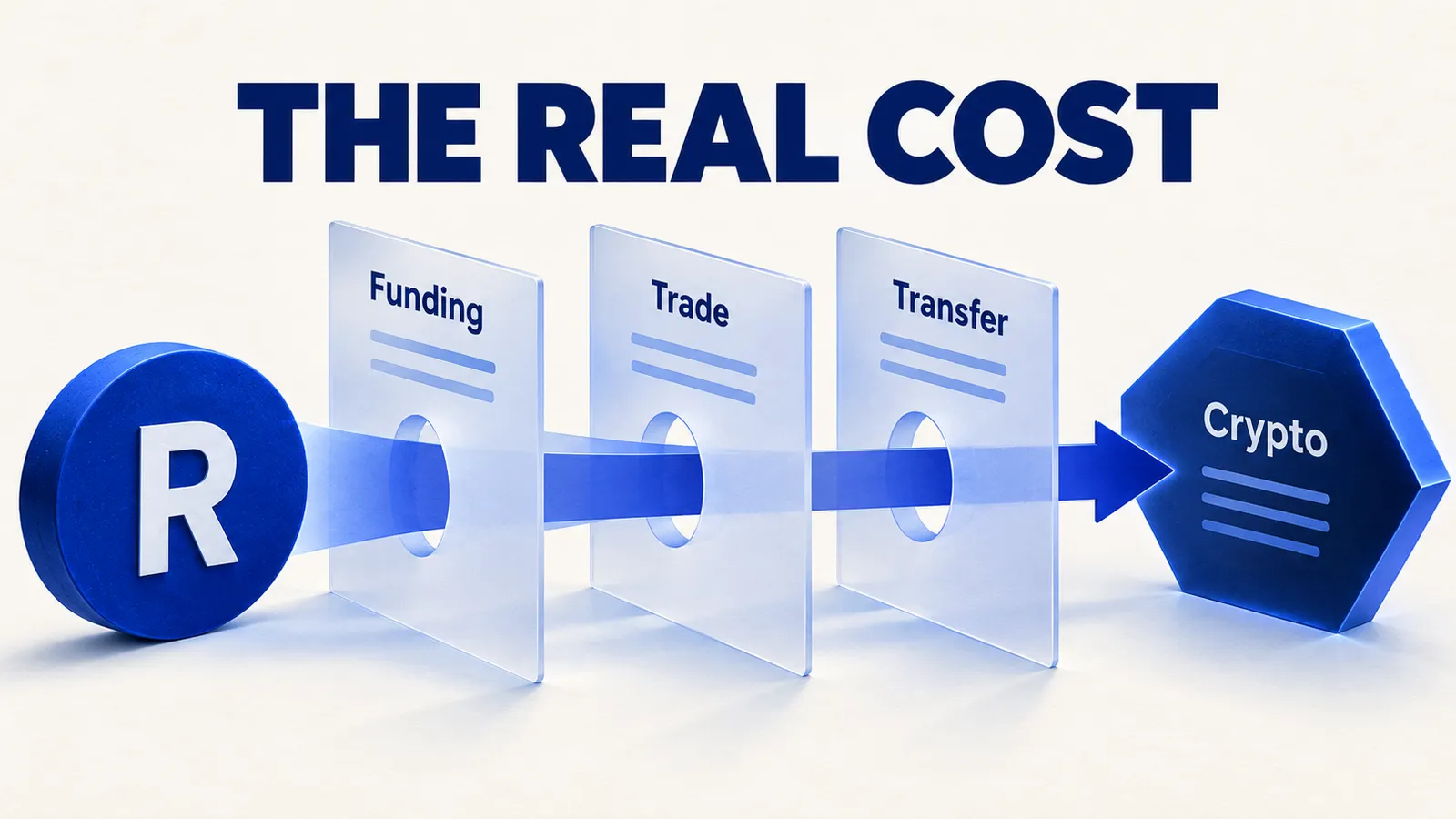
The cheapest way to buy crypto is the route that delivers the most usable crypto for your total rand outlay. A “zero deposit fee” does not answer that question. Trading charges, quoted prices and the cost of moving coins to your intended destination can reverse the result.
For a South African beginner comparing ordinary EFT-funded purchases, an order-book route can have a lower explicit charge than a simple-buy interface. That observation is narrower than declaring one exchange cheapest for everyone. The amount, pair, tier, payment method and destination all matter.
Build a comparable basket
Set one budget and one asset before opening quotes. Decide whether the coins will stay on the exchange or arrive in your own wallet. Compare both providers at similar times. A price from yesterday is not a usable benchmark for today's purchase.
Use these worksheet fields:
| Input | What to record | Common mistake |
|---|---|---|
| Total cash outlay | Rand leaving your bank, including separate bank charges | Recording only the exchange credit |
| Funding cost | Deposit or card fee and how it is deducted | Assuming every funding method is EFT |
| Purchase | Pair, interface, tier and final crypto quantity | Comparing BTC with a stablecoin route |
| Exit | Exact network, withdrawal charge and net wallet receipt | Treating all transfers as free |
| Effective unit price | Total cash outlay divided by usable crypto | Adding a spread already inside the quote |
Keep the quote expiry or timestamp beside every number. “Usable” means the asset has reached your chosen endpoint; an unsupported token on the wrong network is not a cheaper result.
R1,000 and R10,000 fee-only illustrations
The following figures isolate explicit trading fees at the entry tier. They exclude differences in market prices and external withdrawals. The amount is trade value; an all-in budget may require a smaller trade to reserve fees.
| Route | Rate | On R1,000 | On R10,000 |
|---|---|---|---|
| VALR Simple Buy | 1.6% | R16 | R160 |
| VALR BTC/ZAR taker | 0.35% | R3.50 | R35 |
| Luno Portfolio purchase | 2% | R20 | R200 |
| Luno BTC/ZAR taker | 0.60% | R6 | R60 |
Formula: trade value × rate ÷ 100. Both official tables list ordinary EFT funding as free. These rows do not establish a market-wide ranking: they are a reproducible comparison of four documented interfaces. A different pair or volume tier needs its own row.
Why fixed transfer costs hurt smaller purchases
Consider two hypothetical quotes for an external-wallet purchase. Route A delivers R990 worth of crypto before a R40-equivalent withdrawal charge. Route B delivers R985 before a R10-equivalent withdrawal charge. Under identical valuation assumptions, A delivers R950 and B R975. The route with the better purchase quote loses R25 at the final endpoint.
These are invented scenario inputs, not provider fees. To reproduce the exercise, replace them with the final quantities and live withdrawal quotes. Prefer comparing coin amounts directly; using rand equivalents introduces an extra price timestamp.
A R40 transfer charge is 4% of R1,000 but 0.4% of R10,000. Batching withdrawals can reduce the fixed charge per rand, but leaves more funds in exchange custody while you wait. Do not increase an investment solely to make a percentage look smaller.
Maker fees are conditional savings
A posted limit order may qualify for a maker rate if it adds liquidity and later fills. It may also remain unfilled while the market moves away. If it crosses existing orders, it can execute as a taker. Compare the actual order confirmation and fills, not the label on the button.
A fee advantage of R20 on R10,000 is 0.2%. A larger adverse execution-price difference can erase it. This is why the final amount matters more than a marketing headline or a maker rebate considered alone.
Do not fund an unnecessary detour
Buying one asset, sending it elsewhere and swapping again introduces more fee, network and execution inputs. Only consider that route if it serves an actual need and you have verified every step. A direct local purchase may be easier to audit even when a global spot fee looks lower.
Use the exchange hub to compare suitable services and the Bitcoin buying guide for the operational sequence. If the destination is self-custody, verify it against the wallet guide.
Save the winning quote and the losing quote. Repeat the calculation when your amount, bank method, destination network or fee tier changes. A useful cost comparison stays reproducible rather than turning one day's result into a permanent “cheapest” claim.
Sources and verification
Primary sources checked on 20 September 2026. Prices, availability and processing arrangements can change.