
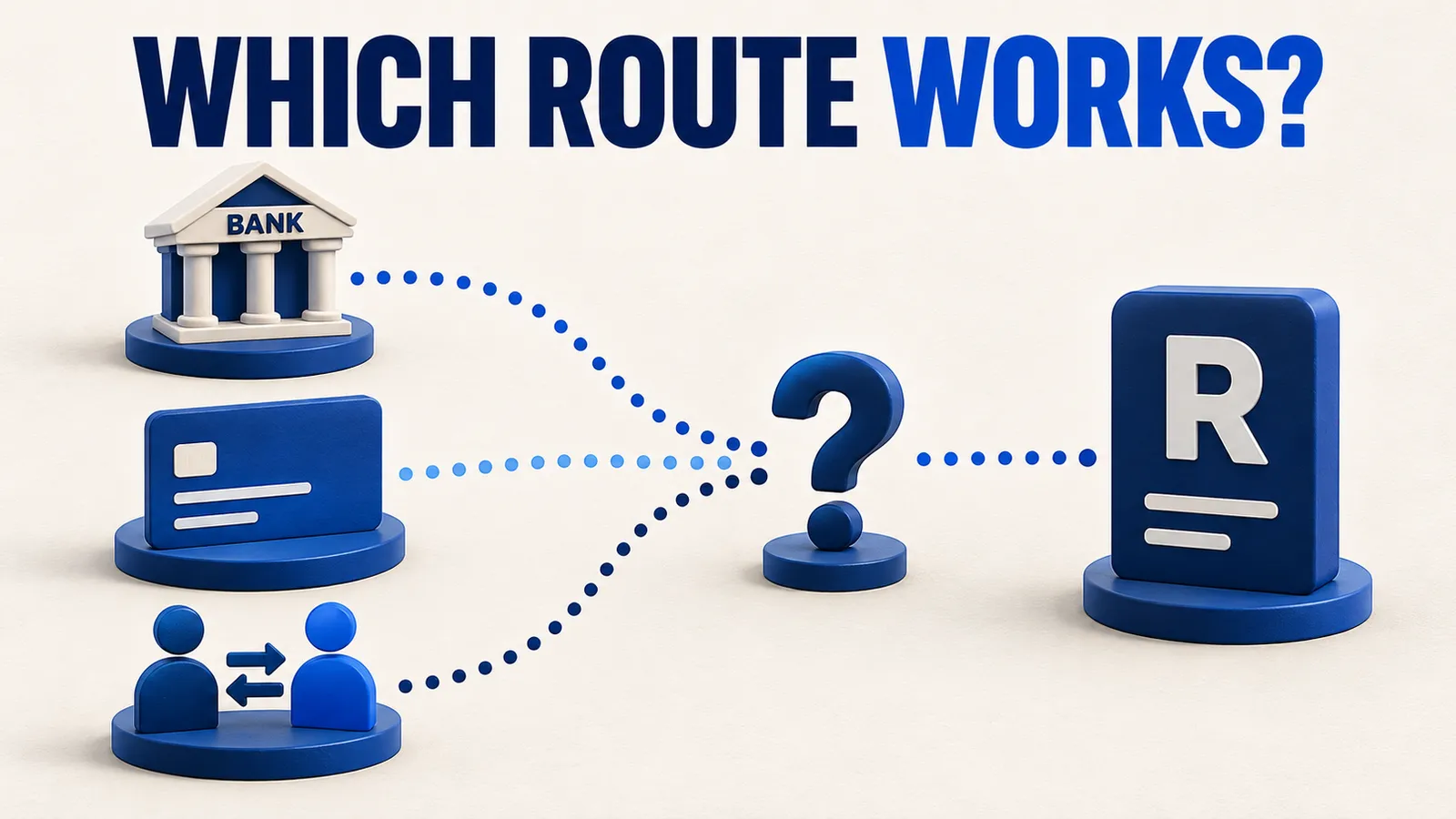
Compare a South African bank by the payment method you need, the exchange receiving it and the exit route back to your account. “Crypto-friendly” is too vague to tell you whether an EFT will work or how much an instant deposit will cost.
A bank can restrict one route while supporting another. An exchange can also suspend a payment product independently of the bank. Check both sides before moving funds.
A method matrix grounded in current documentation
This matrix records documented combinations rather than rating banks as universally good or bad for crypto.
| Combination | What the primary source establishes | What it does not establish |
|---|---|---|
| Capitec to Luno by EFT | Luno says this route is unavailable | That all other payment methods fail |
| Absa to Luno by EFT | Luno also excludes this route | That Absa Pay is the same as EFT |
| Capitec Pay to Luno | Dedicated deposit flow with eligibility checks | A Capitec Pay withdrawal service |
| Discovery linked Luno account | Documented linking, transfer and trading workflow | Free crypto trading or a guaranteed return |
| Standard Bank to Luno by EFT | Luno documents same-bank funding | Guaranteed instant credit in every case |
For FNB, Nedbank and other banks, this review does not assign a green tick without a current method-specific source. Absence from this table is not evidence of a ban. Use your exchange's deposit instructions and the bank's current payment policy.
Ask five questions before comparing fees
First, what currency leaves your account? Second, who is the beneficiary? Third, is the transaction an EFT, instant bank payment, card payment or named payment-gateway service? Fourth, is the receiving account in your own name where required? Fifth, how will you withdraw the eventual proceeds?
These questions prevent a common mismatch: treating a card-enabled exchange as though it accepts an ordinary bank transfer from every bank. They also stop a deposit success being used as proof that a cash-out route is available.
Price the route rather than the bank's label
Luno's South African table lists ordinary EFT as free and instant deposit/Absa Pay at 1.4%. A R2,000 deposit at 1.4% has a R28 service charge; a R10,000 deposit has R140. Those figures exclude any separate bank charge and the later crypto purchase.
A hypothetical bank-account change costing R60 extra per month would cost R720 a year. Avoiding one R28 deposit charge each month saves R336 a year, which would not cover that additional account cost. This is a model, not a bank tariff comparison. Replace both numbers with your actual costs and consider the account's wider uses.
For a fair worksheet, record monthly account cost, number of deposits, charge per deposit, purchase fee, number of cash-outs and charge per cash-out. Keep a separate row for occasional international or card-processing costs. Do not assume a fee shown as “free” at one stage means the whole journey is free.
An evidence hierarchy for conflicting claims
Use the current account-specific confirmation for the transaction you are about to authorise, supported by the provider's fee schedule and current bank policy. A dated launch announcement explains a change but may not describe today's availability. An old blog or social-media comment is weaker evidence.
If the confirmation conflicts with official help, stop and ask support to explain it. Keep the written answer with its date and the exact product name. Do not turn one support response about one account into an unconditional claim for all South Africans.
Keep compliance and troubleshooting separate
A failed payment can reflect unsupported routing, incorrect details, limits or a risk review. It does not automatically mean your crypto purchase is unlawful, nor does it justify changing the description or using another person's account to bypass a restriction.
Maintain a clear trail from your own bank debit to exchange credit and eventual withdrawal. If asked for source-of-funds evidence, provide truthful documents through official channels. A legitimate delay is easier to investigate when the references and account names align.
Use the exchange hub to choose a suitable venue, then confirm the bank method for that venue. Use the cash-out guide to check the return journey. This method-based comparison remains useful even when a bank or exchange changes one supported route.
Sources and verification
Primary sources checked on 20 September 2026. Prices, availability and processing arrangements can change.