
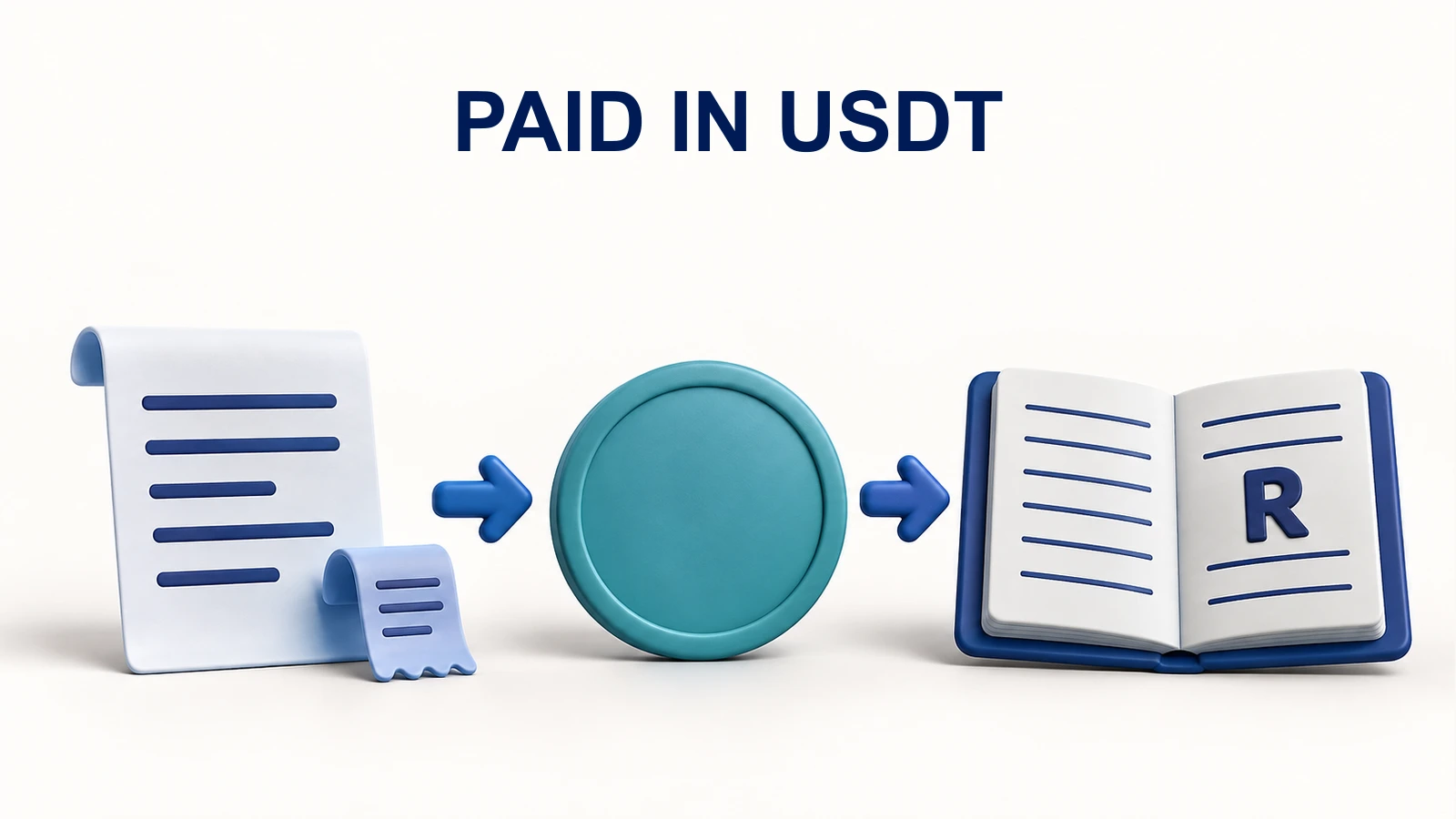
Before agreeing to receive freelance income in USDT, settle the invoice terms and have the proposed payment route checked for South African tax and cross-border compliance. Receiving tokens does not make the income disappear, and a foreign client's preference does not establish that the route is permitted.
This is a documentation workflow for a proposed arrangement. It does not authorise a cross-border receipt or recommend a transfer while its legal treatment is unresolved. Use it to give your accountant, adviser and payment provider a clear transaction file.
Agree what the client owes
An invoice for US$1,000 is not necessarily an agreement to deliver exactly 1,000 USDT. Decide the invoice currency, token amount or conversion method, rate source, valuation time, network and who bears transfer fees. Put those terms in writing before work is settled.
Specify what counts as receipt: the agreed amount credited to the intended account, rather than the client merely initiating a withdrawal. Include how an underpayment or unsupported-network mistake will be handled. Do not publish a reusable deposit address on a public invoice template.
Establish the lawful route first
Give a qualified adviser the client's country, your residence, business form, service supplied, invoice currency and proposed receiving account. Ask which current rules and reporting requirements apply. SARB's August 2026 Crypto Assets Manual statement concerns a draft; its proposed treatment is not an automatic permission.
Ask the receiving provider whether your account may receive this type of business payment and what beneficiary or source-of-funds records it needs. A personal account and a company account can have different requirements. Do not route company receipts through another person's account to avoid onboarding.
Keep a two-stage ledger
This hypothetical record demonstrates documentation, not approved tax treatment or a current market quote. Assume an invoice agreement to deliver 1,000 USDT net, a receipt valuation of R18 per USDT and a later sale at R18.20. Assume a R36.40 sale fee and no other charges.
| Event | Quantity and calculation | Record produced |
|---|---|---|
| Client receipt | 1,000 USDT × R18 = R18,000 | Receipt valuation and income-review entry |
| Later sale | 1,000 × R18.20 = R18,200 | Gross disposal proceeds |
| Sale fee | R36.40 | Separate expense/cost-review entry |
| Net exchange proceeds | R18,163.60 | Reconciliation to withdrawal |
| Difference from receipt value | R163.60 | Candidate later gain before tax classification |
The R163.60 is not the tax due. It assumes the receipt value is the appropriate starting value for later analysis, which must be established from the applicable tax treatment. Do not count R18,000 of income and then treat all R18,163.60 as a second profit without examining the asset's cost treatment.
Assemble the invoice-and-receipt pack
Use the accompanying local download, downloads/freelancer-receipt-checklist.csv, as a blank working template. It includes fields for the contract, invoice, client, agreed network, valuation, receipt and later disposal. No real banking details or executable address is prefilled.
Save the service agreement and evidence that the work was delivered. Link the invoice to the actual transaction identifier and receiving account record. Record the network, amount, date, time zone and fee separately. A blockchain record alone does not explain why the client paid you.
If converting to rands, retain the order fill or conversion confirmation and bank withdrawal record. Reconcile the bank credit rather than assuming it equals the invoice value. The cash-out hub explains the transaction task, while the SARS guide provides broader tax context.
Prepare for questions without oversharing
Luno's source-of-funds guidance lists supporting income and investment documents and specific format requirements. Your provider may ask for different evidence. Submit through the authenticated channel and retain originals. Ask before redacting information required to establish ownership or the source of a payment.
Never provide a seed phrase, login password or one-time code to a client as proof of receipt. If the client sent less than agreed, document the shortfall and resolve it under the contract; do not invent a gross receipt that the account never received.
Keep a rand reserve plan for ordinary expenses and any tax obligations identified by your adviser. A token balance does not guarantee the banked rand amount or timing you need. The stablecoin guide explains those holding risks. Keep the receipt and later sale as separate events so their treatment can be assessed without confusing cash flow with taxable profit.
Sources and verification
Primary sources checked on 20 September 2026. Prices, availability and processing arrangements can change.