
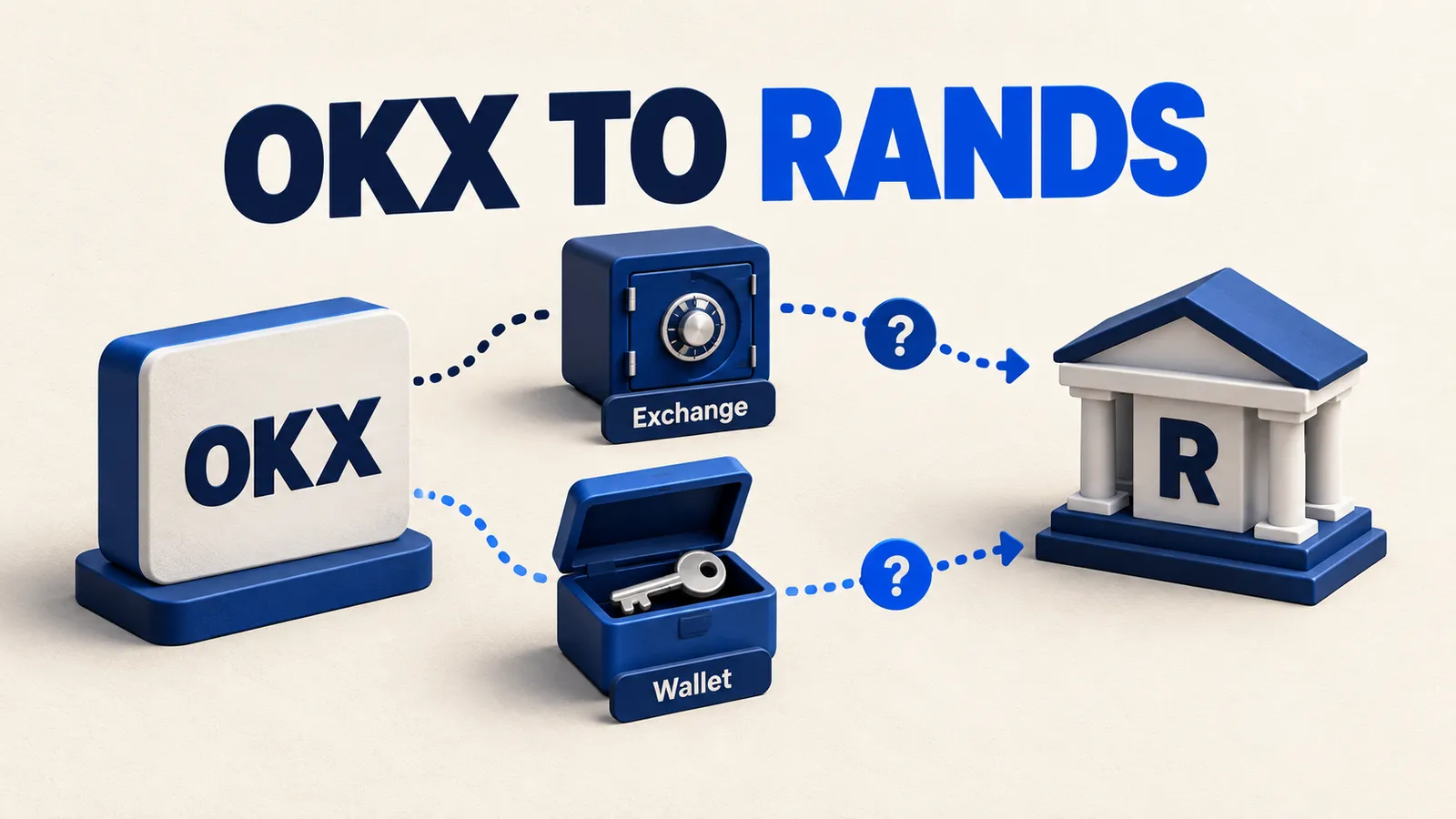
To cash out an OKX balance in South Africa, first establish which exit route your account actually supports. A ZAR price-converter page is not evidence of a direct bank-withdrawal service. The public sources checked for this article did not confirm a direct ZAR cash-withdrawal rail.
OKX documents P2P selling, but says supported fiat currencies vary by region and must be checked in the current order flow. A transfer to a local exchange is another possible technical route only where the exact asset/network is supported and the legal and compliance position has been established.
Compare routes before converting anything
| Route to investigate | Evidence needed | Main additional risk |
|---|---|---|
| Direct cash withdrawal | ZAR option, same-name bank eligibility, fees and limits in account | Assuming a foreign-country guide applies locally |
| P2P sale | ZAR market available, suitable order, own-name bank method and platform rules | Counterparty payment fraud or dispute |
| Crypto transfer then local sale | Matching network, accepted deposit, sale quote and bank exit | Transfer error, multiple fees and cross-border constraints |
Do not infer availability from an international navigation menu. OKX's US domestic-wire guide is explicitly for eligible US residents, and its AUD bank-transfer guide is for Australian customers. Neither is a South African cash-out instruction.
Work backwards from the bank receipt
Decide the amount of rand you need and the bank account that must receive it. For each verified route, calculate the asset quantity required, all conversion charges, any crypto withdrawal fee, local sale charge and bank withdrawal charge. Record only fees that are not already included in the quote.
A hypothetical 100 USDT transfer might charge 1 USDT, leaving 99 USDT to sell. At an assumed R20 per token, gross proceeds are R1,980. A 0.35% illustrative sale fee is R6.93, leaving R1,973.07. Subtracting an assumed R30 bank-withdrawal fee leaves R1,943.07. Effective rate on the original 100 USDT is R19.4307.
Those are model inputs, not a verified OKX-to-local route or current provider quote. The example demonstrates why multiplying 100 by a displayed R20 rate overstates the cash receipt. Obtain the actual numbers before choosing.
P2P requires payment verification
OKX's current P2P sell FAQ tells sellers to check their own receiving account and the payer's name before releasing crypto. It warns against relying on messages or screenshots. A buyer pressing “paid” is not proof that your bank has received the correct payment.
If the payment is missing or the payer differs, keep the order open in the official process and use the dispute route. Do not release coins under pressure from a person claiming to be support. Do not privately refund an alleged overpayment to a different account; seek instructions through the platform and bank.
A bank credit also does not create an unconditional guarantee against every later fraud investigation or reversal. Keep the order evidence and follow your bank's guidance when a payment looks suspicious.
Transfer routes require two-sided checks
Open the receiving exchange's current deposit instructions before setting up the OKX withdrawal. Match asset, network, address, memo/tag and minimum after fees. A token ticker alone is insufficient. If the route includes a bridge or conversion you do not understand, stop rather than improvising.
Check the beneficiary questions and provide truthful information. Technical compatibility does not establish permission for a transfer. Ask the provider and your bank which rules apply to the proposed route before moving assets; do not use a crypto transfer to evade a restriction.
Reconcile and retain the evidence
Track four distinct events where applicable: withdrawal submitted, blockchain confirmed, receiving exchange credited and bank credited. Save each reference. If the blockchain transfer is confirmed but the exchange has not credited it, investigate deposit allocation rather than sending again.
If a direct or P2P payment is pending, establish its status before creating a replacement. Repeated attempts can produce duplicate transfers or trades. Keep the initial order and subsequent support messages together.
The cash-out guide covers the local bank endpoint and the exchange hub lists alternatives. The route comparison is a checklist, not a claim that all three methods are available to your account. If current support cannot be confirmed, do not fund that route or borrow instructions from another country.
Sources and verification
Primary sources checked on 20 September 2026. Prices, availability and processing arrangements can change.