Key Takeaways
- The rand price of Bitcoin has two moving parts. It reflects the global dollar price of BTC multiplied by the USD/ZAR exchange rate, plus or minus a local premium or discount.
- A "cheap" headline rate is not the same as a cheap purchase. The number that matters is how much Bitcoin, or how many rands, you actually end up with after trading fees, spreads and withdrawal costs.
- South African rules shape the local price. Exchange control limits, licensing requirements and tax reporting all influence how easily value moves between local and offshore markets, which is why a local premium can appear at all.
Disclosure: This guide contains affiliate links to VALR, Luno and TradingView. If you sign up through them, Crypto University may earn a commission at no extra cost to you. This does not change the information below, and nothing here is financial advice.
"Bitcoin price today" is one of the most searched phrases in crypto. In South Africa the more useful version is narrower: what is Bitcoin worth in rands right now, and why does the number differ depending on where you look?
This guide explains how the BTC/ZAR price is formed, where to check it, and how to compare platforms without being misled by a friendly looking headline rate.
What the BTC/ZAR Price Actually Represents
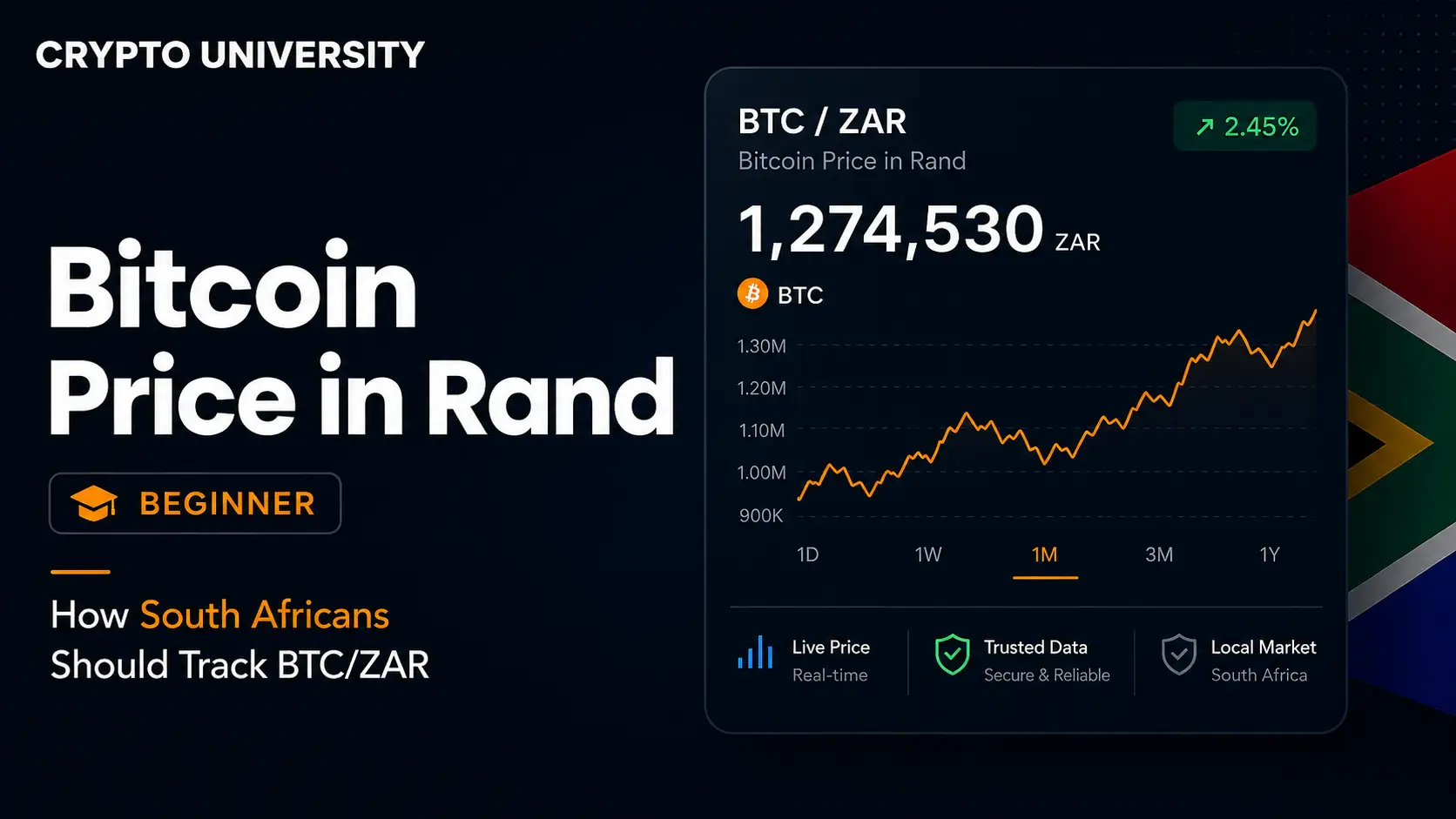
BTC/ZAR is a trading pair. It tells you how many rands the market is currently willing to exchange for one Bitcoin on a particular venue at a particular moment.
That last part matters. There is no single official Bitcoin price. Bitcoin trades continuously across hundreds of venues, each with its own order book. Aggregators such as CoinMarketCap and CoinGecko publish a volume weighted average of many exchanges, usually in US dollars. A local exchange publishes the price on its own book, in rands.
The two are related but not identical, and the gap between them is where most confusion lives.
The Formula Behind the Rand Price
A simple way to think about it:
BTC/ZAR is approximately equal to (BTC/USD) x (USD/ZAR), adjusted by the local premium or discount.
Each part moves independently.
| Component | What it is | What moves it |
|---|---|---|
| BTC/USD | The global dollar price of Bitcoin | Global supply and demand, macro conditions, flows into spot Bitcoin funds |
| USD/ZAR | The rand exchange rate | Interest rate expectations, commodity prices, local politics, global risk appetite |
| Local premium or discount | The gap between the local rand price and the converted global price | Local buying or selling pressure, order book depth, how easily capital can move offshore |
To calculate the premium yourself: divide the local rand price by the converted global price, subtract one, then express the result as a percentage. If BTC trades at R1,610,000 locally while the global price converts to R1,600,000, the local premium is roughly 0.6 percent.
Two Engines, Not One
Because the rand price depends on both Bitcoin and the currency, a South African holder can see gains or losses that a US holder never experiences.
The table below uses illustrative numbers only. It is not a forecast.
| Scenario | BTC in dollars | USD/ZAR | Effect on your rand balance |
|---|---|---|---|
| Bitcoin rises, rand steady | Up 5 percent | Unchanged | Up roughly 5 percent |
| Bitcoin flat, rand weakens | Unchanged | 16.10 to 17.00 | Up roughly 5.6 percent |
| Bitcoin flat, rand strengthens | Unchanged | 16.10 to 15.50 | Down roughly 3.7 percent |
| Bitcoin falls, rand weakens sharply | Down 5 percent | 16.10 to 18.00 | Up slightly, as currency moves offset the fall |
For context, USD/ZAR traded near 16.1 at the end of August 2026, after a year spent roughly between 15.6 and 17.8, according to widely published market data.
This is why South Africans sometimes see their rand portfolio rise on a day when global headlines report a flat or falling Bitcoin market. The currency simply did some of the work.
Where the Local Premium Comes From
A premium appears when local demand cannot easily be satisfied by supply from offshore markets. Three factors dominate.
Order book depth. On a thin book, a single large buy order moves the price more than it would on a deep one. Smaller pairs and quieter hours show wider swings.
Exchange control friction. South African residents face annual limits on how much capital they can move offshore. When it is slow or costly to bring cheaper Bitcoin in from abroad, local prices can drift above the converted global price and stay there.
Banking and settlement rails. Deposit times, withdrawal cut offs and card fees all add friction, and friction keeps prices apart.
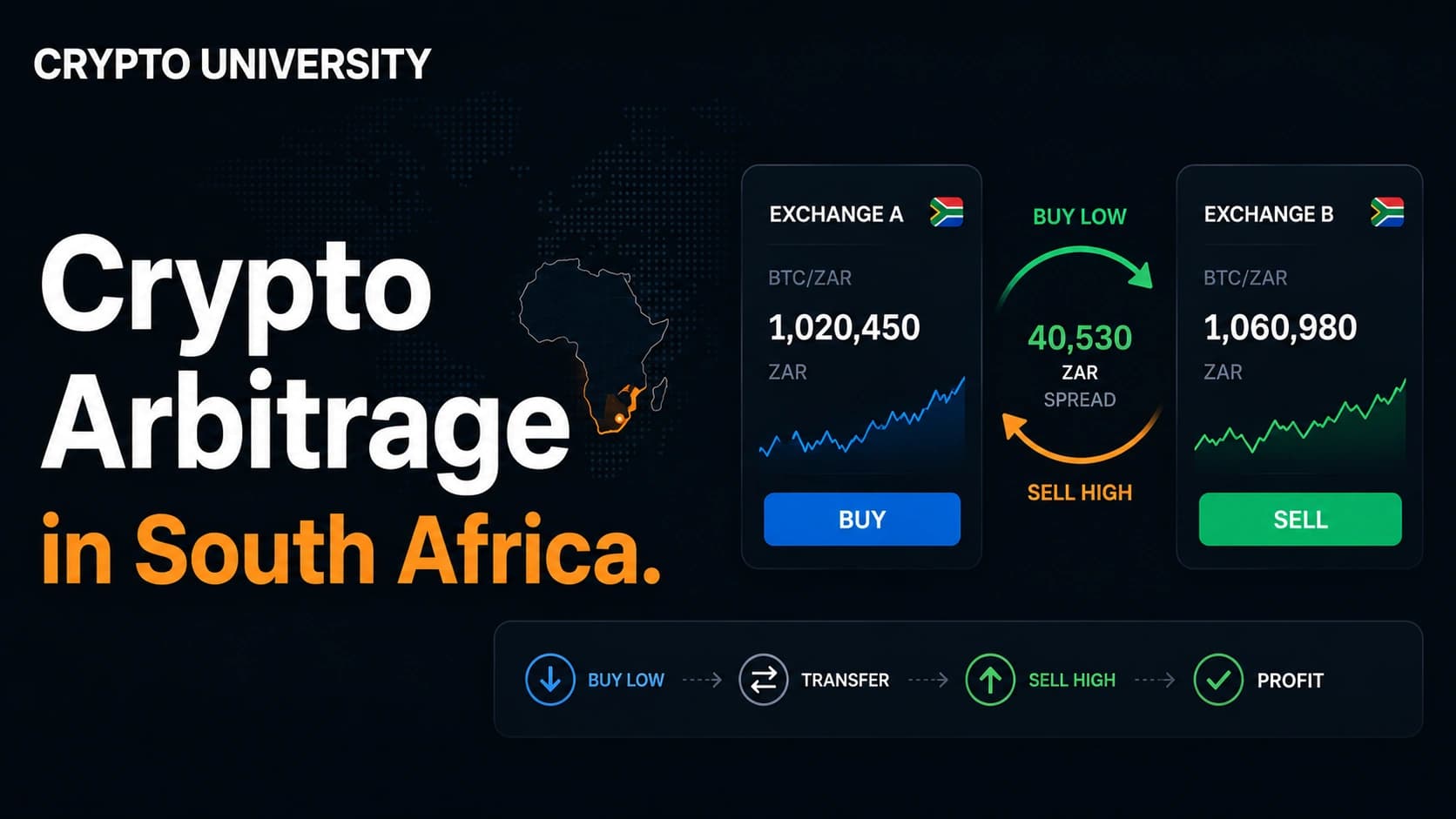
This gap was once large enough to support a cottage industry of arbitrage. Moneyweb has reported a spread of around 8 percent in 2017, narrowing to roughly 2 percent by 2023 and near 1 percent before costs by early 2026. Treat these as reported estimates, since the spread changes constantly.
Where to Check the Price
| Source type | Examples | Best for | Limitation |
|---|---|---|---|
| Global aggregators | CoinMarketCap, CoinGecko | Seeing the world reference price | Does not show what you will pay locally |
| Local exchanges | VALR, Luno, AltcoinTrader | The actual rand price and depth you can trade against | Prices differ between venues |
| Charting platforms | TradingView | Comparing BTC/ZAR against BTC/USD and USD/ZAR on one screen | Data feed may lag the venue you use |
| Currency data | SARB, major banks, forex sites | Checking the USD/ZAR leg on its own | Interbank rates differ from retail rates |
A practical habit is to keep two tabs open: one global price, one local order book. The difference between them is the premium you pay or receive.
Most South Africans do this with a rand denominated order book on a licensed local venue such as VALR or Luno, and a charting tool such as TradingView to view BTC/ZAR, BTC/USD and USD/ZAR side by side. Check which entities hold a current FSCA licence before depositing funds.
How to Compare Platforms Properly
Published fee tables rarely tell the whole story. Follow the money instead.
- Pick a fixed test amount. For example, R5,000, and run it on each venue you are considering, such as VALR and Luno.
- Record the all in rate. Note the price shown at the moment of the trade, not the mid market price.
- Add every fee. Deposit fee, trading or instant buy fee, spread, and network withdrawal fee if you are moving coins to self custody.
- Measure the output. How much BTC actually lands in your wallet, or how many rands land in your bank account when selling.
- Repeat in the other direction. Some platforms are competitive on entry and expensive on exit.
Local coverage has noted that instant buy features often cost more than the order book on the same platform, and that maker and taker fees usually scale down with 30 day volume. Check current published fees, since they change.
The Rules Behind the Local Market
Regulation does not set the price, but it shapes how freely value moves, which affects the premium.
| Area | Current position |
|---|---|
| Product status | The FSCA declared crypto assets to be financial products in October 2022 under the FAIS Act |
| Licensing | Crypto Asset Service Provider licensing opened on 1 June 2023. The FSCA reported 533 applications received as at 31 March 2026, with 310 approved and 17 declined |
| Transfers | The Financial Intelligence Centre requires the Travel Rule for crypto transfers under Directive 9 |
| Exchange control | Residents have a single discretionary allowance plus a foreign capital allowance of R10 million per calendar year that requires a SARS tax compliance PIN. The 2026 Budget announced an increase of the discretionary allowance to R2 million per calendar year |
| Tax | SARS treats crypto assets as assets of an intangible nature. Gains may be capital or revenue in nature. Crypto-Asset Reporting Framework reporting began in 2026 |
This is general information, not tax or legal advice. Confirm details with the FSCA, SARB and SARS, or with a qualified professional.
Common Mistakes When Tracking BTC in Rand
- Comparing a global dollar chart to a local rand quote and assuming one is wrong.
- Judging a platform on headline fees rather than rands received.
- Ignoring the currency leg, then being surprised by a move that came from USD/ZAR.
- Using a stale converter that applies yesterday's exchange rate.
- Treating a short term premium as permanent.
A Simple Tracking Routine
For long term holders, the daily rand print rarely changes anything. A monthly review of holdings, cost basis and records is usually enough, and record keeping matters because SARS expects supporting documents.
For active traders, the local pair, the depth of the book and the cost of moving funds matter far more than the global headline number.
Either way the discipline is the same: know which of the three components moved, and know what you actually received after costs.
Frequently Asked Questions
Why is the Bitcoin price on a South African exchange different from CoinMarketCap? Aggregators show a weighted average across many global venues, mostly priced in dollars. A local exchange shows its own order book in rands. Differences in liquidity, demand and capital flow create a small premium or discount between them.
Does a weaker rand mean my Bitcoin is worth more? In rand terms, yes, all else equal. A weaker rand raises the rand value of any dollar denominated asset. In dollar terms nothing has changed. Both views are valid, so be clear about which currency you are measuring in.
Is buying Bitcoin in rand more expensive than buying in dollars? Not necessarily. Converting rands to dollars first adds forex costs and transfer time. Once fees are counted, buying directly in a rand pair on a liquid local venue is often competitive. Compare rands out and Bitcoin in, not fee tables alone.
How do I calculate the local premium? Take the local rand price, divide it by the global dollar price multiplied by the current USD/ZAR rate, subtract one, and convert to a percentage. A positive result is a premium and a negative result is a discount.
Do I owe tax when the rand value of my Bitcoin rises? An unrealised change in value is generally not a taxable event by itself. Tax consequences usually arise on disposal, and on income such as mining or staking rewards. SARS assesses whether a transaction is capital or revenue in nature case by case. Speak to a tax professional about your circumstances.
Related Terms
- Spot price: The current market price for immediate settlement of an asset.
- Order book: The live list of buy and sell orders on an exchange, which determines available depth.
- Spread: The gap between the best available buy price and the best available sell price.
- Crypto premium: The percentage by which a local market price exceeds the converted global price.
- Exchange control: Rules governing how much capital residents may move across a country's borders.
Sources
- Financial Sector Conduct Authority, update on licensing and supervision of crypto asset service providers, reported April 2026: https://www.fanews.co.za/article/compliance-regulatory/2/financial-sector-conduct-authority-fsca-was-fsb/1059/update-on-licensing-and-supervision-of-crypto-asset-service-providers/43764
- South African Reserve Bank, Financial Surveillance frequently asked questions: https://www.resbank.co.za/en/home/what-we-do/financial-surveillance/FinSurvFAQ
- South African Reserve Bank, Exchange Control Circular No. 3/2026: https://www.resbank.co.za/content/dam/sarb/what-we-do/financial-surveillance/financial-surveillance-documents/2026/3-2026.pdf
- Moneyweb, what has happened to the crypto arbitrage spread: https://www.moneyweb.co.za/moneyweb-crypto/whats-happened-to-the-crypto-arbitrage-spread/
- Moneyweb, which South African crypto exchange is the cheapest: https://www.moneyweb.co.za/moneyweb-crypto/which-sa-crypto-exchange-is-the-cheapest/
- Trading Economics, South African rand data, accessed September 2026: https://tradingeconomics.com/south-africa/currency
- Moonstone, SARS draft guide on the taxation of crypto assets: https://www.moonstone.co.za/sars-draft-guide-sets-out-tax-implications-for-crypto-transactions/
Disclosure
Crypto University may earn a commission when readers open an account through the links in this article. Commissions do not influence which platforms are covered or how they are described. Platform fees, features and licensing status change, so verify current terms on each provider's own site before opening an account. This article is educational and is not financial, tax or legal advice.
More Reading
- South African Reserve Bank, Currency and Exchanges guidelines for individuals. The official reference on allowances and offshore transfer rules for residents.
- Notabene, South Africa crypto regulation overview. A practical summary of FSCA licensing and the Travel Rule for crypto transfers.
- Moneyweb crypto section. Ongoing local coverage of exchange fees, arbitrage conditions and regulatory developments in South Africa.
Continue with Bitcoin and Markets
Use the South African hub to compare current pathways, supporting evidence and next steps.
OPEN BITCOIN AND MARKETS