Key Takeaways
A tokenized deposit is commercial bank money represented on a blockchain that never leaves the regulated, insured banking system. A stablecoin is a token issued by a private company, usually backed by reserves the company holds itself.
Banks are moving on-chain partly to compete. If a bank can give corporate clients instant, around-the-clock settlement using a deposit token, the reason to hold a stablecoin for that same job weakens.
A properly structured tokenized security carries the same ownership rights and investor protections as the off-chain asset. A synthetic token only tracks a price and usually carries neither.
Why This Is Suddenly Confusing
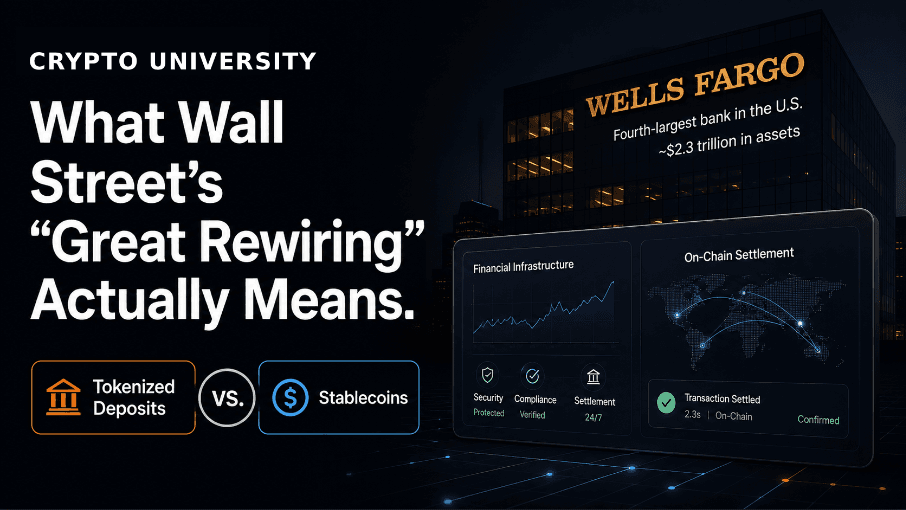
In the first week of August 2026, Wells Fargo, the fourth-largest bank in the United States with roughly $2.3 trillion in assets, said it would offer tokenized deposits to corporate and commercial clients this fall. The service starts with round-the-clock U.S. dollar to British pound payments and expands to more clients and currencies through 2027.
That announcement landed on top of a year of similar moves from JPMorgan, Citigroup, and others. It also arrived while headlines were full of stablecoins, tokenized stocks, and "real-world assets." For anyone learning this space, the words blur together. They should not. A tokenized deposit, a stablecoin, and a tokenized stock are three different products with three different legal structures and three different risk profiles. This guide separates them cleanly.
The Three Things People Mix Up
Start with a simple map. All three live on a blockchain and can move quickly, but that is where the similarity ends. The difference that matters is what you actually own and who is on the hook for it.
Product | What it represents | Who issues it | What you hold |
|---|---|---|---|
Tokenized deposit | A claim on money held at a commercial bank | A regulated bank (e.g. Wells Fargo, JPMorgan) | Commercial bank money, inside the banking system |
Stablecoin | A private token pegged to a currency, usually the U.S. dollar | A private company (e.g. Circle, Tether) | A claim on the issuer and its reserves |
Tokenized security | A share, bond, or fund unit recorded on-chain | An issuer or licensed program | Ownership or economic rights in the underlying asset |
What a Tokenized Deposit Actually Is
A tokenized deposit is your existing bank balance, represented as a digital token on a blockchain. The dollars do not leave the bank. They are the same insured deposits you already had, just given an on-chain form so they can move and settle at any hour, including weekends and holidays.
Wells Fargo described its version as commercial bank money that clients can move, program, and settle around the clock without leaving the regulated, insured banking system. The company frames it as an upgrade to its existing payment plumbing rather than a separate app clients must learn. JPMorgan has been further down this road: its blockchain unit, Kinexys, issues a deposit token called JPMD, described as the first bank-issued U.S. dollar deposit token, and made it available to institutional clients in late 2025 on Base, an Ethereum layer-2 network.
The key point for learners: a deposit token is a bank liability. When you hold it, your counterparty is the bank, and the usual banking protections and rules apply. It carries the credit profile of commercial bank money, not of a crypto company.
How a Stablecoin Is Different
A stablecoin is also a token designed to hold a steady value, usually one U.S. dollar. The difference is who stands behind it. A stablecoin is issued by a private company, not a bank. That company promises to hold reserves, typically cash and short-term government debt, so it can redeem tokens at face value. When you hold a stablecoin, your claim is on that issuer and the reserves it manages, not on an insured bank deposit.
Stablecoins are large and liquid. USDC, one of the biggest dollar-pegged stablecoins, traded around $72 billion in market value in early August 2026. That scale is exactly why banks are paying attention. Every dollar sitting in a stablecoin is a dollar not sitting in a bank deposit, which is part of the reason banks are now building their own on-chain money.
Feature | Tokenized deposit | Stablecoin |
|---|---|---|
Issued by | A regulated bank | A private company |
Your claim is on | Insured bank deposits | The issuer and its reserves |
Deposit insurance | Same eligibility as normal deposits | Not deposit-insured |
Main users today | Corporate and institutional clients | Traders, businesses, and retail users |
Primary purpose | Faster settlement within banking | On-chain cash and transfers |
Why Banks Are Building This Now
Banks are not doing this for novelty. They are responding to a competitive threat. Corporate treasury teams want money that moves instantly and settles at any hour. Traditional bank transfers still run on batch cycles and wire windows that close overnight and on weekends. Stablecoins offered a way around that, which pulled activity, and deposits, away from banks.
A tokenized deposit lets a bank offer the same always-on settlement while keeping the client's money on its own balance sheet. If a bank can give a corporate client instant cross-border settlement with a deposit token, the incentive to park cash in a stablecoin for that purpose fades. That is the real story behind the wave of announcements: banks are competing for the settlement job that stablecoins had started to win.
There is a catch, and it is worth stating plainly. Most of these bank networks are separate and do not yet talk to each other. Analysts note that without interoperability between banks' individual blockchain systems, deposit tokens could have limited real-world usefulness. Wells Fargo is running its own platform while also helping build a shared interbank network through The Clearing House, targeting the first half of 2027, precisely because a token that only works inside one bank is not very useful.
Tokenized Securities Are Not Synthetic Price-Trackers
The third source of confusion is tokenized stocks. Here the crucial distinction is between a real ownership wrapper and a token that merely mirrors a price.
A properly structured tokenized security should carry the same ownership rights, investor protections, and compliance obligations as its off-chain equivalent. In January 2026, the U.S. Securities and Exchange Commission issued guidance drawing a sharp line: issuer-sponsored tokenized securities can represent true ownership, while third-party products that offer only synthetic exposure or custodial entitlements face stricter scrutiny.
A synthetic token is different. It uses smart contracts and price oracles to track a stock's price, but there are no real shares behind it. You get price exposure and nothing else: no share, no dividend rights, no redemption claim. Even many tokens that are backed one-to-one by custodied shares, such as the widely traded xStocks products, give holders indirect price exposure rather than direct shareholder rights. The label "tokenized stock" can cover very different instruments, so the structure matters more than the name.
Issuer-sponsored tokenized security | Synthetic price-tracker | |
|---|---|---|
Real asset behind it | Yes | No |
Ownership rights | Can pass through (e.g. dividends, voting) | None |
Redemption claim | Typically yes | No |
Regulatory treatment | Treated as a security | Often a derivative or unregistered product |
A Scale Check to Keep It Grounded
It is easy to read "Wall Street's great rewiring" and picture a finished system. The market is real but still small. As of August 6, 2026, the data provider RWA.xyz tracked about $37.7 billion of distributed tokenized assets, excluding stablecoins. U.S. Treasury products made up more than 40 percent of that total. These are widely reported figures from a fast-moving market, so treat exact numbers as estimates that change week to week.
For context, that entire tokenized-asset market is a fraction of the stablecoin market alone, and a rounding error next to the traditional finance markets it aims to modernize. The direction is clear and the participants are serious. The scale is early. Both things are true at once, and holding them together is the mark of understanding this topic rather than just reacting to headlines.
Frequently Asked Questions
Is a tokenized deposit the same as a CBDC?
No. A tokenized deposit is issued by a commercial bank and represents money at that bank. A central bank digital currency (CBDC) would be issued directly by a central bank. Different issuer, different risk, different policy debate.
Are tokenized deposits safer than stablecoins?
They are structured differently, not simply "safer." A tokenized deposit keeps the protections and insurance eligibility of a normal bank deposit. A stablecoin's safety depends on the quality and management of its issuer's reserves. Each carries its own risks.
Can regular people use tokenized deposits?
Not yet, in most cases. The current bank products, including Wells Fargo's and JPMorgan's, are aimed at corporate, commercial, and institutional clients rather than retail users.
If I hold a tokenized stock, am I a shareholder?
It depends entirely on the structure. An issuer-sponsored tokenized security can grant ownership rights. Many popular products only give price exposure through a custodial or debt wrapper and do not make you a shareholder. Always check what the token actually represents.
Why do the market-size numbers keep changing?
Tokenization is early and growing quickly, and different trackers count different things. Figures are best treated as estimates from a specific date rather than fixed facts.
Related Terms
Deposit token - a blockchain representation of money held at a commercial bank.
Real-world asset (RWA) - a traditional asset, such as a bond or fund, represented on-chain.
Settlement - the final transfer of funds or assets between parties.
Interoperability - the ability of separate blockchain networks to work together.
Programmable payment - a transfer that executes automatically when set conditions are met.
Sources
Wells Fargo Newsroom - Wells Fargo to Launch Tokenized Deposits for Corporate and Commercial Clients
Forbes - Why Tokenization, Otherwise Known As Wall Street's Great Rewiring, Finally Looks Real
J.P. Morgan - JPM Coin (JPMD) USD Deposit Token Available for Institutional Clients
American Banker - Wells Fargo joins the fast-growing tokenized-deposit club
Bitcoin.com News - Tokenized RWA Sector Hits $38B as Treasury Debt Dominates Market
Disclaimer: Market figures are widely reported estimates from the dates noted and change frequently.
This content is for educational and informational purposes only and is not financial advice. Nothing here is a recommendation to buy or sell any asset or use any platform. Do your own research and manage your risk.
How Are Tokenized Stocks Taxed? A Simple Guide for Investors
Holding Tokenized Stocks in a Wallet vs on an Exchange
Tokenized Stocks vs Traditional Stocks: Which Is Better for Investors?
Best Platforms for Tokenized Stocks: Exchanges, Brokers and Onchain Apps
The Companies Behind Tokenized Stocks: xStocks, Ondo, Dinari, Robinhood and More
Tokenized Stock Risks: Issuers, Custody, Liquidity and Tracking Error