

Key Takeaways
Strategy, the company led by Michael Saylor, is the largest known corporate holder of Bitcoin. As of mid-2026 it holds roughly 843,000 coins, which is close to 4 percent of all the Bitcoin that will ever exist. That puts it ahead of every other public holder and behind only the coins believed to belong to Bitcoin's anonymous creator, Satoshi Nakamoto.
Owning a lot of Bitcoin is not the same as controlling Bitcoin. The network's rules are enforced by thousands of independent computers around the world, not by any single company's balance sheet.
There is a big difference between Satoshi's estimated coins, which are guessed from patterns on the blockchain, and Strategy's holdings, which are verified in audited public filings. Knowing that difference helps you judge any "largest holder" claim for yourself.
What Saylor Actually Claimed
In a recent interview, Michael Saylor said the only person who has never sold more Bitcoin than him is Satoshi Nakamoto, and that Strategy's holdings make the company second only to Satoshi's estimated supply. That claim set off fresh questions about concentration, market structure, and what big corporate treasuries mean for Bitcoin as a network.
One thing is worth flagging right away. Saylor's "never sold" framing held true for years, but in 2026 Strategy started a small Bitcoin sales program, which we cover below. So the claim needs a little updating, and we'll do that as we go. Everything else, we'll keep in plain language.
How Much Bitcoin Does Strategy Hold?
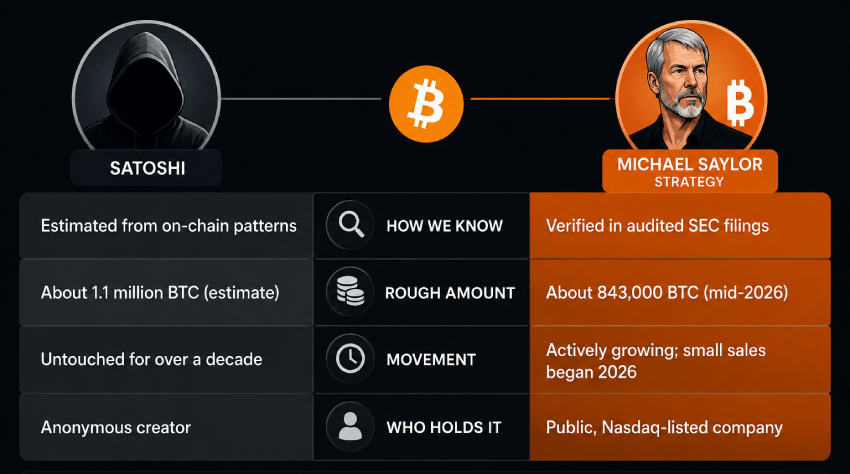
Strategy, the company formerly known as MicroStrategy, publishes regular updates on its Bitcoin treasury. As of its mid-2026 disclosures, it holds roughly 843,000 Bitcoin, bought using a mix of stock sales, debt, and cash. The exact number moves with every purchase, so it is always worth checking the company's latest SEC filings or press releases for the current figure.
For years, Saylor described the plan simply: buy, hold for the long term, and never sell. In early 2026, though, Strategy set up a Bitcoin monetization program and reported a few hundred million dollars of sales during the year. That is tiny next to a treasury worth tens of billions, but it does mean the old "never sold a single coin" line is no longer literally true.
It is also worth knowing that Strategy is not alone at the top. In April 2026 it overtook BlackRock's iShares Bitcoin Trust (IBIT) to become the largest known holder outside Satoshi. The two have traded that top spot back and forth, with IBIT a very close second. The key difference: IBIT holds Bitcoin in custody for ETF investors, while Strategy holds it on its own balance sheet.
What About Satoshi's Coins?
Blockchain researchers have long flagged a group of early addresses from the very first days of Bitcoin mining. The commonly cited estimate for coins linked to Satoshi is roughly 1.1 million Bitcoin, and those coins have not moved in over a decade. Because Satoshi's identity was never confirmed and the addresses were never spent, that number stays an estimate based on patterns, not a verified account.
So Saylor is really comparing two very different kinds of data. Here is the contrast at a glance.
Does Being a Big Holder Mean Being Powerful?
In Bitcoin, power is not the same as balance-sheet size. The rules are enforced by the distributed network of nodes and miners, not by any single wallet. A large holder can sway market liquidity and mood, but it cannot change the protocol, reverse transactions, or touch the fixed cap of 21 million coins.
Strategy's position matters because it is transparent, publicly traded, and constantly growing, which makes it the largest known corporate treasury. But that visibility does not hand it any control over the Bitcoin network itself.
What If Strategy Passes the Satoshi Estimate?
Strategy has already passed every other known holder. The next milestone people talk about is the roughly 1.1 million coins linked to Satoshi. If Strategy ever topped that figure, it would become the single largest known concentration of Bitcoin on public record.
Even then, the real-world effects would show up in market dynamics, not in protocol control. Think bigger influence on short-term liquidity when large buys or sales happen, more attention from regulators and index providers, and still zero change to Bitcoin's consensus rules or anyone else's ability to validate transactions. The network keeps running under the same rules no matter what any one balance sheet says.
Could Strategy Realistically Keep Growing?
It is mathematically possible if the company keeps up its buying pace and the Satoshi-linked coins stay put. A few practical limits still apply, though: how much capital it can raise through stock sales, debt, and cash generation; Bitcoin's fixed issuance schedule and its spread across millions of addresses; and the market impact of large ongoing purchases, which can push up the average cost of each new coin. Whether the company keeps pushing toward that path is a business decision it discloses in its filings.
Is It Healthy for One Company to Own This Much?
Heavy ownership of any asset raises fair questions about systemic risk. For Bitcoin, the main trade-offs look like this.
Possible upside | Possible risk |
|---|---|
Fully transparent, audited disclosures | Bitcoin's short-term price ties more closely to one company's health |
Signals corporate confidence in Bitcoin | Draws extra regulatory attention |
Proves Bitcoin can live on a public balance sheet | A large sale could pressure prices in the short term |
Bitcoin was designed so no single entity can rewrite history or seize coins without the private keys. Concentrated ownership does not override that design, but it can shape how the market feels day to day, especially around volatility.
How Much Could Strategy Ultimately Buy?
The company's stated approach sets no fixed ceiling. The practical limit depends on its access to capital markets, how much dilution or leverage shareholders will accept, and how much Bitcoin is actually available to buy. Saylor frames Bitcoin as a treasury reserve asset rather than a trading position, and any future buying will show up through purchase announcements and balance-sheet updates.
What If Strategy Were Forced to Sell?
A forced sale, whether from debt terms, regulatory action, or company trouble, would put a large amount of Bitcoin onto the market. History shows that big liquidations, like exchange collapses or miner sell-offs, tend to cause temporary price pressure that other buyers eventually absorb. Bitcoin's market has digested multi-billion-dollar supply events before without any protocol failure. The outcome would hinge on the size, speed, and market conditions at the time, not on any built-in fragility of the network.
Could It Become "Too Big to Fail"?
"Too big to fail" comes from traditional finance, where the collapse of a giant institution could damage the wider economy. Bitcoin has no central bank and no deposit insurance. If a large corporate holder ran into trouble, it would mainly hurt that company's own shareholders and lenders. The network has no way to bail anyone out. The market would simply reprice Bitcoin based on the new supply picture.
Does This Strengthen Bitcoin or Add Centralization Risk?
Both can be true at once. On the strengthening side, a transparent public company treating Bitcoin as a long-term reserve brings broader awareness, extra demand from other corporate treasuries, and proof that Bitcoin can sit on a public balance sheet. On the risk side, any large concentrated holding ties Bitcoin's short-term price more closely to one company's health and can draw regulatory focus. Neither effect changes the decentralized validation process that defines Bitcoin.
Why Does Saylor Keep Buying Regardless of Price?
Saylor and Strategy frame Bitcoin as a better treasury asset than cash or other reserves, pointing to its fixed supply and digital scarcity. The company describes a policy of continuous buying funded by capital markets, rather than trying to time short-term moves. That is a corporate treasury decision, not a trading signal for you to copy.
Could Another Company Catch Up?
Other companies and funds hold Bitcoin, and BlackRock's IBIT is right on Strategy's heels. Beyond those two, no corporate treasury comes close. Catching up would take similar capital-raising power and the same long-term commitment. Nothing in Bitcoin's design stops another entity from accumulating large amounts. The barrier is economic and strategic, not technical.
Is Strategy Basically a Bitcoin Reserve Stock?
In practical terms, Strategy's shares have become a way for public-market investors to get exposure to a leveraged Bitcoin treasury. The company still runs its software business, but Bitcoin now dominates both the balance sheet and the investor story. People sometimes call this a Bitcoin proxy stock. It is still a corporate equity, though, carrying the usual risks of leverage, dilution, and business performance.
What If Satoshi's Coins Suddenly Moved?
A move of the estimated Satoshi coins would be one of the largest supply events in Bitcoin's history. Markets would likely react sharply while people worked out whether the coins were being sold or just relocated. If Strategy kept buying at the same time, that would be demand pushing the other way. The net effect would depend on the size and timing of any sales versus ongoing purchases. Bitcoin has absorbed surprise large transfers before, and its rules would keep enforcing the fixed supply no matter which addresses move.
Practical Points for Beginners
When you see claims about the largest holders, separate two things: on-chain estimates that rely on address clustering, and verified corporate disclosures that appear in audited financial statements. Large holdings do not grant control over Bitcoin's rules. They mainly affect liquidity and attention.
If you hold any Bitcoin yourself, secure self-custody matters. You can explore hardware wallet options such as Ledger. As always, verify current holdings and corporate filings independently before you act on anything.
The Bigger Picture
Strategy's buying has turned corporate Bitcoin treasuries into a visible part of the market. The Satoshi comparison mostly highlights the gap between an estimated early-miner supply and a transparent public-company balance sheet. Through it all, Bitcoin's design keeps prioritizing decentralized consensus over any single holder's size. Keep that distinction in mind, and you won't mistake one big balance sheet for the defining feature of the network.
Frequently Asked Questions
How much Bitcoin does Strategy hold right now?
The exact figure changes with every purchase, so check Strategy's latest announcements or SEC filings for the current total. Mid-2026 reports put holdings around 843,000 Bitcoin.
Has Strategy ever sold any Bitcoin?
For years it said it never sold. In 2026 it set up a Bitcoin monetization program and reported a few hundred million dollars of sales, which is small compared with its total holdings but no longer zero.
Does owning more Bitcoin than Satoshi give Strategy control over the network?
No. Bitcoin's rules are enforced by the distributed network of nodes and miners. Balance-sheet size does not change consensus or the 21-million supply limit.
What is the estimated size of Satoshi's holdings?
Blockchain analysis commonly cites about 1.1 million Bitcoin linked to early mining. Those coins have stayed unmoved, and the figure remains an estimate.
Could Strategy's holdings create systemic risk for Bitcoin?
A large forced sale could pressure prices temporarily. But the Bitcoin protocol itself does not depend on any single holder staying solvent.
Sources
Strategy (formerly MicroStrategy) official press releases and SEC 8-K filings on Bitcoin holdings, mid-2026 (about 843,775 BTC and the 2026 monetization program).
Blockchain analytics reports on early Bitcoin address clustering and the estimated Satoshi supply, widely cited at about 1.1 million BTC.
News coverage of Strategy overtaking BlackRock's iShares Bitcoin Trust (IBIT) in April 2026 to become the largest known institutional holder.
Public interview statements by Michael Saylor on Strategy's holding policy and the Satoshi comparison.
Bitcoin whitepaper and protocol documentation on the fixed 21-million supply and decentralized validation.
Disclaimer: This content is for educational and informational purposes only and is not financial advice. Nothing here is a recommendation to buy or sell any asset or use any platform. Do your own research and manage your risk.
Explore the Crypto University Cash Out Crypto Guide
Tokenized Stocks Explained: A Simple Guide for Beginner Traders
Best Token Safety Checkers in 2026
Best Platforms for Tokenized Stocks: Exchanges, Brokers and Onchain Apps