
Key Takeaways
Before you read anything else, here is what matters most:
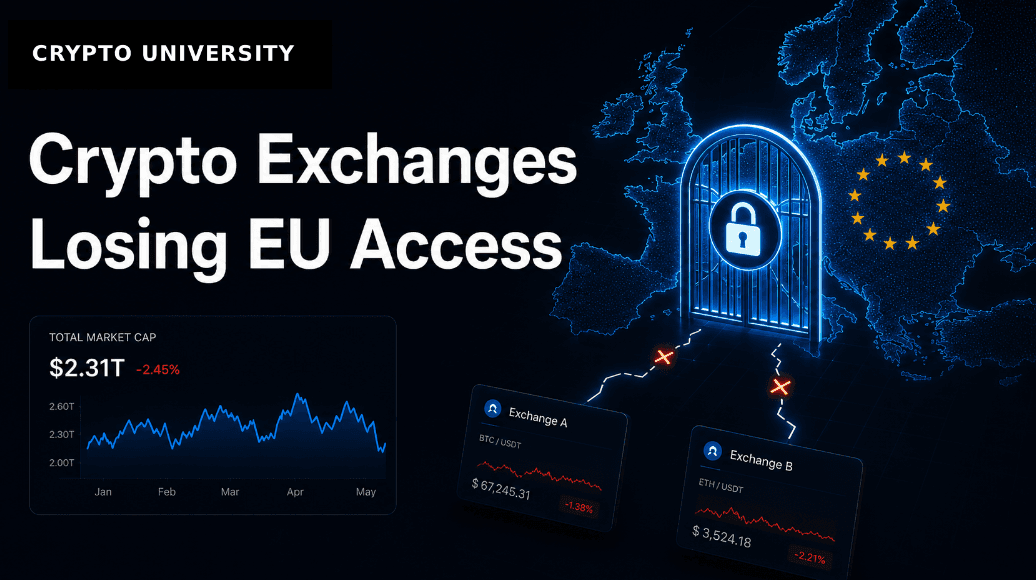
About 80% of the crypto platforms that were registered in the EU before MiCA are now unlicensed. That means hundreds of exchanges, including big names, have to stop serving EU users by July 1, 2026.
If you use MEXC, HTX, or any unlicensed exchange, your money could be at risk if the platform exits in a disorderly way. Withdraw your funds now, not on June 30.
Licensed alternatives like OKX and Bybit EU are ready to go, both are fully compliant, well-established, and accepting new accounts today.
How Big Is This, Really?
Let's be honest about the numbers. They are pretty dramatic. Out of more than 1,200 crypto companies that were legally registered to operate in the EU, only around 200 have gotten full CASP authorization under MiCA. That means roughly 80% of EU crypto exchanges are either already gone, in the process of leaving, or about to become illegal to use for EU residents after July 1, 2026.
Some of those 80% are tiny platforms you've probably never heard of. But several are well-known exchanges with millions of European customers. This is not just a crackdown on small offshore operators.
This article covers which major platforms are leaving, what's happening at each one, and what you need to do before the deadline.
Why Are So Many Exchanges Choosing to Leave?
This is a fair question and the answer is not that these exchanges got lazy or forgot about the rules. Getting MiCA-compliant at an exchange scale is genuinely expensive and complex. Here's a simple breakdown of what it costs:
Cost Type | Estimated Amount |
Year 1 compliance setup | €500,000 - €2,000,000 |
Annual ongoing costs | At least €250,000/year |
On top of the money, exchanges also have to set up a legal entity inside an EU country, hire local compliance staff, complete full identity verification (KYC) for every EU user, meet capital reserve rules, remove non-compliant assets like USDT, and accept ongoing supervision by EU regulators.
For exchanges that were built on the idea of low barriers to entry and a wide range of products, including leverage ratios and tokens not allowed under MiCA and full compliance would essentially mean rebuilding their business model. Some decided the EU market wasn't worth it at that cost. Others tried to comply but ran into obstacles or missed the timeline.
Which Exchanges Are Leaving? The Full Picture
Exchange | MiCA Status | Risk Level | Action for EU Users |
MEXC | No license | HIGH | Withdraw now |
HTX (Huobi) | No license | HIGH | Withdraw now |
KuCoin EU | Licensed but AML ban | MEDIUM | Monitor closely |
EU users must use bybit.eu | LOW (if migrated) | Migrate to bybit.eu | |
Uncertain( under review) | MEDIUM | Read dedicated article | |
Licensed (Malta) | SAFE | Good alternative |
MEXC: No License, No Plan
MEXC is one of the larger Asia-based exchanges by global trading volume, but as of June 2026, it has no MiCA CASP authorization and has not announced any application. Unless MEXC geoblocks EU users or gets a last-minute license, it will be operating illegally in the EU after July 1.
The risk here is not necessarily that your funds vanish on July 2. The bigger danger is that an unmanaged exit could cause withdrawal delays, account restrictions, or access freezes with no EU regulator to complain to.
What you should do: Withdraw your funds now and open an account on a licensed exchange.
HTX (formerly Huobi): No License
HTX, the rebranded version of Huobi, has no MiCA authorization either. Like MEXC, it shows up in industry analysis as one of the exchanges expected to lose EU access entirely after the deadline.
What you should do: Same as MEXC withdraw before July 1.
KuCoin EU: Licensed, but Flagged for AML Failures
KuCoin's situation is more complicated than a simple 'no license' case. KuCoin set up a separate EU entity called KuCoin EU Exchange GmbH, which did receive CASP authorization from Austria's FMA back in November 2025. That was the good news.
The bad news came in February 2026, when the FMA banned KuCoin EU from taking on new customers. The reason? Failures in key anti-money laundering and counter-terrorism financing functions, in other words, some of the most basic compliance obligations. The new customer ban is still in place.
If you already have a KuCoin EU account, you're technically on a licensed platform. But a platform that failed core AML compliance within months of getting licensed is a legitimate concern. Keep a close eye on official communications and consider whether it's worth moving your funds somewhere with a cleaner track record.
Bybit: EU Users Need to Be on bybit.eu
Bybit handled its MiCA transition properly, so this is not really an 'exit' story. The global platform, bybit.com, stopped serving EU-verified users on July 1, 2025. The same day its EU entity, bybit.eu, launched with full Austrian FMA authorization.
If you're an EU-based Bybit user who never completed the migration to bybit.eu, now is the time to do that. The EU platform is fully licensed and operational. This is one you don't need to leave you just may need to properly transfer over.
Binance: The Most Watched Case
Binance is the highest-profile story in the MiCA space, and it's neither a clean compliance nor a clean exit. The short version: Greece's financial regulator (the HCMC) was expected to reject Binance's MiCA license application before the July 1 deadline. Binance's EU operations have been running through its French entity, Binance France S.A.S., which holds AMF authorization, but the company has faced regulatory scrutiny across multiple EU countries.
Whether EU users can legally keep using Binance after July 1 depends on whether the French license can cover the company's broader EU operations, a question that was still being worked out close to the deadline. A separate dedicated article covers this in full detail.
The Silent Exits: Smaller Platforms You May Not Have Heard From
One of the most underreported parts of this story is how many smaller exchanges have already quietly exited. Platforms with narrower user bases and no budget for compliance have been geoblocking EU IP addresses, restricting new signups from EU countries, or sending brief emails telling EU account holders to close their accounts, often with very little notice.
This is visible in the data: analysis by OKX found that 7.6 million EU crypto users between May 2025 and May 2026 downloaded apps from exchanges that lack MiCA authorization. Many of those users are only now realizing their platforms were never planning to stay.
If you've received any notice about account restrictions, withdrawal requirements, or changes to 'supported regions' treat that as a wind-down signal and act now.
What Happens to Your Money When an Exchange Exits?
This is the practical question that matters most. The answer depends entirely on how the platform handles the exit.
Exit Type | What Happens | Risk to You |
Ordered Exit | Platform gives advance notice, keeps withdrawals open, processes transfers in an orderly way. | Low. If you act promptly. |
Disorderly Exit | Restricts access suddenly, experiences withdrawal backlogs, or shuts down without a proper wind-down plan. | High. You may lose temporary or extended access to your funds with no EU regulatory protection. |
MiCA requires platforms planning to exit to implement formal wind-down plans, including notifying clients in advance and arranging asset transfers. But enforcing that against a company headquartered outside the EU and not registered with any EU regulator is operationally difficult. The best protection is simple: withdraw your funds before the deadline. Not after you receive a restriction notice, and definitely not on June 30.
What Should You Do Right Now?
Here are the five steps every EU crypto user should take, in order:
Step | What to Do |
1 | Withdraw your funds immediately to a self-custody wallet or licensed exchange. |
2 | Open an account on a licensed platform before June 30. KYC takes 1- 3 business days. |
3 | Complete identity verification (KYC) early. Don't wait until the last day. |
4 | Convert any USDT you hold. It's not MiCA compliant. Switch to USDC or EUR. |
5 | Consider a hardware wallet (Ledger or Trezor) for long-term Bitcoin holdings. |
OKX (licensed in Malta) and Bybit EU (licensed in Austria) are both fully compliant, offer strong product depth for EU traders, and are processing new account registrations now. Other solid options include Coinbase, Kraken, Bitstamp, and Bitvavo.
This Is a Permanent Change, Not a Temporary Disruption
The exchange exits are not a blip. They represent a fundamental restructuring of the EU crypto market. The era of offshore exchanges serving European users through loosely regulated national registrations is ending. The regulatory floor has been raised, and the platforms leaving are the ones that either couldn't meet it or chose not to.
What remains is a smaller, more regulated, more KYC-focused exchange ecosystem. That means fewer platform options, compliance costs built into fees, and less access to certain tokens and leverage ratios that non-EU platforms still offer. On the other side, it means more investor protections, better transparency, and less exposure to the kind of platform failures that defined the early years of crypto.
Whether that tradeoff suits your needs depends on what you're trying to do with crypto. But if you're an EU resident, the choice has already been made for you. The only remaining decision is which licensed platform to use.
Frequently Asked Questions
How do I know if my exchange is leaving Europe?
Check the ESMA Interim MiCA Register at esma.europa.eu. If your exchange doesn't appear there with a confirmed CASP authorization, it is not licensed and will likely need to stop serving EU users.
What happens to my money if my exchange exits?
If the platform handles the exit properly, you'll receive notice and have time to withdraw. If the exit is disorderly, you could face delayed or blocked access. The only real protection is withdrawing before the deadline — not waiting for a warning notice.
Are there good alternatives for EU users leaving unlicensed platforms?
Yes. OKX and Bybit EU are both fully licensed, liquid, and well-regarded among EU traders. Other good options include Coinbase, Kraken, Bitstamp, and Bitvavo.
Is this a permanent change or will the regulations loosen later?
MiCA is primary EU legislation. Changing it would require a full legislative process across EU institutions. The regulatory framework is permanent and will likely become more comprehensive over time, not less.
Can I use a VPN to keep accessing unlicensed exchanges?
Using a VPN to get around geoblocking doesn't protect you legally. If the platform exits without an orderly wind-down, you have no regulatory recourse regardless of how you accessed it. It's not a safe workaround.
Disclaimer: This content is for educational and informational purposes only and is not financial advice. Nothing here is a recommendation to buy or sell any asset or use any platform. Do your own research and manage your risk.
AI + Crypto Convergence in 2026: What It Means for Web3 Developers and Users
Best Crypto Cards in 2025: Top 10 Reviewed, Compared, and Explained