Key Takeaways
No. | Takeaway |
|---|---|
1 | BitMEX will close for good on 23 September 2026 at 04:00 UTC. If you still hold money there, move it out early rather than waiting for the deadline. |
2 | This is a planned, healthy shutdown, not a blow up. BitMEX says it holds more assets than it owes, and withdrawals stay open even after the doors close. |
3 | BitMEX invented the perpetual swap in 2016. Almost every leveraged crypto trade you place today, on any exchange, uses that same idea. |
What Just Happened
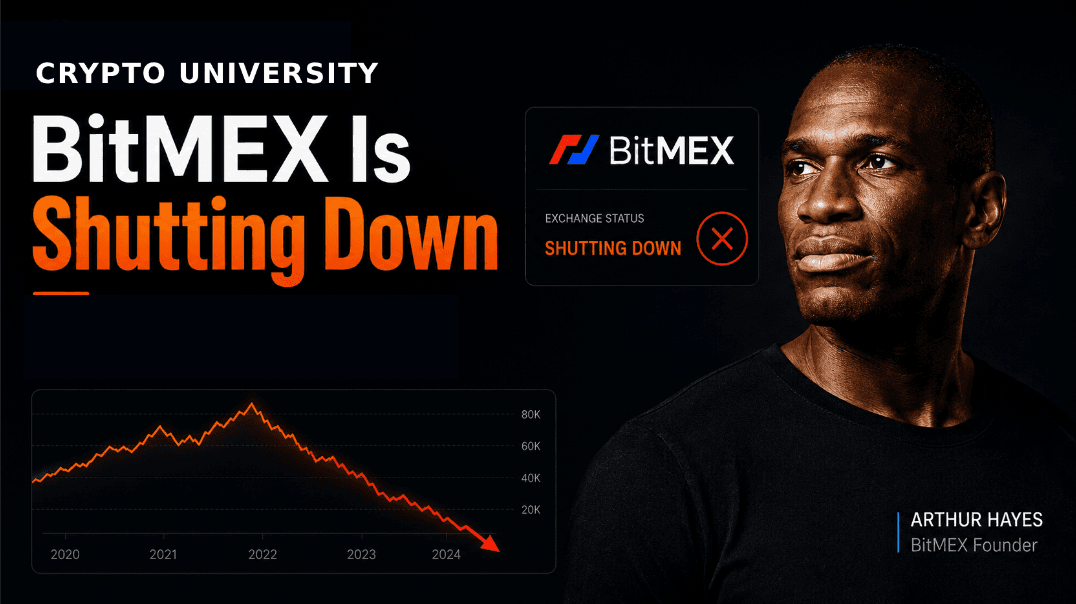
On 23 July 2026, BitMEX told its users it is closing down. The exchange will switch off permanently on 23 September 2026 at 04:00 UTC. New sign ups stopped straight away, and everyone else has roughly two months to close their trades and take their money home.
If you are newer to crypto, the name might not mean much to you. But BitMEX is not just another exchange quietly turning off the lights. It is the platform that created the perpetual swap, which is now the most traded product in the whole crypto market. Every perp you have ever opened on Binance, Bybit, OKX or Hyperliquid traces back to a contract BitMEX launched in 2016.
This article walks you through the whole story in plain language: how BitMEX started, how it became the loudest name in crypto trading, how the US government caught up with it, why it slowly faded, and the question its farewell notice never really answers. Why close the business instead of selling it?
The Closure Timeline at a Glance
Here are the dates that actually affect your account.
Date | What Happens |
|---|---|
23 July 2026 | Announcement day. New account registrations stop immediately. |
26 August 2026 | Risk limits kick in. You can only reduce or close positions, not open new ones. |
Before 23 September 2026 | BitMEX will force close any positions still open, so the markets can wind down in an orderly way. |
23 September 2026, 04:00 UTC | The exchange shuts down. All trading services stop. |
After closure | You can still log in and withdraw, but nothing else works. Dormancy fees start applying to leftover balances. |
The decision came from the board of HDR Global Trading Limited, the company that owns and runs BitMEX, following what it described as a strategic review of the business and the wider crypto industry. No deeper explanation was offered.
Two things matter most for users. First, BitMEX says its assets are greater than its liabilities, backed by its Proof of Reserves and Liabilities page. In plain terms, the money is there. This is a solvent wind down, not a collapse. Second, the company has warned about scammers offering priority withdrawals. That service does not exist. If you still have funds sitting on BitMEX, log in through the official site and withdraw them yourself.
Where BitMEX Came From
BitMEX, short for Bitcoin Mercantile Exchange, opened in November 2014. Its three founders made an unusual team.
Founder | Background | Role at BitMEX |
|---|---|---|
Arthur Hayes | Equity derivatives trader at Deutsche Bank and Citigroup in Hong Kong, laid off after the 2008 banking cuts | The public face and CEO. Wrote the essays, gave the interviews, built the brand. |
Ben Delo | Oxford trained mathematician and former JPMorgan engineer | Built the high speed trading systems behind the platform. |
Samuel Reed | Software developer | Chief Technology Officer. Wrote much of the original exchange code. |
Their idea was simple. Take the kind of professional derivatives products that big institutions had used for decades, and hand them to anyone with bitcoin and an internet connection. No bank account required. You deposited bitcoin, you traded, you withdrew bitcoin.
The first couple of years were slow going. Crypto in 2014 and 2015 was still deep in a bear market after the Mt. Gox disaster, and trading volumes were thin. What changed everything was leverage, plus one very clever invention.
The Perpetual Swap, Explained Simply
In May 2016, BitMEX launched a contract called XBTUSD. It was the first perpetual swap, and it quietly changed how the entire industry trades.
A normal futures contract has an expiry date. When that date arrives, the contract closes, and if you want to keep your position you have to move into the next one. Traders call this rolling, and it is a nuisance. A perpetual swap never expires. To stop its price drifting away from the real market price, it uses a funding rate, which is a small regular payment between traders holding long positions and traders holding short positions.
Feature | Traditional Futures | Perpetual Swap |
|---|---|---|
Expiry date | Yes, fixed date | None, holds forever |
Rolling positions | Required before expiry | Not needed |
Price anchor | Converges at expiry | Funding rate payments between longs and shorts |
Best suited to | Hedging over a set period | Continuous leveraged trading |
Pair that with leverage of up to 100 times, and XBTUSD became the most liquid trading instrument in crypto for years. Today, perpetual swaps are the dominant product across the whole industry, with trillions of dollars changing hands every quarter on both centralised and on chain venues. Whatever happens to BitMEX, that invention lives on.
The Golden Years
By 2018 and 2019, BitMEX was arguably the most important trading venue in crypto. When positions were liquidated there, the whole market felt it. Its insurance fund held tens of thousands of bitcoin. The company famously worked out of the Cheung Kong Center in Hong Kong, some of the priciest office space on the planet, which was a long way from where it started.
Arthur Hayes became the most entertaining personality in the industry. His Crypto Trader Digest essays mixed serious macroeconomics with deliberately outrageous humour, and traders still read them today. In July 2019 he debated the economist and famous crypto sceptic Nouriel Roubini in what was billed as the Tangle in Taipei, one of the defining spectacles of that era.
Behind the showmanship there was real substance. BitMEX ran for more than eleven years without losing a single satoshi of customer money to a hack, a record very few exchanges of its generation can claim.
Where It Went Wrong
Being the biggest venue in crypto also meant collecting the biggest list of complaints. Some were fair, some were exaggerated, and one of them proved fatal.
Issue | What Happened |
|---|---|
System overloads | For years, traders complained that during wild price swings, exactly when they needed to manage positions, the platform showed system overload errors while liquidations kept running. |
Black Thursday, March 2020 | When bitcoin fell around 50 percent on 12 and 13 March 2020, BitMEX went offline mid crash and blamed a DDoS attack. The liquidation cascade stopped almost instantly and prices bounced. Critics argued the outage accidentally halted a death spiral that BitMEX’s own leverage engine had helped create. |
The email leak | In November 2019, a mass email mistake exposed thousands of user email addresses in the CC field, a serious privacy failure for a platform whose users valued staying anonymous. |
The US government case | The one that really mattered. Regulators and prosecutors argued BitMEX served American customers from offshore with almost no anti money laundering controls. |
The Case That Changed Everything
On 1 October 2020, the CFTC and the US Department of Justice filed charges against BitMEX and its founders. The core accusation was that the exchange had taken US customers while operating offshore, without a meaningful anti money laundering programme, breaking the Bank Secrecy Act. Samuel Reed was arrested that same day. Arthur Hayes, then living abroad, handed himself in to US authorities in Hawaii in 2021.
Here is how the case played out over the following years.
When | Outcome |
|---|---|
2021 | BitMEX paid a combined 100 million dollar civil penalty to the CFTC and FinCEN. |
February 2022 | Hayes and Delo pleaded guilty to Bank Secrecy Act violations. Reed followed shortly after. Each agreed to a 10 million dollar penalty. |
May and June 2022 | Hayes received six months of home detention and two years of probation. Delo and Reed also avoided prison. |
July 2024 | BitMEX as a company pleaded guilty to violating the Bank Secrecy Act. |
January 2025 | The company was fined a further 100 million dollars. |
March 2025 | President Trump pardoned Hayes, Delo, Reed, senior employee Greg Dwyer and the HDR corporate entity. |
The pardons closed the legal chapter. By that point, though, the commercial damage was already done.
The Long, Slow Decline
The 2020 charges forced BitMEX to do the very thing its earliest users loved it for avoiding: full identity verification. The anonymous, bitcoin in and bitcoin out model died, and a big part of the platform’s identity died with it.
What followed was not a dramatic crash. It was a slow bleed, in three stages.
Stage | What Happened |
|---|---|
Leadership churn | The founders stepped back from executive roles in late 2020. Alexander Höptner, previously of Börse Stuttgart, became CEO in January 2021 and pushed a beyond derivatives strategy covering spot trading, custody, brokerage and even a plan to buy a 268 year old German bank. |
The pivot failed | The bank purchase was abandoned in early 2022. About 75 employees, a quarter of the staff, were laid off in April 2022. Höptner left that October and CFO Stephan Lutz took over. A new exchange token, BMEX, launched straight into a bear market. |
Competitors ran away with it | While BitMEX was busy with regulators and restructuring, Binance, Bybit and OKX captured the perpetuals volume BitMEX had invented. Then decentralised perp exchanges arrived. By 2026, Hyperliquid was the second largest perpetuals venue by open interest, behind only Binance. |
The numbers tell the rest. In the second quarter of 2026, centralised exchange perpetual volume was roughly 12.7 trillion dollars, and BitMEX’s slice of that had shrunk to a rounding error. Exchange history repeats this pattern constantly. Liquidity attracts liquidity, and once it leaves, it almost never comes back.
Why Close the Doors Instead of Selling?
Here is the detail most news reports skip. BitMEX tried to sell itself. In February 2025, HDR hired the investment bank Broadhaven Capital Partners to run a formal sale process. Seventeen months later, the company announced a shutdown instead. Neither side has said whether any serious buyer ever showed up.
BitMEX has not explained its thinking beyond that strategic review line, so everything below is informed speculation rather than confirmed fact. It is still worth walking through, because it teaches you something useful about what an exchange is actually worth.
Likely Reason | Why It Makes Sense |
|---|---|
The liquidity was gone | When someone buys an exchange, they are really buying users, volume and order flow. BitMEX’s technology was ageing, its brand belonged to an era that no longer exists, and its market share had shrunk to near irrelevance. There may not have been much left to buy. |
The legal history scared buyers off | Even with pardons and settled fines, a buyer inherits the compliance record and the due diligence burden of a company that pleaded guilty to federal charges twice. That is a lot of friction for a small prize. |
A clean wind down beat a fire sale | BitMEX says assets exceed liabilities. If the offers on the table were low or full of conditions, returning capital through an orderly closure was probably better for HDR’s shareholders, who are mainly the founders. All three are independently wealthy. Nobody needed to keep the machine running. |
The industry moved on | The offshore centralised derivatives exchange with a token attached is a crowded, low margin business now, and growth has shifted on chain. An honest review may simply have concluded there was no realistic path back to relevance. |
What This Means for You as a Trader
An orderly ending is worth noticing
Compare this with how exchanges usually die. Mt. Gox was hacked, funds vanished, and creditors waited a decade. FTX ended in fraud and bankruptcy with billions frozen. BitMEX gave two months of notice, published proof of reserves, kept withdrawals open indefinitely and publicly warned users about phishing scams. It is an unglamorous ending, but a respectful one, and that is worth acknowledging from a company with BitMEX’s history.
Exchanges are temporary, good ideas are not
BitMEX the exchange lasted almost twelve years. The perpetual swap it created will probably outlive every exchange running today. If you are studying how crypto markets work, remember that venues compete and die, but well designed mechanisms become shared infrastructure that everyone builds on.
Never leave money on a dying platform
Even in this well managed shutdown, BitMEX is charging dormancy fees, warning about processing delays and force closing positions. If you take one practical lesson from this whole story, make it this one. An exchange is a place to trade, not a place to store your savings. The oldest rule in crypto still holds. Not your keys, not your coins.
Your Practical Checklist
No. | Action | Why It Matters |
|---|---|---|
1 | Withdraw your funds now | Do not wait for 23 September 2026. Late withdrawals risk processing delays and network congestion. |
2 | Close positions before 26 August 2026 | After that date you can only reduce positions, and BitMEX can force close what is left at its own discretion. |
3 | Ignore priority withdrawal offers | Any message promising accelerated or priority BitMEX withdrawals is a scam. Only use the official website. |
4 | Do not leave a leftover balance | Dormancy fees are the greater of 50 US dollars equivalent or 1 percent per year, billed monthly, and can rise over time. |
5 | Move funds to self custody or a stronger venue | Treat every centralised exchange as a counterparty, not a vault. BitMEX ended tidily. The next one might not. |
The Full List of Confirmed MiCA-Licensed Exchanges
Here is a quick overview of every confirmed MiCA-licensed consumer exchange on MICA tracker, followed by deeper detail on How to Cash Out Crypto.
Exchange | Licensed Entity | Regulator | Country | Services |
|---|---|---|---|---|
OKX Europe Limited | MFSA | Malta | Trading, Exchange, Custody | |
Bybit EU | Bybit Technology Austria GmbH | FMA | Austria | Trading, Exchange |
Coinbase | Coinbase Financial Services Ltd | CSSF | Luxembourg | Trading, Exchange, Custody |
Kraken | Payward Europe Limited | CBI | Ireland | Trading, Exchange, Custody |
Bitstamp | Bitstamp Europe S.A. | CSSF | Luxembourg | Trading, Exchange |
Binance | Binance France S.A.S. | AMF | France | Exchange, Trading |
Bitpanda | Bitpanda GmbH | FMA / MFSA | Austria / Malta | Trading, Exchange, Custody, Brokerage |
Bitvavo | Bitvavo B.V. | AFM | Netherlands | Trading, Exchange |
Foris DAX Europe | MFSA | Malta | Trading, Exchange, Custody | |
Gate Technology Ltd | MFSA | Malta | Trading, Exchange | |
Interactive Brokers | Interactive Brokers Ireland Ltd | CBI | Ireland | Exchange, Trading |
EU MiCA License Tracker
Check whether a crypto exchange or platform has a verified MiCA authorization in Europe.
Matched against official ESMA records and refreshed daily.
Frequently Asked Questions
When exactly does BitMEX shut down?
On 23 September 2026 at 04:00 UTC. Restrictions start earlier though. From 26 August 2026 you can only reduce positions, not open new ones.
Is BitMEX insolvent?
There is no evidence of that. BitMEX states that its assets exceed its liabilities, publishes proof of reserves, and is running a two month orderly wind down with withdrawals still open after closure. This looks like a business decision rather than a collapse.
Why did BitMEX decide to shut down?
Officially, because of a strategic review of the business and the wider crypto industry by the board of HDR Global Trading. The company had been looking for a buyer since February 2025 and clearly did not complete a sale. Its market share had been shrinking for years against Binance, Bybit, OKX and newer on chain venues such as Hyperliquid.
Who founded BitMEX?
Arthur Hayes, Ben Delo and Samuel Reed founded it in 2014. All three pleaded guilty to US Bank Secrecy Act violations in 2022 and were pardoned by President Trump in March 2025.
What was BitMEX’s biggest contribution to crypto?
The perpetual swap, launched as XBTUSD in May 2016. It is now the most traded product type in crypto on both centralised and decentralised exchanges.
Can I still withdraw after the closure date?
Yes. BitMEX says users will still be able to log in and withdraw after 23 September 2026. However, dormancy fees apply to whatever is left behind, and no other services will be available.
What happens to my open positions if I do nothing?
BitMEX will force close remaining open positions before the shutdown so that markets can be wound down in an orderly way. You will not get to choose the timing or the price, so it is far better to close them yourself.
Sources: BitMEX official closure announcement dated 23 July 2026, The Block, CoinDesk, CFTC press releases, and the CoinGecko State of Crypto Perpetuals Report 2026. Market share and volume figures are estimates based on published industry data.
Disclaimer: This content is for educational and informational purposes only and is not financial advice. Nothing here is a recommendation to buy or sell any asset or use any platform. Do your own research and manage your risk.
Best Crypto Trading Competitions in 2026: OKX vs Bybit
Best Robinhood Chain Trading Platforms in 2026: FOMO, GMGN, Uniswap and OpenSea Compared
Best RugCheck Alternatives Every Beginner Trader Needs
RugCheck Explained: How Beginners Can Use This Free Solana Token Safety Tool