Key Takeaways
1. BitMart announced on July 26, 2026 that it is winding down its trading platform. New sign-ups, deposits, and new trades stopped immediately, all trading ends on August 26, 2026, and the platform fully closes on January 31, 2027.
2. Withdrawals stay open during the wind-down, but BitMart warns of extra identity and security checks that can slow them. The safest move is to withdraw early rather than wait.
3. BitMart is one of several mid-sized exchanges to close in 2026. The episode is a reminder that any assets left on a centralized exchange depend on that company staying in business.
What Just Happened
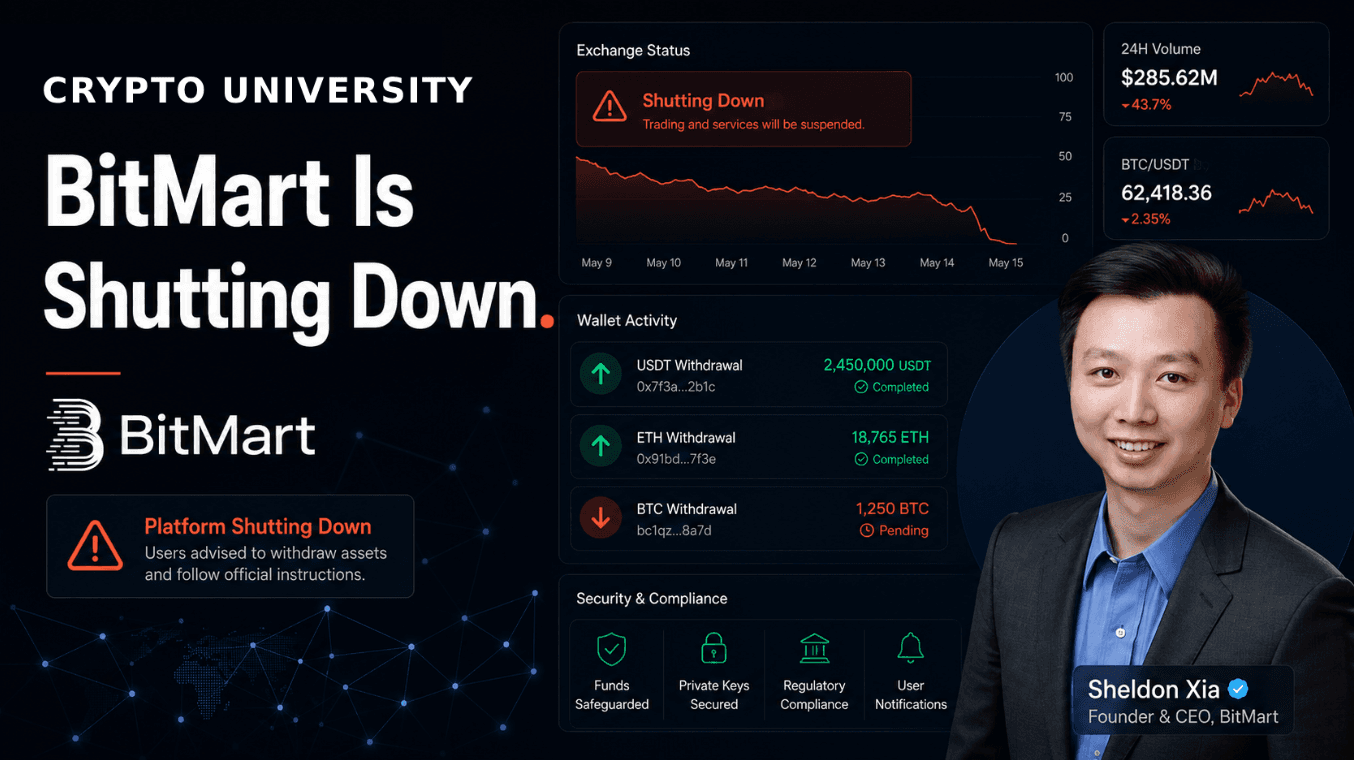
On Sunday, July 26, 2026, the cryptocurrency exchange BitMart announced it would begin what it called an “orderly wind-down” of its trading platform. In its notice, the company said the decision followed a review of its “operating conditions, market environment, and future strategic direction,” and it did not give further detail.
This was not a sudden freeze of the kind seen in past exchange collapses. Trading is being phased out over several weeks, and withdrawals remain open. Still, the direction is clear: BitMart is closing.
The announcement immediately hit BMX, BitMart’s in-house exchange token, which fell by roughly 58 to 60 percent within 24 hours. That deepened a decline that had already run around 70 percent over the prior year, according to market data reported at the time.
BitMart also became part of a wider pattern. It was one of several centralized exchanges to announce closures within a few weeks, alongside BitMEX and AscendEX. Analysts described 2026 as a shakeout year in which weaker mid-tier platforms struggled to compete.
There was also confusion at the top. BitMart’s former global chief executive, Nenter Chow, said publicly that he had been told on July 24 that his employment was ending, and that he learned about the wind-down only when it became public. He stated he had not been consulted on the decision.
The Closure Timeline at a Glance
BitMart laid out specific dates for each stage of the wind-down. Times in the original notice were given in UTC.
Date | What happens |
|---|---|
July 26, 2026 | New user registrations, deposits, and new trading orders suspended. Futures moved to reduce-only mode. Copy trading, grid trading, and API services begin phasing out. |
August 26, 2026 | All trading services discontinued. No further buying or selling on the platform. |
January 31, 2027 | Platform operations officially cease. Final deadline tied to the closure. |
Throughout | Withdrawals remain available, subject to identity and security checks that may cause delays. |
The key point for users is the gap between the announcement and the final closure. There is a window to act, but it narrows in stages. Notably, trading stops well before the platform fully closes.
Where BitMart Came From
BitMart was founded in 2017 by Sheldon Xia and became fully operational in 2018. It was registered in the Cayman Islands and registered with the U.S. Financial Crimes Enforcement Network (FinCEN) as a money services business. Over the years it grew into what the industry calls a “mid-tier” exchange, reporting somewhere between nine and twelve million users across more than 180 countries at various points. These are widely reported figures rather than audited numbers.
BitMart at a glance | Detail |
|---|---|
Founded | 2017 (fully operational in 2018) |
Founder | Sheldon Xia |
Headquarters | Cayman Islands |
Type | Centralized cryptocurrency exchange (mid-tier) |
Native token | BMX |
Reported users | Roughly 9 to 12 million (widely reported, varied over time) |
Recent daily volume | Around $1.6 billion, as reported near the closure |
BitMart was never a top-three exchange like Binance or Coinbase. It sat in the same competitive band as platforms such as KuCoin and Gate. Its business model depended on listing a large number of tokens, including many small and speculative ones, and on a steady flow of new users and trading activity.
Where It Went Wrong
BitMart’s announcement blamed general conditions rather than any single event. But its history included several stress points worth understanding, because they explain why some users had already lost trust.
The most serious was a December 2021 security breach. Attackers used compromised private keys to drain two of BitMart’s “hot” wallets (wallets connected to the internet) on the Ethereum and BNB Chain networks, resulting in losses of roughly $196 million. BitMart’s founder confirmed the incident and said the company would compensate affected users from its own funds. Reimbursement took time, and the episode drew a U.S. Federal Trade Commission investigation, reported as the agency’s first crypto-related probe.
Beyond the hack, the broader 2026 environment was difficult for mid-sized exchanges. Industry commentators pointed to what they called a structural weakness in the mid-tier model: these platforms need a constant inflow of new users and trading volume to stay profitable, and when that slows, the economics break down. One analyst described this as a “fatal flaw” of the mid-tier model.
It is important to be precise here. BitMart described its closure as a strategic wind-down, not a bankruptcy, and it kept withdrawals open. As of the announcement, there was no public confirmation that customer funds were missing. That distinction matters, and it is covered in the next section.
What This Means for You as a Trader
If you hold assets on BitMart, the practical situation is more manageable than a sudden collapse, but it still requires action.
First, this is a wind-down with withdrawals open, not a frozen exchange. That is genuinely better than the worst-case scenarios crypto has seen, where users could not access funds at all. However, “open” does not mean instant. BitMart warned that withdrawals could face extra review, including identity verification, device and IP checks, withdrawal-address screening, source-of-funds questions, and sanctions checks. Any of these can slow a withdrawal, and processing loads tend to rise when many users try to exit at once.
Second, time is not on your side if you wait. Trading ends on August 26, 2026, so any positions you want to convert or rebalance should be handled before then. After trading stops, your options narrow to withdrawing whatever you already hold.
Third, treat this as a lesson in how exchanges work. Any asset held on a centralized exchange is, in practice, an IOU from that company. You are trusting the platform to stay solvent, secure, and operational. When an exchange closes, that trust is tested. This is the reasoning behind the common phrase “not your keys, not your coins,” which points to self-custody wallets where you control the private keys directly.
Note: This is educational information, not financial advice, and it is not a prediction about whether BitMart will complete its wind-down smoothly. It simply describes how exchange closures generally work.
Your Practical Checklist
If you have funds on BitMart, here is a clear, ordered set of steps.
Confirm your balances. Log in and check both spot and futures accounts, and note any open positions.
Complete identity verification (KYC) now. BitMart flagged that incomplete verification can delay or block withdrawals.
Close or settle open positions before August 26, 2026. That is when trading ends. Futures are already in reduce-only mode, so plan around that.
Withdraw early rather than late. Processing may slow as more users exit and as extra checks are applied.
Send funds somewhere you control. Move assets to a self-custody wallet (where you hold the private keys) or to another reputable exchange if you plan to keep trading.
Double-check withdrawal addresses. On-chain mistakes are irreversible, and scammers often target users during closures with fake “recovery” or “support” links.
Keep records. Save transaction IDs, screenshots of balances, and any support correspondence in case you need proof later.
Ignore unsolicited help. No legitimate exchange or agent will ever ask for your seed phrase or private keys.
The Full List of Confirmed MiCA-Licensed Exchanges
Here is a quick overview of every confirmed MiCA-licensed consumer exchange on MICA tracker, followed by deeper detail on How to Cash Out Crypto.
Exchange | Licensed Entity | Regulator | Country | Services |
|---|---|---|---|---|
OKX Europe Limited | MFSA | Malta | Trading, Exchange, Custody | |
Bybit EU | Bybit Technology Austria GmbH | FMA | Austria | Trading, Exchange |
Coinbase | Coinbase Financial Services Ltd | CSSF | Luxembourg | Trading, Exchange, Custody |
Kraken | Payward Europe Limited | CBI | Ireland | Trading, Exchange, Custody |
Bitstamp | Bitstamp Europe S.A. | CSSF | Luxembourg | Trading, Exchange |
Binance | Binance France S.A.S. | AMF | France | Exchange, Trading |
Bitpanda | Bitpanda GmbH | FMA / MFSA | Austria / Malta | Trading, Exchange, Custody, Brokerage |
Bitvavo | Bitvavo B.V. | AFM | Netherlands | Trading, Exchange |
Foris DAX Europe | MFSA | Malta | Trading, Exchange, Custody | |
Gate Technology Ltd | MFSA | Malta | Trading, Exchange | |
Interactive Brokers | Interactive Brokers Ireland Ltd | CBI | Ireland | Exchange, Trading |
Frequently Asked Questions
Is BitMart really shutting down?
Yes. On July 26, 2026, BitMart announced an orderly wind-down of its trading platform, with trading ending on August 26, 2026 and the platform fully closing on January 31, 2027.
Can I still withdraw my money from BitMart?
Yes. Withdrawals remain open during the wind-down. BitMart warned that they may be delayed by identity and security checks, so it is generally wiser to withdraw sooner rather than later.
Why is BitMart closing?
BitMart cited its operating conditions, the market environment, and its future strategy, without giving specifics. Analysts have linked the closure to broader pressure on mid-tier exchanges in 2026 and to BitMart’s own history, including a major 2021 hack.
Did BitMart go bankrupt or get hacked in 2026?
Based on its own statement, BitMart described this as a strategic wind-down rather than a bankruptcy, and it kept withdrawals open. This is different from the 2021 breach, when about $196 million was stolen. There was no public confirmation of missing customer funds tied to the 2026 closure at the time of the announcement.
What happened to the BMX token?
BMX, BitMart’s exchange token, fell sharply after the announcement, reported at roughly 58 to 60 percent within 24 hours. Exchange tokens are closely tied to the health of the platform that issues them.
What is the deadline to get my funds out?
Trading ends on August 26, 2026, and the platform officially closes on January 31, 2027. Treat the earlier date as the practical deadline for any trading, and aim to withdraw well before the final closure.
Is my crypto safer on an exchange or in my own wallet?
Each has trade-offs. Exchanges are convenient but require trusting the company. Self-custody wallets give you direct control of your keys but place full responsibility for security on you. BitMart’s closure is a reminder of why many users keep long-term holdings in wallets they control.
Disclaimer: This content is for educational and informational purposes only and is not financial advice. Nothing here is a recommendation to buy or sell any asset or use any platform. Do your own research and manage your risk.
Best Crypto Trading Competitions in 2026: OKX vs Bybit
Best Robinhood Chain Trading Platforms in 2026: FOMO, GMGN, Uniswap and OpenSea Compared
Best RugCheck Alternatives Every Beginner Trader Needs
RugCheck Explained: How Beginners Can Use This Free Solana Token Safety Tool