
Key Takeaways
A tokenized stock is not the same as owning a real share. In most cases you are holding a token that tracks the price of a stock, issued as a debt style instrument, with no voting rights.
Availability depends heavily on where you live. As of mid 2026, the main products are blocked for people in the United States, Canada, the United Kingdom and Australia, while much of Europe, Asia, the Middle East and Africa can access them.
The extra risks are the part beginners miss. On top of normal stock movement you also take on issuer risk, custody risk, thin liquidity and the chance the token drifts away from the real share price.
What Are Tokenized Stocks?
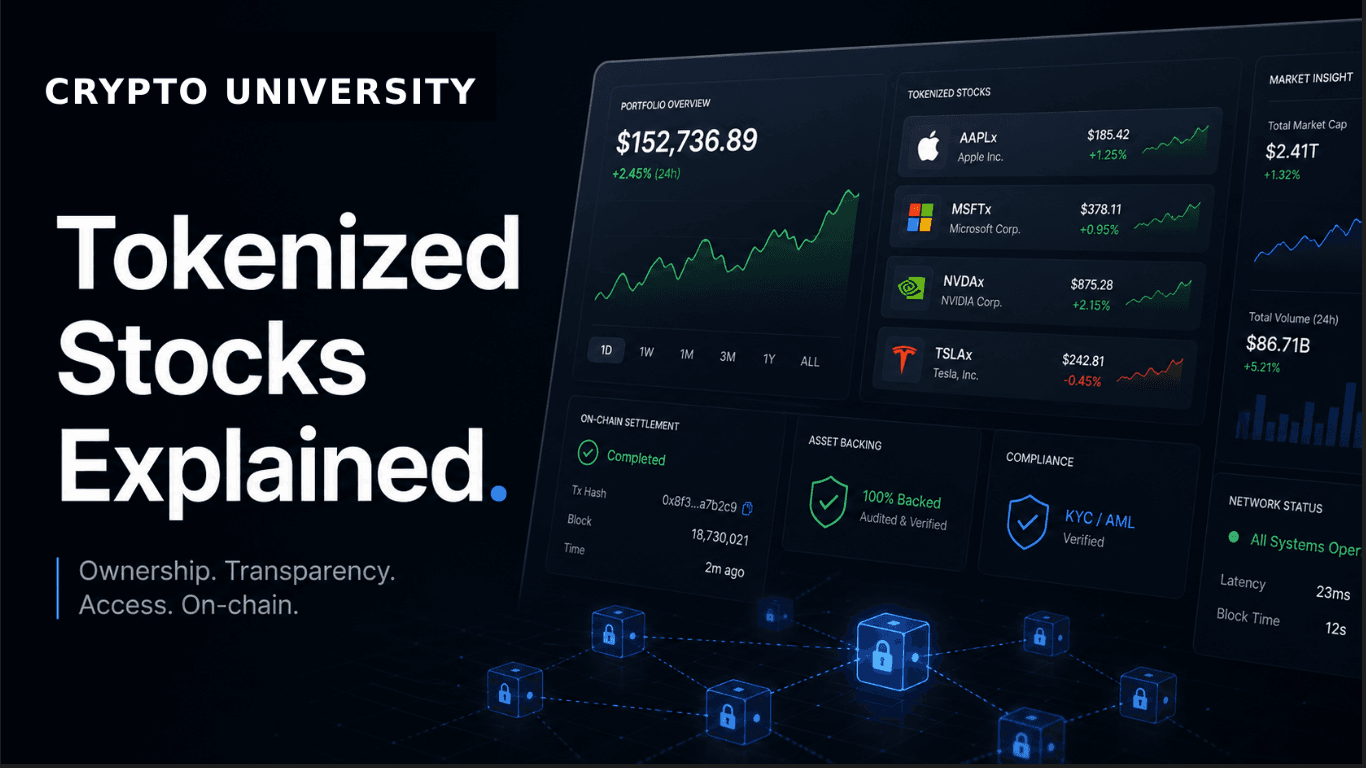
A tokenized stock is a crypto token that is designed to follow the price of a real company share. Instead of buying the share through a traditional broker, you buy a token on a crypto exchange or an onchain app, and that token is meant to move in line with the underlying stock.
The appeal for beginners is simple. You can often trade in small amounts, settle quickly, use stablecoins instead of a bank transfer, and in many cases trade outside normal stock market hours. The catch is that most of these tokens do not give you the same legal rights as a real shareholder, so it is worth understanding exactly what you are holding.
Feature | Typical tokenized stock | Real share |
Price exposure | Yes, tracks the stock price | Yes |
Legal ownership of the company | Usually no, you hold a token or a debt style note | Yes |
Voting rights | No | Yes |
Dividends | Often passed on, sometimes by increasing your token balance | Yes, paid as cash |
Trading hours | Often close to 24 hours, seven days a week | Limited to market hours |
How you fund it | Crypto or stablecoins such as USDT and USDC | Bank transfer through a broker |
How Tokenized Stocks Are Backed
This is the question that matters most, because backing is what gives the token its value. Reputable products are collateralized, which means for every token in circulation there is a matching real share held somewhere safe. The most common model right now comes from a company called xStocks.
With xStocks, each token is a bearer instrument known as a tracker certificate, issued by a regulated entity based in Jersey and distributed in Europe under an approved base prospectus. The tokens are backed one to one by the real shares, dividends are handled by adjusting your token balance rather than paying cash, and there are no voting rights attached. Because the real shares sit with a custodian, the strength of the product depends on trusting that issuer and that custodian.
Who Issues Tokenized Stocks?
Tokenized stocks are not all made the same way. A handful of issuers dominate the market, and each one has a different structure and a different audience. Knowing who stands behind a token helps you judge how safe it is.
Issuer | Structure | Who it is for |
xStocks | Tracker certificates backed one to one by real shares, issued by a regulated Jersey entity | Non United States traders, widely listed on crypto exchanges |
Robinhood | Runs two systems, older derivative style tokens for Europe and newer debt style tokens on its own blockchain for 120 plus countries | Retail users inside the Robinhood app |
Ondo Global Markets | Notes secured by underlying securities held at United States registered broker dealers, built as total return trackers | Non United States investors, grew past one billion dollars in value by May 2026 |
Dinari | First to gain United States broker dealer registration for blockchain based shares, powers other platforms behind the scenes | Compliance focused platforms and partners |
Where Can You Buy Tokenized Stocks?
You can buy tokenized stocks on major crypto exchanges and on some dedicated apps. In mid 2026, OKX launched a unified tokenized stocks product with more than 40 assets sharing a single order book, which makes buying and selling smoother. Several other large exchanges also list xStocks tokens.
Platform | What it offers |
Unified tokenized stocks with 40 plus assets and one shared order book, available across parts of Asia, the Middle East and Turkey | |
Kraken | Lists xStocks across a growing range of companies |
Bybit, Gate, Bitget | Also list xStocks tokens for eligible regions |
Robinhood | Its own stock tokens inside the app for eligible countries |
Onchain apps and DEXs | Let you hold tokens in your own wallet and trade directly onchain |
Which Companies Are Available as Tokens?
Most of the well known names are already available as tokens, along with a couple of index style products that track whole markets. Here are popular examples you will run into first.
Company or index | Ticker |
Tesla | TSLA |
Nvidia | NVDA |
Apple | AAPL |
Amazon | AMZN |
Microsoft | MSFT |
Meta | META |
Coinbase | COIN |
Strategy | MSTR |
Robinhood | HOOD |
Netflix | NFLX |
Palantir | PLTR |
S&P 500 | Index token |
Nasdaq 100 | Index token |
Gold ETF | Commodity token |
Are Tokenized Stocks Legal Where You Live?
This is where beginners get caught out. The rules change from country to country, and the biggest markets are actually the most restricted. In the United States, regulators confirmed in early 2026 that tokenized securities are still treated as securities, and there is no everyday retail access to offshore tokens yet, although new frameworks are being worked on.
Region | Access |
United States, Canada, United Kingdom, Australia | Restricted for the main xStocks products |
European Union and wider Europe | Available through several regulated routes, including Robinhood |
Parts of Asia, the Middle East, Turkey and the CIS region | Available through OKX and other exchanges |
Many countries in Africa and beyond | Available through Robinhood global tokens across 120 plus countries |
Rules move fast. Regulation in this space changes month to month. Always confirm what is allowed in your own country and on your chosen platform before you trade, rather than relying on a snapshot.
How to Buy Tokenized Stocks, Step by Step
If tokenized stocks are available where you live, the process is close to buying crypto. Here is a simple path a beginner can follow.
Choose a platform that operates legally in your country and lists the token you want.
Create an account and complete identity verification, since regulated platforms will ask for it.
Fund your account, usually with a stablecoin such as USDT or USDC, or with crypto you already hold.
Find the tokenized stock by its ticker, for example TSLA or AAPL, and check the current price and backing.
Place your order for the amount you are comfortable with, then confirm the trade.
Decide whether to keep the token on the exchange or move it to your own wallet for self custody.
What Are the Risks?
Tokenized stocks carry all the normal ups and downs of the stock market, plus a few extra risks that come from the crypto wrapper. None of these should scare you off completely, but you should understand them before you commit real money.
Risk | What it means for you |
Issuer risk | You are trusting the company that issues the token to hold the real shares and honour the product |
Custody risk | The real shares sit with a custodian, so problems there can affect the token |
Liquidity risk | Some tokens trade thinly, which can make it hard to buy or sell at a fair price |
Tracking error and depeg | The token can drift above or below the real share price, trading at a premium or a discount |
No shareholder rights | You generally get no votes and no direct say in the company |
Regulatory risk | Access can be restricted or changed if the rules in your country shift |
Frequently Asked Questions
Do I actually own the company when I buy a tokenized stock?
Usually not in the traditional sense. Most tokenized stocks give you exposure to the price through a token or a debt style note rather than a registered share, so you do not get voting rights or a direct ownership claim.
Do tokenized stocks pay dividends?
Many do pass dividends on to you. With xStocks, for example, dividends are handled by increasing your token balance rather than sending you a cash payment, so the value shows up in the amount you hold.
Can I trade tokenized stocks at night or on weekends?
Often yes. One of the big selling points is that many tokenized stocks trade close to 24 hours a day, seven days a week, unlike traditional stock markets that close in the evening and on weekends.
Can I buy tokenized stocks in the United States or the United Kingdom?
As of mid 2026, the main products are restricted for people in the United States, Canada, the United Kingdom and Australia. New frameworks are being developed, so it is worth checking the current position for your country before assuming you have access.
Can I turn a tokenized stock back into a real share or cash?
It depends on the issuer and platform. Some structures allow redemption for the underlying share or its cash value under certain conditions, while others are designed only for trading. Check the specific product terms before you rely on this.
What happens if the token price drifts away from the real stock price?
This is called tracking error, or a depeg when the gap is large. The token can trade at a premium or a discount to the real share, especially when liquidity is thin, which is why checking backing and volume before you buy matters.
Disclaimer: This content is for educational and informational purposes only and is not financial advice. Nothing here is a recommendation to buy or sell any asset or use any platform. Do your own research and manage your risk.
How to Cash Out Crypto in Dubai in 2026
Best Robinhood Chain Trading Platforms in 2026: FOMO, GMGN, Uniswap and OpenSea Compared
RugCheck vs GoPlus: Which Token Security Tool Is Better?
RugCheck Score Explained in two minutes
Best Crypto Trading Competitions in 2026: OKX vs Bybit
How RugCheck Works: A Beginner's Guide to Checking Solana Tokens
Need deeper training?
Join our structured modules with live examples and expert checklists for effective implementation.
JOIN THE ACADEMY