
Key Takeaways
No. | What you need to remember |
|---|---|
1 | There is no single best token safety checker. You need a small stack of tools, because each one only sees part of the picture. |
2 | Five checks cover almost everything that matters: the contract, the holders, the liquidity, the transaction preview, and your wallet approvals. |
3 | A green tick is never a promise. Most people lose money to rushed decisions and unlimited approvals, not to clever code. |
Why One Website Is Never Enough
If you have ever pasted a token address into a scanner, seen a green result, and bought straight away, this guide is for you. That green result feels reassuring, but it only answers one narrow question.
Scams break in very different ways, and each type of failure shows up in a different place. The table below shows what tends to go wrong and where you would actually spot it.
How a token can hurt you | Where you would spot it |
|---|---|
Malicious contract code | Contract scanner |
Mint and freeze controls still switched on | Contract scanner or block explorer |
Hidden insider supply | Holder analysis tool |
Liquidity that can be pulled at any moment | Market and liquidity tool |
Honeypot rules that block selling | Sell simulator |
Dangerous wallet approvals | Approval manager |
Fake websites and copied domains | Community reports and phishing tools |
Hacked social accounts posting fake addresses | Official sources and community reports |
Manipulated trading volume | Market data platform |
No single scanner watches all nine of those. That is the whole reason you build a stack.
The 15 Best Token Safety Checkers in 2026
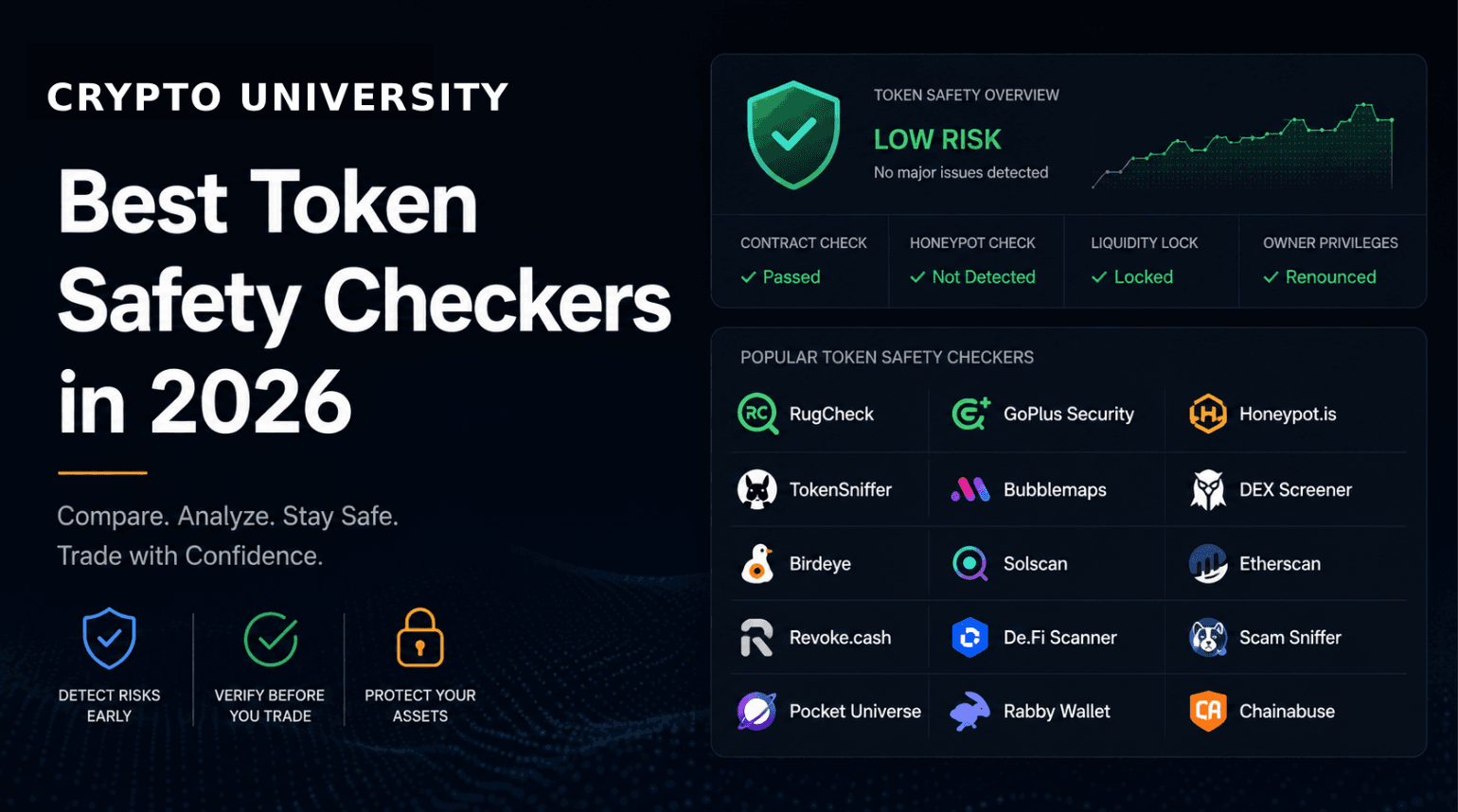
Here is the full list, with the job each tool does best. You do not need all of them. Pick a few that match how you trade.
No. | Tool | Best for |
|---|---|---|
1 | Solana token structure and launch risk, including authorities, holders, liquidity, insiders, and bundled launches | |
2 | Broad coverage across many blockchains for tokens, addresses, approvals, NFTs, dApps, and signatures | |
3 | Testing whether an EVM token can actually be sold, and measuring buy and sell taxes | |
4 | Fast EVM contract checks and comparison against known scam patterns | |
5 | Seeing connected wallets and supply that is quietly concentrated | |
6 | Pair age, liquidity, volume, price impact, and general market structure | |
7 | Solana trading data, wallet activity, token history, and liquidity | |
8 | Raw verification of anything on Solana | |
9 | Verified code, holder lists, deployer history, proxy contracts, and transactions | |
10 | Finding and cancelling risky token approvals | |
11 | Wider smart contract and wallet security checks | |
12 | Phishing sites, malicious signatures, and wallet drainer intelligence | |
13 | Simulating a transaction and warning you before you sign | |
14 | Plain English transaction previews, approval warnings, and network handling | |
15 | Checking community reports linked to addresses, domains, and known scams |
The Five Minute Safety Workflow
This is the routine to run before you buy anything new. It takes a few minutes once you are used to it, and it filters out most of the obvious traps.
Step | What to do | Why it matters |
|---|---|---|
1 | Verify the contract address from an official source | Never search by ticker alone. Copycat tokens use the same name on purpose. |
2 | Scan the contract | Use RugCheck on Solana. Use GoPlus, TokenSniffer, and Honeypot.is on EVM networks. |
3 | Inspect the holders | Bubblemaps and the native explorer show whether a handful of wallets control the supply. |
4 | Inspect the liquidity | Check pool age, depth, whether it is locked, who owns it, and your realistic exit slippage. |
5 | Trace the deployer | Look for previous failed tokens, mixer funding, linked wallets, and fast transfers out. |
6 | Simulate the transaction | A wallet preview or simulator shows what you are really signing before you sign it. |
7 | Use a burner wallet | Never connect your main holdings to a dApp you have not used before. |
8 | Revoke approvals afterwards | Tidy up so an old permission cannot be used against you months later. |
What the Word "Safe" Should Really Mean
Safe is far too absolute a word for crypto. A more honest way to read any scan result is this: no critical issue was detected in the checks that were performed.
A tool you can trust will always be clear about the following five things.
A responsible tool tells you | What that gives you |
|---|---|
What it checked | You know the scope of the result |
When it checked | You know whether the data is stale |
What it could not verify | You know where the gaps are |
Which risks remain | You can decide with open eyes |
What you should inspect next | You know your next move |
The Biggest Blind Spot
Here is the uncomfortable truth. Most losses have nothing to do with exotic code. They come from very human mistakes, and no scanner can catch those for you.
Common cause of loss | Simple habit that protects you |
|---|---|
Greed and fear of missing out | Decide your size before you look at the chart |
Fake urgency and countdown timers | Assume urgency is a sales tactic |
Copied websites | Bookmark official links and use only those |
Wrong contract address | Copy the address from an official source every time |
Unlimited approvals | Approve only what you need, then revoke |
Seed phrase theft | Never type your seed phrase anywhere online |
Insider dumping | Check holder concentration before buying |
Thin liquidity | Test your exit slippage before your entry |
Leverage | Keep it away from new and untested tokens |
Tools reduce risk. They do not replace discipline.
The Best Stack for Your Style
Pick the row that sounds most like you.
If you are a | Use this stack |
|---|---|
Meme coin trader | RugCheck, GMGN, Bubblemaps, DEX Screener, and the native explorer |
DeFi user | GoPlus, De.Fi, Revoke.cash, Pocket Universe, and the native explorer |
Developer | GoPlus API, RugCheck API, direct RPC access, transaction simulation, and your own allow and block lists |
Beginner | Rabby, plus RugCheck or GoPlus, plus Bubblemaps, plus one tiny test transaction |
Final Verdict
Whatever you trade, build your stack from these five roles. Miss one and you leave a real gap open.
Role in your stack | Question it answers |
|---|---|
Contract scanner | Is the code itself dangerous? |
Holder analysis tool | Who actually owns the supply? |
Market and liquidity tool | Can I get out at a fair price? |
Transaction simulator | What am I really signing? |
Approval manager | What can still touch my wallet? |
A token passing one scanner is not due diligence. It is step one.
Frequently Asked Questions
Is one token safety checker enough?
No. Each tool looks at a different layer, so a clean result from a single scanner only tells you that one narrow set of checks passed. Use at least a contract scanner, a holder tool, a liquidity tool, a simulator, and an approval manager.
What is a honeypot token?
It is a token you can buy but cannot sell, usually because the contract blocks selling or applies an impossible tax. Honeypot.is exists specifically to test for this on EVM networks.
Why does holder concentration matter so much?
If a few connected wallets hold most of the supply, they can sell into your buy and collapse the price. Bubblemaps makes those links visible even when the wallets are made to look unrelated.
What is a burner wallet and do I really need one?
A burner is a separate wallet holding only what you are willing to risk. You use it to interact with new or unknown dApps so your main holdings are never exposed. For beginners it is one of the highest value habits you can build.
Why should I revoke token approvals?
An approval lets a contract move your tokens, and many stay active forever unless you cancel them. If that contract is later exploited, your funds can be drained long after you stopped using it. Revoke.cash makes cleaning up quick.
Do these tools guarantee a token is safe?
They do not. Scammers study scanner rules and design around them. Treat every clean result as no critical issue detected in the checks performed, then apply your own judgement.
Research Notes and Sources
Products reviewed for this guide: RugCheck, GoPlus, TokenSniffer, Honeypot.is, Bubblemaps, DEX Screener, Birdeye, Solscan, De.Fi, Scam Sniffer, Pocket Universe, Revoke.cash and Chainabuse.
Reference links used during research:
https://rugcheck.xyz/
https://docs.gopluslabs.io/
https://tokensniffer.com/
https://arxiv.org/abs/2603.24625
https://arxiv.org/abs/2506.18398
Disclaimer: This content is for educational and informational purposes only and is not financial advice. Nothing here is a recommendation to buy or sell any asset or use any platform. Do your own research and manage your risk.
Rugcheck Explained: How to Spot Scam Tokens on Solana in 2 Minutes
Token Safety Checkers Explained: How to Use Free Tools Like GoPlus Before You Buy
How to Cash Out Crypto in Dubai in 2026
Best Robinhood Chain Trading Platforms in 2026: FOMO, GMGN, Uniswap and OpenSea Compared
Best RugCheck Alternatives Every Beginner Trader Needs
Revoke.cash: How to Check and Revoke Token Approvals to Protect Your Wallet
Chainlist: How to Find Chain IDs and Add EVM Networks to Your Wallet
Cryptocurrency Payment Gateways for Beginners: BTCPay Server Explained
Need deeper training?
Join our structured modules with live examples and expert checklists for effective implementation.
JOIN THE ACADEMY