
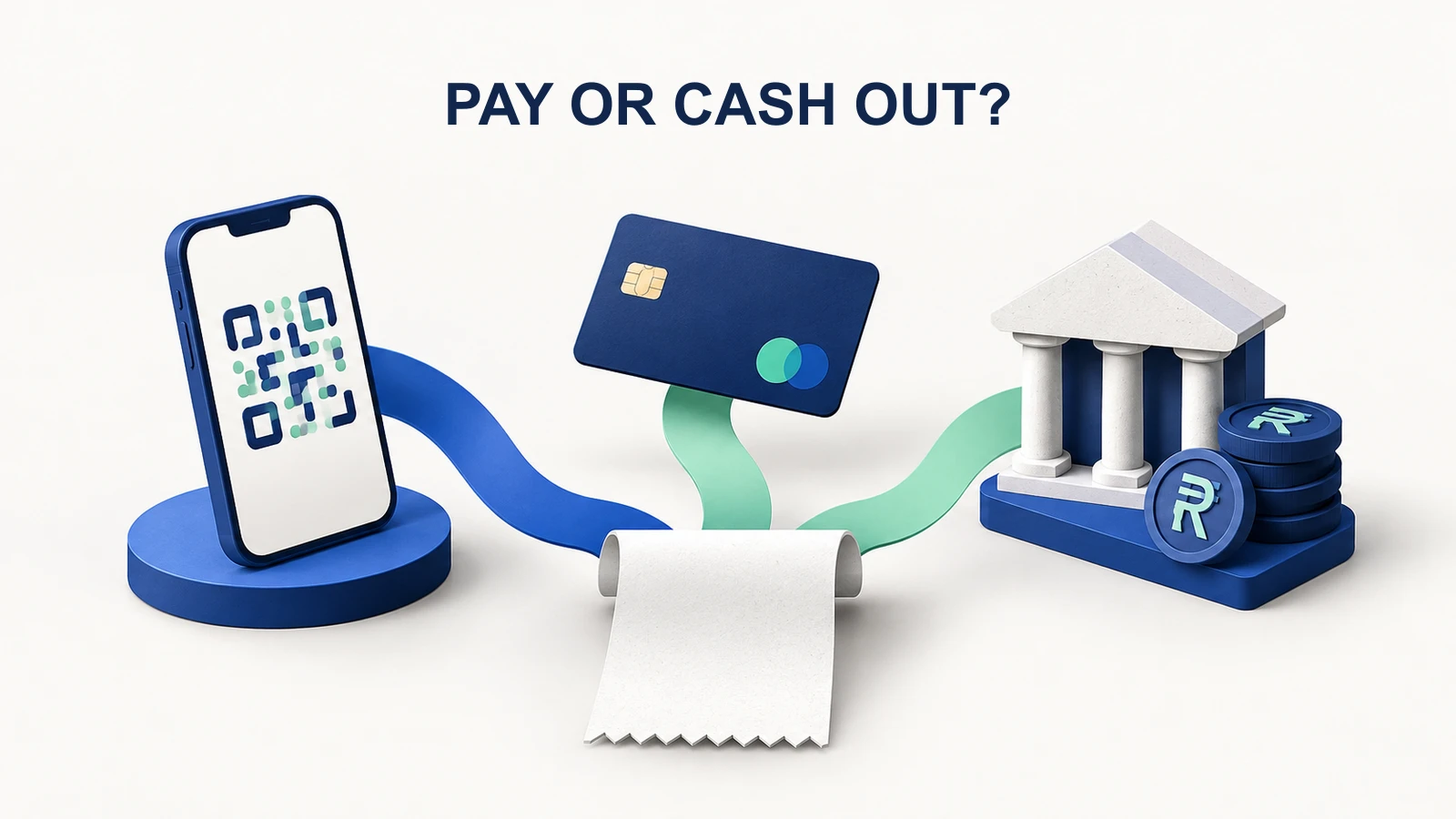
Compare the value you give up to settle the same rand bill. A crypto QR payment, crypto card and exchange cash-out can distribute costs differently, so the route with the lowest advertised fee may not use the least of your balance.
You also need a route that is available to your South African account and completes before the bill is due. A hypothetical card calculation is not evidence that a particular crypto card can be issued to you.
Fix the comparison boundary
Start with crypto you already own, held in a named wallet or exchange. End with the merchant receiving R1,000. Include every required movement between those points: funding, conversion, trading, withdrawal and payment. If a charge is already included in a quote, count it once.
Do not include cashback unless the offer, country, account and purchase category are verified. Do not treat the original purchase price of your crypto as today's payment cost; acquisition history is needed separately for gain or loss analysis.
The spending hub describes practical payment options. The cash-out hub covers the bank route. This worksheet compares their costs without claiming a universal winner.
A reproducible R1,000 basket
All inputs below are assumptions, created on 19 September 2026. They are not current offers, exchange quotes or observed transactions. Assume a comparison value of R18 per token and ignore price movement during the calculation.
| Route | Assumed cost rule | Value needed to settle R1,000 |
|---|---|---|
| QR quote | Total token debit has a benchmark value of R1,010 | R1,010.00 |
| Crypto card | 1.5% charge added to the purchase; no other charge | R1,015.00 |
| Sell then bank | 0.35% deducted from gross sale, followed by R20 withdrawal | R1,023.58 gross sale |
The cash-out calculation is (R1,000 + R20) ÷ (1 - 0.0035) = R1,023.5825…. It is not R1,000 plus 0.35% plus R20, because the percentage is deducted from the gross amount you sell. Round according to the provider's actual rules.
At the assumed R18 reference, those values correspond to approximately 56.1111, 56.3889 and 56.8657 tokens respectively. A route that has no withdrawal fee changes the third calculation to R1,000 ÷ 0.9965 = R1,003.51. Removing one fixed charge reverses the ranking against the modelled QR route.
Now replace the assumptions
For QR, record the exact debit quantity, asset, rand bill and expiry time. For a card, verify issuance eligibility, conversion methodology, any foreign-exchange fee, merchant restrictions and whether charges are added or deducted. A social post showing the card in another country is insufficient.
For cash-out, use the actual sale product and fee tier, then the bank withdrawal method. VALR and Luno distinguish their simplified conversion products from order-book trading. Their withdrawal schedules also distinguish ordinary and faster bank processing. Choose the row matching the transaction, rather than the lowest number on the fee page.
For a larger bill, inspect liquidity at that size. Multiplying a tiny quote by ten assumes the same execution price and fee treatment. That assumption can fail even when the headline market price is unchanged.
Add time and failure handling
Write down when the merchant must be paid and when bank funds are expected. A low-cost withdrawal arriving after a bill's deadline is not equivalent to a payment completed at checkout. Provider timing estimates can be affected by bank processing and account checks.
For a pending QR debit, confirm the first attempt's status before trying another route. Otherwise the cost comparison can become a duplicate-payment problem. Keep a bank payment option available without assuming a refund will be immediate.
Keep a second ledger for tax
Record the asset disposed of, quantity, rand value, date, fees and acquisition evidence. The shopping receipt alone may not establish the cost of the crypto you spent. A later merchant refund also needs its own entry.
This worksheet does not calculate tax or recommend disposing of any particular holding. SARS distinguishes capital and revenue treatment according to the facts; the payment-cost ranking alone cannot determine your tax result. The SARS guide provides broader context. For your next payment, gather fresh quotes and compare total value, delivery time and suitability together.
Sources and verification
Primary sources checked on 20 September 2026. Prices, availability and processing arrangements can change.