For years, cryptocurrency traders relied almost exclusively on Technical Analysis (TA): drawing trendlines, spotting chart patterns, and waiting for RSI crossovers. While TA remains a useful tool for timing entries, the most consistent, asymmetric returns in the 2026 crypto market are generated by a different discipline: Advanced On-Chain Analytics.
Unlike traditional equities, where corporate fundamentals are hidden in quarterly PDF reports, every cryptocurrency transaction, wallet balance, and smart contract interaction is permanently recorded on a public ledger. By 2026, sophisticated retail investors, family offices, and quantitative desks have shifted their focus from "reading the charts" to "reading the chain." They are identifying accumulation phases, tracking the precise movements of "Smart Money," and front-running retail FOMO by analyzing raw blockchain data.
This comprehensive guide breaks down the core pillars of modern on-chain analysis, the top-tier tools required to extract actionable alpha in 2026, and the strict operational frameworks needed to translate data into profitable, tax-compliant trades.
The 3 Pillars of On-Chain Alpha Generation in 2026
To generate consistent alpha from blockchain data, you must move beyond basic metrics like "total transaction count" and focus on high-signal, low-noise indicators.
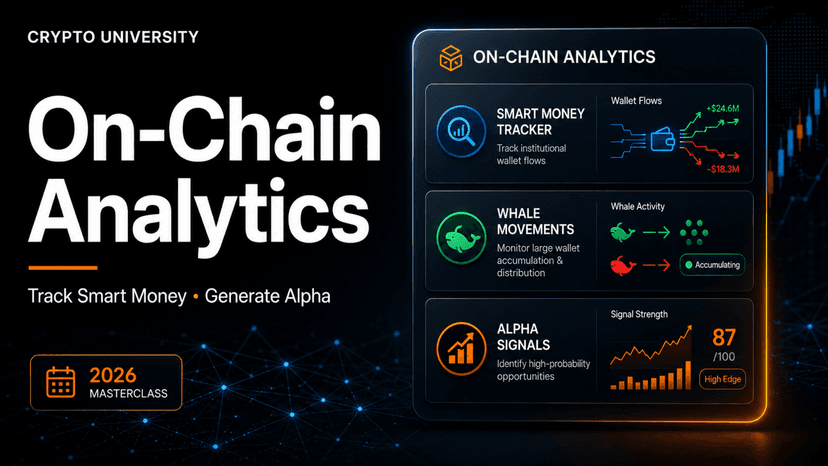
Smart Money and Whale Wallet Tracking: Not all large wallets are created equal. A wallet holding $100 million might belong to a passive, long-term institution, while a wallet with $500,000 might belong to a highly active, consistently profitable insider or quantitative fund. Advanced analytics in 2026 focus on Win Rate, Profitability, and Early Entry Timing to identify true "Smart Money," filtering out market makers, exchange cold wallets, and dumb luck.
Exchange Net Position and Flow Dynamics: The movement of assets between self-custody wallets and centralized exchanges is a powerful leading indicator. Sustained, large-scale outflows from exchanges to cold storage indicate long-term accumulation and supply shock. Conversely, massive, coordinated inflows to exchanges often precede major distribution events or impending sell pressure.
Protocol Health and Developer Activity: Price can be manipulated; code and usage cannot. Evaluating a project’s fundamental health requires tracking active developer commits (GitHub activity), the growth of unique active addresses (filtering out bot-driven volume), and the quality of Total Value Locked (TVL)—specifically, the ratio of organic, long-term staked TVL versus mercenary, yield-farming TVL.
Top Platforms and Tools for On-Chain Analytics in 2026
Extracting alpha from the blockchain requires a stack that combines deep data aggregation, advanced charting, and secure execution.
1. TradingView: Best for Integrating On-Chain Metrics with Technical Confluence
While specialized on-chain platforms exist, TradingView remains the ultimate command center for synthesizing blockchain data with traditional price action.
Core Features: TradingView’s extensive library of custom Pine Script indicators allows users to overlay critical on-chain metrics directly onto price charts. You can chart Exchange Reserve balances, MVRV (Market Value to Realized Value) Z-Scores, Net Unrealized Profit/Loss (NUPL), and even custom smart money wallet accumulation bands alongside the BTC/USD or ETH/USD price.
Confluence Trading: By visualizing on-chain accumulation zones (e.g., when long-term holder supply hits a multi-year high) alongside technical support levels, traders can identify high-probability, low-risk entry points with mathematical precision.
Why Analysts Choose It: It eliminates the need to toggle between a dozen different dashboards. You can build a unified, multi-pane workspace that monitors macro on-chain health and micro price action simultaneously.
👉 Integrate Advanced On-Chain Metrics into Your Charts with TradingView
2. Bybit: Best for Executing Alpha with Deep Liquidity and Low Latency
Identifying a smart money accumulation pattern is useless if you cannot execute the trade efficiently. When retail FOMO hits based on the same on-chain signals you identified, slippage can destroy your profit margin.
Core Features: Bybit provides the deep order book liquidity and sub-millisecond execution speeds required to capitalize on on-chain alpha. Whether you are accumulating a newly identified altcoin or setting up a delta-neutral hedge based on exchange outflow data, Bybit’s infrastructure ensures your orders fill at your intended price.
Unified Risk Management: If your on-chain analysis indicates a sudden shift in market structure, Bybit’s Unified Trading Account allows you to instantly deploy hedging instruments (like short perps) using your existing spot holdings as collateral, protecting your portfolio without moving funds.
Why Traders Choose It: It bridges the gap between data analysis and market execution, providing the liquidity depth necessary to scale into and out of positions based on on-chain signals without moving the market against yourself.
👉 Execute On-Chain Alpha Strategies with Deep Liquidity on Bybit (Use referral code: 46164)
3. Ledger: Best for Securing Your "Alpha" and Smart Money Wallets
When you track a highly profitable smart money wallet, the natural next step is to interact with the same protocols, new token launches, or DeFi pools they are using. These early-stage interactions are the highest-risk moments in crypto, rife with honeypots, malicious approvals, and drainers.
Core Features: Ledger hardware wallets ensure that every interaction with a new, unproven smart contract requires physical, cryptographic approval on the device’s secure screen.
Clear Signing for New Protocols: Ledger’s ecosystem parses complex, unfamiliar contract interactions, displaying human-readable details (e.g., "Approve unlimited USDC spend to Contract 0x...") to prevent you from blindly signing a malicious payload disguised as a routine swap or claim.
Why Analysts Choose It: It provides the ultimate physical circuit breaker. You can aggressively pursue early-stage on-chain alpha with the confidence that your core capital is protected from the inevitable smart contract exploits and phishing attempts that target active DeFi users.
👉 Secure Your On-Chain Alpha Operations with a Ledger Hardware Wallet
Step-by-Step: How to Build a Smart Money Tracking Workflow
Generating alpha from on-chain data requires a systematic, repeatable process. Follow this exact blueprint:
Step 1: Identify and Filter Smart Money
Do not just sort wallets by largest balance. Use on-chain analytics tools to filter for wallets that:
Consistently buy tokens before major price pumps (early accumulation).
Have a high win rate (>60%) across multiple market cycles.
Interact directly with new, unaudited smart contracts (indicating insider knowledge or advanced bot usage).
Crucial: Filter out known market maker wallets (e.g., Wintermute, Jump Crypto) and exchange hot wallets, as their movements are for liquidity provisioning, not directional speculation.
Step 2: Set Up Real-Time Alerts
Once you have a curated list of 10 to 20 high-conviction smart money wallets, set up real-time alerts (via Telegram bots, Discord webhooks, or specialized tracking platforms). You want to be notified the second one of these wallets executes a swap, provides liquidity, or interacts with a new protocol.
Step 3: Verify the Thesis Before Copying
When an alert triggers, do not blindly copy the trade. Perform a rapid 60-second verification:
Is the token a honeypot or a known scam?
Is the smart money wallet buying a massive, illiquid position that I cannot exit?
Does this align with broader on-chain macro trends (e.g., is overall exchange supply decreasing)?
Step 4: Execute and Secure
If the thesis holds, execute the trade on a liquid platform like Bybit or via a decentralized exchange, ensuring your wallet is secured by a Ledger device. Set a strict stop-loss. Smart money can afford to hold through drawdowns; retail traders often cannot.
Step 5: Track the Tax Implications
High-frequency on-chain alpha generation (e.g., copying multiple smart money trades per week) creates a massive volume of taxable events.
👉 Automate Your High-Frequency On-Chain Tax Tracking with Koinly
Risk Management: The Hidden Dangers of On-Chain Analytics
Following the blockchain ledger is powerful, but it is not a crystal ball. You must actively manage these specific pitfalls:
Survivorship Bias and Fake "Smart Money": Many wallets that appear to have a 100% win rate are actually part of a "wash trading" ring, or they simply got lucky on one meme coin and have been losing steadily since. Mitigation: Require a minimum sample size (e.g., 50+ trades) and verify profitability across different market conditions (bull and bear markets) before trusting a wallet.
The "Exit Liquidity" Trap: Sometimes, a known smart money wallet will intentionally buy a small amount of an illiquid token to trigger tracking bots, creating artificial buying pressure. Once retail traders follow the "smart money" alert and drive the price up, the wallet dumps its entire position, using the followers as exit liquidity. Mitigation: Never chase a trade if the token has already pumped 50%+ since the smart money entry.
Insider Trading and Regulatory Scrutiny: Some "smart money" wallets are actually insiders trading on material non-public information. While you cannot be penalized for publicly copying a wallet address, associating your primary identity with wallets that engage in illicit activity could theoretically attract regulatory scrutiny. Mitigation: Use dedicated, pseudonymous "burner" wallets (secured by Ledger) for interacting with the same protocols as anonymous smart money, keeping your main identity separate.
Frequently Asked Questions (FAQ)
Q: What is the best metric to identify a market bottom using on-chain data?
A: A confluence of metrics is best, but historically, the MVRV Z-Score dropping below 0 (indicating the market is trading below its "realized" cost basis) combined with a spike in Long-Term Holder (LTH) supply and massive Exchange Outflows has been the most reliable on-chain indicator of a macro market bottom.
Q: Can I automate the process of copying smart money wallets?
A: Yes, using advanced DeFi automation tools or custom bots. However, this is highly risky. Smart money wallets often execute complex, multi-step transactions (like flash loans or arbitrage) that a simple copy-bot will fail to replicate, resulting in failed transactions, wasted gas fees, or accidental exposure to malicious contracts. Manual verification is strongly recommended.
Q: How are profits from on-chain alpha generation taxed?
A: Every time you buy or sell a token based on an on-chain signal, it is a taxable event. If you are frequently rotating capital based on smart money alerts, you will generate hundreds of short-term capital gains and losses. In most jurisdictions, short-term gains are taxed at your highest marginal income rate. Using automated software like Koinly is mandatory to accurately calculate your net tax liability and avoid costly reporting errors.
Q: Is it legal to track and copy public wallet addresses?
A: Yes. Blockchain data is public by design. Analyzing public ledgers and making trading decisions based on that data is entirely legal in all major jurisdictions. However, using that data to engage in market manipulation or insider trading (if you have a personal relationship with the wallet owner) is illegal.
Risk Warning: Cryptocurrency trading and on-chain analysis carry a high level of risk. Smart money wallets can be misidentified, market conditions can change rapidly, and copying on-chain activity can result in becoming "exit liquidity" for sophisticated actors. You could sustain a loss of some or all of your initial investment.
Not Financial Advice: The information provided in this article is for educational and informational purposes only. It does not constitute financial, investment, legal, or tax advice. Always conduct your own research (DYOR) and consult with a qualified, licensed professional before making any financial decisions based on on-chain data.
Affiliate Disclaimer: This article contains affiliate links. If you click on these links and sign up for a service or make a purchase, we may earn a commission at no additional cost to you. We only recommend platforms, tools, and services that we have thoroughly vetted and believe provide genuine value, security, and utility to our readers.
Read More:
Mastering Crypto Structured Products: Dual Investment, Principal Protection, and Yield Optimization in 2026
On-chain Analytics for Beginners