
Key Takeaways
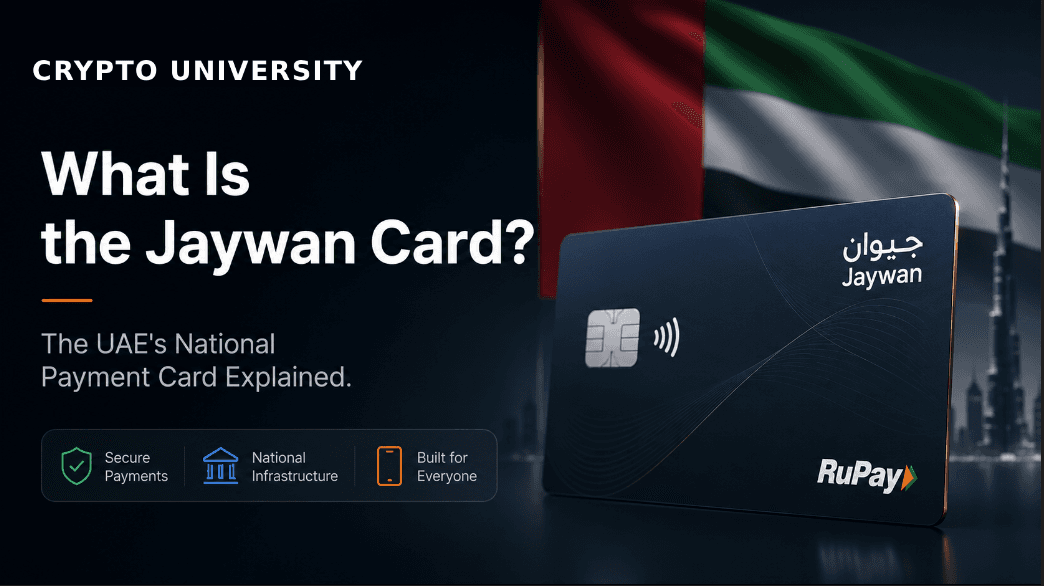
Jaywan is the UAE's first national (domestic) card scheme, owned and operated by Al Etihad Payments, a subsidiary of the Central Bank of the UAE. It is built to process everyday card payments inside the country instead of routing every transaction through an international network.
Cards come in two forms. Mono-badge cards (Jaywan only) work in the UAE and across the GCC. Co-badge cards pair Jaywan with a global network such as Visa, Mastercard, UnionPay or Discover, so they also work when you travel or shop abroad.
Jaywan is a payment card, not a cryptocurrency and not the Digital Dirham. It sits alongside the UAE's separate central bank digital currency project as part of a wider national effort to modernise and localise how money moves.
On 20 July 2026, the UAE formally launched Jaywan, its first national card payment scheme, and instructed banks to begin issuing the cards to customers. For most residents this arrived as a short news alert, but the change is bigger than a new card design. Jaywan is the UAE building its own payment rails, the invisible plumbing that moves money every time you tap a card. This guide explains what Jaywan is, how it works, its benefits and travel perks, which banks offer it, how to apply, whether you can use it abroad, and whether it is worth getting.
What is the Jaywan card?
Jaywan is a domestic card payment scheme. That means it is the network that authorises and routes a card payment between your bank and a shop, in the same way that Visa, Mastercard and India's RuPay do. It is owned and operated by Al Etihad Payments (AEP), a subsidiary of the Central Bank of the UAE (CBUAE). The project began in 2024 and moved to nationwide issuance in July 2026.
Two points often get confused. First, Jaywan is a scheme, not a single card. Your physical card is still issued by your bank; Jaywan is the network printed on it. Second, Jaywan is not a bank account or a currency. The money behind the card is the same dirhams sitting in your normal account.
The scheme was built with technical support from NPCI International Payments Limited (NIPL), the company behind India's RuPay network. The UAE has followed a model similar to India's: create a nationally governed alternative to international card networks rather than depending entirely on foreign systems.
Why the UAE built its own payment card
Until now, most card payments in the UAE were processed by international networks based outside the country. Every swipe carried fees that flowed abroad, and the transaction data travelled through overseas systems. Jaywan is designed to change that. The stated goals are:
Financial sovereignty: keeping domestic payment processing and data inside the UAE.
Lower payment costs: reducing the fees that merchants and banks pay to route local transactions.
Financial inclusion: making basic card products easier to offer to more residents, including through exchange houses and fintech apps.
Digital economy growth: supporting the UAE's wider goal of becoming a less cash-dependent society.
Domestic Jaywan transactions are processed through UAESWITCH, the country's national payment switch, rather than an overseas network.
The card types available
Jaywan currently comes in debit and prepaid forms, with credit cards planned. In a move described as a global first, Al Etihad Payments and Mastercard announced a co-badged Jaywan credit card, which is expected to widen the range further. For everyday use, the more important distinction is mono-badge versus co-badge.
Card type | What it is | Where it works |
|---|---|---|
Mono-badge | Carries the Jaywan logo alone | UAE and other GCC countries |
Co-badge | Pairs Jaywan with Visa, Mastercard, UnionPay or Discover | UAE domestically, plus international acceptance abroad through the partner |
Prepaid | Loaded with a set balance; useful for budgeting or salary disbursement | Depends on badging (mono or co-badge) |
Debit | Linked directly to your bank account | Depends on badging (mono or co-badge) |
Credit (planned) | Announced with Mastercard as a co-badge product | Expected to support domestic and international use |
Standard cards focus on everyday spending, while richer travel and lifestyle perks tend to sit on premium tiers, covered further below.
Key benefits of the Jaywan card
Jaywan is meant to work like any everyday bank card, with a few advantages that come from being built and run locally. The main benefits fall into five groups.
Benefit area | What you get |
|---|---|
Everyday payments | Contactless tap-to-pay, in-store purchases, online checkout and ATM cash withdrawals, used much like any debit or prepaid card |
Strong security | EMV chip technology, contactless PIN, and 3D Secure authentication for online payments |
Digital wallets | Support for Apple Pay, Google Pay and Samsung Pay, so you can pay by phone or smartwatch |
Rewards and offers | Discounts and promotions across more than 150 merchants in travel, dining, retail, entertainment and wellness |
Local processing | Domestic transactions cleared inside the UAE through UAESWITCH, which supports lower costs and keeps payment data in the country |
Which banks are issuing Jaywan cards?
The Central Bank has said eleven financial institutions were ready to issue Jaywan cards at launch, with more joining in phases. First Abu Dhabi Bank launched a Jaywan debit card and Commercial Bank of Dubai introduced prepaid cards among the early movers.
Early Jaywan issuers (as of July 2026) | Type |
|---|---|
Bank | |
Bank | |
Bank | |
Emirates Islamic | Bank |
Commercial Bank of Dubai (CBD) | Bank |
Sharjah Islamic Bank (SIB) | Bank |
Bank of Baroda | Bank |
Citi | Bank |
MBank | Bank |
Botim | Fintech / digital |
Al Ansari Exchange | Exchange house |
Availability depends on whether your specific bank has started issuing the product. The rollout is phased, and the CBUAE has signalled that UAE banks will be required to issue Jaywan debit cards over the coming years, with wider adoption expected by around 2027. If your bank is on the list, the practical step is simply to ask whether the Jaywan version of your card is available yet.
How to apply for a Jaywan card
Getting a Jaywan card works like getting any other bank card in the UAE. There is no separate Jaywan application portal; you apply through a participating bank or exchange house. The typical steps are:
Check that your bank issues Jaywan. Use the issuer list above, or ask your bank directly whether the Jaywan version of your debit or prepaid card is available yet.
Choose the right card type. Decide between a mono-badge card (UAE and GCC) and a co-badge card (works abroad), and pick debit or prepaid based on how you want to spend.
Confirm the tier and perks. If you want travel and lifestyle benefits, ask whether a premium Jaywan tier is offered and what it costs.
Apply through your bank. Use your bank's app, website or branch. Existing customers may be able to request a Jaywan card or receive one when their current card is renewed.
Provide standard documents. Expect the usual requirements, such as Emirates ID and proof of residency, in line with your bank's process.
Activate and add to your wallet. Once issued, activate the card and, if you prefer phone payments, add it to Apple Pay, Google Pay or Samsung Pay.
Because the rollout is phased, availability depends on your bank. If your card is not offered yet, it is likely to appear over the coming months as more institutions join the scheme.
Can you use Jaywan abroad? The question every resident asks
This is the single biggest concern for Dubai residents, many of whom travel often. The honest answer is: it depends on the card.
A mono-badge Jaywan card is intended mainly for the UAE and the GCC. It may not work in most other countries.
A co-badge Jaywan card is built for travel. Inside the UAE it runs on Jaywan through UAESWITCH; when you shop or travel abroad, the transaction switches to the partner network (Visa, Mastercard, UnionPay or Discover), which is accepted in roughly 200 countries.
Al Etihad Payments has signed co-badging agreements with Discover, Mastercard, UnionPay and Visa, plus a bilateral link with India's RuPay to serve one of the UAE's largest remittance corridors. Global acceptance is planned across more than 100 countries as the rollout continues. If you travel, confirm that the card your bank offers is the co-badge version before relying on it overseas.
Travel and lifestyle perks
The strongest perks sit on the premium Jaywan tiers, which banks position for frequent travellers and higher spenders. Exact benefits vary by bank and card level, but widely reported premium perks include the following.
Perk | What it offers |
|---|---|
Airport lounge access | Priority Pass membership for use of participating lounges worldwide |
Travel insurance | Cover tied to the card for eligible trips, with terms set by the issuer |
Purchase protection | Cover on eligible purchases against damage or theft within a set period |
Jaywan Entertainer | Buy-one-get-one and discount offers through the Entertainer platform |
Careem+ | Discounts and benefits on Careem rides and services |
Reel Cinemas | Offers on cinema tickets |
Airline benefits | Airline-related perks depending on the card and partner |
Standard cards focus on everyday payments, while these lifestyle perks are usually reserved for premium tiers. Always confirm the exact list, any annual fees and the eligibility rules with your bank, since perks differ from one issuer to another.
Jaywan, the Digital Dirham and crypto: how they differ
Because Jaywan launched around the same time as the UAE's Digital Dirham, the two are often mixed up. They are different things, and neither is a cryptocurrency. Here is a clean comparison.
Jaywan | Digital Dirham | Crypto (e.g. Bitcoin, stablecoins) | |
|---|---|---|---|
What it is | Card payment scheme | Central bank digital currency (CBDC) | Decentralised or privately issued digital asset |
Issued by | Bank cards under a CBUAE-owned scheme | Directly by the Central Bank of the UAE | No central issuer (Bitcoin) or private firms (stablecoins) |
The money | Ordinary dirham bank deposits | A digital form of the national currency | A separate asset, not central bank money |
Status (2026) | Live, nationwide issuance from July 2026 | Retail rollout reported during 2026 | Regulated separately under UAE virtual asset rules |
In short, Jaywan changes the rails your existing dirhams travel on. The Digital Dirham is a new digital form of the currency itself, issued by the central bank. Cryptocurrencies are a separate category of asset governed by their own rules. All three are part of a broader shift toward digital, and in the UAE's case increasingly sovereign, money, but they are not interchangeable.
What Jaywan means for your costs
Jaywan is designed to lower the overall cost of payments by keeping local processing inside the country. Network International, a major payment processor, has said merchants using its gateway will not pay an extra fee for Jaywan e-commerce transactions. Lower costs for banks and merchants can, over time, translate into cheaper or more competitive products for customers. This does not automatically mean your card will be free, however. Customer fees still depend on your bank and card tier, so read the specific terms before assuming you will save money.
Should you get a Jaywan card? A straight answer
There is no hype-free reason to rush. Jaywan is a solid, well-supported national card scheme, but for most people it is an additional option rather than an urgent upgrade.
Consider a co-badge Jaywan card if you want one card that works both locally and abroad, and your bank offers competitive terms and perks.
A mono-badge card can make sense for domestic spending, budgeting through prepaid, or salary disbursement.
If you travel widely and already hold a well-priced Visa or Mastercard, there may be little immediate benefit until fees and rewards clearly improve.
Over the next couple of years, as issuance becomes mandatory and acceptance widens, many residents will end up holding a Jaywan card by default when their bank reissues cards. There is no need to treat it as a major financial decision beyond comparing fees, acceptance and perks against what you already carry. Jaywan is simply a new way to pay.
Frequently Asked Questions
Is Jaywan a cryptocurrency?
No. Jaywan is a card payment scheme that moves ordinary dirhams. It is not a crypto token and not the Digital Dirham.
Can I use my Jaywan card outside the UAE?
Only if it is a co-badge card. Mono-badge Jaywan cards are meant for the UAE and GCC; co-badge cards work internationally through partners like Visa or Mastercard.
How do I apply for a Jaywan card?
Contact your bank and ask whether it issues Jaywan cards yet. Availability is being rolled out in phases.
Which banks offer Jaywan?
Early issuers include FAB, ADCB, Emirates NBD, Emirates Islamic, Commercial Bank of Dubai, Sharjah Islamic Bank, Bank of Baroda, Citi, MBank, Botim and Al Ansari Exchange, with more to follow.
Will Jaywan replace Visa and Mastercard in the UAE?
No. Jaywan works alongside international networks, often on the same co-badge card, rather than replacing them.
Does Jaywan cost money to use?
The scheme aims to lower payment costs, and some merchant fees have been waived, but customer fees depend on your bank and card tier.
Source:
https://aep.ae/en/services/about-jaywan/
https://www.bankfab.com/en-ae/personal/jaywan-debit-card
https://www.mastercard.com/news/eemea/en/newsroom/press-releases/en/2026/july/in-a-global-first-of-its-kind-issuance-al-etihad-payments-and-mastercard-announce-the-first-co-badged-credit-card-in-the-uae/
Disclaimer: This content is for educational and informational purposes only and is not financial advice. Nothing here is a recommendation to buy or sell any asset or use any platform. Do your own research and manage your risk.
Crypto University: How to Cash Out Crypto
Best Crypto Off-Ramps in the UAE: OKX, BitOasis and Fasset Compared