Key Takeaways
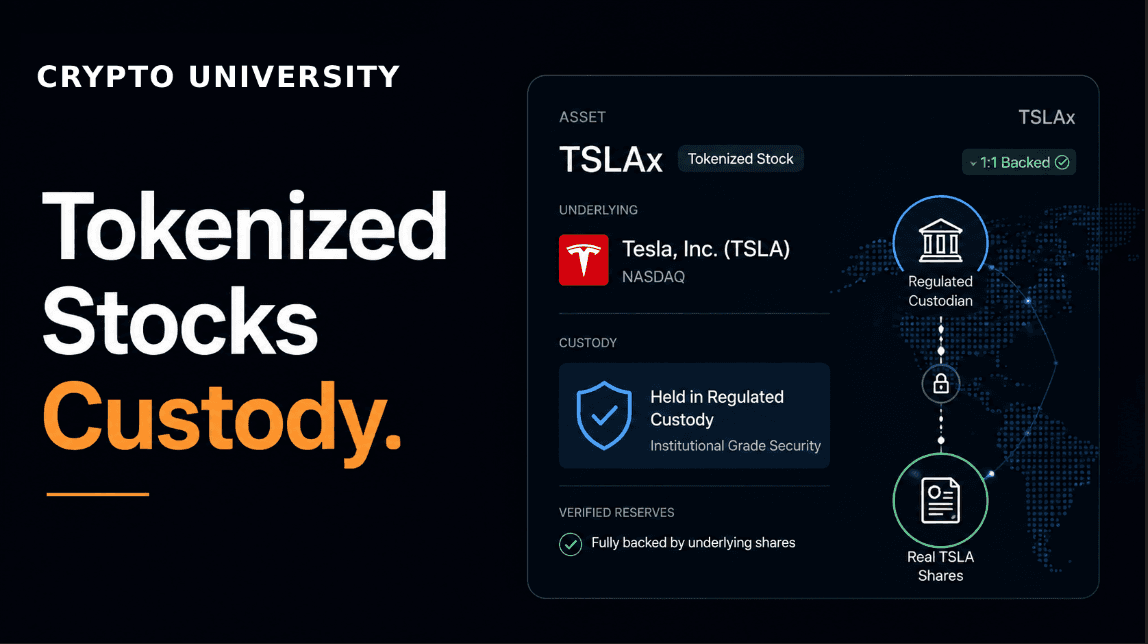
The real shares behind tokens like TSLAx are held by regulated custodians and broker-dealers in separate, ring-fenced accounts set up by the issuer, inside the same US settlement system your normal brokerage uses.
Your safety net comes from four things working together: separated accounts, a legal claim (security interest) held on your behalf, independent verification of the backing, and legal liability if the issuer lies.
You do not have to take anyone's word for it. In about ten minutes you can check the legal documents, the proof-of-reserve data, and the token's contract address to confirm the shares are really there.
When you hold TSLAx, a real Tesla share is sitting somewhere with your token's name on it, figuratively speaking. The good news is that "somewhere" has a very specific answer. Knowing that answer is the difference between trusting a nice-looking marketing page and actually understanding what you own.
This guide walks the custody chain one step at a time, in plain language: who holds the shares, what protects you, and how you can check any of it yourself without simply believing a website.
The Custody Chain, One Step at a Time
For a backed product like xStocks, the path from you to the real share looks like this:
You → your platform or wallet → the token → the issuer (SPV) → custodians and brokers → the shareholder register
Here is what each link actually does:
Link in the chain | Who or what it is | What it does for you |
|---|---|---|
The issuer | Backed Assets (JE) Limited, a Jersey company (SPV) registered with the JFSC | Exists only to create and redeem xStocks. It owes you performance and arranges custody of the shares. It is not the custodian itself. |
Custodians and brokers | Regulated custodian and brokerage firms (for example, US broker-dealers for some issuers) | This is the actual electronic home of the shares, held in collateral accounts set aside for the issuer's backing. |
The register | The custody system of record (Cede & Co. for US shares held via DTC) | Names the top-level holder, exactly as it would for shares in your own brokerage account. |
The one real difference from ordinary investing is not the top of the chain. It is that an issuer sits between you and the shares, instead of your own brokerage account. That is also the reason voting rights do not usually pass through to you.
The Protections Built Into the Chain
A chain is only as trustworthy as the safeguards wrapped around it. Backed products lean on four:
Protection | What it means for you |
|---|---|
Segregation | The collateral accounts are kept separate from the issuer's own money and from the custodian's balance sheet. The aim is that neither the issuer nor the custodian going bankrupt should swallow your shares. |
Security interest | Tokenholders are usually given a legal claim over the collateral through an appointed agent. This is what turns "backed" into an actual legal right rather than a marketing slogan. |
Independent verification | Some issuers use a verification agent that reviews the backing daily, and tools like Chainlink Proof of Reserve let anyone compare the token supply against the reported collateral. |
Prospectus liability | Official prospectus documents create legal responsibility for false statements, so misrepresenting the backing carries real consequences. |
The honest limits
None of this makes tokenized stocks risk-free, and it would be dishonest to pretend otherwise. Segregation and security interests only work through the courts, which means any recovery takes time. These are cross-border structures (a Jersey issuer, a Swiss parent, an EU prospectus, US custody), so several legal systems can be involved if something goes wrong. And verification proves the shares existed at the moment they were checked, not that every possible fraud is impossible. In short: strong design, run by human institutions.
How to Check It Yourself in About Ten Minutes
You genuinely can verify the backing on your own. Here is a simple routine to run once before you buy, and again once a year afterwards.
Step | What to do | Why it matters |
|---|---|---|
1. Read the legal overview | Find the product's legal documents. They name the issuer, the structure, and the exact terms for your specific token. | The final terms for TSLAx are the real source of truth, not a summary page. |
2. Check proof of reserve | Compare the reported collateral against the circulating token supply using the issuer's dashboard or feed. | Confirms the shares backing the tokens actually add up. |
3. Confirm the token contract | Match the contract address of the token you hold against the issuer's published addresses. | Protects you from copycat or fake tokens, especially if you bought onchain. |
4. Note how often it is verified | See how frequently the backing is reviewed. | Daily or continuous checks beat quarterly ones, which beat nothing at all. |
5. Match the claim to the structure | Ask whether "backed 1:1" comes with prospectus liability and proof of reserve, or is just words. | The same phrase means very different things from a regulated issuer versus an anonymous DeFi copy. |
Custody of the Token vs Custody of the Shares
It is easy to mix up two different layers, so let's keep them separate.
Layer | Who decides where it lives | Can you move it? |
|---|---|---|
The real shares | The issuer arranges this with institutional custodians | No. This is fixed and not something you control. |
Your token | You do, via an exchange account or a self-custody wallet | Yes. This is your choice, with its own trade-offs. |
Moving TSLAx to your own wallet changes who controls the token. It does not move the underlying Tesla shares at all, they stay in the custody chain either way.
Practical Takeaways
The real shares behind backed tokens sit with regulated custodians and broker-dealers in separated collateral accounts, inside the ordinary US settlement system.
You are protected by segregation, a security interest held on your behalf, independent verification, and prospectus liability.
Verification is truly available to you through legal documents, proof-of-reserve feeds, and contract addresses. Use it once before buying and once a year after.
If something fails, recovery is a legal process across several jurisdictions. It is designed to work, but it will be slow.
Frequently Asked Questions
Who holds the Tesla shares behind TSLAx?
Regulated custodians and brokers hold them in collateral accounts for Backed Assets (JE) Limited, the Jersey issuer that creates xStocks. The shares live in the standard US settlement system and are kept separate from the issuer's own assets.
Can the issuer spend or lend out the backing shares?
No. The collateral structure and prospectus terms restrict those shares to backing the tokens. Proof-of-reserve feeds, verification agents, and legal liability all exist to make sure that rule is followed.
What happens to the shares if the custodian fails?
Client-asset rules mean a custody client's securities are not part of the custodian's bankruptcy estate. In the normal case the collateral should transfer or return through the resolution process, with delay rather than outright loss.
Is the proof of reserves audited?
It varies. Chainlink Proof of Reserve gives ongoing, automated attestation for Backed, and some issuers add daily third-party checks. Full accounting audits across the industry are still uneven, so favour products with at least daily or continuous verification.
Are the shares registered in my name anywhere?
No. The register shows the custody chain, and your name only appears on your token balance. Your claim is contractual, through the token, against the issuer, and it is secured by the collateral.
Sources
xStocks product legal overview, Backed legal documentation (prospectus and final terms), Ondo Global Markets documentation, and Chainlink Proof of Reserve.
Disclaimer: This content is for educational and informational purposes only and is not financial advice. Nothing here is a recommendation to buy or sell any asset or use any platform. Do your own research and manage your risk.
Explore the Crypto University Tokenized Stocks Directory.
Tokenized Stocks Explained: A Simple Guide for Beginner Traders
How to Buy Tokenized Stocks: A Step by Step Guide for Beginners
Best Platforms for Tokenized Stocks: Exchanges, Brokers and Onchain Apps
Tokenized Stock Risks: Issuers, Custody, Liquidity and Tracking Error
Can You Buy Tokenized Stocks in the USA? Current Rules and Alternatives
Need deeper training?
Join our structured modules with live examples and expert checklists for effective implementation.
JOIN THE ACADEMY