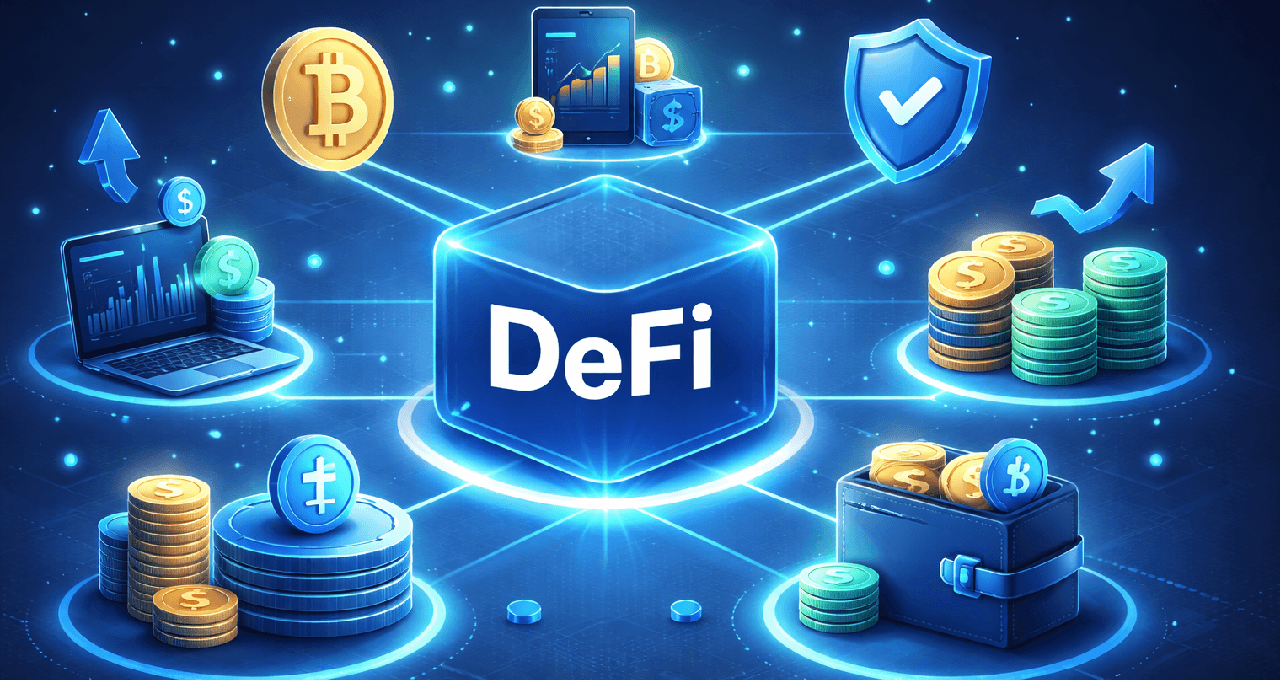
If you are just getting into crypto trading, DeFi might sound fancy, but it is actually pretty straightforward once you see it up close. Decentralized finance (DeFi) is basically a way to do normal money stuff like trading, lending, borrowing, and earning interest using blockchain apps instead of going through a bank or big company.
You stay in control of your own wallet, and smart contracts (just pieces of automatic code) handle everything fairly and openly. No bossy middlemen, no paperwork, and it runs 24/7. Sounds cool, right? This guide walks you through it all in plain English so you can decide if it fits your beginner trading journey.
What Does DeFi Mean?
DeFi simply means financial services that run on blockchain technology rather than old-school banks or brokers. The main idea is that the rules are written into code anyone can check, so everything feels more open and direct.
You can swap tokens, lend your crypto to earn interest, borrow against what you own, or even use stablecoins that act like digital dollars. Some parts might still have teams or websites helping out, but the heart of it lives on the blockchain.
How DeFi Works in Simple Terms
Everything in DeFi revolves around smart contracts. These are like vending machines on the blockchain: you put something in, the rules kick in automatically, and you get what you asked for.
Here is how a typical DeFi move goes for you:
Step | What Happens |
1 | You connect your crypto wallet to the DeFi app |
2 | You approve the transaction in your wallet |
3 | The smart contract runs the action instantly |
4 | The blockchain records it forever |
5 | Your wallet updates with the new balance |
No bank account needed, no waiting for approval. Just you, your wallet, and the code.
The Building Blocks of DeFi
To keep it easy, here are the five key pieces you will meet as a beginner:
Building Block | What It Is | Why It Matters for You |
Blockchain networks | The roads where everything runs (Ethereum and others) | They power fast, secure transactions |
Smart contracts | The automatic rules written in code | They replace bank tellers |
Crypto wallets | Your personal key to everything | You control your money directly |
Tokens | The digital coins and assets you trade | Used for swaps, rewards, and more |
Oracles | Bring real-world prices into the blockchain | Help loans and trades stay fair |
Common Types of DeFi Applications
DeFi is not just one thing. Here is a clear table of the main ones, plus how beginner-friendly each feels right now (rated 0-5, where 5 is super easy for new traders like you):
Type of DeFi App | What You Can Do | Beginner Rating (0-5) | Why the Rating |
Decentralized exchanges (DEX) | Swap tokens directly from your wallet | 5 | Simple and quick to try |
Lending and borrowing platforms | Lend crypto to earn interest or borrow against your holdings | 4 | Easy start but watch collateral |
Stablecoin protocols | Hold dollar-like coins for stability | 5 | Feels safe and familiar |
Yield farming & liquidity pools | Add your tokens to pools and earn fees/rewards | 3 | Rewards are nice but more risk |
Derivatives & advanced products | Trade futures, options, or complex stuff | 1 | Too risky for most beginners |
Key Differences Between DeFi and Traditional Finance
Feature | Traditional Finance | DeFi |
Access | Needs bank account and approval | Just a wallet and internet |
Hours | Business hours only | 24/7 |
Who controls it | Banks and brokers | Smart contracts |
Speed of settlement | Can take days | Often instant on-chain |
Transparency | Hidden behind closed doors | Everything is public on blockchain |
Reversing mistakes | Usually possible | Hard or impossible |
Benefits of DeFi
You will love these parts as a new trader:
Open access: Jump in from anywhere with just a wallet.
You keep full control: Your crypto never leaves your wallet unless you say so.
Total transparency: You can check every rule and transaction yourself.
Everything connects: Apps work together like Lego blocks for cool new ideas.
Always open: Trade or lend any time, even at 3 a.m.
Risks of DeFi
It is exciting, but you need to know the real risks so you do not lose sleep (or money). Here is a simple breakdown:
Risk Type | What Can Go Wrong | How to Stay Safer |
Smart contract | Bug in the code lets hackers in | Stick to well-known, audited apps |
Wallet security | You lose your seed phrase or approve bad transaction | Double-check every pop-up |
Price swings | Your collateral value drops fast | Borrow small and watch prices |
Liquidation | Loan gets closed automatically if value falls | Keep extra buffer in your position |
Fake sites | Phishing links steal your wallet | Bookmark real sites only |
A Simple Real-Life Example
Say you own some ETH and want stablecoins without selling. You can:
Deposit your ETH as collateral.
Borrow a stablecoin against it.
Use the stablecoin to trade or pay bills.
Pay back the loan later and get your ETH back.
Super handy, but if ETH price drops too much, the app might sell some of your ETH to protect the lender. That is why you start small!
Is DeFi Good for Beginners?
Yes, but only if you go slow. Treat it like learning to drive: start in an empty parking lot. Use tiny amounts, pick big trusted apps, read every wallet message carefully, and never chase crazy-high yields. The biggest rookie mistake is thinking DeFi is free money. Every reward has some risk attached.
Final Thoughts
DeFi is like a new global playground for your crypto. It gives you direct control, fast deals, and creative ways to grow your portfolio, but you are the one holding the keys and checking the map. Start simple, learn one thing at a time (wallets, swaps, then lending), and you will feel way more confident as a trader.
Pros and Cons of DeFi (Rated Overall: 4/5 for Beginner Traders)
I rate DeFi 4 out of 5 because it is powerful and exciting, but the risks mean you have to be careful and keep learning.
Pros
You stay in full control of your money
No bank needed – truly global and open
Super transparent and runs non-stop
Fees are often lower than traditional finance
Endless ways to combine apps and earn
Cons
You are responsible for your own security (no help desk)
Smart contract bugs or hacks can happen
Prices can swing wildly and liquidate positions
Scams and fake sites are common
Steep learning curve at first
FAQ
What does DeFi stand for?
Decentralized finance – financial apps that use blockchain code instead of banks.
Is DeFi the same as cryptocurrency?
No. Crypto is the money (like Bitcoin). DeFi is the apps that let you use that money in new ways.
Do I need a bank account to use DeFi?
Usually not. You only need a wallet, though you might use a bank to buy crypto first.
Is DeFi safe?
It can be, but it has real risks. Start tiny, use trusted apps, and never rush.
What is the easiest DeFi activity for beginners?
Just swapping one token for another on a DEX – it feels like using a simple exchange but you keep your keys.
Disclaimer: This content is for educational and informational purposes only and is not financial advice. Nothing here is a recommendation to buy or sell any asset or use any platform. Do your own research and manage your risk.
Read More
Need deeper training?
Join our structured modules with live examples and expert checklists for effective implementation.
JOIN THE ACADEMY