Key Takeaways
1 | The EU's 20th sanctions package marks a shift from targeting individual Russian exchanges to a blanket sectoral ban on all Russian-licensed crypto asset service providers (CASPs), with a hard compliance deadline of May 24, 2026. |
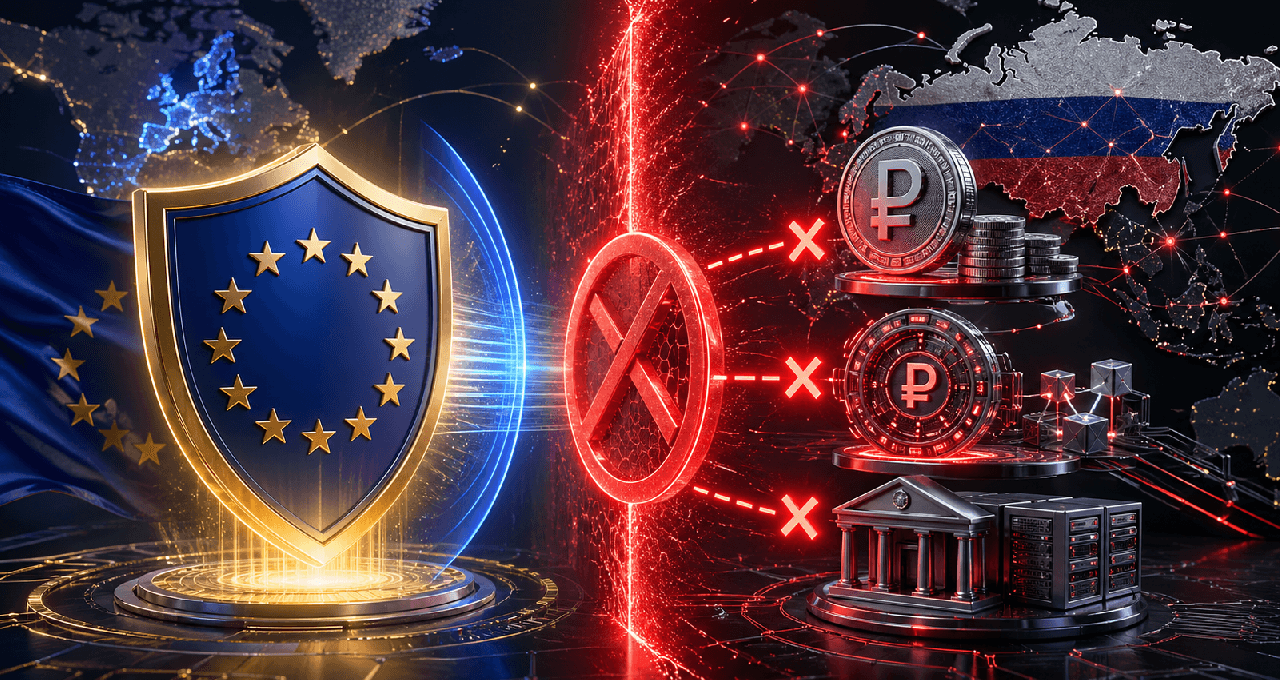
2 | Three asset classes are now explicitly prohibited: the RUBx stablecoin, the digital ruble (Russia's CBDC), and all crypto services provided by Russian-regulated platforms — regardless of where those services are accessed. |
3 | Third-country platforms in Central Asia, the UAE, and the Caucasus that facilitate Russian crypto flows now face secondary designation risk, meaning they could be sanctioned for enabling evasion. |
Why This Package Is Different
The European Union has imposed nineteen rounds of economic sanctions on Russia since the 2022 invasion of Ukraine. The twentieth package, adopted in early 2026, is the first to take a fundamentally different approach to cryptocurrency. Rather than naming individual exchanges or wallets, the EU has moved to sector-level prohibitions — banning entire categories of Russian crypto infrastructure in one sweep.
For traders, exchange operators, and compliance teams, this is not a marginal update. It changes who is responsible, what is banned, and what the consequences look like for platforms that continue to serve Russian crypto users after the compliance window closes on May 24, 2026.
This guide explains what changed, why it changed, and what concrete steps you need to take.
What Changed: From Individual Bans to a Sectoral Approach
Previous EU sanction rounds against Russia's crypto sector targeted named entities. Garantex, a Russian exchange, was designated in 2022. Bitpapa, EXMO, and others followed. Each designation required a separate legal process, a public announcement, and then enforcement — during which the named exchange often simply rebranded and resumed operations.
The Garantex case became the clearest illustration of the problem. After designation, Garantex rebranded as Grinex and attempted to continue operating under a new legal identity. This 'rebrand loop' exposed a structural weakness: individual designations create enforcement whack-a-mole when the underlying infrastructure, team, and user base remain intact.
The 20th package closes this loophole by prohibiting all Russian crypto asset service providers — not a list, but a category. Any entity licensed, registered, or operating under Russian jurisdiction falls under the ban, regardless of its current name or branding.
What Is Banned: The Three Core Prohibitions
The 20th package introduces three distinct prohibition categories:
Prohibited Asset / Service | What It Covers | Why It Was Targeted |
RUBx Stablecoin | A rouble-pegged stablecoin designed to facilitate ruble-denominated crypto transactions outside the SWIFT-blocked banking system | Used to move ruble value cross-border via DeFi protocols and offshore wallets |
Digital Ruble (CBDC) | Russia's central bank digital currency, in active pilot phase since 2023 | A state-controlled digital payment rail that could replace sanctioned banking channels at scale |
All Russian CASPs | Any crypto asset service provider licensed or operating under Russian regulation, including exchanges, brokers, custodians, and wallet providers | Closes the 'rebrand loop' by targeting the regulatory category rather than individual firms |
The May 24, 2026 Compliance Deadline
The EU has set May 24, 2026 as the hard deadline for compliance. This is the date by which:
EU-based exchanges and brokers must terminate service relationships with Russian CASPs
EU residents must cease holding, transferring, or transacting in RUBx or the digital ruble
European financial institutions must block any payment routes connected to Russian CASP infrastructure
The compliance window applies to existing contracts and relationships, not just new ones. Platforms that have existing liquidity partnerships, API integrations, or custody arrangements with Russian CASPs are expected to unwind those relationships before the deadline.
Exchanges operating under MiCA (Markets in Crypto-Assets Regulation) authorisation are particularly exposed, since MiCA compliance already requires adherence to EU sanctions law. A post-May 24 violation would put a platform's MiCA licence at risk, not just its sanctions standing.
The Garantex to Grinex Loop: Why Individual Designations Failed
Understanding the Garantex-Grinex case is important context for why the EU changed its approach.
Garantex was designated by the EU and the US Treasury's OFAC in 2022, identified as a major processing hub for ransomware payments and sanctioned-entity transactions. In 2025, law enforcement seized the platform's infrastructure — but the core team and much of its user infrastructure reportedly migrated to a new entity operating under the name Grinex.
This is not an isolated incident. Sanctioned crypto entities in Russia have repeatedly adopted the following playbook: dissolve the designated legal entity, move assets and personnel to a new shell, re-register under a new name, and resume operations within weeks. Individual designations, which take months of legal preparation, cannot keep pace with this approach.
The sectoral ban in the 20th package is designed as a structural fix. By making all Russian CASPs prohibited by category, the EU removes the legal gap that the rebrand loop exploits.
What Are Netting Transaction Bans?
One of the less-discussed elements of the 20th package is its prohibition on netting transactions involving Russian crypto assets.
A netting transaction, in simple terms, is when two parties settle offsetting obligations against each other rather than making individual payments. In crypto markets, this is common in OTC (over-the-counter) trading desks, market-making arrangements, and cross-border settlement between exchanges.
The ban means that EU entities cannot participate in netting arrangements where one leg of the transaction involves a Russian CASP or a prohibited asset like RUBx. This is a technical but significant restriction — it removes a commonly-used workaround where technically compliant net settlements were obscuring exposure to sanctioned parties on individual legs.
Third-Country Platform Exposure: UAE, Central Asia, and the Caucasus
The 20th package extends its reach beyond the EU through secondary designation provisions. Platforms located outside the EU — including exchanges based in the UAE, Kazakhstan, Georgia, Armenia, and other jurisdictions — now face the risk of being added to the EU sanctions list if they are found to be facilitating Russian crypto flows that circumvent the main prohibitions.
This matters because a significant volume of Russian crypto activity has migrated to these jurisdictions since 2022. Several exchanges based in Dubai and Central Asia have reported strong growth in Russian-language user bases following earlier sanctions rounds.
Under the secondary designation framework, these platforms do not need to be EU-regulated to face consequences. If they are designated, EU persons and entities are prohibited from transacting with them — effectively cutting them off from EU banking and payment infrastructure regardless of where they are registered.
What This Means For You: By Trader Type
Your Profile | Key Risks | What To Do |
EU Resident Trader | Holding RUBx, using Russian CASP accounts, or transacting in the digital ruble after May 24 creates direct sanctions exposure | Liquidate any RUBx holdings now. Close accounts on Russian-regulated platforms before the deadline. |
Non-EU Trader on a Global Exchange | If your exchange operates in the EU or under MiCA, it will need to restrict access to prohibited assets and services — your account may be affected even if you are not in the EU | Review your exchange's compliance announcements. Expect asset delistings and service restrictions in the weeks leading to May 24. |
Exchange Operator or OTC Desk | Netting bans, CASP prohibitions, and MiCA compliance overlap create complex legal exposure across existing counterparty relationships | Conduct a full counterparty audit before May 24. Seek legal counsel on any existing netting arrangements with Russian-linked entities. |
5-Step Trader Action Checklist
Audit your holdings. Check whether you hold RUBx or any ruble-pegged stablecoins in your wallet or exchange account. If yes, liquidate or swap before May 24.
Check your exchange's jurisdiction. Confirm whether your primary trading platform is EU-based or operates under MiCA. If it is, expect compliance-driven changes to available assets and counterparties.
Close Russian CASP accounts. If you have accounts on any Russian-regulated exchange or broker, withdraw your funds and close the account before May 24.
Monitor secondary designations. If you use exchanges based in the UAE, Kazakhstan, or Georgia, watch for any EU designation announcements that could affect those platforms' access to European infrastructure.
Track compliance news on TradingView. Use TradingView to monitor news and market reactions around the May 24 deadline, especially for affected trading pairs.
FAQ
Does the EU ban affect traders outside Europe?
Not directly in terms of legal obligation. But if your exchange operates in Europe or under MiCA regulation, it will implement the ban — which will affect available assets and counterparties regardless of where you are located. Non-EU platforms that facilitate prohibited flows also face secondary designation risk.
What is the RUBx stablecoin and who uses it?
RUBx is a ruble-pegged stablecoin that operates on blockchain networks. It was designed to allow ruble-denominated value transfer outside the traditional banking system — making it a useful tool for routing money around SWIFT restrictions. Its ban under the 20th package reflects its role as a potential sanctions-evasion instrument.
What is the digital ruble and how is it different from RUBx?
The digital ruble is Russia's official central bank digital currency (CBDC), issued and controlled by the Bank of Russia. Unlike RUBx, which operates on open blockchain infrastructure, the digital ruble runs on a state-controlled system. Its ban targets its potential as a state-backed alternative to SWIFT-blocked payment rails.
Is Grinex the same as Garantex?
Grinex emerged following enforcement action against Garantex in 2025. While officially a separate entity, it is widely reported to share operational infrastructure and personnel with Garantex. The EU's shift to a sectoral ban rather than individual designations is partly a direct response to this type of rebrand-and-continue approach.
What happens if I miss the May 24 deadline?
EU residents who hold prohibited assets or maintain relationships with Russian CASPs after May 24 could face sanctions enforcement, including fines and asset freezes. For platform operators, the consequences are more severe — potential loss of MiCA authorization and EU market access.
Disclaimer: This content is for educational and informational purposes only and is not financial advice. Nothing here is a recommendation to buy or sell any asset or use any platform. Do your own research and manage your risk.
Read More
Strategy Holds 815,061 BTC: What Corporate Bitcoin Treasury Strategy Means for Traders
UK FCA P2P Crypto Crackdown 2026: What Compliance-Minded Traders Need to Know
Need deeper training?
Join our structured modules with live examples and expert checklists for effective implementation.
JOIN THE ACADEMY