
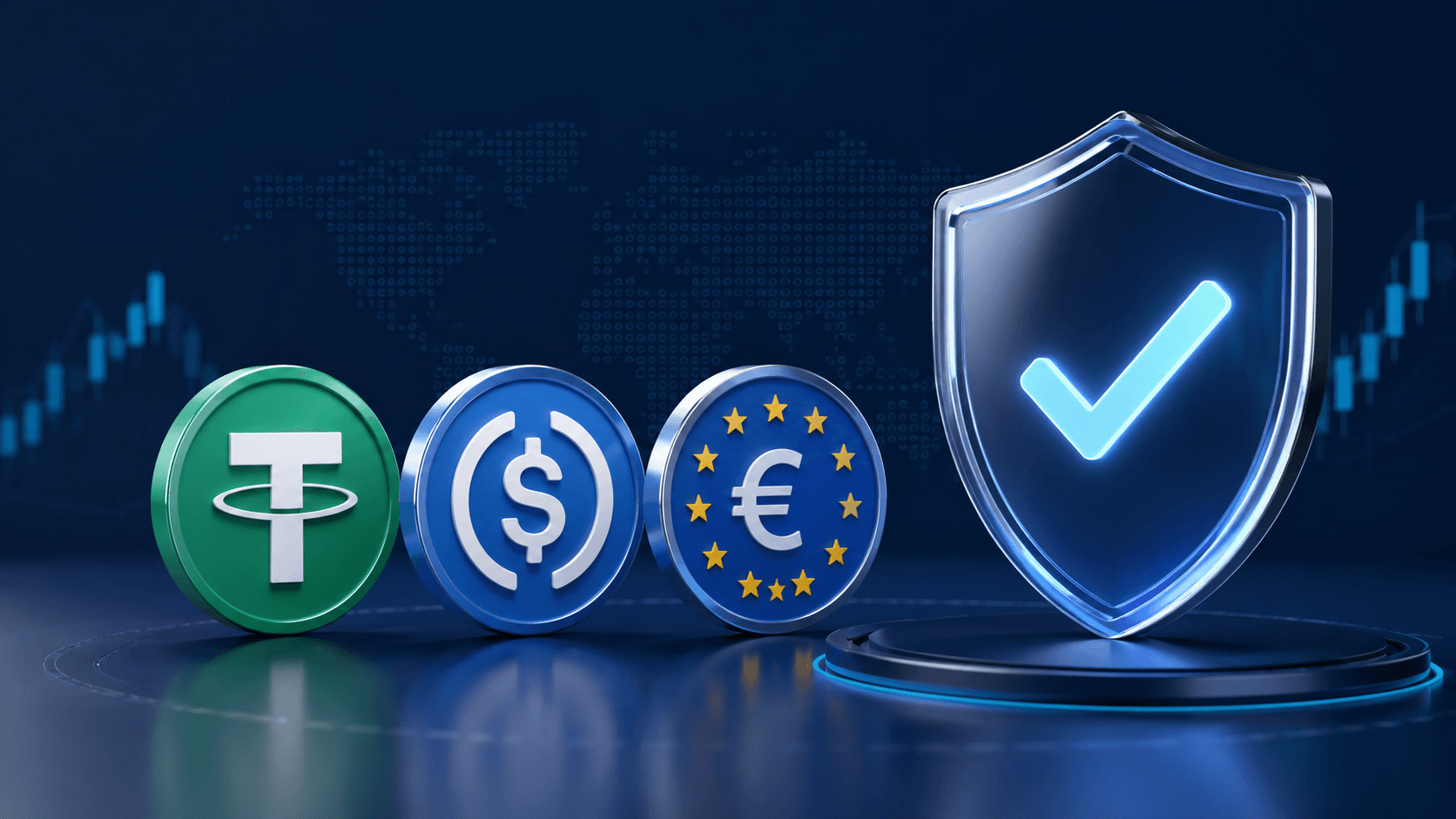
Key Takeaways
Stablecoins are cryptocurrencies designed to keep a steady value, usually pegged one-to-one to a fiat currency such as the US dollar or euro.
Most widely used stablecoins like USDT and USDC are backed by real-world reserves, while others rely on crypto collateral or algorithms.
Understanding how stablecoins work and their risks helps beginners use them more safely for trading, payments, or transfers.
What Is a Stablecoin?
Hey there, if you’re just starting out in crypto trading, stablecoins are one of the easiest tools to get your head around. Think of them as digital dollars or euros that live on the blockchain. Unlike Bitcoin or Ethereum, which can swing 10% in a day, stablecoins are built to stay steady – usually worth exactly $1 or €1. They give you all the fast, borderless benefits of crypto without the stomach-churning price drops. That’s why they’ve become huge: as of May 2026 the whole stablecoin market is worth more than $322 billion, and USDT plus USDC make up most of it. Traders use them every day for buying and selling other coins, sending money overseas, or just parking cash during wild market moves.
Why Most Stablecoins Are Pegged to Fiat Currencies
Fiat money (the regular dollars and euros from governments and banks) is way more stable than most crypto. So stablecoin issuers simply tie their coin’s value to it – usually at a 1:1 ratio. One stablecoin equals one dollar or one euro. This creates a perfect bridge between old-school banking and blockchain. You get speed and global reach without worrying that your money will lose value overnight. If the price ever drifts too far from $1, traders jump in to buy low or sell high and quickly push it back to the peg.
How Stablecoins Try to Maintain Their Value
The secret is simple: most stablecoins hold real reserves that match every coin in circulation. When you send dollars to the issuer, they create (mint) the same number of stablecoins. When you cash out, they destroy the coins and send your dollars back. Exchanges also help keep things steady. If a stablecoin drops below $1 on the market, people buy it cheap and redeem it for a full dollar – pushing the price back up. The same thing works in reverse if it goes above $1.
The Main Types of Stablecoins
Here’s a clear breakdown so you can see exactly how they differ:
Type | Backing | Examples | How It Maintains Peg | Key Characteristics |
Fiat-backed | Cash, Treasuries, bank deposits | USDT, USDC, EURC, EURT | 1:1 reserves + redemption | Most common and trusted for daily use |
Crypto-backed | Other cryptocurrencies | DAI | Smart contracts and liquidation | More decentralized but can be volatile |
Algorithmic | No or minimal collateral | (Historical: TerraUSD) | Supply adjustments via algorithms | Highest risk – no real assets behind it |
Commodity-backed | Gold or other physical assets | Tether Gold, Pax Gold | Reserves of commodities | Less common for everyday trading |
Fiat-backed stablecoins rule the market because they are straightforward and have proven reliable.
USDT (Tether): The Largest Stablecoin
USDT is the giant of the stablecoin world with around $189 billion in circulation. Launched back in 2014, it’s accepted almost everywhere. Every USDT is supposed to be backed by real reserves (cash, cash-like assets, and US Treasuries). Tether releases regular transparency reports so you can see what’s in the vault. It’s super liquid and perfect for trading pairs or moving money between exchanges quickly.
USDC (USD Coin): The Transparent Alternative
USDC comes in second with about $76 billion. Issued by Circle, it’s also fully backed by real assets – mostly short-term US Treasury bills and cash. A top accounting firm (Deloitte) checks the reserves every month and publishes the results. Many serious traders and institutions love USDC because of its clear, regular audits and strong focus on following the rules.
Euro Stablecoins: EURC, EURT, and Others
If you live in Europe or deal mostly in euros, these are your friends:
EURC (from Circle) works just like USDC but in euros – fully backed and regularly audited.
EURT (from Tether) is the euro version of USDT and is also widely available.
They’re smaller than the dollar versions but great for euro payments, remittances inside Europe, or protecting yourself from dollar-euro exchange swings. More platforms are adding them every month.
Rating the Popular Stablecoins for Beginners (0–5)
To make your choice even easier, here’s a quick rating based on what actually matters to new traders:
Stablecoin | Liquidity (how easy to buy/sell) | Transparency (how clear the reserves are) | Overall Beginner Friendliness | My Recommendation |
USDT | 5/5 | 4/5 | 4.5/5 | Best for high-volume trading |
USDC | 4.5/5 | 5/5 | 5/5 | Top pick for safety and trust |
EURC | 4/5 | 5/5 | 4.5/5 | Great if you use euros |
EURT | 4/5 | 4/5 | 4/5 | Solid euro alternative |
Common Stablecoin Risks (and How to Spot Them)
Stablecoins are much calmer than other crypto, but they’re not perfect. Here are the main things to watch:
Issuer risk – You’re trusting the company to hold the right reserves and let you cash out.
Depegging – In crazy market times the price can briefly drop below $1 (it happened to USDC in 2023 but recovered fast).
Regulatory risk – Governments are still writing new rules that could change how these coins work.
Redemption limits – Most people buy and sell on exchanges; big panic moments can make it hard to exit quickly.
The scariest example was the 2022 collapse of the algorithmic stablecoin TerraUSD, which wiped out billions when it completely lost its peg.
How to Choose a Stablecoin Carefully
Use this simple checklist before you put any real money in:
Read the issuer’s latest transparency report.
Check that reserves are mostly cash and safe government bonds.
Make sure it trades on exchanges and wallets you already trust.
Look at daily trading volume so you know it’s liquid.
Start tiny – test with a very small amount first.
Consider holding two different stablecoins to spread the risk.
A Stablecoin Safety Checklist for Beginners
Read the issuer’s official transparency page.
Confirm recent third-party audits.
Verify the coin trades near its peg on multiple exchanges.
Only use money you’re okay risking.
Keep your wallet secure with 2-factor authentication.
Stay updated on any news about the issuer.
Stablecoins are one of the most practical tools in crypto once you understand them. They let you move value fast without the constant worry of price swings. Take your time, check the facts, and you’ll use them confidently and safely.
FAQ
What is the difference between USDT and USDC?
USDT is bigger and more liquid but has had some past questions about its reserves. USDC gives more frequent independent checks and is often the favorite of big institutions.
Are stablecoins safe?
They are generally far steadier than other cryptocurrencies, but they still carry issuer, regulatory, and depegging risks. Nothing in crypto is 100% risk-free.
Can I earn interest on stablecoins?
Yes – some platforms let you lend or stake them for yield. Just remember extra risks come with that, so always research the platform carefully.
Why would I use a euro stablecoin instead of USDT or USDC?
It cuts out currency conversion fees and protects you from dollar-euro exchange rate moves if you mostly deal in euros.
What happens if a stablecoin loses its peg?
The price can drop for a while. In bad cases it takes time to recover. Keep an eye on the news and be ready to act if confidence drops.
Are stablecoins regulated?
Rules are still evolving. Some issuers already follow existing financial laws, while others are seeing brand-new stablecoin regulations in different countries.Stablecoins give beginners a practical way to move value in crypto without constant price worry. By learning how they work, reviewing transparency, and using the safety checklist above, you can trade and transfer with a lot more confidence.
Disclaimer: This content is for educational and informational purposes only and is not financial advice. Nothing here is a recommendation to buy or sell any asset or use any platform. Do your own research and manage your risk.
Read more
Best Crypto Cards in 2025: Top 10 Reviewed, Compared, and Explained
AI + Crypto Convergence in 2026: What It Means for Web3 Developers and Users
AI Meets DAOs: How Artificial Intelligence Is Changing On-Chain Governance in 2026
Need deeper training?
Join our structured modules with live examples and expert checklists for effective implementation.
JOIN THE ACADEMY