Key Takeaways
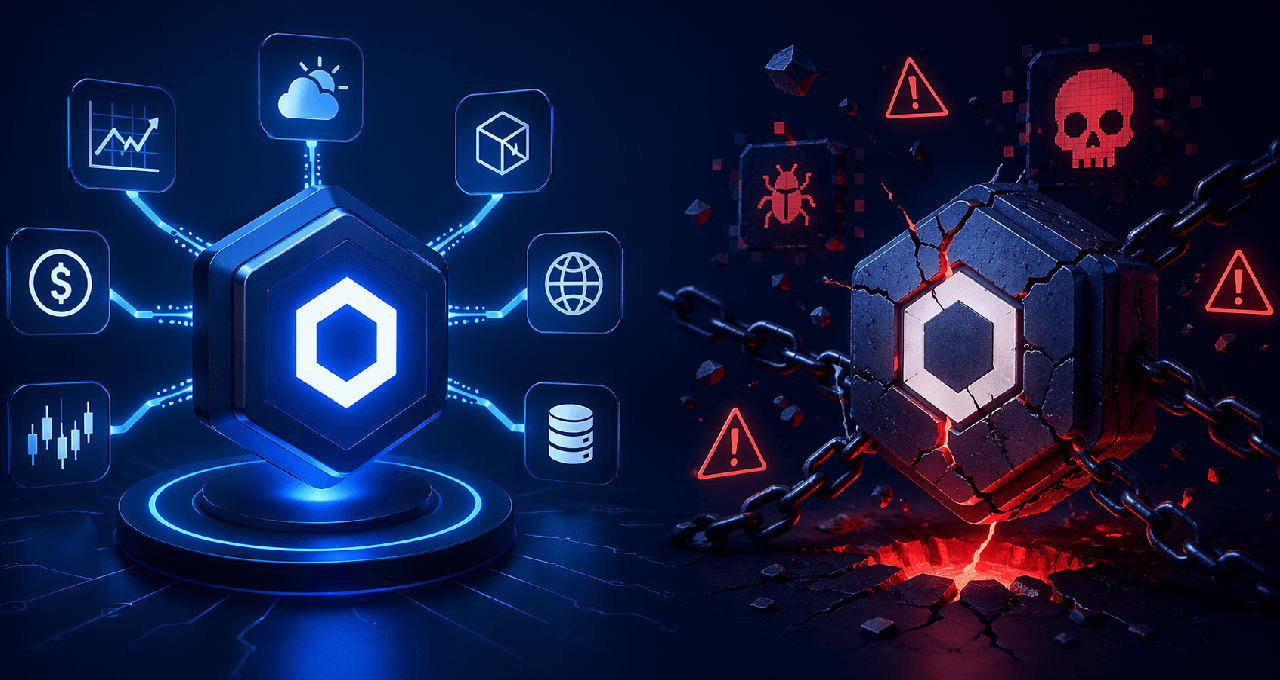
Oracles are the bridges that bring real-world data (like prices, weather, or sports results) into blockchains. Without them, smart contracts would be completely blind to the outside world.
Oracle manipulation is one of the most common DeFi hacks. Attackers fake price data to trick lending protocols, exchanges, and yield farms into handing over millions.
Chainlink and Pyth are the two biggest oracle networks. Chainlink wins on proven security; Pyth wins on super-fast data for trading.
Blockchains are amazing, but they’re also a bit like a computer stuck in a room with no windows. A smart contract on Ethereum has no idea what Bitcoin is trading at right now, whether it’s raining in Tokyo, or if your favourite sports team just won. It can only “see” data that already lives on the blockchain.
That’s called the oracle problem. And fixing it is one of the biggest (and riskiest) jobs in DeFi.
What Is a Crypto Oracle?
A crypto oracle is simply a service that grabs information from the real world and delivers it to the blockchain in a way smart contracts can understand. Think of it like a trusted messenger.
Most oracles focus on price data. For example:
A lending app needs to know ETH’s price to decide if your loan is safe.
A DEX needs the swap rate between two tokens.
But oracles can bring in lots of other useful info too:
Sports scores and election results (for prediction markets)
Proof that a stablecoin really has the cash behind it
Interest rates for on-chain loans
Weather data for insurance policies
Random numbers for NFT mints and games
Without oracles, DeFi as we know it simply wouldn’t work.
Centralized vs. Decentralized Oracles
Not all oracles are created equal. Here’s a quick comparison:
Feature | Centralized Oracles | Decentralized Oracles |
Data source | One single trusted provider | Many independent sources |
Risk level | High – one bad source can break it | Much lower – harder to fool |
Best for | Small or low-stakes apps | Big DeFi protocols with millions at stake |
Speed | Usually fast | Can be fast or slower depending on design |
Most serious DeFi projects use decentralized oracles because trusting one company with hundreds of millions in TVL is just too risky.
How Decentralized Oracle Networks Work
Here’s the simple process most networks follow:
Your smart contract asks for a price (e.g., ETH/USD).
Many independent oracle nodes check different price sources off-chain.
Each node sends its answer back.
The network takes the median or average and sends the final price to the contract.
Nodes get paid for being accurate and can be punished for bad data. This makes it expensive and difficult for attackers to manipulate the price.
Chainlink vs. Pyth: The Two Giants
Chainlink and Pyth are the clear leaders. They’re built differently and suit different needs. Here’s an easy comparison with ratings out of 5 (based on security, speed, and real-world use):
Oracle | Security (0-5) | Speed (0-5) | Best For | Overall Rating |
Chainlink | 5 | 3 | Lending, stablecoins, long-term safety | 4.8 |
Pyth | 4 | 5 | Perpetual futures, options, fast trading | 4.7 |
Use Chainlink when you want maximum security. It’s been running since 2019, survived multiple crashes, and powers Aave, Compound, and many big protocols.
Use Pyth when you need lightning-fast prices. It pulls data straight from big trading firms and updates hundreds of times per second — perfect for perpetuals on Drift or Synthetix.
Oracle Manipulation Attacks: How They Work
This is the scary part. Attackers trick protocols by feeding them fake prices. There are two main tricks:
Flash-loan spot manipulation
Borrow millions with no collateral → dump it on a small DEX to crash or pump the price → borrow or liquidate at the fake price → repay the loan in one transaction. No real money needed.Slow manipulation using stale prices
Some oracles only update every hour. If the real market moves fast, attackers jump in during that lag.
Major Oracle Exploits in History
The most famous recent case is the 2022 Mango Markets attack. The attacker (Avraham Eisenberg) pushed the price of MNGO tokens to 10× their real value on a thin market. He then borrowed almost everything in the treasury using the fake price as collateral. Loss: about $116 million. He was later arrested and convicted.
These attacks show why choosing the right oracle matters so much.
How to Identify Oracle-Dependent Protocols (and Stay Safe)
Before you deposit money, check these quick things:
Check This | What to Look For | Red Flag |
Documentation | Mentions Chainlink, Pyth, or TWAP | No oracle info at all |
Audit reports | Oracle section reviewed | No public audit |
Pricing method | TWAP (time-weighted average) vs spot | Raw spot price on one DEX |
Token liquidity | Deep liquidity on many venues | Obscure token with thin pools |
Tools for Monitoring Oracle Risk
Here’s a simple table of helpful free tools:
Tool | What It Shows | Best For |
Chainlink Data Feeds Dashboard | Live prices, update times, deviation thresholds | Checking Chainlink feeds |
DeFi Llama Oracle Tracker | Which oracle every protocol uses + TVL | Quick protocol risk check |
Real-time CEX vs DEX price differences | Spotting possible manipulation |
FAQ
Can a blockchain verify data without an oracle?
No. Blockchains are closed systems. They can’t look outside themselves. Oracles are the only safe way to bring real-world info on-chain.
Is Chainlink the only oracle network?
No. Pyth is huge on Solana and fast chains. Others like API3 and Band Protocol exist too. Each has different strengths.
What’s the difference between an oracle and an API?
An API is just a normal web connection. An oracle adds the trust and verification layer so a smart contract can actually use the data safely.
Are all oracle attacks done with flash loans?
No. Flash loans are popular because they need zero starting capital, but attackers can also use normal money or just wait for stale prices.
How do I know if a DeFi protocol is vulnerable?
Look for Chainlink or Pyth, TWAP pricing, and strong liquidity requirements. If none of these are mentioned, be extra careful.
Disclaimer: This content is for educational and informational purposes only and is not financial advice. Nothing here is a recommendation to buy or sell any asset or use any platform. Do your own research and manage your risk.
More Read
Need deeper training?
Join our structured modules with live examples and expert checklists for effective implementation.
JOIN THE ACADEMY