Key Takeaways:
Makers add liquidity to the order book and typically pay lower fees than takers, who remove liquidity with immediate orders.
Fee structures vary significantly between exchanges and can have a meaningful impact on long-term trading costs.
Using limit orders instead of market orders is a practical way to qualify for maker rates and reduce fees over time.
What Are Maker vs Taker Fees and Why They Matter
If you have ever placed a trade on a crypto exchange and wondered why two different users might pay different fees for the same trade size, the answer often comes down to one distinction: whether you are a maker or a taker.
Understanding this difference is not just a technical detail. For anyone trading regularly, it can have a real impact on how much of your money stays in your account.
How Crypto Exchange Order Books Work
Before defining maker and taker fees, it helps to understand what an order book is.
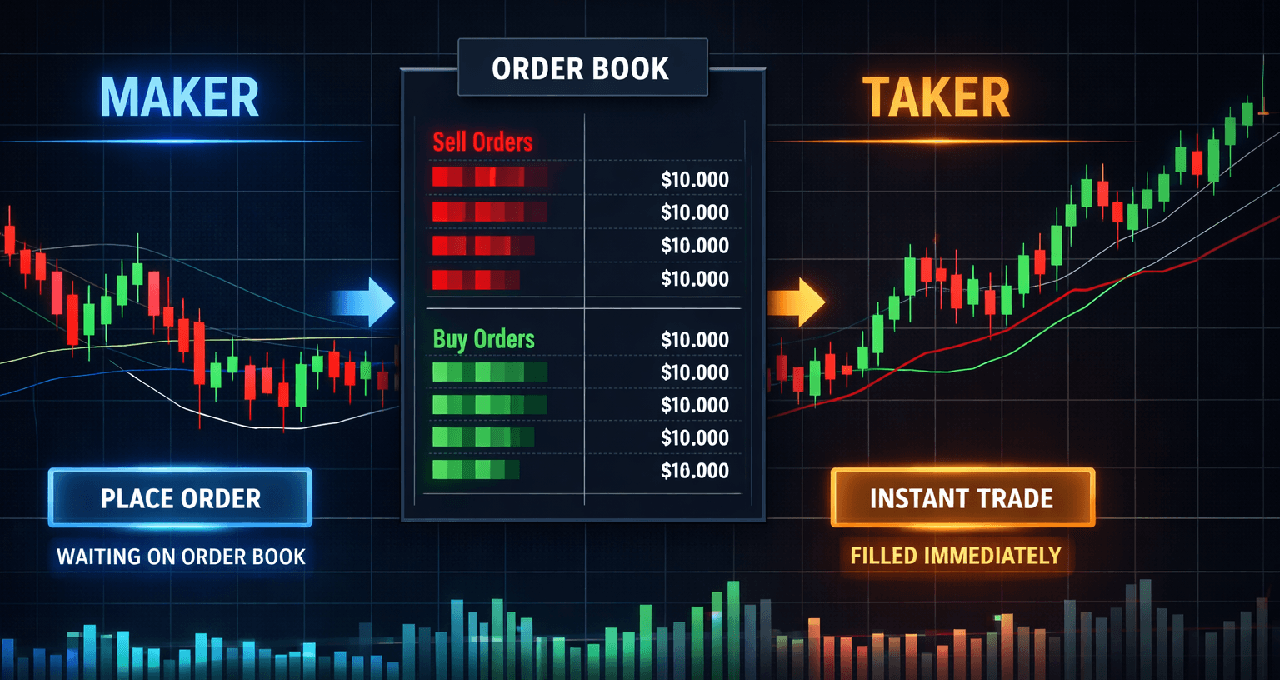
An order book is a live list of buy and sell orders on an exchange. When you place an order, it either sits on the book waiting to be matched, or it gets filled immediately against an existing order.
This distinction is what separates makers from takers.
What Is a Maker?
A maker is someone who places an order that does not get filled immediately. Instead, the order is added to the order book, where it waits for another trader to match it.
Example: You place a limit order to buy Bitcoin at $58,000 when the current price is $60,000. Your order sits on the book. You are a maker.
Makers are considered liquidity providers. They make it possible for other traders to fill their orders quickly. Exchanges reward this behaviour with lower fees.
What Is a Taker?
A taker is someone who places an order that fills immediately against an existing order on the book. Takers remove liquidity from the exchange.
Example: You place a market order to buy Bitcoin right now at whatever the current price is. Your order is matched instantly against someone else's existing sell order. You are a taker.
Because takers are consuming liquidity rather than providing it, they typically pay higher fees.
Maker vs Taker Fee Comparison Table
Feature | Maker | Taker |
Order type | Limit order (not immediately filled) | Market order or immediately filled limit order |
Role | Provides liquidity | Removes liquidity |
Typical fee | Lower | Higher |
Execution speed | Slower (waits for match) | Instant |
Best for | Cost-conscious traders | Traders prioritising speed |
Why Do Exchanges Charge Different Fees?
Exchanges benefit from having deep, active order books. The more buy and sell orders sitting on the book at any time, the easier it is for traders to execute orders quickly and at fair prices. This attracts more users.
To incentivise traders to add orders to the book rather than just consuming existing ones, exchanges charge makers less. It is a structural choice designed to keep markets liquid and functional.
Real-World Fee Examples
Fee structures differ across major exchanges. Below are approximate figures based on widely reported standard rates for new or low-volume accounts. Fees can decrease significantly at higher trading volumes.
Exchange | Maker Fee (Standard) | Taker Fee (Standard) |
Binance | 0.10% | 0.10% |
Coinbase Advanced | 0.40% | 0.60% |
Kraken | 0.25% | 0.40% |
0.10% | 0.10% | |
0.08% | 0.10% |
Note: These figures are approximate and subject to change. Always check the current fee schedule on the exchange's official website.
Some exchanges offer identical maker and taker rates. Others have tiered structures where fees drop as your 30-day trading volume increases.
How Fee Tiers Work
Most large exchanges operate a volume-based tiering system. The more you trade in a given period, typically 30 days, the lower your fees become.
Example of a tiered structure (simplified):
30-Day Volume | Maker Fee | Taker Fee |
Under $10,000 | 0.40% | 0.60% |
$10,000 to $50,000 | 0.25% | 0.40% |
$50,000 to $100,000 | 0.15% | 0.25% |
Over $100,000 | 0.08% | 0.10% |
Figures above are illustrative and not tied to a specific exchange.
Does the Fee Difference Actually Matter?
Yes, especially over time.
Example calculation:
Suppose you trade $5,000 worth of crypto per week.
At a taker rate of 0.60%, you pay $30 per week in fees.
At a maker rate of 0.25%, you pay $12.50 per week in fees.
Over one year, that is $1,560 vs $650. A difference of $910.
For high-frequency traders or anyone moving larger sums, the gap widens further.
How to Qualify as a Maker
The practical step is simple: use limit orders instead of market orders when you are not in a rush.
A limit order lets you set the exact price you are willing to buy or sell at. If that price is not currently available in the market, your order sits on the book and you qualify as a maker.
Maker-friendly habits:
Set limit orders below the current market price when buying
Set limit orders above the current market price when selling
Avoid market orders unless execution speed is genuinely urgent
Check whether your exchange offers a maker rebate, where you actually receive a small payment for adding liquidity
What Is a Maker Rebate?
Some exchanges, particularly derivatives platforms, go further than simply charging makers less. They offer a maker rebate, which means the exchange pays you a small amount for placing orders that add liquidity.
This is common on perpetual futures markets. A maker rebate of -0.02% means you receive 0.02% of the trade value back, rather than paying a fee.
Common Misconceptions
"Market orders are always bad." Not true. If you need to exit a position quickly, speed matters more than fees. Market orders exist for a reason.
"Limit orders always qualify as maker." Not always. If you place a limit order at or above the current market price when buying, it may fill immediately and classify you as a taker.
"Fees are the same on every exchange." Fees vary significantly. Comparing exchange fee structures before committing is a practical step every trader should take.
FAQ
What is the difference between a maker and a taker in crypto? A maker adds an order to the exchange's order book that is not immediately filled. A taker places an order that fills immediately against an existing order. Makers typically pay lower fees because they provide liquidity.
Is a limit order always a maker order? Not always. A limit order becomes a maker order only if it is not filled immediately. If your limit price matches the current market price and fills instantly, you are a taker.
Which is better: being a maker or a taker? It depends on your priorities. Makers benefit from lower fees. Takers benefit from immediate execution. Most traders use both depending on the situation.
Do all exchanges charge different maker and taker fees? Not all. Some exchanges charge the same fee for both. Others use tiered structures where fees decrease as your trading volume increases.
What is a maker rebate? A maker rebate is when an exchange pays you a small amount for placing orders that add liquidity to the order book, rather than charging you a fee. This is more common on derivatives exchanges.
Disclaimer: This content is for educational and informational purposes only and is not financial advice. Nothing here is a recommendation to buy or sell any asset or use any platform. Do your own research and manage your risk.
Read More
Top 5 Crypto Exchanges for New Crypto Traders
Top 5 Crypto Wallets for Beginner Traders
AI Trading Assistants 2026: Beginner Guide to HTX AI Skills and TraderClaw
Need deeper training?
Join our structured modules with live examples and expert checklists for effective implementation.
JOIN THE ACADEMY