Key Takeaways:
Vesting schedules control when team members, investors, and advisors can access their token allocations, helping to prevent immediate sell-offs after a project launches.
Cliff vesting means no tokens are released until a specific date, after which a portion unlocks; linear vesting releases tokens gradually over time.
Large token unlock events can increase circulating supply rapidly, which may affect a token's price if demand does not keep pace.
When a crypto project launches a token, not all of it enters circulation at once. Teams, early investors, advisors, and ecosystem funds typically receive their allocations gradually over time through a mechanism called a vesting schedule.
Understanding vesting schedules helps you assess a project's tokenomics more clearly. Large, poorly structured vesting events have historically preceded significant sell pressure. Knowing what to look for puts you in a better position to evaluate any project you are researching.
What Is a Vesting Schedule?
A vesting schedule is a predetermined timeline that controls when allocated tokens become available to their recipients.
Think of it as a release plan. A team member might be allocated 5 million tokens, but those tokens are locked for a set period and only released according to the agreed schedule. They cannot sell or move tokens that have not yet vested.
Vesting serves several purposes:
Aligns incentives: recipients are motivated to keep working on the project because their rewards depend on future performance and commitment
Reduces immediate sell pressure: prevents large holders from dumping tokens at launch
Signals commitment: projects with long vesting periods are often seen as more credible, though this alone is not a guarantee of quality
Who Typically Has Vesting Schedules?
Recipient Category | Why Vesting Applies |
Core team and founders | Keeps founders committed long-term |
Early investors and VCs | Prevents immediate exit after token generation event |
Advisors | Rewards contribution over time, not just at signing |
Ecosystem and treasury funds | Ensures funds are deployed thoughtfully |
Community or airdrop pools | Sometimes vested to prevent immediate dumps |
Public sale participants and open market buyers typically receive their tokens without vesting, or with minimal lock-up periods.
What Is Cliff Vesting?
A cliff is a period during which no tokens are released at all. Once the cliff period ends, a portion of the allocation unlocks in one event.
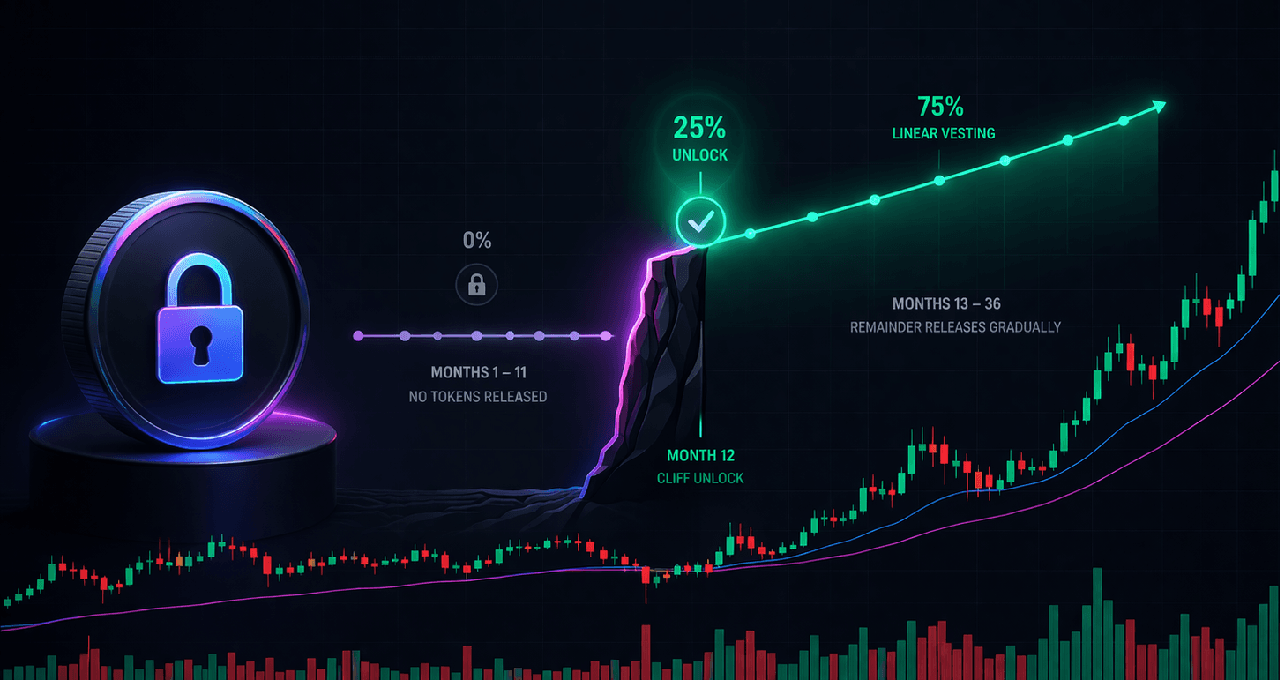
Example: A team member has a 12-month cliff with a 36-month total vesting period. For the first year, they receive nothing. At the end of month 12, 25% of their allocation unlocks. The remaining 75% then vests monthly over the next 24 months.
This structure is common in traditional tech startup equity and has been adopted widely in crypto. It protects the project from contributors who might leave early and immediately sell.
Visual breakdown of a cliff vesting example:
Period | Tokens Released |
Month 1 to 11 | 0% |
Month 12 (cliff) | 25% unlocks |
Month 13 to 36 | Remaining 75% releases gradually |
What Is Linear Vesting?
Linear vesting releases tokens in equal increments over a fixed period, with no cliff. Every month, week, or day, the same proportion of tokens becomes available.
Example: 12 million tokens vest over 24 months with linear monthly releases. That is 500,000 tokens per month, every month, for two years.
Linear vesting creates predictable, steady release schedules. It is easier to model and tends to produce more consistent sell pressure rather than sudden spikes.
Cliff Plus Linear: The Combined Structure
Many projects use both. A cliff period is followed by a linear release schedule. This is sometimes called a cliff and vest structure.
Example:
Total allocation: 10 million tokens
6-month cliff, then 18 months of linear monthly vesting
At month 6, nothing has unlocked yet (some projects unlock the cliff tranche at this point, others do not)
From month 7 onward, approximately 555,000 tokens unlock per month
The exact terms vary by project. Always check the whitepaper, investor documentation, or token unlock tracker for specifics.
What Is Token Dilution?
Dilution refers to the increase in circulating supply as locked tokens are released. When more tokens enter the market, the share of ownership represented by any existing token decreases.
This does not automatically mean the price falls. Dilution only puts downward pressure on price when the new supply is sold and demand does not absorb it.
Factors that affect how dilution impacts price:
The size of the unlock relative to current daily trading volume
Whether recipients are likely to sell (early investors who bought at much lower prices may have more incentive to sell than long-term team members)
Market conditions at the time of the unlock
Whether the project has strong ongoing demand or utility
How to Find Vesting Schedules for Any Project
Most established projects publish their vesting schedules in:
The project whitepaper or token documentation
Investor relations pages or blog posts
Platforms such as TokenUnlocks, Vesting.app, or CryptoRank, which track upcoming unlock events
Checking upcoming unlock events before investing is a useful research practice. A large unlock from early investors in the coming weeks is a piece of information worth knowing.、Real-World Context: Why Unlocks Can Be Market Events
Large token unlock events are sometimes referred to as unlock cliffs and have historically received significant attention from traders and analysts. When a large percentage of total supply becomes available to early investors, it can create visible sell pressure, particularly if those investors entered at valuations much lower than the current market price.
This does not mean every unlock leads to a price drop. Projects with strong demand and real usage can absorb unlock events without significant price impact. But for projects without strong fundamentals, a large unlock arriving into weak demand has historically created difficulties.
Checking the upcoming 30 to 90 days of any token's vesting schedule is a reasonable step before making any investment decision.
Vesting Schedule Red Flags to Watch For
Red Flag | Why It Matters |
No vesting for team tokens | Team can sell immediately after launch |
Very short vesting periods (under 6 months) | Little long-term commitment signal |
Large single unlock events near current date | Potential incoming sell pressure |
No public vesting documentation | Lack of transparency |
Team holds a very large share with short vesting | Concentrated risk and misaligned incentives |
Summary of Key Vesting Types
Vesting Type | Structure | Pros | Cons |
Cliff | All or large portion unlocks at one date | Simple, clear milestone | Creates sudden supply event |
Linear | Equal amounts released on schedule | Predictable, gradual | Less incentive tied to milestones |
Cliff plus linear | Cliff, then gradual release | Balances both | More complex to model |
Back-weighted | More unlocks later in schedule | Stronger long-term alignment | Slower early rewards |
Front-weighted | More unlocks early | Faster recipient access | Higher early sell pressure |
FAQ
What is a token cliff in crypto? A cliff is a period during which no tokens are released. After the cliff period ends, a portion of the total allocation unlocks. It is designed to ensure contributors remain involved for a minimum period before receiving any reward.
Do vesting schedules affect token price? They can, particularly when large unlock events increase circulating supply quickly. However, the price impact depends on market demand, the size of the unlock, and whether recipients choose to sell.
Where can I check a token's vesting schedule? Look in the project's whitepaper or token documentation. Third-party platforms such as TokenUnlocks and CryptoRank aggregate upcoming unlock data for many projects.
What is token dilution? Dilution refers to the increase in circulating supply as locked tokens are released over time. It reduces the proportional ownership represented by each existing token, though price impact depends on supply and demand dynamics.
Is a longer vesting period always better? Not necessarily, but it is generally a positive signal for alignment of incentives. A team locked into a 4-year vesting schedule has more reason to remain committed than one with a 6-month schedule.
Disclaimer: This content is for educational and informational purposes only and is not financial advice. Nothing here is a recommendation to buy or sell any asset or use any platform. Do your own research and manage your risk.
More Read
Need deeper training?
Join our structured modules with live examples and expert checklists for effective implementation.
JOIN THE ACADEMY