Key Takeaways:
Tokenomics refers to the economic design of a cryptocurrency, covering supply, distribution, incentives, and how tokens are created or destroyed over time.
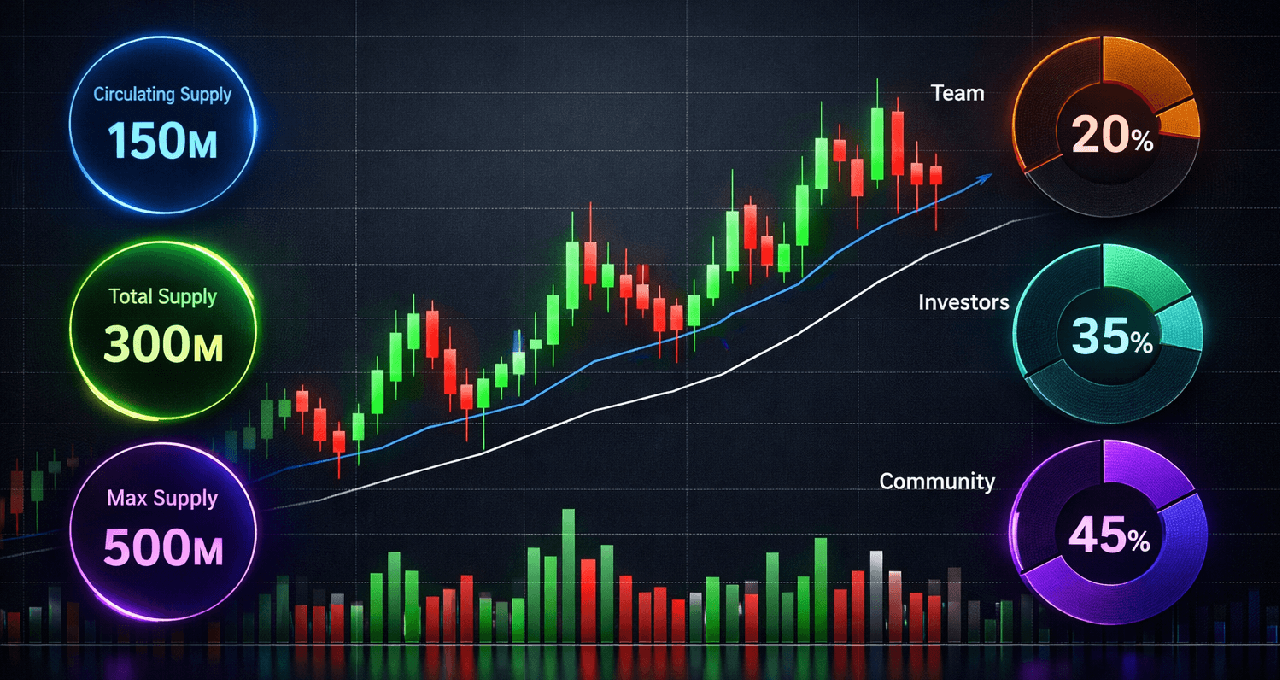
Key metrics include circulating supply, total supply, max supply, and how tokens are allocated across different groups such as teams, investors, and communities.
Understanding tokenomics helps you assess whether a project's economic model is sustainable and whether token supply dynamics might affect value over time.
Every cryptocurrency is governed by a set of rules that determine how many tokens exist, who receives them, how new tokens are created, and how they flow through the ecosystem. This system is called tokenomics, a combination of token and economics.
Tokenomics is not a guarantee of a project's success or failure, but it is one of the most important structural elements to understand before evaluating any crypto asset. A well-designed token model can support long-term sustainability. A poorly designed one can undermine even a technically sound project.
Why Tokenomics Matters
Before putting money into any cryptocurrency, asking basic tokenomics questions helps you understand what you are actually buying and how the supply dynamics might evolve.
Key questions include:
How many tokens exist or will ever exist?
Who currently holds the tokens?
Are there large allocations to insiders that could be sold into the market?
Does the token have a use case within its ecosystem?
Is there a mechanism that reduces or increases supply over time?
Without this context, evaluating any token is difficult.
Supply: The Foundation of Tokenomics
Supply is the starting point for any tokenomics analysis. There are three supply figures you will encounter regularly:
Circulating Supply The number of tokens that are currently available in the market and can be bought or sold. This is the figure used when calculating market capitalisation.
Market cap = Circulating supply x Current token price
Total Supply The total number of tokens that currently exist, including those that are locked, vested, or not yet in circulation. This is larger than circulating supply in most cases.
Max Supply The hard cap on the total number of tokens that will ever exist. Some tokens have a fixed max supply, like Bitcoin's 21 million cap. Others have no maximum and continue to issue new tokens indefinitely.
Supply Type | Definition | Example (Bitcoin) |
Circulating supply | Tokens actively in the market | ~19.7 million BTC (approx. 2024 estimate) |
Total supply | All tokens created including locked ones | ~19.7 million BTC (close to circulating for BTC) |
Max supply | Hard cap on total ever to exist | 21 million BTC |
Not every token has a max supply. Ethereum, for example, does not have a hard cap, though its issuance rate is controlled and offset by token burning mechanisms.
Token Distribution: Who Holds What
Token distribution refers to how the total supply is allocated across different groups. This is usually shown in a project's whitepaper or documentation as a pie chart or table.
Common allocation categories include:
Allocation Category | Typical Role |
Core team and founders | Compensates those who built the project |
Early investors and VCs | Reward for pre-launch funding |
Ecosystem and development fund | Long-term development budget |
Community and airdrops | User acquisition and decentralisation |
Public sale / ICO / IEO | Sold to early public buyers |
Liquidity reserves | Provides trading liquidity on exchanges |
Advisors | Compensates external contributors |
Why distribution matters: If a small number of wallets hold a large share of total supply, the token is highly concentrated. This creates the potential for large coordinated selling events and raises questions about decentralisation.
A rough rule of thumb used by many analysts is to be cautious when a team and investor allocation combined exceeds 30 to 40% of total supply, particularly when combined with short vesting periods. This is not a hard rule, but a starting point for questioning.
Inflation and Deflation in Crypto
Tokenomics determines whether a token's supply grows, shrinks, or stays fixed over time. This affects the basic supply and demand relationship.
Inflationary Tokens New tokens are created over time, increasing the total supply. This is common in proof-of-work and proof-of-stake networks, where new tokens are issued as block rewards to validators or miners.
If demand does not grow proportionally, inflation can dilute the value of existing tokens.
Deflationary Tokens The supply decreases over time through mechanisms like token burns. A token burn permanently removes tokens from circulation, reducing total supply.
Some protocols burn a portion of transaction fees. Others conduct periodic buyback-and-burn events funded by project revenue.
Fixed Supply Tokens The total supply is set at the start and never changes. Bitcoin is the most well-known example, with a capped supply of 21 million.
What Is a Token Burn?
A token burn is the process of permanently removing tokens from circulation by sending them to an address from which they can never be retrieved, often called a burn address.
Burns are used to:
Reduce circulating supply over time
Counter inflationary issuance
Distribute value back to token holders by increasing scarcity
Ethereum introduced a burn mechanism via EIP-1559, which burns a portion of the base fee on every transaction. During periods of high network activity, Ethereum can become net deflationary, meaning more ETH is burned than issued.
Not all burn mechanisms are equal. A small, infrequent burn on a token with massive issuance may have little practical impact. Evaluating the net supply change requires looking at both issuance and burn rates together.
Token Utility: What Does the Token Actually Do?
A token's utility is what gives it demand within its ecosystem. Without real demand, supply dynamics alone cannot sustain value over time.
Common token utility models include:
Utility Type | Description | Example |
Used to pay for transactions on a network | ETH on Ethereum | |
Governance token | Gives holders voting rights on protocol decisions | UNI on Uniswap |
Staking token | Locked to secure a network and earn rewards | SOL on Solana |
Access token | Required to use certain features or services | Various DeFi protocols |
Payment token | Used as a medium of exchange | BTC, LTC |
Tokens with clear, high-demand utility within an active ecosystem tend to have stronger fundamentals than tokens whose primary function is speculation.
Emission Schedule: How New Tokens Enter Circulation
An emission schedule outlines when and how new tokens are created and distributed over time. This is most relevant for tokens with ongoing issuance, such as those distributed as staking rewards.
Understanding the emission schedule helps you anticipate how circulating supply will grow. A high emission rate in the near term combined with low demand is a risk factor worth noting.
How to Read a Tokenomics Summary
When evaluating a project, look for:
Total and max supply - Is supply capped? Is there runaway inflation?
Current circulating supply as a % of total - A low percentage means much of the supply is still locked
Team and investor allocation - How concentrated is insider ownership?
Vesting schedules - When do locked tokens unlock?
Utility - What creates genuine demand for the token?
Burn mechanisms - Is supply being actively reduced?
Emission schedule - How fast is new supply entering the market?
Common Tokenomics Red Flags
Red Flag | Why It Matters |
No published tokenomics | Lack of transparency |
Very high team allocation with short vesting | Misaligned incentives, potential sell pressure |
No clear token utility | Demand depends on speculation alone |
Unlimited supply with no burn mechanism | Ongoing dilution risk |
Very low initial circulating supply | Artificially inflated price; large unlocks ahead |
FAQ
What does tokenomics mean? Tokenomics refers to the economic design of a cryptocurrency. It covers how many tokens exist, how they are distributed, how new tokens are created or destroyed, and what purpose the token serves within its ecosystem.
What is the difference between circulating supply and total supply? Circulating supply is the number of tokens currently available in the market. Total supply includes all tokens that exist, including those that are locked, vested, or reserved. Total supply is always equal to or greater than circulating supply.
What is a token burn? A token burn permanently removes tokens from circulation by sending them to an address that cannot be accessed. It reduces total supply and is used by some projects to counter inflation or distribute value to existing holders.
Why does token distribution matter? If a small number of insiders hold a large share of total supply, they have significant potential influence over the market. Concentrated ownership increases the risk of large sell events and raises questions about decentralisation.
Where can I find a project's tokenomics? Most projects publish tokenomics in their whitepaper or dedicated documentation pages. Third-party platforms such as CoinGecko, CoinMarketCap, and Messari often aggregate this information in a readable format.
Disclaimer: This content is for educational and informational purposes only and is not financial advice. Nothing here is a recommendation to buy or sell any asset or use any platform. Do your own research and manage your risk.
More Read
Need deeper training?
Join our structured modules with live examples and expert checklists for effective implementation.
JOIN THE ACADEMY