Key Takeaways
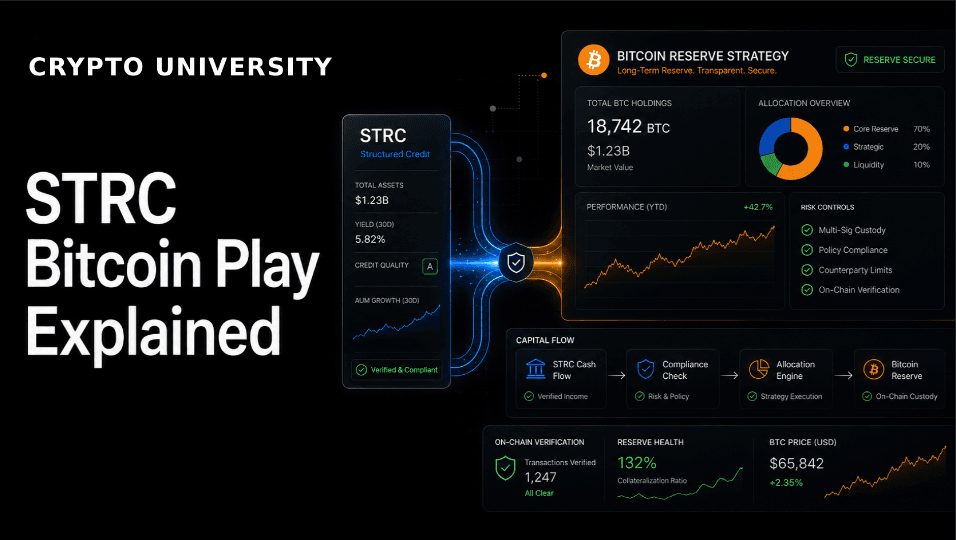
1 | Owning Bitcoin means holding the asset itself. Owning STRC means lending money to a company that holds a huge pile of Bitcoin, and getting paid a regular cash dividend in return. |
2 | STRC is built for steady income and a price that hugs $100, not for riding Bitcoin to the moon. If Bitcoin triples, STRC will not. |
3 | The eye-catching 12% yield is not guaranteed or risk-free. It depends on Strategy's board choosing to pay it, the company staying healthy, and investors staying interested in its securities. |
The big idea in one minute
Picture Bitcoin as a rare box of digital gold. You can buy the box yourself. If the price doubles, your money roughly doubles. If it drops by half, you feel every bit of that pain.
Strategy (the company that used to be called MicroStrategy) plays a different game. It raises money from investors, spends a lot of it on Bitcoin, then builds financial products for different kinds of buyers. STRC is one of those products.
Here is the cleanest way to hold it in your head:
If you... | Then you are... |
|---|---|
Buy Bitcoin | Owning the asset directly. |
Buy STRC | Lending long-term money to a company that owns a lot of Bitcoin, in exchange for a cash dividend. |
That one difference is the whole story.
The lemonade-stand version
Say a fellow named Michael runs a lemonade stand. He is convinced lemons are about to become incredibly valuable, so he wants to buy as many as he can. You have two ways to get involved.
Option one: buy the lemons yourself. If lemons soar, you win. If they crash, you lose. That is like buying Bitcoin.
Option two: fund Michael's lemon warehouse. Michael says, “Give my company $100. I'll use it to buy more lemons, and I'll try to pay you a nice cash income every month.” That is much closer to STRC. You do not own a specific slice of Bitcoin. You own a security issued by Strategy, and your return rides on the dividend, the market price, Strategy's ability to keep paying, and the fine print of the deal.
What STRC actually is
STRC's full name is a mouthful: Strategy's Variable Rate Series A Perpetual Stretch Preferred Stock. Every word in it tells you something, so here is the plain-English translation.
Term | What it means for you |
|---|---|
Preferred stock | It ranks above Strategy's regular shares, but below the company's debt. |
Variable rate | The dividend rate can be changed over time. |
Perpetual | There is no set date when Strategy must hand your $100 back. |
Cash dividend | When dividends are declared, they are paid in cash, not in Bitcoin. |
Aims for around $100 | Strategy says it wants to manage the rate so STRC trades near its $100 stated value. That is an intention, not a promise. |
As of July 2026, Strategy's annual STRC dividend rate sits at 12%, up from 11.5% through June. The yield you actually earn shifts with STRC's market price, and any dividend still needs the board to declare it and the funds to be legally available.
This is not a savings account. It is a security that carries credit risk, interest-rate risk, liquidity risk, and Bitcoin-linked company risk.
Why not just buy Bitcoin?
Because a lot of STRC buyers are not trying to squeeze out maximum Bitcoin gains. They usually want one or more of these things.
What they want | Why STRC appeals |
|---|---|
Cash income | Bitcoin never pays you anything until you sell it. STRC is built to send cash to income-focused buyers like income funds, corporate treasuries, family offices, retirees, and institutions that cannot hold crypto directly. |
Less direct volatility | Bitcoin can swing 10% in a week without warning. STRC is designed to behave more like a steady high-yield security aiming for $100, though it can still fall. |
A better seat if things go wrong | If Strategy hits trouble, preferred holders rank ahead of regular shareholders. Note that “preferred” is not “safe,” and creditors still rank ahead of them. |
A familiar product | Many institutions cannot legally hold Bitcoin but can buy a Nasdaq-listed preferred stock. No wallets, private keys, or crypto custody required. |
A bet on Strategy's model | Some buyers are betting Strategy can keep raising money and paying an attractive dividend. That is a different bet from simply “Bitcoin will go up.” |
What Strategy gets out of it
Strategy sells STRC and collects cash. It can use that money for general purposes, including buying more Bitcoin. Because STRC is perpetual, there is no maturity date forcing repayment like a normal bond. That sets up a kind of capital conveyor belt:
Step 1 | Issue securities. |
Step 2 | Collect dollars. |
Step 3 | Buy Bitcoin. |
Step 4 | Grow the Bitcoin pile. |
Step 5 | Use that growing treasury and the market's interest in it to issue even more securities. |
When demand is strong, Strategy can raise the Bitcoin backing each common share without selling any of its existing Bitcoin. That is why Michael Saylor calls these securities “digital credit.” The company is trying to turn wild Bitcoin swings into products with calmer, more predictable profiles.
Who wins if Bitcoin explodes?
Type of holder | What they get |
|---|---|
Direct Bitcoin holders | The cleanest upside. |
MSTR common shareholders | Amplified upside, but with company, valuation, dilution, and execution risk. |
STRC holders | Mostly the agreed package: cash dividends, preferred status, and whatever STRC's own price does. |
If Bitcoin runs from $100,000 to $500,000, do not expect STRC to multiply by five. That would defeat its whole purpose as an income product hovering near $100.
Who gets hurt if Bitcoin crashes?
Everyone can feel it, just in different ways.
Type of holder | What they feel |
|---|---|
Direct Bitcoin holder | Sees the price drop right away. |
MSTR shareholder | May feel even bigger swings, since the market re-prices both the Bitcoin and the financing model. |
STRC holder | May keep getting dividends at first, but the market could start doubting Strategy's ability to keep paying. STRC could slip below $100, its yield could climb, and it could get harder to sell. |
The key point: STRC does not remove Bitcoin risk. It just repackages it.
The risks people skip over
Risk | What to know |
|---|---|
Dividends are not guaranteed | The board has to declare them. A high advertised rate is not a government-backed promise. |
No normal maturity date | “Perpetual” means you may have to sell in the market to get your money back, possibly for less than you paid. |
The dividend can change | STRC is variable-rate, and Strategy has real discretion within the security's terms. |
You are tied to one company | Bitcoin is decentralized. STRC depends on management decisions, regulation, financing access, lawsuits, and day-to-day operations. |
Inflation can eat your income | A 12% yield looks great, but your real return depends on inflation, tax, STRC's price, and whether the payout holds. |
Bitcoin itself may crush it | If you simply believe Bitcoin rises over ten years, STRC may be the wrong tool. You trade away most of the upside for income. |
Bitcoin, MSTR, or STRC?
Do not ask “which one is best?” Ask “what job am I hiring this asset to do?”
Your goal | The more natural fit |
|---|---|
Maximum direct Bitcoin exposure | Bitcoin |
Leveraged company bet on Strategy's Bitcoin strategy | MSTR common stock |
Cash income with indirect Strategy and Bitcoin risk | STRC |
A guaranteed return of your principal | None of these |
The honest answer
So why don't STRC buyers just buy Bitcoin? Because they are after things Bitcoin does not offer: cash income, preferred status, easy access through a normal brokerage, and a security built to trade near a set value. In return, they give up direct ownership and most of Bitcoin's upside.
STRC is not “better Bitcoin.” It is a credit-like product built on top of Strategy's Bitcoin treasury. That can be genuinely useful. It can also be dangerous if someone sees “12%” and ignores everything underneath it.
Frequently asked questions
Is STRC the same as owning Bitcoin?
No. Bitcoin is the asset itself. STRC is a preferred stock issued by Strategy. You are lending capital to a Bitcoin-heavy company in exchange for a cash dividend.
How does the 12% yield work?
That is the annual dividend rate as of July 2026. Your actual yield depends on the price you pay, and the dividend still needs the board to declare it.
Will STRC go up if Bitcoin skyrockets?
Not by much. It is designed to trade near $100 as an income product, so it will not track Bitcoin's big gains.
Is STRC safe?
No investment here is “safe.” Dividends are not guaranteed, there is no maturity date, and you are exposed to one company's decisions and to Bitcoin risk in a repackaged form.
When do I get my $100 back?
There is no set maturity date. To exit, you generally sell in the market, which could be above or below what you paid.
Who is STRC really for?
Income-focused buyers such as funds, family offices, retirees, and institutions that want exposure to Strategy's model without holding crypto directly.
Sources and further reading
Strategy: STRC product information (strategy.com/strc/learn).
Strategy: STRC dividend history and declarations (strategy.com/strc/dividends).
Strategy: company and capital structure overview (strategy.com).
Strategy: Q1 2026 financial results and investor relations materials.
Barron's, July 2026: reporting on preferred-share yields and stress in Strategy's capital structure.
Financial Times, July 2026: analysis of Strategy's digital credit framework and Bitcoin monetization plan.
Disclaimer: This content is for educational and informational purposes only and is not financial advice. Nothing here is a recommendation to buy or sell any asset or use any platform. Do your own research and manage your risk.
Solana Alpenglow Explained: How Votor and Rotor Achieve 100x Faster Finality
MiCA Explained: What the End of the EU Crypto Transition Period Means
Need deeper training?
Join our structured modules with live examples and expert checklists for effective implementation.
JOIN THE ACADEMY