Key Takeaways
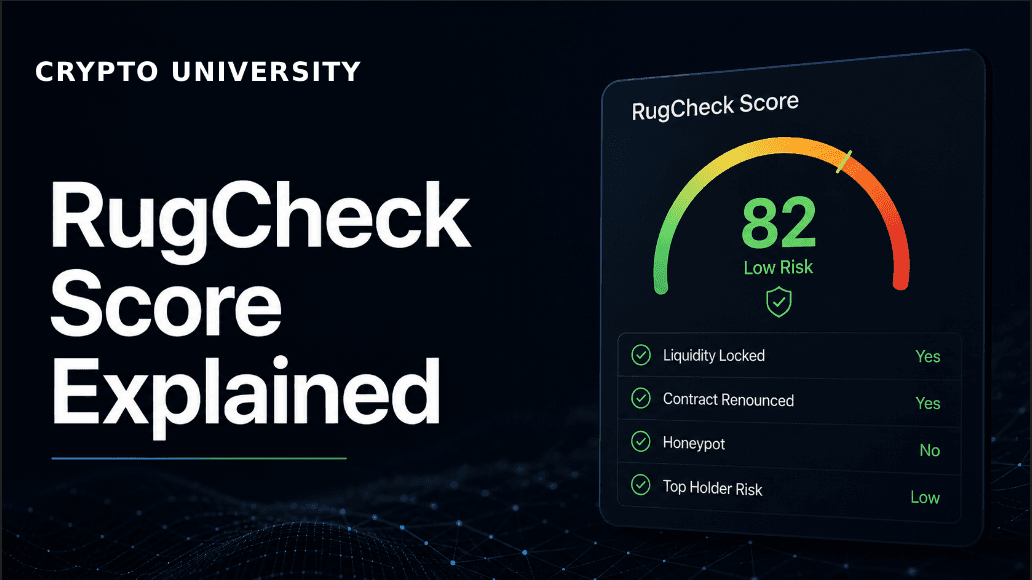
A RugCheck score is a quick summary of the risks it detected. It is not a prediction that a token will rug, and it is not a signal that a token is safe to buy.
The detailed flags underneath the score, like mint authority, liquidity and holder concentration, tell you far more than the single number or colour on top.
Even a perfect score can still rug if insiders quietly control the supply. Your own research and judgement are what actually make the decision.
What the RugCheck Score Actually Is
The RugCheck score is a summary of the token risks the tool managed to detect. That is all it is, and it helps to be clear about what it is not.
It is not the probability that a token will rug. It is not an investment rating. And it is not a prediction of where the price is heading.
What the score really does is squeeze a lot of on-chain findings into one fast signal you can glance at. The detailed findings sitting underneath that signal are the part that truly matters, so try not to stop at the headline number.
Think of It Like a Car Dashboard
The easiest way to picture the score is to imagine the dashboard in your car. When a warning light switches on, it is telling you that something deserves your attention. That is genuinely useful. But that little light cannot tell you everything.
A dashboard light will not tell you how much the repair will cost, whether the car is even worth buying, whether the person selling it to you is honest, or whether a second problem is hiding somewhere you cannot see.
RugCheck works in exactly the same way. It points at the things worth checking. It does not make the decision for you.
The Common Risk Levels
RugCheck can change its wording and layout over time, but findings are usually grouped by how serious they are. Here is how the levels tend to break down.
Risk level | What it means | Typical examples |
|---|---|---|
Critical or high | Issues that can directly hurt holders. Stop and understand them before going any further. | Dangerous authority controls, suspicious liquidity, extreme supply concentration, obvious launch manipulation, known scam links |
Warning or medium | Might be perfectly fine depending on context, but you need a good explanation first. | Changeable metadata, notable holder concentration, unlocked allocations, odd wallet activity, thin liquidity, a very new market |
Informational or low | Extra background that adds context. Usually not dangerous on its own. | Minor notes that simply help you understand the token better |
A high-risk finding is your cue to pause the whole process until you understand what it means.
The Main Flags in Plain English
These are the warnings you will bump into most often. For each one, the smart move is to ask a follow-up question rather than react on instinct.
Flag | What it means | The question to ask |
|---|---|---|
Mint authority enabled | Someone may still be able to create more tokens. | Who controls it, and why has it not been turned off? |
Freeze authority enabled | Someone may be able to freeze token accounts. | Is this a regulated asset with a real reason, or a meme coin where freezing makes no sense? |
High holder concentration | A few wallets hold a large slice of the supply. | Are those wallets liquidity pools, burn addresses, vesting contracts, exchanges or insiders? |
Low liquidity | The token may be hard to sell without a big price drop. | How much can I actually cash out, ignoring the flashy market cap? |
Unlocked or removable liquidity | The liquidity provider could pull the pool. | Who controls the LP, and how long is any lock genuinely valid? |
Bundled supply | Several wallets grabbed supply together at launch. | Are these real independent buyers, or one person spread across many wallets? |
Mutable metadata | The token's name and image can be changed. | Does the team still need this power, and could it be used to impersonate something? |
Insiders detected | Linked wallets appear to hold meaningful supply. | What percentage could those wallets dump at the same time? |
Why a Good Score Can Still Rug
Here is the uncomfortable truth: a team does not need any malicious code to walk away with your money. They can simply sell.
A token can have revoked authorities, burned liquidity, clean metadata, no obvious blacklist and a strong RugCheck rating, and still collapse because insiders own the supply through wallets that look completely unrelated.
These economic rugs are often far simpler than the technical ones. The founders and early buyers just sell into public demand. No clever contract exploit is needed at all, which is exactly why the score alone cannot protect you.
Why a Bad Score Is Not Always a Scam
It cuts the other way too. Some perfectly legitimate tokens keep certain controls switched on for good reasons. A warning simply means a power exists. Your job is to work out whether that power is justified and safely governed.
Projects that may legitimately keep controls include:
Stablecoins that need freezing powers for compliance.
Regulated tokenised securities.
Upgradeable protocols.
Games that mint in-app assets.
Projects with treasury allocations.
Tokens still finishing a staged launch.
Do Not Compare Scores Across Unrelated Tokens
A stablecoin, a governance token, a meme coin and a gaming asset all have very different requirements, so comparing their scores side by side rarely makes sense.
An active freeze authority might be a dealbreaker on a meme coin, yet completely expected on a regulated dollar token. High concentration can be normal for a vesting contract, but alarming when an anonymous creator holds the keys. Context changes everything about how you read a flag.
A Better Way to Score a Token
Instead of leaning on one number, split your thinking into three separate scores. RugCheck is strongest on the first two. The third one is on you.
Score | What you are checking | Who does the work |
|---|---|---|
1. Contract and authority risk | Mint authority, freeze authority, upgrade controls, metadata, blacklist functions | RugCheck handles this well |
2. Market-structure risk | Liquidity depth, LP ownership, holder concentration, bundled wallets, volume quality, price impact | RugCheck handles this well |
3. Human and operational risk | Team history, funding, communication, audits, multisig, incident response, legal structure, paid promotion | You must research this yourself |
A Practical Decision Table
When you are staring at a report and not sure what to do, this quick reference can help you act with a clearer head.
What you see | What to do |
|---|---|
Active mint authority with no clear reason | Avoid |
Freeze authority on an anonymous meme coin | Avoid |
Creator controls removable liquidity | Avoid |
Top connected wallets dominate the supply | Avoid, or size extremely small |
Low liquidity relative to your position | Reduce your size |
Clean scan but an anonymous team | Keep researching |
Clean scan and deep liquidity | Still inspect the holders and the deployer |
Different scanners disagree | Assume the higher risk |
The One Rule to Remember
Never let a single green label overrule what the market is plainly telling you.
If a token shows a fifty million dollar valuation with only eighty thousand dollars of liquidity, anonymous founders, paid influencers and clustered holders, then the score is not your biggest problem. The score is only a filter. Your judgement is the actual decision.
Frequently Asked Questions
Is a high RugCheck score a signal to buy?
No. A good score only means the tool did not detect obvious technical dangers. It says nothing about whether the price will go up, or whether insiders plan to sell. Treat it as one filter among many, never as a buy signal.
Can a token with a perfect score still rug?
Yes. If insiders hold a big chunk of the supply through wallets that look unrelated, they can simply sell into demand and crash the price. No malicious code is needed, so a clean score cannot rule this out on its own.
Does a bad score always mean a scam?
Not necessarily. Some legitimate projects, like stablecoins or regulated tokens, keep certain controls for valid reasons. A warning just flags that a power exists. Your job is to decide whether that power is justified and safely managed.
What single flag should worry me the most?
There is no one flag that matters above all others, because context changes everything. That said, an active mint authority with no explanation, removable liquidity controlled by the creator, or a handful of wallets dominating the supply are all strong reasons to step back.
Should I trust one scanner or use several?
Use more than one where you can, and inspect the holders and deployer yourself. If two scanners disagree, assume the higher risk. Tools are a starting point, not the final word.
What does the score not cover?
It cannot see the human side: team history, funding, communication, audits, legal structure or paid promotion. That research is entirely up to you, and it is often where the real risk hides.
Research Notes and Sources
RugCheck live token reports and platform: rugcheck.xyz
RugCheck API schema and risk objects: api.rugcheck.xyz/swagger
Community RugCheck integrations and wrapper output were reviewed to understand individual risk weights and labels.
SolRugDetector research: arxiv.org/abs/2603.24625
Disclaimer: This content is for educational and informational purposes only and is not financial advice. Nothing here is a recommendation to buy or sell any asset or use any platform. Do your own research and manage your risk.
RugCheck Explained: How Beginners Can Use This Free Solana Token Safety Tool
How to Cash Out Crypto in Dubai in 2026
How to Get Started on Robinhood Chain: A Complete Beginner's Guide
Best Robinhood Chain Trading Platforms in 2026: FOMO, GMGN, Uniswap and OpenSea Compared
Need deeper training?
Join our structured modules with live examples and expert checklists for effective implementation.
JOIN THE ACADEMY