Key Takeaways
✓ AI agents in DeFi can scan multiple protocols simultaneously, execute trades, and rebalance portfolios around the clock without human input. |
✓ Real-world asset (RWA) tokenization is using AI to automate valuation, compliance checking, and liquidity management of physical assets brought on-chain. |
✓ AI in DeFi introduces real risks, including model errors, oracle manipulation, and over-automation. Human oversight and governance guardrails remain important. |
What Is an AI Agent in a DeFi Context?
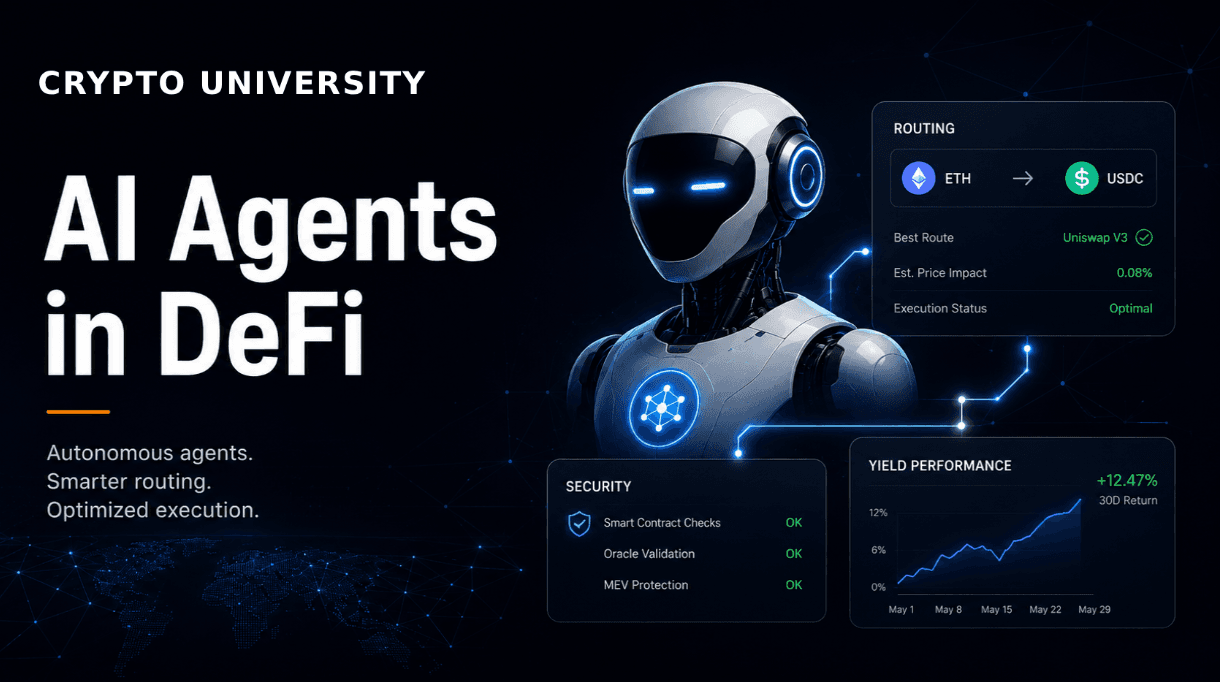
Before diving into use cases, it helps to understand what an AI agent actually is. In decentralized finance, an AI agent is autonomous software that can observe its environment, make decisions based on that data, and take actions on a blockchain without requiring a human to approve each step.
This is different from a traditional trading bot. A bot typically follows fixed rules: if price goes above X, sell Y. An AI agent, by contrast, can learn from historical data, adapt to changing conditions, and execute multi-step strategies across multiple protocols in real time.
The term DeFAI (Decentralized Finance AI) has emerged to describe this convergence. It is not a single platform or protocol but a growing category of tools and services that layer artificial intelligence on top of existing DeFi infrastructure.
Why DeFi Is a Natural Fit for AI Agents
DeFi operates 24 hours a day, seven days a week. Prices move in seconds. Yield rates on lending platforms like Aave fluctuate constantly as supply and demand shift. No human can monitor all of this in real time across dozens of protocols and chains simultaneously.
This is exactly the kind of environment AI agents are built for. They can:
Process thousands of data points per second from on-chain and off-chain sources
Execute complex multi-step transactions within a single block on fast chains
Rebalance positions automatically based on predefined risk parameters
Operate across multiple blockchains without needing manual bridging decisions
Overview: Common AI Agent Use Cases in DeFi
The table below summarizes the main areas where AI agents are being applied, along with real-world examples as of mid-2026.
Use Case | What It Does | Real Examples |
Yield Optimization | Scans multiple protocols and auto-moves capital to highest-returning pools | Yearn Finance, BrahmaFi Morpho Agents, PancakeSwap AI tools |
Automated Arbitrage | Detects and executes cross-exchange price gaps in milliseconds | Flash loan agents on Solana, Fetch.ai trading agents |
Collateral Monitoring | Watches loan-to-value ratios and adds collateral before liquidation | Gauntlet, Chaos Labs (Aave, Compound parameters) |
RWA Compliance Checks | Verifies on-chain KYC and eligibility before token transfers | IXS regulated investment layer, Centrifuge, Maple Finance |
Oracle Data Validation | Cross-references price feeds to filter out manipulated inputs | AI-enhanced Chainlink-style oracles, Compound lending feeds |
Governance Automation | Monitors proposals and executes pre-approved votes on behalf of holders | Olas protocol, Theoriq agent swarms |
Use Case 1: Yield Optimization Across Protocols
One of the most active areas for AI agents in DeFi is yield farming. Traditional yield farming requires a user to manually move funds between lending platforms, liquidity pools, and reward farms to chase the best return. This is time-consuming, gas-intensive, and easy to get wrong.
AI agents change that by scanning protocols continuously. An agent might track lending rates on Aave and Compound, liquidity pool fees on Curve and Uniswap, and staking rewards across multiple chains simultaneously. When one opportunity becomes more attractive than another, the agent moves the funds automatically.
Some practical examples:
Yearn Finance pioneered automated yield aggregation by routing deposited assets to the highest-performing strategy available, adjusting as conditions change.
PancakeSwap launched AI-powered tools in early 2026 that allow agents to assess liquidity positions and compare yield farming opportunities across eight blockchains at once.
Uniswap Labs released open-source tools that enable agents to handle swaps and liquidity management on Uniswap v4 without manual input.
BrahmaFi Morpho Agents had accumulated over $20 million in total value locked on Base by mid-2025, demonstrating real capital flowing into AI-managed strategies.
Agents also reduce gas costs by batching operations. Instead of harvesting yields, swapping rewards, and redepositing in three separate transactions, an agent can combine them into one. This reportedly reduces gas costs by a significant margin compared to manual management.
Use Case 2: Automated Arbitrage and Flash Loans
Arbitrage is the practice of exploiting price differences for the same asset across different markets. In traditional finance, this is the domain of large institutions with fast infrastructure. In DeFi, AI agents can do it at a much smaller scale but at tremendous speed.
On high-throughput chains like Solana, AI-powered trading agents can execute over 1,000 transactions per second. They scan decentralized exchanges (DEXs), identify price discrepancies, calculate whether the opportunity covers gas and bridge fees, and execute the trade within milliseconds.
A related tool is the flash loan: a loan borrowed and repaid within a single blockchain transaction. AI agents can use flash loans to fund arbitrage trades without requiring any upfront capital. The agent borrows, executes the trade across two markets, repockets the profit, and repays the loan in one atomic transaction.
It is worth noting that flash loans are also frequently used in exploits. They amplify both legitimate strategies and malicious ones, which is part of why AI-driven risk monitoring (covered below) has become equally important.
Use Case 3: Collateral Monitoring and Liquidation Prevention
In DeFi lending protocols, users deposit collateral to borrow other assets. If the value of their collateral falls too far relative to their loan, the protocol liquidates their position, often at a penalty.
AI agents are being used to prevent this from happening. By monitoring collateral ratios around the clock, an agent can automatically top up a position with additional collateral before it reaches the liquidation threshold, or move funds to reduce risk exposure during volatile market periods.
On the protocol level, risk providers such as Gauntlet and Chaos Labs use simulation-driven approaches to help protocols like Aave and Compound set safer parameters. These systems analyze historical on-chain behavior and stress-test collateral ratios and interest rate curves under adverse scenarios. The result is that protocol parameters are updated more dynamically instead of relying solely on governance votes after problems appear.
Use Case 4: AI Agents in Real-World Asset (RWA) Workflows
Tokenized real-world assets are physical or financial assets, such as real estate, government bonds, private credit, and commodities, that are represented as tokens on a blockchain. This space has grown significantly. As of early 2026, tokenized private credit stood at roughly $16.8 billion, and tokenized commodities had reached approximately $7.3 billion in total market value, according to widely cited industry estimates.
AI agents are being applied at several stages of the RWA workflow:
Asset Valuation
Before an asset can be tokenized, it needs to be valued. AI agents can process historical market data, economic indicators, and asset-specific information to generate valuations faster and at lower cost than manual appraisal processes.
Compliance and Eligibility Checks
Many tokenized RWAs are regulated instruments that can only be held by verified investors. AI agents can check on-chain identity credentials and eligibility requirements before approving a transfer, reducing the manual compliance workload.
Liquidity Management
Platforms like IXS have built regulated investment layers designed for AI agents that can hold, manage, and transact tokenized assets autonomously. Centrifuge and Maple Finance enable businesses to tokenize real-world credit assets and use smart contracts to automate income distribution, removing significant administrative overhead.
A notable milestone occurred in early 2026 when BlackRock's BUIDL fund entered DeFi rails via Uniswap, allowing a regulated tokenized fund to serve as collateral in decentralized lending protocols. This illustrates how AI-assisted RWA workflows are beginning to connect institutional finance with DeFi infrastructure.
Use Case 5: Oracle Data Validation and Fraud Detection
Oracles are the systems that feed external data, such as asset prices, into smart contracts. If an oracle is manipulated, the protocol relying on it can make incorrect decisions.
AI agents are increasingly being used to strengthen oracles by cross-referencing data from multiple sources simultaneously. If one price feed deviates significantly from others, the agent can flag or ignore that data point rather than letting it trigger an erroneous transaction.
On the fraud detection side, AI systems can monitor wallet behavior patterns, identify anomalous transaction sequences, and flag potential rug pulls by detecting warning signs like sudden large liquidity withdrawals or unusual token minting activity.
Risks of AI Agents in DeFi: What You Should Understand
AI agents in DeFi are not without significant risks. The same properties that make them useful, speed and autonomy, can amplify losses when things go wrong.
Risk Category | Description | Mitigation Approaches |
Model Error | AI makes wrong predictions based on incomplete or biased training data | Human-in-the-loop oversight, governance guardrails |
Oracle Manipulation | Agents act on false price data injected into data feeds | Cross-referencing multiple oracles, on-chain verification |
Prompt Injection | Malicious inputs redirect agent behavior in unintended ways | Sandboxed execution environments, input validation |
Over-Automation | Cascading automated actions amplify losses during volatility | Position limits, circuit breakers, spending caps |
Smart Contract Risk | Bugs in the agent or protocol code lead to fund loss | Audited code, phased rollouts, bug bounties |
Regulatory Ambiguity | Agents may be classified as unlicensed financial advisors | Legal counsel, staying within user-controlled parameters |
DeFi hacks and exploits resulted in over $3.1 billion in losses between 2024 and 2025, according to widely reported industry data. Flash loan attacks accounted for a large share of those incidents. AI agents do not eliminate these risks. In some configurations, they may even accelerate them.
One specific concern is prompt injection: a type of attack where malicious content in a data source causes an AI agent to take unintended actions. As agents become more autonomous and interact with more external data, this attack surface grows.
Regulatory questions are also unresolved. Depending on how they are structured, AI agents that make trading decisions could be classified as financial advisors or investment managers in some jurisdictions, triggering compliance requirements. The legal landscape is still forming.
The State of AI Agent Adoption in DeFi: 2025 to 2026
As of mid-2026, AI agents in DeFi have moved from purely experimental to live production in several areas. The shift is most visible in:
Yield optimization tools from established protocols like Uniswap and PancakeSwap
Risk management services used by major lending protocols to tune parameters
RWA platforms that automate compliance, income distribution, and collateral use
On-chain arbitrage agents operating at high frequency on fast Layer-1 chains
Wider adoption faces real constraints. Gas costs and bridge fees make AI agents most economically sensible for portfolios above a meaningful minimum size. Below that threshold, transaction costs can erode any yield improvement. Layer 2 solutions are reducing this barrier, but it remains relevant.
The global AI agent market is projected to grow from roughly $7.84 billion in 2025 to over $52 billion by 2030, according to MarketsandMarkets estimates. DeFi is one segment of that broader trend, but it is one where the combination of open data, programmable money, and autonomous execution makes the technology particularly applicable.
Frequently Asked Questions
What is an AI agent in DeFi?
An AI agent in DeFi is autonomous software that connects to blockchain protocols, collects data, makes decisions based on that data, and executes transactions without requiring a human to approve each action. It is more adaptive than a traditional trading bot, which only follows fixed rules.
What is DeFAI?
DeFAI stands for Decentralized Finance AI. It refers to the broader category of products and protocols that combine artificial intelligence with DeFi infrastructure, covering everything from yield optimization agents to AI-powered oracle validation systems.
Can AI agents in DeFi lose money?
Yes. AI agents operate based on models and data, both of which can be wrong. Model errors, manipulated oracle feeds, smart contract bugs, and fast-moving market conditions can all result in financial losses. Users should understand these risks before deploying capital through any AI-managed strategy.
What is a real-world asset (RWA) in crypto?
A real-world asset (RWA) is a physical or financial asset, such as real estate, bonds, private credit, or commodities, that has been tokenized and represented on a blockchain. Tokenization allows these assets to be traded, used as collateral, or managed programmatically within DeFi protocols.
Are AI agents in DeFi regulated?
This varies by jurisdiction and is still evolving. Some regulatory bodies may classify AI agents that make autonomous financial decisions as investment advisors or asset managers, which would trigger licensing requirements. Users and developers should monitor regulatory developments in their region.
What is a flash loan?
A flash loan is a type of uncollateralized loan available in DeFi that must be borrowed and repaid within a single blockchain transaction. AI agents can use them to fund arbitrage strategies without upfront capital. They are also frequently used in exploits, making them a tool with significant dual-use potential.
Which protocols are using AI agents today?
As of mid-2026, documented examples include PancakeSwap (AI yield tools across 8 chains), Uniswap (open-source agent tooling for v4), BrahmaFi (Morpho agents on Base), Fetch.ai (trading agents on DEXs), Gauntlet and Chaos Labs (risk management for Aave and Compound), Centrifuge and Maple Finance (RWA credit platforms), and IXS (regulated AI agent investment layer). This list continues to grow.
Disclaimer: This content is for educational and informational purposes only and is not financial advice. Nothing here is a recommendation to buy or sell any asset or use any platform. Do your own research and manage your risk.
Read More
AI + Crypto Convergence in 2026: What It Means for Web3 Developers and Users
AI Meets DAOs: How Artificial Intelligence Is Changing On-Chain Governance in 2026
Real-World Asset Tokenization Hits $31 Billion: What It Means for On-Chain Finance
Need deeper training?
Join our structured modules with live examples and expert checklists for effective implementation.
JOIN THE ACADEMY