Key Takeaways
1. Web3 was a broad vision for a decentralized internet. That vision has largely stalled, with most consumer blockchain apps failing to reach meaningful adoption.
2. DeFi (Decentralized Finance) and DePIN (Decentralized Physical Infrastructure Networks) are the two sectors that have demonstrated measurable, real-world usage and revenue.
3. Understanding the difference between DeFi and DePIN helps you read the crypto landscape more clearly and assess where genuine innovation is happening.
What Was Web3?
Web3 became a popular term around 2020 and 2021. The core idea was straightforward: build a new version of the internet where users own their data, control their digital identities, and participate in platforms without depending on corporations like Google, Meta, or Amazon.
The early vision included decentralized social media, blockchain-based games where players truly owned in-game items, creator economies run by tokens, and decentralized autonomous organisations (DAOs) replacing traditional companies.
It was an ambitious idea. It also attracted enormous amounts of investment and media attention. But by 2024 and 2025, most of those projects had failed to retain users. Blockchain gaming attracted speculation, not sustainable players. Decentralized social apps remained tiny compared to mainstream platforms. NFT trading volumes, which peaked in 2021, collapsed and never recovered to those levels.
This does not mean blockchain technology itself failed. What failed was a specific narrative: that ordinary internet users would switch to blockchain-powered apps for the same reasons they use regular apps. That transition largely did not happen.
What is DeFi?
DeFi stands for Decentralized Finance. It refers to a category of financial services built on public blockchains, primarily Ethereum, that operate through smart contracts rather than banks, brokers, or other traditional intermediaries.
A smart contract is a piece of code that executes automatically when certain conditions are met. It does not require a human or a company to approve and process the transaction. This means two people or entities can lend, borrow, trade, or earn yield without a bank sitting in the middle.
What can you actually do in DeFi?
Trade tokens: Decentralized exchanges (DEXs) like Uniswap allow users to swap one cryptocurrency for another without a centralized company controlling the order book.
Lend and borrow: Platforms like Aave and Compound let users deposit assets to earn interest or borrow against collateral, all managed by code on-chain.
Earn yield: Liquidity providers deposit asset pairs into pools and earn a share of trading fees.
Trade derivatives: Platforms like Hyperliquid let users trade perpetual contracts in a decentralized environment.
DeFi is permissionless: anyone with an internet connection and a compatible crypto wallet can access these services without identity verification or account approval. Transactions are recorded on a public blockchain, making them transparent and auditable.
DeFi is not risk-free. Smart contract bugs have led to significant losses. Users are responsible for managing their own private keys, and there is no customer service number to call. But the core proposition, financial services that run on code with no central gatekeeper, has demonstrated real and sustained demand.
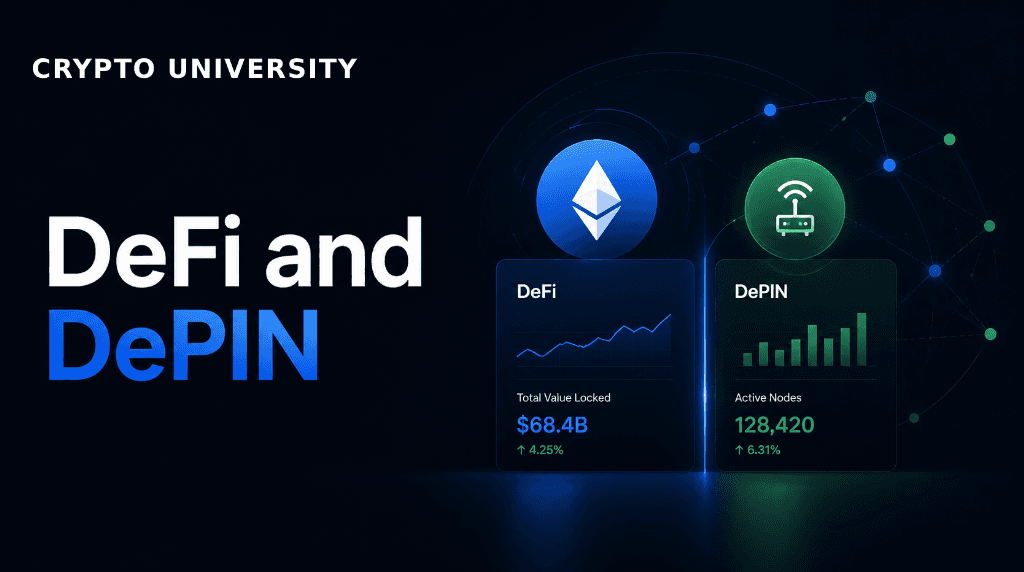
DeFi at a Glance
Aspect | Detail |
|---|---|
What it is | Financial services built on public blockchains using smart contracts |
Key activity | Trading, lending, borrowing, yield generation |
Who controls it | Code (smart contracts), not companies or banks |
Main chains | Ethereum, Solana, and others |
Examples | Uniswap, Aave, Compound, Hyperliquid |
Who can access it | Anyone with a crypto wallet and internet connection |
What is DePIN?
DePIN stands for Decentralized Physical Infrastructure Networks. This is a newer concept that applies blockchain incentives not to digital finance, but to the real world.
The idea works like this: instead of a large company like Amazon, Google, or a telecoms operator owning and running physical infrastructure (servers, wireless towers, mapping systems, energy grids), a decentralized network of individual contributors provides that infrastructure. They are rewarded with cryptocurrency tokens for their participation.
Think of it as the blockchain version of a cooperative. No single company owns the network. Instead, thousands of individuals each contribute a small piece of hardware, bandwidth, or computing power, and the blockchain coordinates them and handles payments automatically.
Real DePIN projects in operation today
Helium: Individuals deploy wireless hotspots in their homes or businesses. These hotspots provide wireless coverage for IoT devices and, through a partnership with T-Mobile, mobile connectivity. Contributors earn tokens in return.
Filecoin: Users share unused hard drive space to provide decentralized cloud storage. Anyone can store files on the network, and providers earn Filecoin tokens.
Render Network: Owners of GPUs (graphics cards) contribute their idle computing power to render 3D graphics and digital content for creators and studios.
Hivemapper: Drivers fit dashcams that capture street-level imagery while driving. The images feed into a decentralized mapping database. By 2025, Hivemapper had mapped over 400 million kilometres of streets, funded by token rewards to contributors.
Akash Network: A decentralized marketplace for cloud computing, where providers offer spare computing capacity to users who need it at lower cost than centralised providers.
What makes DePIN compelling is that it addresses real-world demand for infrastructure that currently costs a lot when provided by monopolised or oligopolised industries. Cloud storage, GPU compute, wireless connectivity, and mapping data are all large markets with established demand.
DePIN at a Glance
Aspect | Detail |
|---|---|
What it is | Blockchain-coordinated networks of physical hardware contributors |
Key activity | Providing real-world services: storage, compute, wireless, mapping, energy |
Who controls it | Distributed contributors; protocol governs rewards |
Main chains | Solana, Ethereum L2s, Filecoin's own chain |
Examples | Helium, Filecoin, Render, Hivemapper, Akash |
Who can participate | Anyone with compatible hardware (hotspot, GPU, storage, dashcam) |
DeFi vs DePIN: How They Differ
Both DeFi and DePIN use blockchains and tokens. But they target completely different problems.
Category | DeFi | DePIN |
|---|---|---|
Primary focus | Financial services | Physical infrastructure services |
What it replaces | Banks, exchanges, brokers | Telecoms, cloud providers, mapping firms |
Where it operates | Entirely on-chain (digital) | On-chain coordination + off-chain hardware |
What participants provide | Capital (liquidity) | Physical resources (compute, storage, bandwidth) |
Token role | Governance, yield, trading | Rewards for hardware contributions |
Proof of value | Trading volume, TVL (total value locked) | Real-world usage and service revenue |
Key risk | Smart contract exploits, market volatility | Hardware costs, token volatility, regulatory |
Why Samani Said "Web3 Is Dead"
Samani's claim is not that crypto itself is over. He remains, by his own description, heavily invested in Solana and the broader crypto space. His argument is more specific: the original Web3 vision, building consumer apps that compete with mainstream internet services on blockchains, has failed to produce real traction.
The numbers support a cautious reading of that claim. Most blockchain-based social networks remain tiny compared to their centralised equivalents. Many Web3 gaming projects shut down after initial excitement faded. NFT projects that promised ongoing utility delivered little. Attempts to build 'decentralized YouTube' or 'decentralized Twitter' have not produced products that ordinary users choose over existing alternatives.
Samani argues that DeFi and DePIN are different because they each solve a clear, measurable problem. DeFi provides financial access and services that run transparently on code. DePIN coordinates real-world hardware into useful networks. Both have demonstrable demand. Neither depends on the premise that users want their social media to run on a blockchain.
Not everyone agrees with the conclusion. Other voices in the industry point to real-world asset tokenisation (RWAs), prediction markets, and AI-driven on-chain applications as areas that still fit the Web3 label and are growing. The debate reflects a genuine disagreement about what blockchain is actually useful for, which is a healthy and important conversation.
Why This Debate Matters for Builders and Learners
If you are learning about crypto or building something in this space, Samani's framing is a useful lens. It pushes past hype and asks: what problem does this actually solve? Who uses it? Does it have real demand, or does it rely on the expectation that users will eventually show up?
DeFi and DePIN both pass a basic test: they address problems that existed before crypto. Expensive, gated financial services. Centralised, expensive infrastructure providers. Whether blockchain is always the best solution to those problems is a legitimate debate, but the problems themselves are real.
Web3 gaming, decentralised social media, and token-gated communities have not yet demonstrated that they solve a problem users urgently need solved. That does not mean they never will. It means they have not yet.
Understanding this distinction helps you evaluate any new crypto project with clearer questions: What real-world demand does this address? What would happen to users if the blockchain layer were removed? Does the token serve the network, or is the network an excuse for a token?
Ready to go deeper? Enroll in our DeFi Fundamentals module at Crypto University.
FAQ
Is Web3 actually dead?
The term 'Web3 is dead' reflects a view held by some industry figures, including Multicoin Capital co-founder Kyle Samani, that the broad vision of a decentralised consumer internet has not materialised. Most blockchain-based consumer apps have not reached meaningful adoption. However, specific sectors within crypto, especially DeFi and DePIN, continue to grow and generate real usage. Whether you call this the death of Web3 or a refinement of it depends on how you define the term.
What is the difference between Web3, DeFi, and DePIN?
Web3 is the broad concept of a decentralised internet, covering everything from social media to gaming to finance. DeFi is a specific category focused on financial services, such as lending, trading, and borrowing, operated through smart contracts. DePIN is a category focused on building and coordinating real-world physical infrastructure, such as wireless networks, storage, and computing, using blockchain-based incentives.
Do I need tokens to use DeFi?
Yes. To interact with DeFi protocols, you typically need a compatible cryptocurrency (usually ETH or a stablecoin) and a crypto wallet. Most DeFi platforms are permissionless, meaning anyone can use them without identity verification, but you do need to manage your own wallet and understand the risks involved.
Can ordinary people participate in DePIN?
Yes, depending on the network. Some DePIN projects (like Helium) require you to purchase and operate specific hardware. Others (like certain storage or compute networks) can be accessed using hardware you may already own. The barrier to entry varies by project, and token rewards fluctuate with the market. DePIN participation carries risks including hardware costs and token price volatility.
Is DeFi regulated?
DeFi regulation varies by country and is evolving rapidly. In many jurisdictions, DeFi protocols currently operate in a grey area because they do not have a traditional legal entity to regulate. Regulators in the EU, the US, and elsewhere are developing frameworks that may affect DeFi protocols, stablecoins, and decentralised exchanges. This article is educational, not legal advice; consult a qualified professional for guidance on your situation.
What is Kyle Samani's background?
Kyle Samani is a co-founder of Multicoin Capital, a US-based crypto investment firm known for early investments in Solana, Helium, and other crypto infrastructure projects. In 2026 he stepped back from day-to-day management at Multicoin and became chairman of Forward Industries, a Solana-focused company. His June 2026 statement that 'Web3 is dead' sparked significant discussion within the industry.
Disclaimer: This content is for educational and informational purposes only and is not financial advice. Nothing here is a recommendation to buy or sell any asset or use any platform. Do your own research and manage your risk.
Read More
DeFi Risk Management 101: How to Protect Your Portfolio From Protocol Failures
Cross-Chain Bridges: A Plain-English Guide to How They Work and When to Avoid Them
AI + Crypto Convergence in 2026: What It Means for Web3 Developers and Users
AI Meets DAOs: How Artificial Intelligence Is Changing On-Chain Governance in 2026
Need deeper training?
Join our structured modules with live examples and expert checklists for effective implementation.
JOIN THE ACADEMY