Key Takeaways:
Withdrawal fees are charged by exchanges when you move cryptocurrency off their platform and vary by asset, network, and exchange.
These fees are separate from trading fees and can significantly affect your total cost, especially for smaller transfers.
Choosing the right withdrawal network and timing transfers strategically can reduce these costs.
Most crypto beginners focus on trading fees when comparing exchanges. But there is another cost that often goes unnoticed until it shows up as a surprise deduction: withdrawal fees.
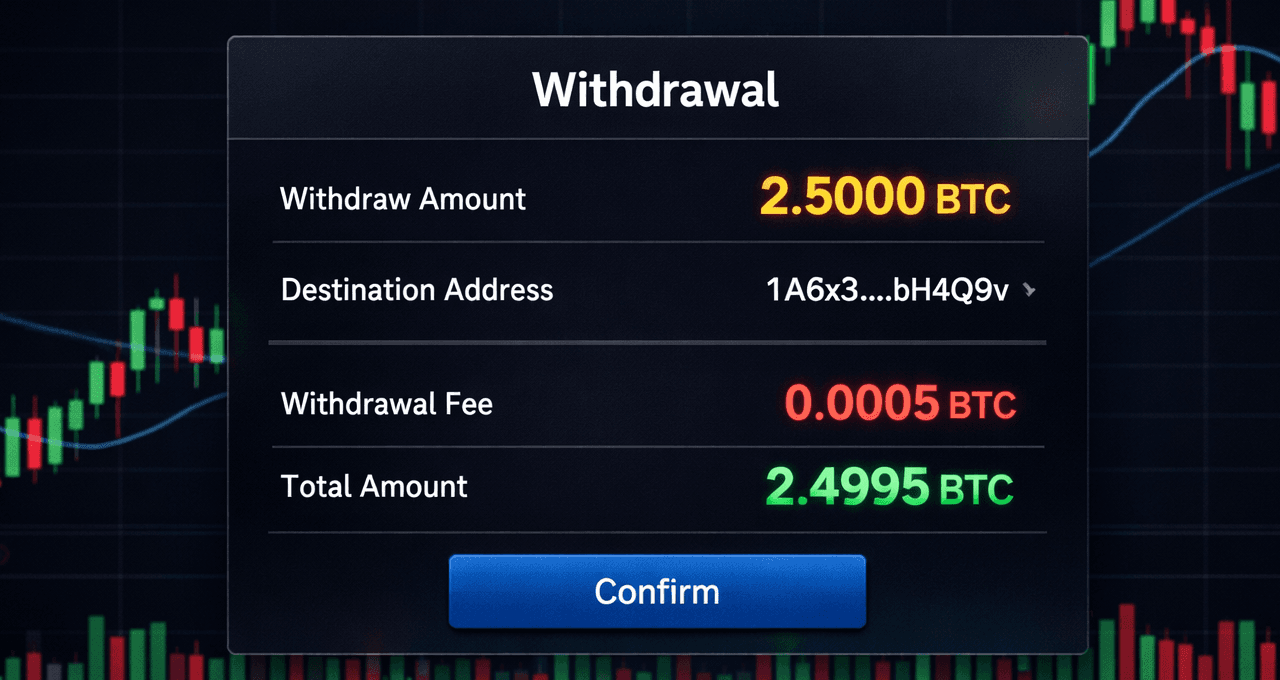
Withdrawal fees are charged when you move cryptocurrency from an exchange to an external wallet or another platform. They are separate from trading fees, and depending on the asset and the network you use, they can range from negligible to surprisingly large relative to the amount you are transferring.
Understanding how they work is an important part of calculating your true cost of trading.
What Is a Withdrawal Fee?
A withdrawal fee is an amount deducted from your transfer when you send cryptocurrency from a centralised exchange to an external address.
This fee serves two purposes:
Network fee (gas or miner fee): The cost of processing the transaction on the blockchain. This goes to validators or miners, not the exchange.
Exchange markup: Some exchanges add a margin on top of the actual network cost. This portion goes to the exchange.
Not all exchanges are transparent about how much of the withdrawal fee is the actual network cost versus their markup. It is worth checking.
Why Do Withdrawal Fees Vary So Much?
Withdrawal fees differ based on several factors:
The asset you are withdrawing Bitcoin withdrawals typically cost more than withdrawals of assets on cheaper networks. Ethereum withdrawals during periods of high network activity (high gas) can be expensive.
The network you choose Many tokens exist on multiple blockchains. For example, USDT (Tether) is available on Ethereum (ERC-20), Tron (TRC-20), BNB Chain (BEP-20), and others. Each network has different transaction costs.
Network congestion Blockchain fees fluctuate based on demand. During busy periods, network fees rise. This directly affects withdrawal costs on networks where the exchange passes on real-time gas costs.
The exchange's fee policy Some exchanges set flat withdrawal fees. Others pass on the actual network cost dynamically. The approach differs by platform.
Common Withdrawal Fee Examples
The following figures are approximate and widely reported estimates. Actual fees change frequently based on network conditions and exchange policies. Always check the current fee on the exchange's withdrawal page before transacting.
Asset | Network | Approx. Withdrawal Fee |
Bitcoin (BTC) | Bitcoin | 0.0002 to 0.0005 BTC |
Ethereum (ETH) | Ethereum | 0.001 to 0.005 ETH |
USDT | Ethereum (ERC-20) | $5 to $15 equivalent |
USDT | Tron (TRC-20) | $0.50 to $2 equivalent |
USDT | BNB Chain (BEP-20) | $0.10 to $0.80 equivalent |
BNB | BNB Chain | Under $0.10 |
XRP | XRP Ledger | Very low (under $0.01) |
Solana (SOL) | Solana | Very low (under $0.05) |
The contrast between USDT on Ethereum versus USDT on Tron illustrates why network selection matters. The token is the same. The cost can be 10 times different or more.
How Withdrawal Fees Affect Your Real Costs
Withdrawal fees are most impactful when:
You are moving small amounts If you withdraw $50 worth of ETH and the withdrawal fee is $10, you are paying a 20% cost on top of any trading fees. That is significant.
You withdraw frequently Regular transfers add up. Ten withdrawals at $5 each is $50 gone before a single trade.
You are using expensive networks ERC-20 tokens on Ethereum during high-activity periods can make small transfers uneconomical.
Example: Total cost comparison for a $500 trade and withdrawal
Cost Type | Low-Cost Scenario | High-Cost Scenario |
Trading fee (0.1%) | $0.50 | $0.50 |
Withdrawal fee | $0.50 (TRC-20 USDT) | $12 (ERC-20 USDT) |
Total cost | $1 (0.2%) | $12.50 (2.5%) |
In the high-cost scenario, the withdrawal fee dwarfs the trading fee entirely.
How to Reduce Withdrawal Fees
Choose cheaper networks When withdrawing stablecoins or multi-chain tokens, check which networks the exchange supports. Tron (TRC-20), BNB Chain (BEP-20), and Solana are typically much cheaper than Ethereum (ERC-20).
Important: Make sure your destination wallet or exchange supports the same network. Sending TRC-20 USDT to an ERC-20 address will result in lost funds.
Consolidate withdrawals Instead of withdrawing small amounts frequently, accumulate and withdraw in fewer, larger transactions. The fee is usually fixed per transaction, not percentage-based, so larger transfers are proportionally cheaper.
Compare exchanges before choosing Withdrawal fees for the same asset can differ significantly between exchanges. If you plan to move funds regularly, this is worth factoring into your exchange selection.
Use assets with lower network fees If you are moving value rather than a specific asset, consider converting to a low-fee asset for the transfer, such as XRP, SOL, or a stablecoin on a cheap network, then converting at the destination if needed.
Time your Ethereum withdrawals Gas fees on Ethereum vary throughout the day and week. Tools like Etherscan's gas tracker show current and historical fee trends. Transacting during lower-activity periods can reduce costs.
The Hidden Cost of Minimum Withdrawal Amounts
Some exchanges set minimum withdrawal amounts. If you have a small balance below that threshold, you cannot withdraw it at all. This is a separate issue from the fee itself but worth knowing, especially for users who end up with dust balances in multiple assets.
Internal Exchange Transfers: Often Free
Some large exchanges offer internal transfer features that let you move funds between users on the same platform without paying a network fee. Binance Pay and Coinbase's internal transfer system are examples. If you are moving funds to someone who uses the same exchange, this can be a zero-cost option.
Withdrawal Fees vs Trading Fees: Which Matters More?
This depends on how you use the exchange.
If you trade frequently and rarely withdraw, trading fees dominate your costs.
If you trade infrequently but move funds often, withdrawal fees may matter more.
If you are making small, frequent transfers, withdrawal fees could easily exceed your trading costs.
The best approach is to calculate both when evaluating a platform.
FAQ
Are withdrawal fees the same as gas fees? Not exactly. Gas fees are the cost of processing a transaction on a blockchain and go to validators or miners. Exchanges may pass this cost on directly or add a markup. The total withdrawal fee you pay may include both.
Can I avoid withdrawal fees entirely? In most cases, no. Blockchain transactions require fees. However, you can reduce them significantly by choosing cheaper networks and consolidating transfers.
What happens if I choose the wrong network when withdrawing? If you send funds via the wrong network, for example TRC-20 USDT to an ERC-20 address, you may lose those funds permanently. Always confirm the destination wallet supports the network you select before confirming a withdrawal.
Why are Ethereum withdrawal fees so much higher than other networks? Ethereum's fee structure is based on network demand. During periods of high activity, gas fees rise significantly. Other networks like Solana and Tron were designed with lower transaction costs as a priority.
Do withdrawal fees change over time? Yes. Fees tied to network conditions fluctuate. Even flat fees set by exchanges can change based on their policies. Always check the current fee on the withdrawal page before transacting.
Disclaimer: This content is for educational and informational purposes only and is not financial advice. Nothing here is a recommendation to buy or sell any asset or use any platform. Do your own research and manage your risk.
More Read
Need deeper training?
Join our structured modules with live examples and expert checklists for effective implementation.
JOIN THE ACADEMY