Key Takeaways:
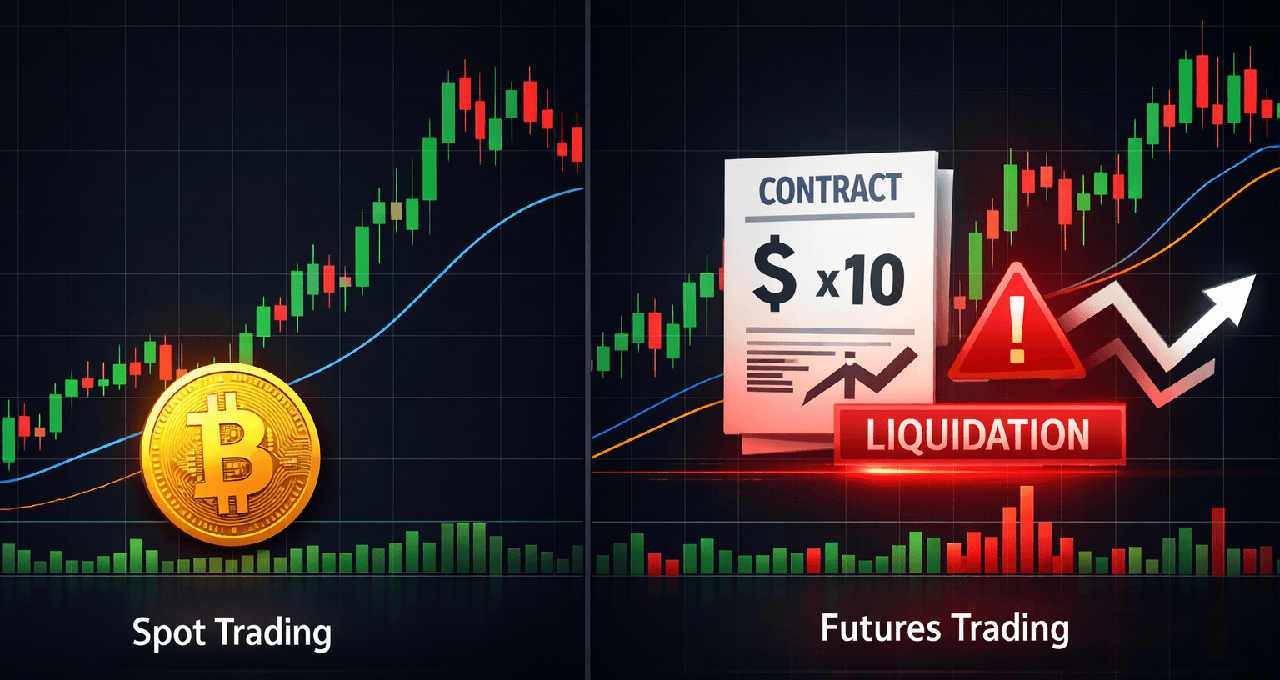
Spot trading involves buying and owning the actual asset; futures trading involves contracts that track the asset's price without requiring ownership.
Futures trading introduces leverage, which amplifies both potential gains and potential losses, including the risk of liquidation.
Spot trading is generally more straightforward and lower risk, making it a better starting point for beginners.
Spot Trading vs Futures Trading: Key Differences for Beginners
Two of the most common ways to trade cryptocurrency are spot trading and futures trading. They might look similar on the surface since both involve predicting whether a price goes up or down, but the mechanics, risks, and purposes are quite different.
This guide breaks down both approaches clearly so you can understand what each involves before deciding which is relevant to your situation.
What Is Spot Trading?
Spot trading means buying or selling a cryptocurrency at its current market price, with the transaction settling immediately or near-immediately. When you buy Bitcoin on a spot market, you receive actual Bitcoin. You own it. You can hold it, transfer it to a wallet, or sell it later.
Key features of spot trading:
You own the underlying asset
No expiry date on your position
No leverage by default (though some platforms offer margin on spot)
Risk is limited to what you put in
Simple to understand and execute
Spot markets are the foundation of most crypto exchanges. When someone says they "bought Ethereum," they usually mean on the spot market.
What Is Futures Trading?
Futures trading involves contracts that represent an agreement to buy or sell an asset at a specific price on a specific date, or in the case of perpetual futures, with no expiry date at all.
When you trade crypto futures, you are not buying or selling the actual cryptocurrency. You are trading a contract that tracks its price. This distinction has significant implications.
Key features of futures trading:
You do not own the underlying asset
Positions can be leveraged (more on this below)
You can profit from falling prices by going short
Contracts can have expiry dates or be perpetual
Higher complexity and higher risk
Crypto futures were popularised by platforms such as OKX and Bybit, and have since become a major portion of total crypto trading volume.
Spot vs Futures: Side-by-Side Comparison
Feature | Spot Trading | Futures Trading |
Asset ownership | Yes | No |
Leverage | Generally no | Yes (often 2x to 100x+) |
Short selling | Not directly | Yes |
Expiry | No expiry | Can be perpetual or dated |
Risk level | Lower | Higher |
Suitable for | Beginners and long-term holders | Experienced traders |
Settlement | Immediate | At expiry or via funding rate |
Liquidation risk | No | Yes |
What Is Leverage and Why Does It Matter?
Leverage lets you control a larger position than your actual capital would allow. For example, with 10x leverage, a $1,000 deposit lets you open a $10,000 position.
This sounds appealing, but the risks are proportional. If the market moves 10% against your position at 10x leverage, you lose your entire deposit. This is called liquidation, where the exchange automatically closes your position to prevent a negative balance.
Example of how leverage affects outcomes:
Scenario | Without Leverage (Spot) | With 10x Leverage (Futures) |
You deposit | $1,000 | $1,000 |
Position size | $1,000 | $10,000 |
Asset rises 10% | +$100 gain | +$1,000 gain |
Asset drops 10% | -$100 loss | -$1,000 loss (liquidated) |
The potential for amplified gains is why futures attract experienced traders. The risk of rapid liquidation is why they are not recommended for beginners.
What Are Perpetual Futures?
Most crypto futures trading today uses perpetual contracts, often called perps. Unlike traditional futures, perpetual contracts have no expiry date. You can hold the position as long as you want, provided you maintain sufficient margin.
To keep the perpetual contract price anchored to the spot price, exchanges use a mechanism called the funding rate.
How the funding rate works:
If the futures price is above the spot price, longs (buyers) pay a small fee to shorts (sellers)
If the futures price is below the spot price, shorts pay longs
This is usually settled every 8 hours
Funding rates can become significant during volatile or highly directional markets
Perpetual futures are the dominant product on most derivatives exchanges and represent a large portion of daily crypto trading volume.
Going Long vs Going Short
One major advantage of futures trading is the ability to profit from falling prices by opening a short position.
Long position: You profit if the price rises
Short position: You profit if the price falls
On spot markets, you can only profit from rising prices. You buy an asset, and if the price goes up, you sell at a profit. You cannot directly profit from a declining market on spot (without more complex strategies).
Futures traders can go short, which is why futures markets attract traders looking to hedge their spot holdings or speculate on downward moves.
Key Risks in Futures Trading
Liquidation If the market moves against your position and your account falls below a minimum margin threshold, the exchange liquidates your position automatically. You lose your margin.
Funding rate costs Holding a perpetual futures position in a trending market can become expensive due to recurring funding rate payments.
Complexity Futures involve understanding leverage, margin types (isolated vs cross), funding rates, and liquidation prices. Getting one of these wrong can result in significant losses.
Emotional pressure Leveraged positions move fast. A 5% market move at 10x leverage creates a 50% change in position value. Many beginners find this psychologically difficult to manage.
Which Is Right for You?
There is no universal answer, but there are useful guidelines.
Consider spot trading if:
You are new to crypto
You want to hold assets long term
You prefer lower-risk exposure
You want to actually own the asset
Consider futures trading if:
You have experience with spot trading first
You understand leverage and liquidation mechanics
You want to short the market or hedge
You have a clear strategy and risk management plan
Most experienced traders use both. Spot for long-term positions and asset ownership. Futures for hedging, short-term speculation, or yield strategies.
Fees: How Spot and Futures Compare
Both spot and futures markets charge trading fees, but the structures differ.
Fee Type | Spot Markets | Futures Markets |
Trading fee | Maker/taker fee per trade | Maker/taker fee per trade |
Funding rate | Not applicable | Paid or received every 8 hours |
Withdrawal fee | Applies | Applies |
Overnight cost | None | Can accumulate via funding |
For short-term trades, the differences are minor. For positions held over days or weeks in a trending market, funding rates can add up.
FAQ
Is spot trading safer than futures trading? Generally yes. Spot trading limits your downside to the amount you invest. Futures trading introduces leverage and liquidation risk, which can result in losing your entire margin quickly.
Can I lose more than I deposit in futures trading? On most modern exchanges, loss is limited to your margin deposit through liquidation systems. However, in extreme market conditions, some platforms have experienced losses beyond margin. Always check the risk controls of any platform you use.
What is a perpetual futures contract? A perpetual futures contract is a type of futures contract with no expiry date. It tracks the spot price through a mechanism called the funding rate, which is paid between long and short holders at regular intervals.
Do I need to understand futures to trade crypto? No. Many people only ever use spot trading and find it sufficient for their goals. Futures are not a requirement for participating in crypto markets.
What does it mean to go short? Going short means opening a position that profits if the price falls. On futures markets, this is done by selling a contract you do not own, with the intention of buying it back at a lower price.
Disclaimer: This content is for educational and informational purposes only and is not financial advice. Nothing here is a recommendation to buy or sell any asset or use any platform. Do your own research and manage your risk.
More Read
Top 5 Cryptocurrency Payment Gateways for Beginners
Free On-Chain Tools After March Regulatory News: DeFiLlama Basics for New Traders
AI Trading Assistants 2026: Beginner Guide to HTX AI Skills and TraderClaw
Need deeper training?
Join our structured modules with live examples and expert checklists for effective implementation.
JOIN THE ACADEMY