Key Takeaways
No licensed exchange, mostly P2P. Uganda does not recognise crypto as legal tender and has not licensed any exchange, and banks are barred from converting crypto to cash. Most people cash out through peer-to-peer (P2P) trades or pan-African apps that pay out to mobile money or a bank account.
Stablecoins move value most predictably. Sending a stablecoin such as USDT on a low-fee network (like Tron) is the common way to hold steady value while you wait for a buyer, because the price does not swing during the trade.
Fees and tax are more than the spread. Mobile money withdrawals carry a 0.5% excise duty on the amount withdrawn plus operator fees, and profits can fall under Uganda's general income or capital gains rules.
Cashing out crypto means turning a digital asset such as Bitcoin, Ethereum or a stablecoin back into spendable Ugandan shillings. In Uganda this step is where most of the friction lives, because the country sits in a legal grey zone. The government and the Bank of Uganda do not recognise cryptocurrency as legal tender, no company is licensed to sell or trade it, and licensed banks and payment firms have been directed not to convert crypto into mobile money. A 2023 High Court ruling upheld that position.
Despite this, adoption is high and a large informal market exists. This guide explains, in plain terms, how the cash-out process actually works, what your realistic options are, and how to reduce fees and risk. It is educational and does not offer legal, tax or financial advice.
The basic process, step by step
Almost every cash-out follows the same five steps, whichever platform you use. Understanding the flow first makes the platform choices below easier to compare.
Decide where the crypto currently sits. Is it in a self-custody wallet (you hold the keys) or on an exchange? You can only cash out from a place that lets you sell or send.
Choose your off-ramp. This is the service that converts crypto to shillings, such as a pan-African app, a P2P marketplace, or an over-the-counter (OTC) desk.
Move the crypto to that off-ramp. Send it to the deposit address the platform gives you, using the correct network. A wrong network can mean lost funds.
Sell and pick a payout. Sell the crypto and choose how you want the shillings: MTN Mobile Money, Airtel Money, or a bank transfer.
Confirm and keep records. Check the money arrives, then save the receipt or transaction reference. Records matter for disputes and for any future tax question.
Comparing your main options
By "main options" we mean app-based services where you sell inside a single platform, rather than trading directly with another person. In Uganda the practical shortlist is short, and each option comes with an important status note. Availability and features change often, so always confirm inside the app before relying on it.
Platform | What it is | Payout methods | Status note (2026) |
|---|---|---|---|
A well-known global exchange and wallet, popular across Africa. | Historically bank transfer in UGX. | Luno paused Ugandan shilling deposits and withdrawals after its banking partner exited crypto, and in 2026 it moved to narrow its footprint. Confirm current status and any deadlines before relying on it to reach cash. | |
Yellow Card | A licensed pan-African on-ramp and off-ramp for stablecoins and major coins, active in around 20 countries including Uganda. | MTN Mobile Money, Airtel Money, bank transfer. | Widely used in Uganda with mobile money payouts. Requires ID verification (KYC). Pricing is built into the spread rather than a fixed fee. |
An African Bitcoin and stablecoin app for saving, sending and cashing out. | Bank transfer and mobile money in supported markets. | Supports local-currency conversion for a small set of countries including Uganda. Withdrawal limits and fees apply, so check them in-app. |
The pattern to notice: fully licensed, bank-connected off-ramps are limited in Uganda because banks are wary of crypto. That is why pan-African apps and P2P (below) carry most of the volume.
Comparing your P2P options
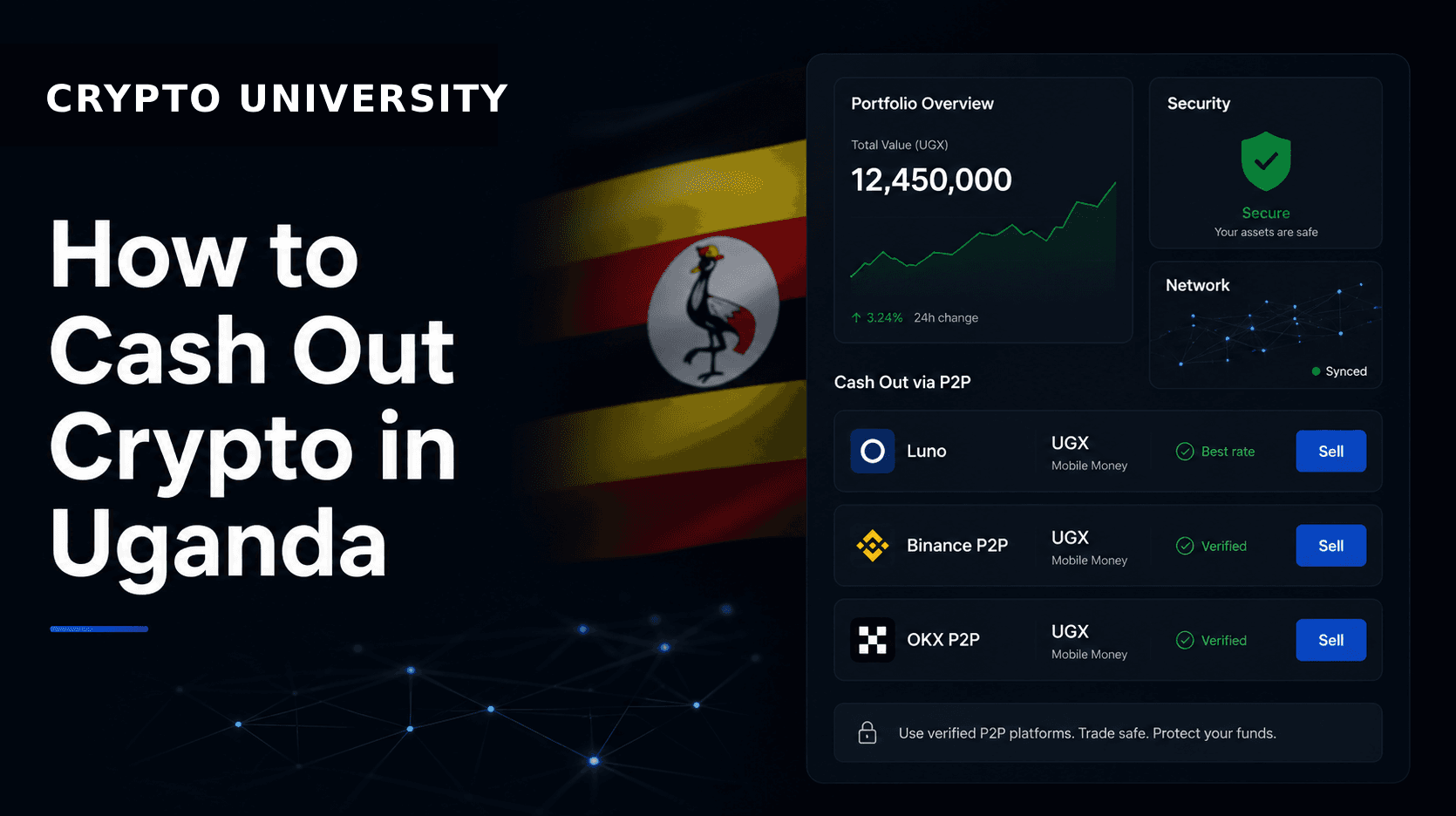
Peer-to-peer (P2P) means you sell directly to another person, and the platform holds the crypto in escrow until you confirm the shillings have landed in your account. Escrow is the safety mechanism: the buyer cannot get the crypto until you release it. P2P is the most common way Ugandans cash out because it plugs straight into mobile money.
Platform | How it works | Payout / payment rails | What to know |
|---|---|---|---|
A P2P marketplace built for emerging markets, with a strong Africa focus. | Mobile money and bank transfer, listed per offer. | Wide choice of local sellers. Check the trader's completed-trade count and rating before you deal. | |
The P2P section of the world's largest exchange, matching buyers and sellers with escrow. | MTN Mobile Money, Airtel Money, bank transfer, depending on the offer. | Deep liquidity and tight rates. Uses a merchant and reputation system. Verify the counterparty and never release before funds are clear. | |
The P2P marketplace inside the OKX exchange, also escrow-based. | Mobile money and bank options where available. | Fewer UGX offers than Binance at times, so compare rates. The same escrow and reputation rules apply. |
How to trade safely on P2P
Only release crypto after the shillings actually show in your account, not when someone sends a screenshot.
Keep all communication and payment inside the platform so escrow and dispute tools apply.
Match the sender name to the trader's verified name. Mismatches are a common scam and money-laundering red flag.
Start with a small test trade with any new counterparty, then scale up once trust is established.
A word on P2P and OTC desks
P2P works well for everyday amounts, but it has trade-offs. Rates vary between sellers, large trades can take time to fill, and you carry more personal responsibility for checking the other party. Because Uganda's market is informal, disputes can be harder to resolve than on a fully regulated exchange.
For larger sums, some people use an over-the-counter (OTC) desk. An OTC desk is a broker that fills a big order at a single agreed price, off the public order book, often with a dedicated contact who walks you through it. The upside is a fixed rate and no slippage on a big trade. The downsides are that quality varies, many desks are informal, and counterparty risk is real. If you consider an OTC route, favour established operators, insist on clear terms in writing, and be cautious of anyone promising rates that look too good.
One safety principle covers both P2P and OTC: never move first with a stranger, and never let urgency or a "special rate" push you into skipping verification. Here is a quick overview of deeper detail on How to Cash Out Crypto.
Which crypto should you send?
The coin you move to your off-ramp affects both cost and predictability. Two things matter: price stability while you wait for a buyer, and the network fee to move it.
Asset | Why people use it | Watch out for |
|---|---|---|
USDT (Tether) | A stablecoin pegged to the US dollar, so value stays steady during the trade. The most listed asset on P2P in Uganda. | Always match the network. USDT on Tron (TRC-20) has low fees, while USDT on Ethereum (ERC-20) can be expensive. |
USDC | Another dollar stablecoin, seen as transparent and widely supported. | Slightly fewer local buyers than USDT in some markets, which can mean a thinner order book. |
Bitcoin (BTC) | The most recognised asset and easy to sell almost anywhere. | The price can move while you wait for a buyer, so the shillings you receive may differ from what you expected. |
Ethereum (ETH) | Liquid and widely accepted. | Network fees can be high at busy times, and the price also moves during the trade. |
The common approach is to convert to a stablecoin first, send it on a low-fee network, then sell for shillings. This removes price uncertainty from the moment that matters most, when you are waiting for payment.
Cashing out large amounts
Large cash-outs need more planning, both for practical and compliance reasons.
Mind the limits. Mobile money has a per-transaction ceiling (MTN's maximum single transaction is UGX 5,000,000), so a big payout may arrive in several transfers, each with its own fees.
Split thoughtfully, not deceptively. Breaking a payout across accounts purely to dodge reporting ("structuring") is treated as a warning sign by regulators. Splitting because of genuine platform limits is normal, but keep it transparent.
Consider an OTC desk for a single fixed price, which avoids moving the market against yourself on a public P2P board.
Keep a clean paper trail. Save trade receipts, wallet addresses and payout references. Uganda's Financial Intelligence Authority (FIA) monitors virtual asset activity for money-laundering risk, and the Uganda Revenue Authority (URA) has begun requesting data from crypto exchanges.
Larger transfers also draw more scrutiny from mobile money providers and banks, which can pause or query unusual inflows. A clear record of where the funds came from makes those conversations simpler.
What about taxes?
Uganda has no crypto-specific tax law, so there is no single "crypto tax" rate. Instead, existing rules can apply depending on what you did. This is general information, not tax advice, and a qualified Ugandan tax adviser can tell you what fits your situation.
Cost or rule | How it can apply to a cash-out |
|---|---|
Mobile money withdrawal duty | A 0.5% excise duty is charged on the value you withdraw as cash, on top of operator fees. The government kept this rate for 2026/27 after a proposed cut was shelved. |
Income or business tax | If crypto trading looks like a regular income-earning activity, profits may be treated as taxable income under Uganda's progressive rates. |
Capital gains | Uganda includes capital gains in taxable income rather than taxing them at a separate flat crypto rate. Gains on disposal could therefore fall within general provisions. |
Data sharing | URA has started requesting crypto exchange data and issued notices about offshore holdings, so cross-border activity is increasingly visible. |
The practical takeaway is to keep records of what you bought, what you sold, and what it cost, so you can answer questions accurately if they ever arise.
The bottom line
Cashing out crypto in Uganda in 2026 is common but informal. There is no licensed local exchange with a clean bank rail, so the realistic routes are pan-African apps such as Yellow Card and Bitnob, and P2P marketplaces such as NoOnes, Binance P2P and OKX P2P that pay out to MTN Mobile Money or Airtel Money. Luno remains a place many Ugandans hold crypto, but its shilling off-ramp has been paused, so check its status before counting on it.
Whatever route you pick, the same fundamentals protect you: use a stablecoin on a low-fee network to hold steady value, verify counterparties and only release funds once shillings arrive, budget for the 0.5% withdrawal duty and platform spread, and keep clean records. Do your own research and confirm current rules, because Uganda's regulatory picture is still evolving.
Frequently asked questions
Is it legal to cash out crypto in Uganda?
Crypto is not recognised as legal tender, and no company is licensed to trade it, so activity happens in a grey zone. Owning and selling crypto is not the same as it being a regulated, protected service. There is little consumer protection if something goes wrong, so caution matters.
What is the fastest way to get shillings?
For most people, a P2P trade or a pan-African app paying out to MTN Mobile Money or Airtel Money is quickest, often within minutes once a buyer is matched and payment clears.
Why do people cash out using USDT instead of Bitcoin?
USDT is a stablecoin pegged to the US dollar, so its value does not swing while you wait for a buyer. Bitcoin can move up or down during the trade, changing how many shillings you end up with.
Which network should I use to send USDT?
Tron (TRC-20) is popular because fees are low. Ethereum (ERC-20) can be much more expensive. Always confirm the receiving platform supports the same network before you send.
How much are the fees?
Expect a platform spread (built into the buy or sell rate) plus a 0.5% mobile money withdrawal duty on cash and standard operator fees. Small withdrawals feel the fees most, in percentage terms.
Do I have to pay tax when I cash out?
There is no crypto-specific tax, but general income and capital gains rules can apply, and the mobile money withdrawal duty always applies at cash-out. A Ugandan tax adviser can confirm your position.
Is P2P safe?
It can be, thanks to escrow, but you carry responsibility. Trade with well-rated counterparties, keep everything on-platform, match sender names, and only release crypto after money truly arrives.
Sources
This article draws on publicly reported information available at the time of writing. Platform features, availability, fees and rules change, so always confirm current details directly with each provider and with a qualified adviser.
Bank of Uganda public warnings on cryptocurrency (Blockchain.News; CoinGeek).
Lightspark, "Is Crypto Legal in Uganda? Regulations & Compliance in 2026."
Daily Monitor, reporting on Uganda's informal crypto market and mobile money taxes.
BitcoinKE, "Bank of Uganda Governor Lists 6 Foundational Pillars for Crypto Regulation."
Luno Help Centre, "We've paused deposits and withdrawals in Uganda" and service-wind-down guidance; TechCentral on Luno's footprint changes.
Yellow Card reviews and app listings (Cryptowisser; Gate Learn; ChimpReports); Bitnob app and reviews.
Parliament of Uganda, The Observer, New Vision and Bloomberg Tax on the 0.5% mobile money withdrawal duty (2026).
TaxAtlas and Global Law Experts on Uganda's 2026 tax framework; MRT Tax on URA data requests.
Disclaimer: This content is for educational and informational purposes only and is not financial advice. Nothing here is a recommendation to buy or sell any asset or use any platform. Do your own research and manage your risk.
Crypto University: How to Cash Out Crypto
How to Cash Out Crypto in South Africa in 2026
How to Cash Out Crypto in Nigeria in 2026
Best Crypto Trading Competitions in 2026: OKX vs Bybit
How RugCheck Works: A Beginner's Guide to Checking Solana Tokens
Need deeper training?
Join our structured modules with live examples and expert checklists for effective implementation.
JOIN THE ACADEMY