
Key Takeaways
Sell then withdraw. The standard way to cash out in Indonesia is to sell your crypto for rupiah (IDR) on a licensed local exchange, then withdraw the rupiah to your bank account.
Know the tax. Since August 2025, sellers pay a 0.21% final income tax on licensed local exchanges and 1% on foreign platforms. Local exchanges withhold this automatically.
P2P adds risk. Peer-to-peer trades on Binance or OKX can offer flexible rates, but carry counterparty and bank-freeze risks, so always verify who you are dealing with.
Understanding What Cashing Out Means
Cashing out crypto means converting your digital assets, such as Bitcoin or a stablecoin like USDT, back into Indonesian rupiah (IDR) that you can spend or hold in a bank account. In Indonesia this is legal and increasingly straightforward, but the rules changed in 2025. Crypto is now regulated as a digital financial asset by the Financial Services Authority (OJK), and a new tax structure applies to sellers.
This guide walks through the practical steps, compares the main platforms, and explains what you owe at tax time. It is an educational overview of how the process works in 2026, not financial or tax advice.
The Basic Process, Step by Step
For most people, cashing out follows the same simple path regardless of which app they use.
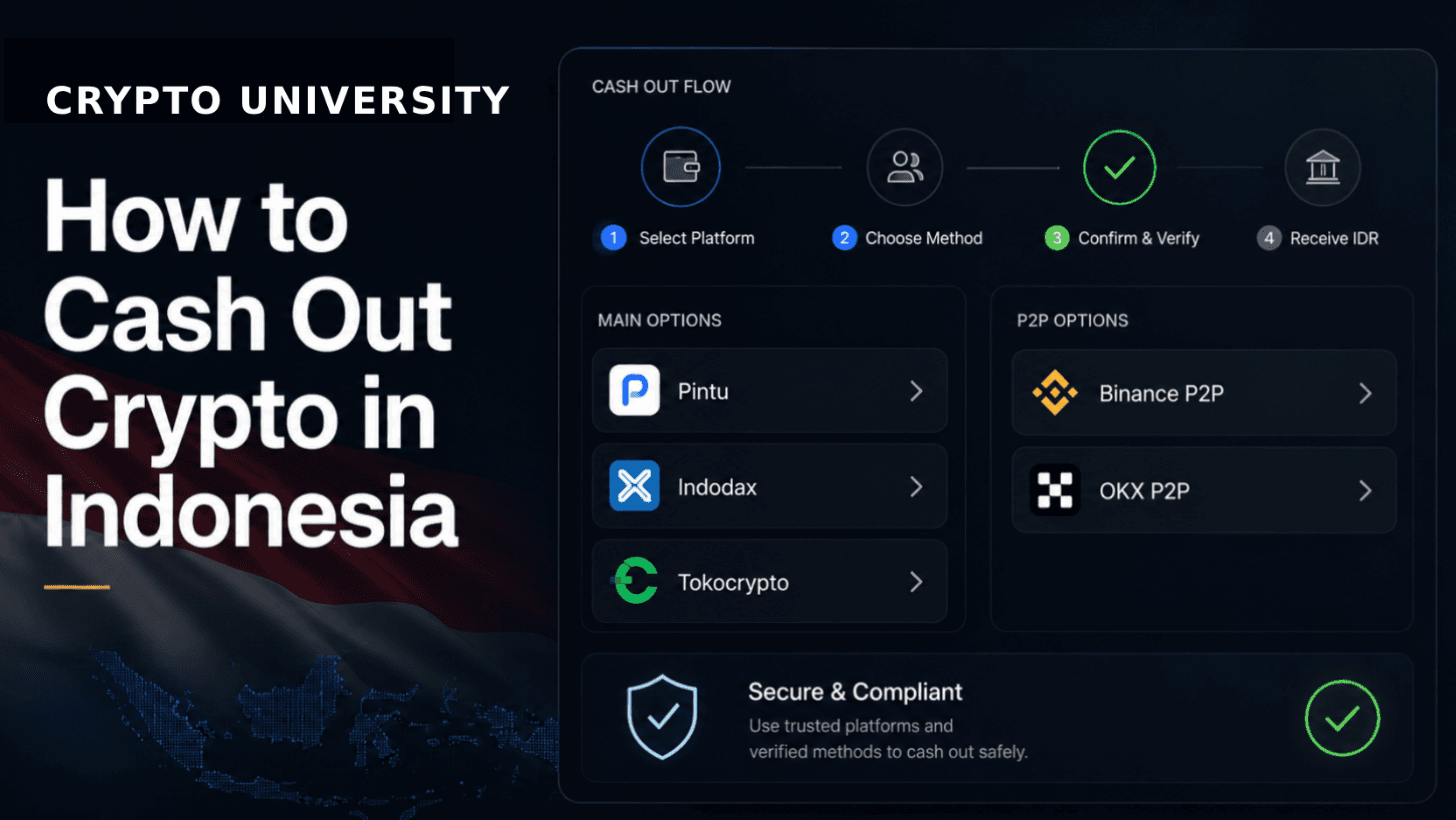
Move your crypto to a licensed exchange. If your coins are in a personal wallet, send them to an account on a local exchange that supports rupiah withdrawals, such as Indodax, Tokocrypto, or Pintu.
Complete identity verification (KYC). Indonesian exchanges require a national ID card (e-KTP) for residents or a KITAS for foreign residents. This is a legal requirement under OJK and anti money laundering rules.
Sell your crypto for rupiah. Place a sell order on the trading screen. You can sell at the current market price, or set your own price with a limit order.
Confirm the rupiah balance. After the sale settles, your rupiah appears in your exchange wallet balance.
Withdraw to your bank. Enter your Indonesian bank details and request a withdrawal. Banks such as BCA, Mandiri, BNI, and BRI are widely supported, and many platforms also allow e-wallets like GoPay, OVO, and DANA.
Wait for the transfer. Bank transfers usually arrive within minutes to a few hours, depending on the platform and the time of day.
That is the entire flow. The differences between platforms mostly come down to fees, supported coins, withdrawal speed, and how much you are moving.
Comparing Your Main Options: Pintu, Indodax, and Tokocrypto
All three are licensed by the OJK and connected to CFX, Indonesia's national crypto exchange that handles clearing and settlement for licensed local platforms. Being licensed means they follow Indonesian consumer protection rules and handle tax withholding for you.
Platform | Best for | IDR withdrawal | Notes |
|---|---|---|---|
Beginners and mobile-first users | Bank transfer and e-wallets | Clean, simple app aimed at first-time users | |
Long-term users, wide coin range | Bank transfer | Indonesia's oldest and largest homegrown exchange, formerly Bitcoin Indonesia | |
Users wanting Binance-linked access | Bank transfer, QRIS, e-wallets | Binance-backed, supports a large number of tokens |
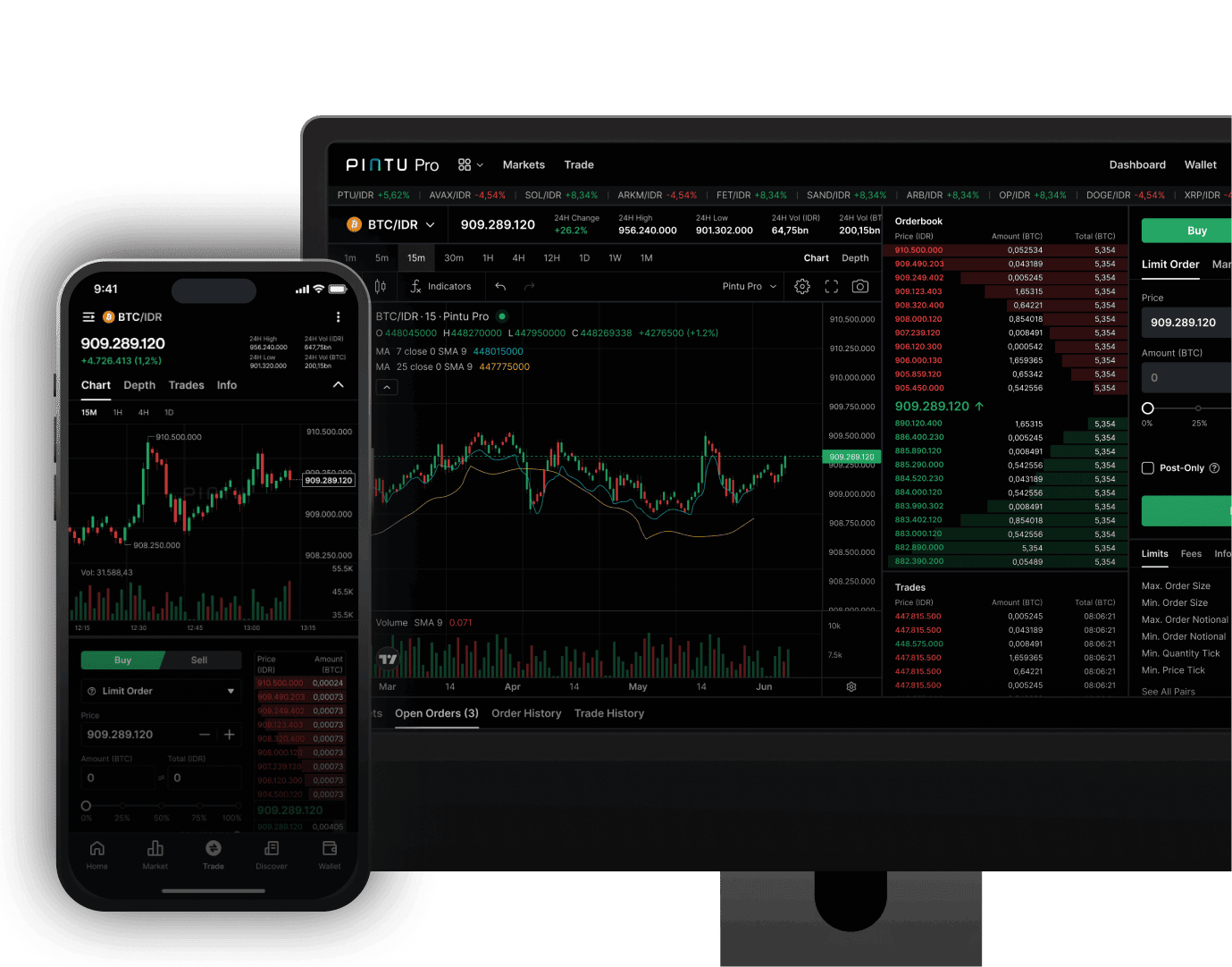
Pintu is built to be approachable, with a stripped-back mobile interface that suits first-time users.
Indodax is the veteran of the market and offers a wide range of coins with reliable rupiah rails.
Tokocrypto is backed by Binance and appeals to users who want access to a large token selection and multiple funding methods.
Because these platforms are licensed, they automatically withhold the 0.21% final income tax when you sell, then remit it to the tax office and provide records. This reduces your paperwork at filing time.
Comparing Your P2P Options: Binance P2P and OKX P2P
Peer-to-peer (P2P) trading lets you sell crypto directly to another person, who pays you in rupiah through a bank transfer or e-wallet. The platform holds your crypto in escrow until you confirm you received payment. Binance and OKX both run large P2P marketplaces with strong rupiah liquidity.
Feature | Binance P2P | OKX P2P |
|---|---|---|
Liquidity in IDR | Very high | Moderate to high |
Common payment methods | BCA, Mandiri, BNI, BRI, Jago, plus QRIS via GoPay, OVO, DANA, ShopeePay | Major banks and popular e-wallets |
Escrow protection | Yes | Yes |
Local OJK license | No, operates as a global platform | No, operates as a global platform |
Applicable tax rate | 1% foreign-platform rate | 1% foreign-platform rate |
Binance and OKX are global platforms and are not licensed as local Indonesian exchanges, so their main markets do not offer direct rupiah trading pairs. On P2P, the rupiah changes hands between you and another user, not the exchange. Because these are foreign platforms, sales made through them fall under the 1% foreign-platform tax rate rather than the 0.21% local rate, and you are generally responsible for reporting it yourself.
A Word on P2P and OTC Desks
P2P and OTC both let you trade outside the standard order book, but they suit different needs.
Method | How it works | Best for | Main risk |
|---|---|---|---|
P2P | You trade directly with another user; the platform escrows the crypto | Everyday amounts, flexible payment methods | Fraud, chargebacks, or receiving flagged funds |
OTC desk | A dealer quotes one price for the whole trade | Large volumes where slippage matters | Fewer providers; must verify the desk is reputable |
The most common practical risk with P2P is receiving rupiah that was involved in fraud elsewhere. If a buyer pays you with money linked to a scam, your bank account can be frozen while the case is investigated, even though you did nothing wrong. To reduce this risk, trade with counterparties who have high completion rates and strong reputations, keep screenshots and records of every trade, and be cautious of offers that look unusually generous. Never release your crypto until you have confirmed the payment actually landed in your account, not just that you received a notification.
OTC desks reduce slippage on large trades by quoting one price for the full amount, but there are fewer of them, so it is important to use an established, licensed provider.
Which Crypto Should You Send?
The easiest asset to cash out is usually a stablecoin, most commonly Tether (USDT), because its value tracks the US dollar and it has the deepest liquidity on both local exchanges and P2P markets. Selling USDT tends to give you tighter spreads and faster matches than a less traded coin.
USDT is the default choice for P2P and quick conversions. On P2P, USDT on the Tron network (TRC-20) is popular because network fees are low.
Bitcoin (BTC) and Ethereum (ETH) are also highly liquid on local exchanges and sell easily.
Smaller altcoins may have thinner order books, wider spreads, and slower sales. It is often cheaper to swap them into USDT or BTC first, then cash out.
Network fees matter. Sending the same token over a cheaper network (for example TRC-20 rather than ERC-20 for USDT) can save on transfer costs. Always confirm the receiving platform supports that network before sending.
Cashing Out Large Amounts
Selling a small amount is quick. Larger sums need more planning for three reasons: price impact, limits, and scrutiny. Here is a quick overview of deeper detail on How to Cash Out Crypto.
Price impact and slippage. A very large market sell order can move the price against you on a thin order book. Breaking it into smaller orders, or using a limit order, can reduce this.
Withdrawal limits and verification tiers. Exchanges set daily and monthly withdrawal limits based on your verification level. Higher limits usually require additional identity documents.
Bank and AML scrutiny. Large or sudden transfers can trigger a bank's anti money laundering checks. Keeping clear records of where your funds came from helps if your bank asks questions.
For sums large enough to disturb the normal market, an over-the-counter (OTC) service is often the better route.
What About Taxes?
Indonesia updated its crypto tax rules with Minister of Finance Regulation No. 50 of 2025 (PMK 50/2025), which took effect on 1 August 2025 and applies through the 2026 tax year. The headline changes are summarised below.
Item | Rule under PMK 50/2025 |
|---|---|
Seller tax on licensed local exchanges | 0.21% final income tax (PPh Article 22) on the transaction value |
Seller tax on foreign platforms | 1% final income tax on the transaction value |
VAT (PPN) on crypto transfers | Removed, because crypto is now treated as a financial instrument |
Who pays | The seller, not the buyer |
Mining, staking, and similar yields | Taxed under normal income tax rules from 2026 |
Filing | Report in your annual tax return (SPT) via DJP e-Filing, generally by 31 March |
On a licensed local exchange, the 0.21% is withheld automatically when you sell, so it is deducted at the point of sale and reported for you. On foreign platforms the 1% rate applies, and you are typically responsible for calculating and reporting it yourself, converting values to rupiah using Bank Indonesia reference rates. Because it is a final tax on the transaction value, it is charged whether or not the individual sale was profitable.
Tax rules change and personal situations differ, so for anything complex it is sensible to consult a qualified Indonesian tax professional. This section is educational and not tax advice.
The Bottom Line
For most people in Indonesia, the simplest and safest way to cash out in 2026 is to sell on a licensed local exchange such as Pintu, Indodax, or Tokocrypto and withdraw rupiah to a bank account. These platforms handle the 0.21% tax for you and operate under OJK supervision.
P2P markets on Binance or OKX give you flexibility and can be useful, but they carry counterparty risk and fall under the higher 1% foreign-platform tax rate. Whichever route you choose, confirm the platform is licensed where required, keep good records, and understand the tax before you sell rather than after.
Frequently Asked Questions
Is cashing out crypto legal in Indonesia?
Yes. Trading and cashing out crypto is legal and regulated by the OJK, which treats crypto as a digital financial asset. However, using crypto to pay for goods and services is not legal, because the rupiah is the only recognised legal tender.
How long does a rupiah withdrawal take?
On most licensed local exchanges, bank withdrawals arrive within minutes to a few hours. Timing varies with bank processing hours and the size of the withdrawal.
What is the cheapest way to cash out?
There is no single answer, because fees depend on the platform, the coin, the network, and the amount. Selling a liquid asset like USDT or BTC on a local exchange with low withdrawal fees is usually efficient for everyday amounts.
Do I pay tax if I sell at a loss?
The 0.21% local and 1% foreign rates are final taxes on the transaction value, not on profit, so they apply regardless of whether a particular sale made money. Consult a tax professional for your specific situation.
Can foreigners cash out crypto in Indonesia?
Foreign residents can generally use local exchanges after completing KYC with a valid document such as a KITAS and holding an Indonesian bank account. Requirements and tax treatment vary by platform, so check current rules.
Is P2P safe?
P2P uses escrow to protect the crypto side of the trade, but the payment side carries risk. The main danger is receiving funds linked to fraud, which can lead to a bank account freeze. Trade only with well-rated counterparties and keep records.
Source
Minister of Finance Regulation No. 50 of 2025 (PMK 50/2025), as summarised by SSEK Law Firm, Rajah & Tann Asia, and Assegaf Hamzah & Partners.
OJK whitelist of 29 licensed crypto exchanges, December 2025 (reported by CryptoNews, Phemex, and others).
Liminal Custody, "Top Crypto Exchanges in Indonesia 2026: Regulation and Tax Guide."
KPMG TaxNewsFlash, "Indonesia: Updated tax rates for cryptoasset transactions."
Lightspark, "Is Crypto Legal in Indonesia? Regulations and Compliance in 2026."
Indonesia Business Post and MEXC Blog crypto tax guides, 2025 to 2026.
Disclaimer: This content is for educational and informational purposes only and is not financial advice. Nothing here is a recommendation to buy or sell any asset or use any platform. Do your own research and manage your risk.
Crypto University: How to Cash Out Crypto
Best Crypto Trading Competitions in 2026: OKX vs Bybit
How RugCheck Works: A Beginner's Guide to Checking Solana Tokens
Best Crypto Off-Ramps in the UAE: OKX, BitOasis and Fasset Compared
Need deeper training?
Join our structured modules with live examples and expert checklists for effective implementation.
JOIN THE ACADEMY