
Key Takeaways
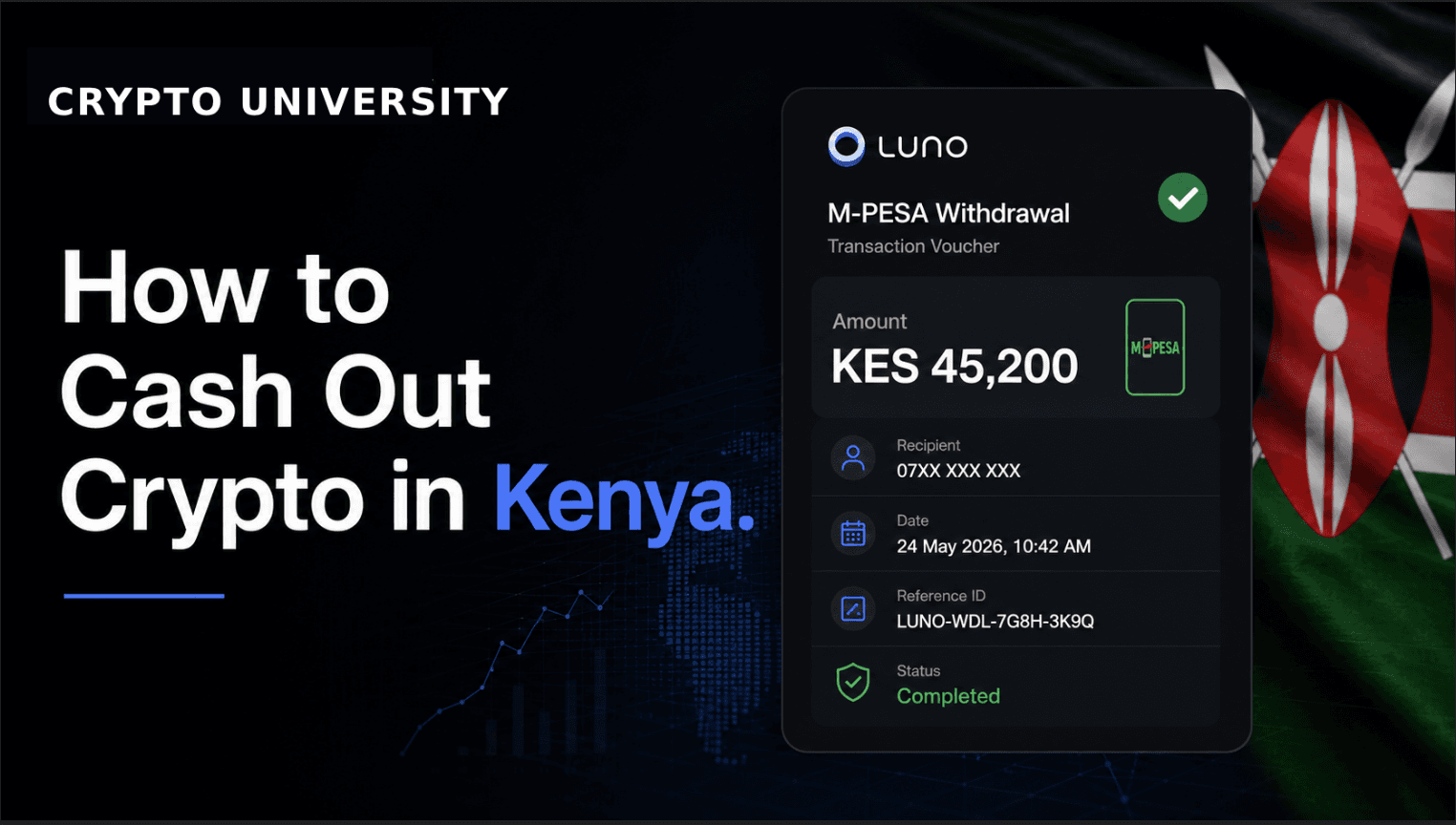
The most direct route is to sell your crypto for Kenyan shillings on a beginner-friendly platform and withdraw to M-PESA. Luno offers a simple M-PESA withdrawal voucher with a flat KES 50 fee.
Standard M-PESA rules cap most transfers at KES 250,000 per transaction and KES 500,000 per day, so large cash-outs usually need to be spread over days or sent to a bank.
Kenya repealed the 3% Digital Asset Tax in July 2025 and replaced it with a 10% excise duty on platform service fees. Trading profits can still fall under normal income tax, so keep clear records.
Cashing out crypto in Kenya has become routine, mostly because nearly every practical route connects to M-PESA, the mobile money service most Kenyans already use. "Cashing out" simply means converting your cryptocurrency, such as Bitcoin or a stablecoin, into Kenyan shillings (KES) you can actually spend. This guide walks through the basic process, compares the main platforms, and explains fees, limits, safety, and the current tax position for 2026. None of this is financial advice. It is an educational walkthrough so you can make your own informed decision.
The Basic Process, Step by Step
No matter which platform you use, the flow is broadly the same. There are five stages.
Verify your identity (KYC). Every regulated platform asks for a valid Kenyan ID or passport and a selfie before you can withdraw. This is a legal requirement and usually takes anywhere from a few minutes to a day.
Move your crypto to the platform. If your coins sit in an external wallet, send them to your deposit address on the exchange. Always check the network first so funds are not lost.
Sell your crypto for shillings. Convert to KES on the exchange, or match with a buyer on a peer-to-peer (P2P) marketplace. P2P means you trade directly with another person rather than the platform itself.
Withdraw to M-PESA or your bank. Send the shillings to your M-PESA number or a linked Kenyan bank account.
Keep your records. Save every transaction confirmation for tax purposes and in case of a dispute.
One practical tip: the name on your M-PESA line should match your platform account. Mismatched names are the single most common reason withdrawals get delayed or flagged.
Comparing Your Main Options
Three routes cover the vast majority of cash-outs in Kenya. Here is how they differ before we go into detail.
Platform | How it works | Typical payout speed | Fees (widely reported) | Best for |
|---|---|---|---|---|
Sell to the platform, withdraw voucher straight to M-PESA | Usually within 24 hours | Flat KES 50 withdrawal; about 1% on deposits | Beginners who want simplicity | |
Binance P2P | Sell to another user who pays you via M-PESA | Minutes to a few hours | Often no platform fee; the rate spread is your cost | Users comfortable with P2P and chasing better rates |
Yellow Card | Sell to the platform, receive an M-PESA payout | Instant to a few hours | Varies; confirm in the app | Stablecoin cash-outs with local support |
Fees and limits change often. Always confirm the current figures inside each app before you move money.
Option 1: Luno (Best Option): M-PESA Withdrawal Voucher
Luno is one of the most beginner-friendly routes because it sells you shillings at a set price and pays out directly to M-PESA. There is no need to negotiate with another person, which removes a lot of the guesswork for new users.
How to withdraw on Luno:
Sign in to the Luno app
Open Portfolio and select your KES wallet
Tap Withdraw
Choose the M-PESA number you want to withdraw to
Enter the amount and tap Next
Confirm the amount and fee, then tap Complete Withdrawal
Key facts (per Luno's Kenya help centre):
Detail | Value |
|---|---|
Withdrawal fee | Flat KES 50 per withdrawal |
Minimum withdrawal | KES 500 |
Payout time | Usually reflects within 24 hours |
Limits (standard M-PESA) | KES 250,000 per transaction; KES 500,000 per day |
Why it matters: predictable pricing and a fixed fee make Luno easy for beginners who would rather avoid the back-and-forth of peer-to-peer trading.
Option 2: Binance P2P
Binance P2P is a marketplace where you sell your crypto directly to another person who pays you in shillings, often through M-PESA. Binance holds the crypto in escrow, meaning it locks the coins until you confirm you have received payment, which protects both sides.
Trades often carry no platform fee, but you accept or set a rate, and that spread is effectively your cost.
You must complete identity verification, which Binance calls Level 2.
Only release the crypto after the genuine M-PESA confirmation SMS from Safaricom arrives.
Important: Binance states it is not licensed to operate in Kenya and is based outside the country, which can make it harder to enforce your rights under Kenyan law. That is worth weighing before you use it for large sums.
Option 3: Yellow Card
Yellow Card is an Africa-focused exchange that supports M-PESA, P2P, and bank transfers, and it is licensed in several African markets. To sell, you pick the crypto, choose M-PESA as the payout method, confirm, and the shillings land in your mobile money account. It is a popular choice for cashing out stablecoins and for users who value local support.
Which Crypto Should You Send?
You can cash out most major coins, but two choices dominate in Kenya.
Stablecoins such as USDT or USDC. A stablecoin is a token designed to track the value of a currency, usually the US dollar. Because the price barely moves, it shields you from short-term swings while you transfer and sell. USDT is the most traded coin on Kenyan P2P markets, so it usually has the best liquidity, meaning many buyers and sellers and tighter pricing.
Bitcoin (BTC). Widely accepted and liquid, but its price moves, so the shilling value can shift between the moment you send and the moment you sell.
Network fees matter too. When sending USDT, the TRC20 network (Tron) is commonly used because fees are very low, often around a dollar or less, compared with higher fees on some other networks. Always confirm the receiving platform supports the network you choose, or the funds can be lost.
Practical takeaway: if your goal is simply to convert to shillings with minimal price risk and low cost, a stablecoin on a low-fee network is usually the smoothest route.
Cashing Out Large Amounts
M-PESA has built-in ceilings, so a large cash-out cannot land in a single mobile money payment. As widely reported for 2026, the standard limits are as follows.
M-PESA limit | Amount |
|---|---|
Per transaction | KES 250,000 |
Per day (total) | KES 500,000 |
Maximum wallet balance | KES 500,000 |
Options for larger sums:
Split across days. Withdraw within the daily limit over several days.
Withdraw to a bank account. Many exchanges let you send shillings to a linked Kenyan bank, which handles larger amounts better than mobile money.
Use an OTC desk. For very large trades, an over-the-counter desk can settle the whole amount at one agreed price (explained below).
Also plan around the wallet balance cap. If your M-PESA is near KES 500,000, move funds to your bank or spend before withdrawing more.
Here is a quick overview deeper detail on How to Cash Out Crypto.
A Word on P2P and OTC Desks
Peer-to-peer trading can offer better rates, but you are dealing with a stranger, so safety habits matter.
Use the platform's escrow. Never move a trade to WhatsApp or off-platform.
Wait for the real Safaricom SMS before releasing crypto. Screenshots can be faked.
Check the sender's name matches the buyer's verified account name.
Start small with new counterparties and review their completion rate and ratings first.
Keep every chat and receipt in case you need to open a dispute.
OTC (over-the-counter) desks handle large trades privately, away from the public order book. They can offer a single agreed price for a big amount plus dedicated support, which suits businesses or high-value sellers. The trade-off is that you must pick a reputable desk and complete their compliance checks. Treat unusually generous rates as a warning sign rather than a bargain.
Quick Comparison
Platform | Liquidity (ZAR) | Ease of Use | Payment Flexibility | Best For |
Highest | High | Good (mainly banks) | Volume & reliability | |
Medium | High | Highest | Variety & local options | |
Good | High | Good | Zero fees & clean UX |
What About Taxes?
Kenya's crypto tax rules changed recently, so this is where many people are working from old information.
The 3% Digital Asset Tax (DAT), introduced in 2023 on the value of each transfer, was repealed with effect from 1 July 2025.
It was replaced by a 10% excise duty on the service fees charged by Virtual Asset Service Providers (VASPs) such as exchanges and wallets. In practice this applies to platform fees, not to the whole value of your transaction.
Trading profits can still fall under normal income tax, depending on your circumstances.
The Virtual Asset Service Providers Act, 2025 came into force in late 2025, naming the Central Bank of Kenya (CBK) and the Capital Markets Authority (CMA) as regulators. As of early 2026, the implementing regulations were still being finalised and no VASPs had been formally licensed yet.
The proposed Finance Bill 2026 would add reporting duties for platforms and align Kenya with international information-sharing standards. As of mid-2026 these remained proposals under debate, not settled law.
This is general information, not tax advice. The rules are moving quickly, so keep clear records of what you sold, when, at what price, and the fees paid, and confirm your position with a qualified Kenyan tax professional or the Kenya Revenue Authority (KRA).
The Bottom Line
For most people in Kenya in 2026, the simplest cash-out is to sell on a beginner-friendly platform and withdraw to M-PESA. Luno's flat-fee M-PESA voucher is the easiest starting point, Binance P2P can offer better rates for those comfortable with peer-to-peer trading, and Yellow Card is a solid option for stablecoin cash-outs with local support. Use stablecoins on low-fee networks to cut risk and cost, plan around M-PESA's daily limits for larger sums, follow basic P2P safety habits, and keep records for tax. Prices, fees, and rules all change, so confirm the current details in the app before you move money.
Frequently Asked Questions
What is the cheapest way to cash out crypto in Kenya?
Fees change, but selling a low-fee stablecoin and withdrawing through a fixed-fee route like Luno's M-PESA voucher (a flat KES 50 as widely reported) is often the most predictable. P2P can beat it on rate but adds effort and counterparty risk. Compare the total cost in the app before you commit.
How long does it take to receive money on M-PESA?
It varies. Luno says funds should reflect within 24 hours, and in practice mobile money often arrives faster. P2P payments can land within minutes once the buyer sends them.
Is cashing out crypto legal in Kenya?
Buying, selling, and cashing out crypto is not banned. Kenya passed the Virtual Asset Service Providers Act in 2025, and regulators (CBK and CMA) are building the licensing framework. Using reputable platforms and completing identity checks is the safer approach.
What is the maximum I can withdraw to M-PESA at once?
As widely reported for 2026, standard M-PESA limits are KES 250,000 per transaction and KES 500,000 per day, with a wallet balance cap of KES 500,000. For larger sums, withdraw to a bank or split the amount across several days.
Should I cash out in Bitcoin or a stablecoin?
Many Kenyans convert to a stablecoin like USDT first because its value stays steady, then sell for shillings. Bitcoin works too, but its price can move between sending and selling. This is a personal choice, not a recommendation.
Do I have to pay tax when I cash out?
The 3% Digital Asset Tax was repealed in July 2025 and replaced by a 10% excise duty on platform service fees. Trading profits may still be taxable under normal income tax. Keep records and confirm your position with a Kenyan tax professional or KRA.
Sources
Luno Help Centre, "How do I withdraw money from my Luno account in Kenya?" (steps, KES 50 fee, KES 500 minimum, 24-hour payout, M-PESA limits).
Binance Blog and Binance P2P, Kenya M-PESA trading pages (P2P via M-PESA, escrow, Level 2 verification, not licensed in Kenya).
Yellow Card, Kenya mobile money (M-PESA) support and product pages (M-PESA payouts, P2P, bank transfers).
Central Bank of Kenya and Capital Markets Authority, joint public notice on the Virtual Assets Service Providers Act, 2025 (November 2025).
ClearTax Kenya and AMG Advocates, Kenya crypto taxation guides (repeal of the 3% Digital Asset Tax; 10% excise duty on VASP fees).
Grant Thornton Kenya and KPMG Kenya, analyses of the Finance Bill 2026 (proposed reporting rules and CARF alignment).
Safaricom M-PESA 2026 tariff and transaction-limit references.
Disclaimer: This content is for educational and informational purposes only and is not financial advice. Nothing here is a recommendation to buy or sell any asset or use any platform. Do your own research and manage your risk.
How to Cash Out Crypto in South Africa in 2026
Best Crypto Trading Competitions in 2026: OKX vs Bybit
How RugCheck Works: A Beginner's Guide to Checking Solana Tokens
Best Crypto Off-Ramps in the UAE: OKX, BitOasis and Fasset Compared
Need deeper training?
Join our structured modules with live examples and expert checklists for effective implementation.
JOIN THE ACADEMY