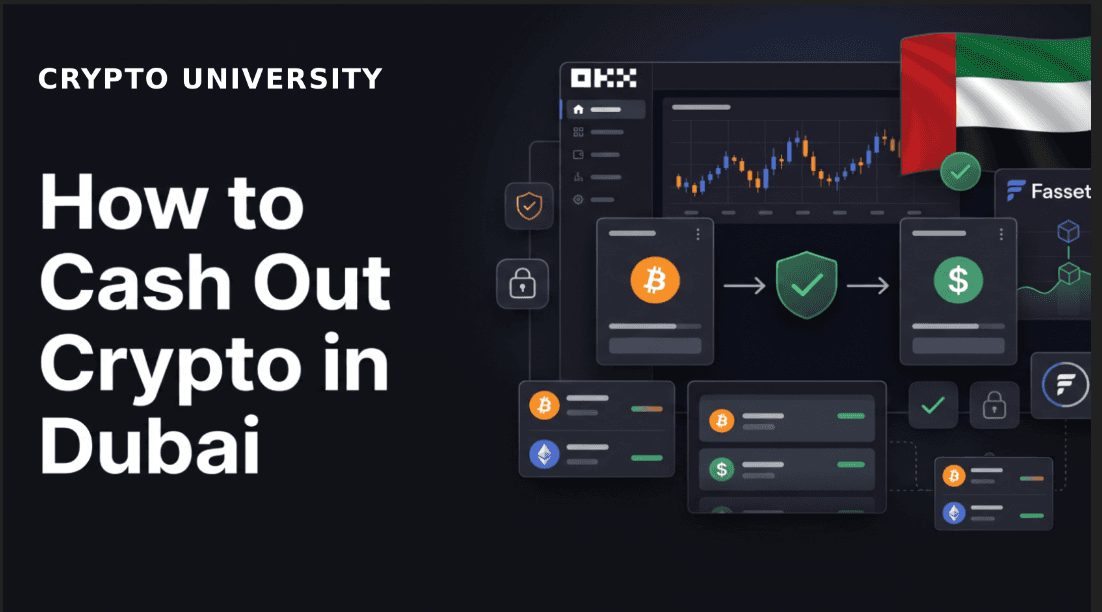
Key Takeaways 1. The safest way to cash out is on a licensed platform: sell your crypto into AED, then withdraw the AED to a UAE bank account in your own name. Skip cash deals with strangers. 2. Fees, limits, and supported coins change often, so check OKX UAE, BitOasis, and Fasset on the regulator's public register before you deposit a single dirham. 3. Keep every record. If your bank asks where the money came from, clean proof of your source of funds is what keeps your transfer moving smoothly. |
Let's be honest about what "cashing out" should look like in Dubai. It is not meeting a stranger in a parking lot with a bag of cash. That is how people lose money, or worse.
The clean way is simple: use a properly licensed platform, sell your crypto into AED, and withdraw that AED to a bank account in your own name. That's it. This guide walks you through the whole thing in plain language.
Three platforms are worth checking as a starting point: OKX UAE, BitOasis, and Fasset. Availability, fees, supported coins, and withdrawal methods all change over time, so always confirm a platform's current status on the UAE regulator's public register before you deposit anything.
The basic process, step by step
Every platform follows more or less the same path. Once you've done it once, it feels routine.
Step | What you do |
|---|---|
1 | Open an OKX UAE account. |
2 | Complete identity verification (KYC). |
3 | Add and verify your UAE bank account. |
4 | Deposit crypto to the correct network and address. |
5 | Sell or convert the crypto into AED. |
6 | Withdraw the AED to your verified bank account. |
7 | Save your transaction records for later. |
Comparing your three main options
Here's a quick side-by-side so you can see which platform fits how you plan to use it. The numbers below reflect what was published at the time of research, so always double-check the live figures in your account.
Platform | Best for | Typical AED withdrawal cost* |
|---|---|---|
OKX UAE | Active traders and anyone already holding funds on OKX who wants deeper trading tools | 35 AED fee, 200 AED minimum (incl. fee) |
People who want a UAE-focused platform and straightforward AED conversion | 10 AED fee, 200 AED minimum (210 AED balance) | |
Users interested in regulated access, payments, and tokenized assets | Confirm availability and fees for your account |
*Fees and minimums change. Treat these as a guide, not a promise, and confirm on the live screen.
Option 1: OKX UAE
OKX offers AED services for eligible UAE customers, and its trading tools are on the deeper end if you like to be hands-on.
To withdraw AED to your bank, OKX's published flow asks you to:
Step | Action on OKX |
|---|---|
1 | Go to Assets. |
2 | Select Withdraw. |
3 | Choose AED cash withdrawal. |
4 | Pick a verified bank account. |
5 | Enter the amount. |
6 | Complete security verification. |
A couple of things to know: only verified bank accounts show up as options, and OKX may ask for an initial deposit from that account first to prove it's really yours. At the time of research, OKX listed a 35 AED bank-transfer withdrawal fee and a 200 AED minimum that includes the fee. Check the live account screen, because these can change.
OKX Card: Pay anywhere, straight from your stablecoin balance.
Best for
Active traders, people who already keep funds on OKX, and anyone who wants an exchange with more advanced trading features.
Option 2: BitOasis
BitOasis is a long-standing regional platform with AED banking support, and it keeps things simple if you just want to convert and cash out locally.
Its May 2026 cash-withdrawal guide laid out the following:
Detail | What it said |
|---|---|
Destination | Withdrawals only to a personal bank account |
Minimum withdrawal | 200 AED |
Fee | 10 AED |
Balance needed | At least 210 AED for the standard flow |
Timing | Requests submitted before 11:00 AM UAE time, Monday to Saturday, could process the same day (subject to amount and banking conditions) |
Best for
People who want a UAE-focused platform, a straightforward AED conversion, and simple local bank withdrawals.
Option 3: Fasset
Fasset provides digital-asset services in the region with a focus on regulated access, payments, and tokenized assets. Before you rely on it for cashing out, confirm a few things specific to your account:
Check | Why it matters |
|---|---|
Direct AED withdrawals | Confirm they are actually available to your account |
Supported banks | Make sure yours is on the list |
Limits | Know the daily and monthly caps |
Legal entity | Understand which entity is servicing you |
Licensing status | Confirm it is current |
Fees and timing | Compare cost and processing time |
Don't assume every global Fasset product is available in the UAE.
Which crypto should you send?
USDT and USDC are the usual choices for settlement, but the truly safe answer is whichever coin and network your destination platform explicitly supports. Sending the right coin on the wrong network can mean losing it for good.
Before you hit send, run through this quick checklist: match the network exactly, copy (don't type) the deposit address, check whether a memo or tag is required, send a small test amount first, wait for it to confirm, and only then send the rest.
What your UAE bank may ask
Banks watch incoming funds under anti-money-laundering rules. Crypto trading being allowed doesn't mean a bank has to accept money it can't understand. Clean records are what make this painless, so be ready to show:
Document | Purpose |
|---|---|
Exchange statements | Show where the funds came from |
Wallet transaction hashes | Prove the on-chain movement |
Proof of original purchase | Show how you first acquired the crypto |
Source of funds | Explain the money's origin |
Trading records | Support your activity history |
Invoices or contracts | If the crypto came from business |
Tax-residency information | Clarify your tax position |
Explanation of large transfers | Give context for big amounts |
Cashing out large amounts
Never chop one legitimate transaction into lots of tiny withdrawals to dodge review. It looks worse, not better, and can trigger exactly the scrutiny you were trying to avoid.
For a large amount, do it the grown-up way: contact the platform's OTC or institutional desk, tell your bank before the transfer arrives, prepare your source-of-funds documents in advance, compare execution price and fees, use a regulated counterparty, and get professional tax and legal advice.
A quick overview of deeper detail on How to Cash Out Crypto.
A word on P2P and OTC desks
Peer-to-peer trading can be useful, but it adds real counterparty risk. The list of things that can go wrong is long: stolen bank accounts, chargebacks, fake payment screenshots, third-party transfers, frozen accounts, criminal proceeds, and in the worst cases, physical robbery.
If you do use P2P, always use the platform's escrow and never release your crypto until the money has irreversibly cleared. Steer clear of informal cash desks that can't show you a license and a documented source-of-funds process.
What about taxes?
The UAE is well known for not charging personal income tax on individuals. That's true, but it isn't a complete tax picture, and it's not tax advice for your specific situation.
Your actual position can shift depending on things like your tax residency elsewhere, business activity, corporate structures, employment compensation, how often and how seriously you trade, VAT or corporate-tax considerations, and any nationality-based tax obligations. Keep good records, and for meaningful amounts, get proper advice.
The bottom line
For most Dubai residents, the plan is straightforward: verify OKX UAE, BitOasis, and Fasset against current regulatory records, compare the live AED withdrawal quote, use a bank account in your exact legal name, send a small test transaction first, and keep full source-of-funds evidence.
Remember, the fastest cash-out isn't always the safest. The real goal is money sitting in your bank account that you can still explain six months from now.
Frequently asked questions
Is cashing out crypto legal in Dubai?
Yes, using licensed platforms is permitted. The key is to sell into AED on a regulated platform and withdraw to a bank account in your own name, while keeping records of where the funds came from.
Which coin should I send to cash out?
USDT and USDC are common, but the safest choice is whatever coin and network your platform explicitly supports. Always match the network exactly and send a small test transaction first.
How long does an AED withdrawal take?
It varies by platform and by your bank. As an example, BitOasis indicated that requests submitted before 11:00 AM UAE time, Monday to Saturday, could be processed the same day, subject to conditions.
Will my bank ask questions about the money?
It might. Banks review incoming funds under anti-money-laundering rules, so keep exchange statements, transaction hashes, and proof of your original purchase ready to show your source of funds.
Do I pay tax when I cash out in the UAE?
The UAE generally doesn't charge personal income tax on individuals, but your situation can differ based on tax residency, business activity, and other factors. Get professional advice for meaningful amounts.
Is P2P safe for cashing out?
It can work but carries extra risk, from chargebacks to frozen accounts. If you use it, rely on platform escrow and never release crypto until the payment has fully and irreversibly cleared.
Research notes and sources
The regulator's register lists OKX Middle East Fintech FZE, BitOasis Technologies FZE, and Fasset FZE, but with different licensed service categories. Always verify the live register and confirm the exact service available to your own account.
Source | Link |
|---|---|
VARA public register | vara.ae/en/licenses-and-register/public-register/ |
OKX AED bank-transfer guide | okx.com/help/how-do-i-withdraw-aed-with-bank-transfer |
OKX 2026 cash-withdrawal limits and fees | okx.com/help — cash withdrawal UAE guide |
BitOasis help centre | support.bitoasis.net |
Fasset official site | fasset.com |
Community discussion reviewed | Reddit r/UAE thread on cashing out in Abu Dhabi or Dubai |
Affiliate disclosure: Crypto University may earn a commission when readers use selected partner links. This does not change our editorial conclusions.
Disclaimer: This content is for educational and informational purposes only and is not financial advice. Nothing here is a recommendation to buy or sell any asset or use any platform. Do your own research and manage your risk.
Need deeper training?
Join our structured modules with live examples and expert checklists for effective implementation.
JOIN THE ACADEMY