


Key Takeaways
Use a naira off-ramp you trust. The cleanest way to turn crypto into naira in 2026 is through an exchange that supports direct bank withdrawals, such as Luno, Quidax, or Busha. You sell your crypto for naira on the platform, then withdraw to a bank account in your own name.
Crypto is regulated and taxed now. Nigeria formally recognises digital assets under the Investments and Securities Act 2025, and profits from selling crypto are taxable under the 2026 tax framework. Keep a record of what you bought and sold.
Stablecoins are the common exit asset. Most Nigerians cash out through stablecoins like USDT or USDC because they hold a steady dollar value while funds move. Always confirm the network and fees before you send.
Cashing out crypto means converting a digital asset such as Bitcoin, Ether, or a stablecoin into naira you can spend or save. The process is more structured in 2026 than it was a few years ago. Nigeria now has clearer rules, licensed platforms, and a tax framework that treats crypto profits like other taxable gains.
This guide explains the standard process, compares your main options, and covers the practical details around choosing the right coin, moving large amounts, using peer to peer trading, and handling tax. It is educational and does not offer financial advice.
The basic process, step by step
No matter which platform you use, cashing out follows the same shape. You get your crypto onto a platform that supports naira, sell it, and withdraw the naira to your bank.
Send crypto to an exchange that supports naira. Move your coins from a self custody wallet or another platform to a receiving address on an exchange that lets you withdraw naira to a Nigerian bank.
Complete verification (KYC). Nigerian platforms require your Bank Verification Number (BVN), National Identification Number (NIN), a government ID, and a selfie or liveness check. This identity linking is now a legal requirement, not an optional extra.
Sell the crypto for naira. On the exchange, sell your asset into naira. The naira value then sits in your platform wallet.
Withdraw naira to your bank. Enter a bank account registered in your own name and confirm the amount. Withdrawals to a Nigerian bank usually clear within a few hours.
Save the record. Keep the transaction details, including buy price, sell price, and fees. You will need them for tax and for your own tracking.
Note: Crypto exchanges do not send naira straight to your bank from your crypto balance. You must sell the crypto for naira on the platform first, and then withdraw the naira. These are two separate actions.
Comparing your main options
Below are the most common ways Nigerians cash out in 2026, with the trade-offs of each. The best choice depends on how much you are moving, how fast you need it, and how much local support you want.
Option | Naira to bank | Speed | Best for |
|---|---|---|---|
Yes, direct | Around 6 to 12 hours | Simple, direct bank withdrawals | |
Yes, direct | Usually within hours | Local support, SEC provisional licence | |
Yes, direct | Usually within hours | Local support, SEC provisional licence | |
Yellow Card / Breet / Roqqu | Yes, direct | Minutes to hours | Fast stablecoin off-ramps |
Peer to peer (P2P) | Buyer pays you | Minutes | Flexibility, but higher risk |
Option 1: Luno (a strong default): local withdrawal supported
Luno is one of the oldest exchanges serving Nigeria, having operated in the country for years. It supports direct naira withdrawals to a Nigerian bank account, which is the main reason many people pick it for cashing out. Withdrawals to a bank generally arrive within about 6 to 12 hours, and the bank account must be registered in your own name. Luno charges a withdrawal fee of roughly 2 percent capped at a few thousand naira, and its published fees and any promotions can change, so check the app before you withdraw.
Luno lists fewer coins than some rivals, but for turning major assets and stablecoins into naira it is straightforward and beginner friendly. The clean interface and local bank support make it a common starting point.
Option 2: Quidax
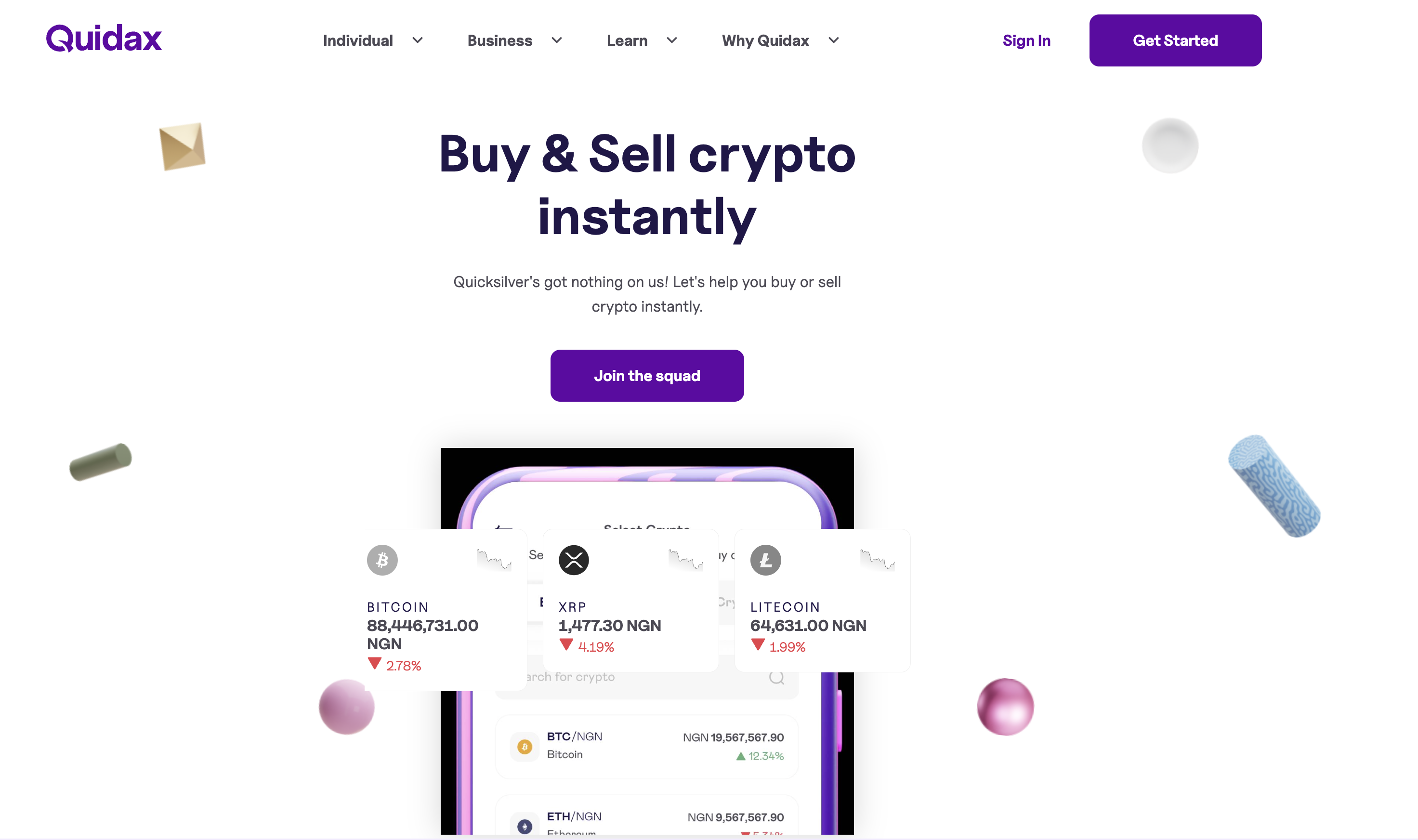
Quidax is a Nigerian exchange and was the first platform to receive a provisional operating licence from Nigeria's Securities and Exchange Commission (SEC) under the Accelerated Regulatory Incubation Programme in 2024. It supports direct naira withdrawals and offers local customer support, which many users value when something goes wrong.
Option 3: Busha
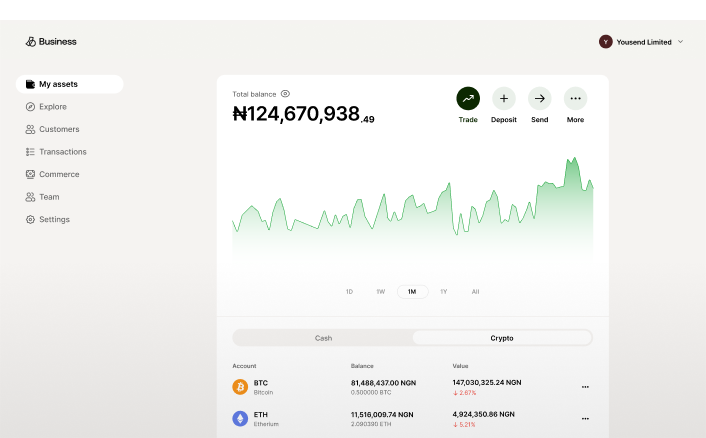
Busha is another Nigerian exchange that received a provisional SEC licence at the same time as Quidax. It offers direct naira withdrawals and a simple interface, and it is widely treated as a credible local option alongside Quidax.
Option 4: Yellow Card, Breet, and similar off-ramps
Several platforms specialise in fast conversion of crypto, especially stablecoins, into naira. Yellow Card, Breet, and Roqqu are commonly used for quick cash-outs. These can be convenient for smaller, frequent withdrawals, though you should still confirm fees, limits, and the platform's regulatory standing.
A note on Binance and other offshore apps
As of 2026, access to Binance in Nigeria is restricted. The Binance website has been blocked by local internet providers, naira peer to peer pairs were suspended, and Nigerian users can no longer make naira deposits or withdrawals through it. Some other offshore platforms have also suspended their naira channels. For turning crypto into naira reliably, a locally supported exchange is the practical route. If you hold funds on an offshore platform, you will typically need to move a stablecoin to a local exchange to cash out.

Which crypto should you send?
You can cash out most major coins, but the asset you choose affects speed, fees, and how much value you keep. In Nigeria, stablecoins are by far the most common exit asset. Surveys have reported that the large majority of Nigerian crypto users hold stablecoins, largely because they track the US dollar and hold value while the naira has weakened over recent years.
Asset type | Why people use it | Watch out for |
|---|---|---|
Stablecoins (USDT, USDC) | Steady dollar value while you move funds; widely accepted by off-ramps | Send on a network your exchange supports, or funds can be lost |
Bitcoin (BTC) | Accepted everywhere; deepest liquidity | Network fees and price movement while you wait to sell |
Ether (ETH) | Widely supported | Gas fees can be high at busy times |
The network matters as much as the coin. The same stablecoin can travel on several networks, and each has different fees and confirmation times. Always copy the exact receiving address from the exchange for the exact network shown, and send a small test amount first if you are unsure. Sending on the wrong network is a common and often unrecoverable mistake.
Cashing out large amounts
Larger withdrawals need a little more planning. A few things change once the sums get bigger. Here is a quick overview of deeper detail on How to Cash Out Crypto.
Verification tiers set your limits. Most platforms cap daily and per-transaction amounts by verification level. To move large sums, complete the highest verification tier well before you need it.
Consider an OTC desk. For very large amounts, an over the counter (OTC) desk run by a licensed platform can handle the trade in one negotiated deal, often with better pricing and less market impact than selling on the open order book.
Expect bank scrutiny. Large inflows can trigger bank compliance checks. Using an account in your own name and keeping records of the source of funds reduces the chance of delays or a frozen account.
Plan for tax. Bigger gains mean bigger tax obligations. Keep clear records of cost and proceeds so you can calculate what is owed.
A word on P2P and OTC desks
Peer to peer (P2P) trading connects you directly with another person who pays you naira to your bank while the platform holds the crypto in escrow until payment is confirmed. It is flexible and can give competitive rates, and it remains popular in Nigeria. It also carries the most risk for beginners.
Scam risk. Some buyers claim to have paid when they have not, or send fake receipts. Only release crypto after you have confirmed the naira is actually in your account, not just when a receipt appears.
Frozen account risk. If a P2P counterparty pays you with funds linked to fraud, your bank account can be flagged or frozen. Trading with well rated, verified merchants reduces this risk but does not remove it.
Always stay inside escrow. Never move a trade off the platform to private chat or a direct transfer. The escrow system is your main protection.
OTC desks are the higher-volume cousin of P2P. Instead of matching you with a random buyer, a desk quotes a price for your whole order and settles it directly. For large trades, a licensed OTC desk is usually safer and cleaner than open P2P.
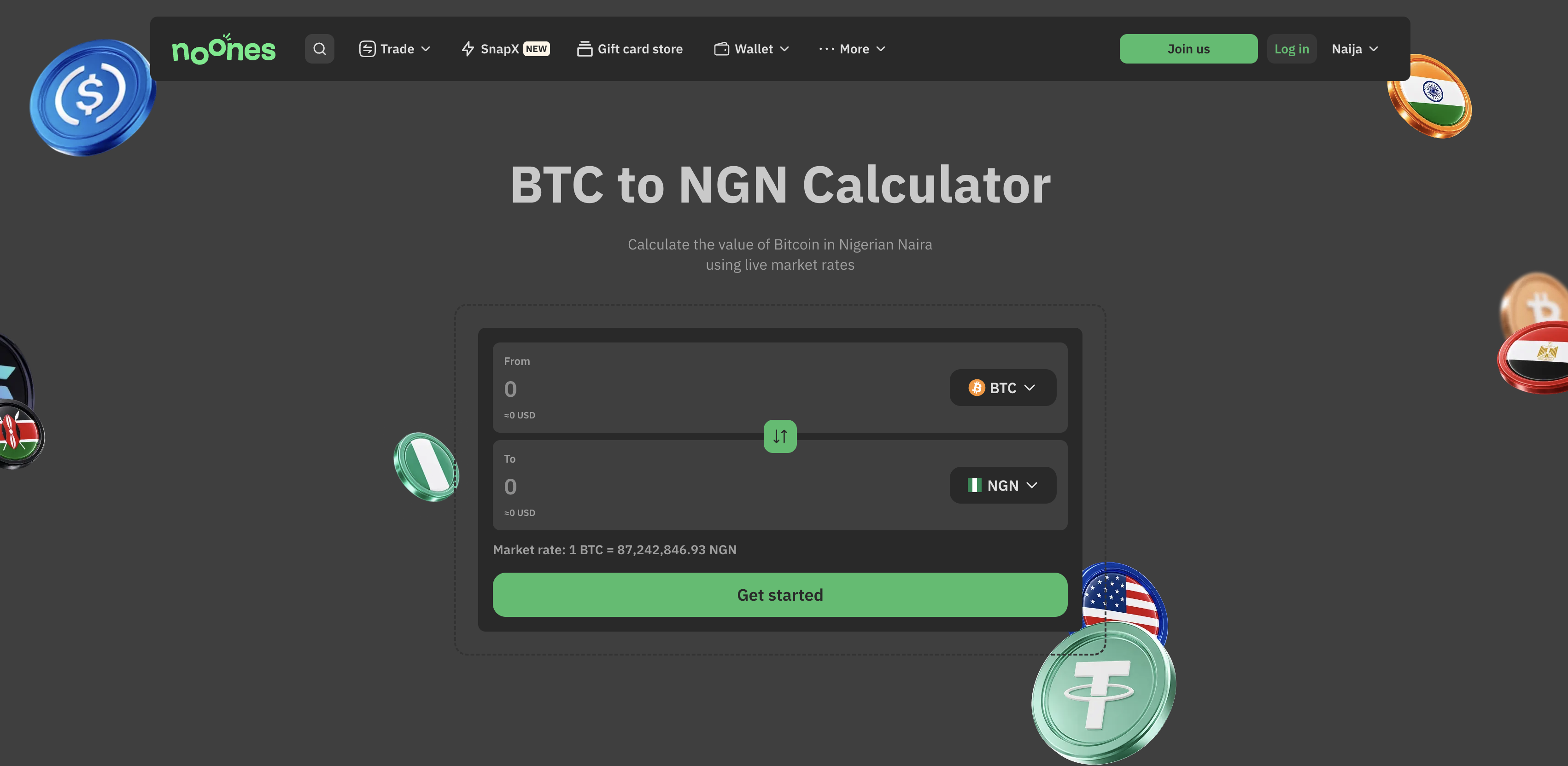
NoOnes P2P
NoOnes Peer-to-peer marketplace with a strong focus on the Global South (including active Nigeria community and partners).
Very flexible payment options (local bank transfers, cash, gift cards, mobile money, etc.).
Escrow protection. Good for users seeking more payment variety or competitive rates.
Also offers broader “cash-out” features (bank/card); Naira support continues to expand.
Slightly less institutional feel than the big exchanges but popular for flexibility.
What about taxes?
Nigeria introduced a broad tax overhaul that took effect from the start of 2026. Under the Nigeria Tax Administration Act 2025 and related laws, digital assets are treated as chargeable assets, and profits from selling or disposing of crypto are taxable. A Presidential Executive Order signed in July 2026 also pushed the Central Bank, the SEC, and the Nigeria Revenue Service to coordinate oversight of the sector.
The key points below are widely reported figures based on the new framework. Because the rules are new and still being applied, treat these as general information and confirm your own position with a qualified tax professional.
You are taxed on profit, not on holding. Tax is triggered when you sell or dispose of crypto at a gain, for example selling Bitcoin for more than you paid. Simply holding coins is not a taxable event.
Gains are taxed under the personal income framework. Reporting has moved profits into personal tax bands, with rates that reporting suggests can reach up to around 25 percent, replacing the earlier flat 10 percent capital gains approach. Some reliefs and thresholds have been reported, so the exact figure depends on your total income and situation.
Platforms now report and link identities. Licensed platforms link accounts to your Tax Identification Number and NIN and file transaction reports, so crypto activity is far more visible to authorities than before.
Keep records and file properly. Save your buy prices, sell prices, dates, and fees. Filing is handled through the revenue service's online tax system.
The bottom line
Cashing out crypto in Nigeria in 2026 is more straightforward and more regulated than it used to be. The reliable path is to sell on an exchange that supports direct naira withdrawals to a bank account in your own name, such as Luno, Quidax, or Busha, and to keep good records for tax.
Choose your exit asset with care, usually a stablecoin on a supported network, be cautious with P2P by staying inside escrow and confirming payment before releasing crypto, and use a licensed OTC desk for very large sums. None of this is financial advice, but following these habits keeps the process clean, traceable, and lower risk.
Frequently asked questions
What is the fastest way to cash out crypto to naira in Nigeria?
Selling a stablecoin on a local exchange that supports direct bank withdrawals is usually the fastest reliable route. Fast off-ramps can clear in minutes, while direct exchange withdrawals often land within a few hours.
Can I withdraw crypto straight to my bank account?
No. You must first sell the crypto for naira on a platform, then withdraw the naira to your bank. Crypto and naira are handled as two separate balances.
Is cashing out crypto legal in Nigeria?
Yes. Crypto is legal and regulated under the Investments and Securities Act 2025. It is not legal tender, and platforms serving Nigerian users are expected to be licensed by the SEC, but individuals buying, holding, and selling crypto are within the law.
Do I have to pay tax when I cash out?
If you sell at a profit, that gain is generally taxable under the 2026 framework. You are taxed on the profit, not on simply holding coins. Keep records and, for anything significant, speak to a tax professional.
Why can I not use Binance to withdraw naira anymore?
As of 2026, Binance's site is blocked in Nigeria, its naira P2P pairs were suspended, and it does not process naira deposits or withdrawals for Nigerian users. Most people now use locally supported exchanges to cash out.
Is P2P safe for cashing out?
P2P can work but carries real risks, including scams and the chance of a bank account being frozen if a counterparty pays with tainted funds. Stay inside the platform's escrow, trade with well rated merchants, and only release crypto after confirming the naira has arrived.
Which coin should I use to cash out?
Stablecoins such as USDT or USDC are the most common because they hold a steady dollar value while you move funds. Whatever you choose, confirm the network your exchange supports before sending.
Sources
Investments and Securities Act 2025 and SEC licensing coverage, Cryptoverse Lawyers and CoinEdition / CryptoRank (2026)
Presidential Executive Order on Virtual Assets Coordination 2026, WithinNigeria (July 2026)
SEC provisional licences for Quidax and Busha under ARIP, Techpoint Africa and Finextra (2024)
Luno fees, limits, and Nigerian bank withdrawal guides, Luno Help Centre
Binance access and naira channel status in Nigeria, NairaCompare (2026)
Stablecoin usage among Nigerian crypto users, Chainalysis reporting cited by kkInvesting (2026)
Nigeria Tax Administration Act 2025 and 2026 crypto tax framework, Tekedia, Zawya, Economy Post, and MEXC tax guides (2026)
Disclaimer: This content is for educational and informational purposes only and is not financial advice. Nothing here is a recommendation to buy or sell any asset or use any platform. Do your own research and manage your risk.
How to Cash Out Crypto in South Africa in 2026
Best Crypto Trading Competitions in 2026: OKX vs Bybit
How RugCheck Works: A Beginner's Guide to Checking Solana Tokens
Best Crypto Off-Ramps in the UAE: OKX, BitOasis and Fasset Compared
Need deeper training?
Join our structured modules with live examples and expert checklists for effective implementation.
JOIN THE ACADEMY