Key Takeaways
# | Takeaway |
|---|---|
1 | Trading competitions are not free money. They are built to get you trading more, using more leverage, and taking bigger risks, which is exactly how beginners lose money fast. |
2 | Bybit runs the single biggest event (WSOT), while OKX runs a steady stream of smaller contests. The largest prize pool is not always the easiest to win, so a small niche competition can be the smarter target. |
3 | You win by picking the right contest for your account size, setting a strict budget you can afford to lose, understanding how winners are ranked, and never chasing the leaderboard with last-minute leverage. |
Crypto Competitions Look Like Free Money. They Are Not.
Crypto trading competitions look like a shortcut to easy money. They are not, and it helps to understand why before you sign up.
Here is what is really going on. The exchange wants more trading volume, more deposits, more active users, and more attention. You get a shot at a prize, but in return you get nudged toward trading more often, using more leverage, and loosening your risk discipline. If you are new, that trade is rarely in your favour.
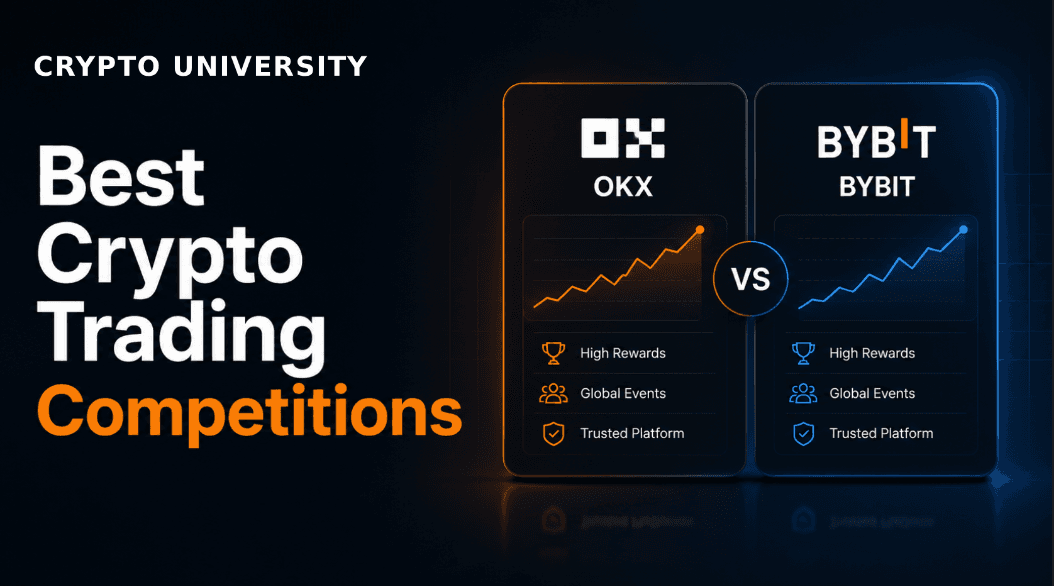
In 2026, OKX and Bybit are still the two platforms to watch if you want to join a big global or regional competition. Let's walk through how each one works and how to compete without wrecking your account.
Only use links and products that are available in your country. Crypto University may earn a commission when readers use selected partner links. That never changes our editorial view.
The Two Main Types of Competition
Bybit: The World Series of Trading (WSOT)
Bybit's headline event is WSOT, short for the World Series of Trading. The 2025 edition advertised a prize pool of up to 10 million USDT and packed in individual, squad, preheat, livestream, and on-chain rounds. Afterwards, Bybit reported more than 520,000 traders taking part and around 7.97 million dollars handed out in rewards.
As of 15 July 2026, a 2026 WSOT schedule had not been publicly confirmed, so do not assume last year's dates still apply. Bybit has stayed busy through its TradeMasters series, and its Stockholm Open 2026 edition advertised a 1.6 million USDT prize pool. Always check the current dates before you plan around them.
OKX: Global Championships and Recurring Arenas
OKX takes a different approach. Instead of one giant event, it runs a rolling mix of contests:
OKX event type | What it is |
|---|---|
Global trading championships | Large, headline contests with big prize pools. |
Seasonal trade arenas | Recurring events tied to a season or theme. |
Affiliate-exclusive competitions | Contests you enter through a partner or creator. |
Regional leaderboards | Rankings limited to certain countries or regions. |
Task-based reward campaigns | Points for deposits, first trades, referrals, and daily activity. |
On-chain DEX competitions | Contests run through the OKX Wallet and decentralised exchange. |
As of July 2026, OKX's affiliate campaign advertised a prize pool of up to 130,000 USDT. Earlier 2026 campaigns ranged from small affiliate leaderboards to token-specific pools, and the 2025 Global Trading Championship advertised up to 1 million USDT. The live campaign hub is where you confirm what is running right now.
Because OKX spreads its rewards across many smaller campaigns, the field is often less crowded. That can actually work in your favour.
Which Exchange Has the Bigger Competitions?
It depends on what you mean by "biggest."
What you care about | Winner |
|---|---|
Largest flagship spectacle | Bybit WSOT |
More frequent chances to compete | Often OKX |
Best chance of actually winning | Not necessarily the largest prize pool |
Here is the part beginners miss. A 10 million dollar competition with hundreds of thousands of traders can be far harder to win than a 20,000 dollar niche contest with a small, qualified field. A bigger prize pool does not mean better odds.
How Competitions Decide Who Wins
Every competition ranks traders somehow, and the ranking method changes how you should play. Here are the common ones.
Ranking method | How it works | What it rewards | The catch |
|---|---|---|---|
Profit and loss % | Measures your return against your starting balance. | Small accounts can compete. | Encourages extreme leverage on tiny accounts. |
Absolute profit | Measures total dollars earned. | Larger accounts. | A 5% gain on 1 million beats 50% on 5,000. |
Trading volume | Measures how much you trade. | High turnover. | You can overtrade and pay more in fees than the prize. |
Team or squad | A captain recruits traders who compete together. | Communities and creators. | Your result depends on teammates. |
Task points | Points for deposits, first trades, referrals, and activity. | New and active users. | "Prize pool up to" may depend on targets never reached. |
Read the ranking formula closely before you enter. The phrase "prize pool up to" often hides participation targets that may never be hit.
How to Join a Competition
The typical steps look like this:
Create and verify an eligible account.
Register on the competition page.
Meet the minimum deposit or balance requirement.
Use the eligible account type.
Trade only the eligible products.
Avoid any excluded market-making or hedging behaviour.
Track the ranking and reward rules as you go.
Keep your funds in the account until the required snapshots finish.
Two things trip people up. Registration is often not automatic, and any trading you do before you click "Join" may not count.
A Smarter Approach
Set a Maximum Competition Budget
Decide how much you are willing to lose before you enter, and stick to it. Do not add more money just because the leaderboard is moving.
Keep the Competition Money Separate
Where the exchange allows it, use a subaccount for the competition. That way a bad run in the contest cannot damage your long-term portfolio.
Match Your Strategy to the Ranking Formula
A plan built to win on profit percentage looks very different from one built for volume or absolute profit. Know which one you are playing before you start.
Do the Fee Maths First
Fees quietly eat your prize. Here is a simple example:
Item | Amount |
|---|---|
Notional volume traded | 2,000,000 |
Average fee and slippage cost | 0.08% |
Total friction cost | 1,600 |
Realistic share of the prize pool | 200 |
In that example you are already 1,400 dollars in the hole before you count any trading losses. If the maths does not work, the competition is not worth it.
Avoid the Final-Day Leverage Trap
Many traders crank up leverage near the deadline to jump up the leaderboard. A few win. Most simply turn a decent result into a liquidation. Do not let the last day undo weeks of discipline.
Save the Rules
Campaign pages change. Take screenshots of the eligibility, ranking, reward, and payout terms so you have proof of what you signed up for.
How a Community Can Run These Competitions Well
These events suit an education community like Crypto University, because a live competition gives people a reason to open and fund an account now. The key is to build the campaign around discipline, not gambling.
A weak campaign just says "sign up to Bybit." A strong one says: join the CU trading team, where we publish the rules, host weekly strategy sessions, track the leaderboard together, and reward the most disciplined trader, not the biggest gambler.
The content flow that supports this looks like:
Publish the competition guide.
Post an X thread explaining the prize structure.
Open a Telegram squad.
Share the partner link.
Host a pre-competition risk workshop.
Share leaderboard updates.
Interview the top performers.
Publish a post-event performance review.
To keep the focus on learning instead of pure churn, reward more than volume:
Award | What it rewards |
|---|---|
Best risk-adjusted return | Good returns without reckless risk. |
Lowest drawdown | Protecting capital under pressure. |
Best trading journal | Clear thinking and record keeping. |
Most consistent daily process | Discipline over lucky one-off trades. |
Best beginner performance | Encouraging new traders to build good habits. |
OKX vs Bybit at a Glance
Feature | OKX | Bybit |
|---|---|---|
Flagship event | Global championships and Trade Arenas | WSOT |
Event frequency | Frequent and spread out | One big annual event plus smaller ones |
Team format | Varies by campaign | Strong squad format |
On-chain competitions | Strong Wallet and DEX integration | Included in recent WSOT formats |
Beginner friendliness | Depends heavily on the event | Preheat and task formats can be accessible |
Main danger | Chasing volume | Chasing leverage and the leaderboard |
Red Flags to Watch Before You Join
If you spot any of these, slow down and read the fine print:
Red flag | Why it matters |
|---|---|
Prize pool needs impossible volume | The advertised reward may never be paid in full. |
Rewards are coupons, not real assets | You may not be able to withdraw what you win. |
Only new users qualify | Existing traders are excluded. |
Profits use unusual snapshots | The scoring may not match what you actually earned. |
Subaccounts are excluded | Your safest setup may not be allowed. |
Market makers get an edge | You are competing on an uneven field. |
Wash trading rules are vague | You could be disqualified without warning. |
Rewards vest or expire | You might lose the prize if you do not act in time. |
Your region is excluded | You may not be eligible at all. |
Rules can change without notice | The goalposts can move mid-competition. |
Final Verdict
Bybit WSOT is the event to watch if you want the biggest global trading spectacle. OKX is the platform to keep an eye on all year for recurring arenas and affiliate campaigns.
The smart move is to use both: Bybit for the major annual team campaign, and OKX for a steady calendar of smaller trading events.
The opportunity is real, and so is the risk. The goal is to turn competition traffic into long-term, educated traders, not to push beginners into blowing up their accounts for a leaderboard screenshot.
Risk warning: Trading derivatives can lead to rapid losses. Competition rewards do not make up for reckless leverage.
Frequently Asked Questions
Are crypto trading competitions worth it for beginners?
They can be, but only if you treat them as a learning experience with a strict budget you can afford to lose. Do not enter expecting easy money.
Which is better for beginners, OKX or Bybit?
Bybit's preheat and task-based formats are often more beginner-friendly, while OKX offers smaller contests with less crowded fields. The best choice depends on the specific event that is live when you sign up.
Do I need a lot of money to compete?
Not always. Some contests rank by profit percentage, which lets small accounts compete. Just be aware that this format also tempts people into risky, high-leverage trades.
How do competitions decide the winner?
Common methods are profit percentage, absolute profit, trading volume, team performance, and task points. Always read the exact formula before you enter, because it shapes the best strategy.
What is the biggest mistake people make?
Piling on leverage on the final day to jump up the leaderboard. It occasionally works, but far more often it turns a solid result into a liquidation.
If I rank high, is my prize guaranteed?
No. Rewards can depend on volume targets, snapshots, vesting, or regional eligibility. Save the rules in writing so you know exactly what you qualify for.
Sources
Bybit WSOT official pages and 2025 recap.
Bybit trading competition guides and competitions hub.
Bybit TradeMasters Stockholm Open 2026 announcement.
OKX 2026 Campaign Hub and July 2026 affiliate campaign.
OKX Global Trading Championship 2025 and Spring Trade Arena 2026.
Disclaimer: This content is for educational and informational purposes only and is not financial advice. Nothing here is a recommendation to buy or sell any asset or use any platform. Do your own research and manage your risk.
Layer 1 vs Layer 2: Understanding Blockchain Scalability from First Principles
MetaMask Agent Wallet: A Complete Beginner's Guide
AI Agents in Crypto Wallets: Technical Foundations and Security Considerations
Tokenized Assets Go Institutional: What Standard Chartered's 2028 Projection Means for Web3 Learners
How to Verify a Stablecoin's Reserves Yourself (Before the Rules Change)
Need deeper training?
Join our structured modules with live examples and expert checklists for effective implementation.
JOIN THE ACADEMY