Key Takeaways
Takeaway | |
|---|---|
1 | Kenyans can already buy tokenized US stocks like Tesla, Apple, and Amazon today through crypto platforms such as Bitget, and M-Pesa makes funding refreshingly easy. |
2 | Kenya's new VASP Act (2025) created a real legal framework, but licensing is still being switched on, with a deadline for operators around November 2026. |
3 | Tokenized stocks are not the same as real shares. The CMA warns they carry no local investor protection, so treat them as offshore-linked exposure and manage the risks. |
Kenya's Interesting Moment for Tokenized Stocks
Kenya is at a genuinely interesting turning point when it comes to tokenized stocks. Local demand is real and growing, several platforms already serve Kenyan users, and the country has just built its first proper legal framework for virtual assets. The one catch is that this framework is still being switched on.
In plain language: you can practically buy tokenized US stocks in Kenya today, even though the licensing rules that will formally govern these platforms are still being rolled out. Understanding both halves keeps you on solid ground. This guide walks you through it, step by step, in words a first-time investor can follow.
First, What Is a Tokenized Stock?
A tokenized stock is a digital token that tracks the price of a real company's share, such as Tesla or Apple. You get price exposure to that stock, but you are buying a crypto-style token, not the actual share listed on a stock exchange. Keep that distinction in your back pocket, because it shapes your rights and protections later on.
The New Legal Framework in Kenya
Between 2025 and 2026, Kenya moved from an unregulated grey zone to a structured system. Here is what changed, in plain terms.
The Rules at a Glance | What It Means for You |
|---|---|
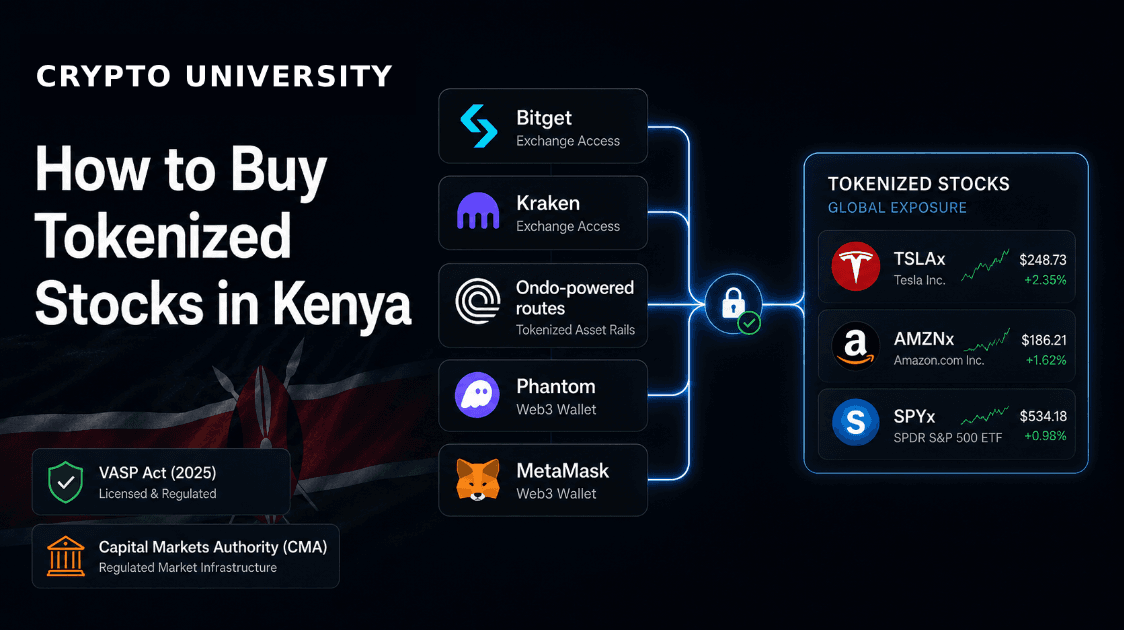
The VASP Act (2025) | Kenya's Virtual Asset Service Providers Act was signed into law on 15 October 2025. It created a full framework for licensing and regulating crypto and tokenized-asset activity. |
Who regulates it | The Capital Markets Authority (CMA) oversees exchanges, brokers, advisers, and tokenization platforms. The Central Bank of Kenya (CBK) is involved on the money side. |
The licensing transition | Existing operators have until around November 2026 to meet licensing requirements. So through much of 2026, platforms are operating in a transitional window: legal activity under a framework that is still being fully implemented. |
The CMA's caution | The CMA has warned that these products are volatile and, unlike ordinary shares, tokenized assets carry no investor protection under Kenyan law. In short: tokenized is not the same as shares. |
The practical read is simple. Kenya now has a real, emerging framework, which is far better footing than an ungoverned market. But you are still operating during its rollout, so platform legitimacy and that no-local-protection warning both deserve your attention.
Want to compare live issuers, backing, and venues for each asset? The Crypto University Tokenized Stocks Directory lists them side by side.
What Kenyans Can Access Right Now
Kenyan investors are already trading tokenized US stocks through crypto platforms. Here are the main routes available today.
Platform / Route | What You Can Buy | Good to Know |
|---|---|---|
Tokenized US stocks (Tesla, Apple, Amazon, and more) plus crypto | One account, buy and sell inside the app. This is among the platforms most often cited for Kenyan access. | |
Kraken and other global exchanges | xStocks | Available in the regions where Kenya is enabled. |
Ondo-powered routes | 100+ tokenized US stocks | Held onchain, for eligible non-US users. |
Onchain wallets (Phantom, MetaMask) | xStocks on Solana, Ondo on Ethereum | You hold the tokens yourself (self-custody). Normal product terms apply. |
One big advantage for Kenya is its mature mobile-money system. M-Pesa and the wider ecosystem make funding unusually smooth compared with many other markets. Just remember that availability shifts as the VASP rules settle in, so confirm a platform's current status and licensing before you commit, and cross-check the directory.
Step-by-Step Guide for a Kenyan Investor
Here is the whole journey, broken into five plain steps.
Choose a platform that serves Kenya. Ideally pick one that is clearly moving toward VASP licensing. Bitget and major global exchanges are common choices. Check current availability first.
Complete KYC using your Kenyan ID. KYC simply means "know your customer". It is the standard identity check every regulated platform runs when you sign up.
Fund your account. You can use Kenyan shillings through mobile money or bank transfer, or send stablecoins directly. The table below breaks down both options.
Place your order. Use a limit order, where you set the price you are willing to pay, or the platform's simple buy button. Trading during US market hours usually gives you smoother pricing.
Decide where to keep your tokens. You can leave them on the platform, or move them to your own wallet (self-custody) where that is supported.
How to fund your account
Funding Method | How It Works | Things to Note |
|---|---|---|
Mobile money or bank (KES) | Deposit Kenyan shillings where the platform supports it, then convert to USDT or USD. | Kenya's M-Pesa rails make this smooth. A currency conversion (an FX step) happens right here. |
Stablecoins (USDT / USDC) | Send stablecoins you already hold straight to the platform. | This skips the shilling conversion. Handy if you already own stablecoins. |
Risks Every Kenyan Should Weigh
No guide is complete without the honest part. Read these before you buy.
Risk | What It Means for You |
|---|---|
No local investor protection | The CMA has said it plainly: tokenized US stocks are not NSE shares and are not protected like local securities. Think of them as offshore-linked exposure, not a locally guaranteed investment. |
Transitional platform risk | Licensing is still rolling out. Favour platforms clearly working toward VASP compliance and credible global operators. Remember, you are trusting both the platform and the issuer behind the token (names like Backed or Ondo). |
Currency and dollar exposure | Funding in shillings means a shilling-to-dollar conversion, and every US stock token holds US dollar exposure inside it. That can help if the shilling weakens, but it also adds currency and market risk. It is exposure, not a guaranteed hedge. |
Tax and record-keeping | Kenya's tax treatment of crypto and tokenized-asset gains is still developing. Keep clear records of everything and get local tax advice. |
Quick Recap
Kenyans can already buy tokenized US stocks through Bitget and other routes, helped along by strong mobile-money funding. The VASP Act and CMA oversight give the space a real framework, though licensing is still being finalised toward that late-2026 deadline. Above all, the CMA has been clear that these tokens are not protected shares, so choose platforms moving toward licensing, fund sensibly through shillings or stablecoins, keep good records, and size your positions for platform, currency, and market risk.
Frequently Asked Questions
Can Kenyans buy tokenized US stocks?
Yes. Platforms including Bitget already let Kenyans trade tokenized equities like Tesla, Apple, and Amazon alongside crypto, and onchain routes exist too. Always confirm current availability on your chosen platform first.
Is it legal in Kenya?
Kenya's VASP Act (2025) established a legal framework, with CMA and CBK oversight and licensing still being put in place. Operators have until roughly November 2026 to comply. So the activity is legal under an emerging regime, but the CMA cautions that tokenized assets carry no local investor protection.
How do I fund purchases in Kenya?
You can use mobile money or a bank transfer in shillings where it is supported, then convert to USDT or USD. Or you can deposit stablecoins directly. Just note that a currency conversion applies when you fund with shillings.
Do tokenized stocks carry investor protection in Kenya?
No. The CMA has explicitly warned that they do not carry the protections of conventional shares under Kenyan law. They are offshore-linked exposure instruments, not local securities.
Which platform should I use?
Pick one that serves Kenya and, ideally, is progressing toward VASP licensing. Bitget and credible global venues are among the options. Verify current status and lean toward established, well-known operators.
Sources: Kenya Virtual Asset Service Providers Act, 2025 (signed 15 October 2025); CMA draft regulations (2026); CMA and CBK oversight and the licensing transition; CMA investor-protection caution; media coverage of Kenyans accessing tokenized US stocks (The Standard, 2026); and Bitget's tokenized-stocks offering.
Disclaimer: This content is for educational and informational purposes only and is not financial advice. Nothing here is a recommendation to buy or sell any asset or use any platform. Do your own research and manage your risk. Research date: Aug 4,2026. Kenya's VASP framework is being operationalised through 2026, so verify platform status before acting.
Explore the Crypto University Tokenized Stocks Directory.
Are Tokenized Stocks Legal? Regulations, Restrictions and Investor Rights
The Companies Behind Tokenized Stocks: xStocks, Ondo, Dinari, Robinhood and More
How to Buy Tokenized Stocks: A Step by Step Guide for Beginners
Can You Trade Tokenized Stocks 24/7? Market Hours and Weekend Pricing Explained
How to Cash Out Crypto in Kenya in 2026: A Step-by-Step Guide
Need deeper training?
Join our structured modules with live examples and expert checklists for effective implementation.
JOIN THE ACADEMY