Key Takeaways
Takeaway | What it means for you |
|---|---|
Do your homework first | Before you spend a cent, run three quick checks: what the token actually is, who issued it, and whether it is legally available where you live. |
Start on an exchange | For most beginners, a trusted centralized exchange is the simplest and safest way to buy. Going straight onchain gives you round the clock access and self custody, but it asks more of you. |
Look past the headline fee | The advertised fee is never the full cost. Add up the spread, currency conversion, network fees, and price impact, and always test with a small order before going big. |
Getting Started
Once your account is set up, buying a tokenized stock takes about as long as buying any other crypto asset. It is quick. The part that really deserves your attention is not the buying itself, but the three checks that come before it: what the token actually is, who created it, and whether it is legally offered where you live.
Skip those checks and you can easily end up with the wrong kind of product, or an asset your platform will not let you withdraw. So let's slow down for a minute at the start, and then the rest is easy. This guide walks you through both ways to buy: the exchange route and the onchain route.
Before You Buy: Three Quick Checks
Think of these as your safety belt. They take a few minutes and save you from the most common beginner mistakes.
Check | What to look for | Why it matters |
|---|---|---|
1. What is the product? | Find out who issues the token and how it is backed. The listing page should say this clearly. | “Tokenized stock” covers very different structures, and each behaves differently when markets get rough. |
2. What is the underlying? | A Tesla token should track TSLA on Nasdaq. Check the ticker, and for onchain buys, check the contract address in the issuer's official docs. | Anyone can name a token “TSLA” on a decentralized exchange. Fake tickers are a real problem. |
3. Are you eligible? | Read the platform's own supported countries page, not just whether the site loads for you. | A site loading in your country does not mean you are allowed to hold the product there. |
Tip: if a listing page will not clearly tell you who issues a token and how it is backed, treat that silence as your answer and walk away.
A closer look at what you might be buying
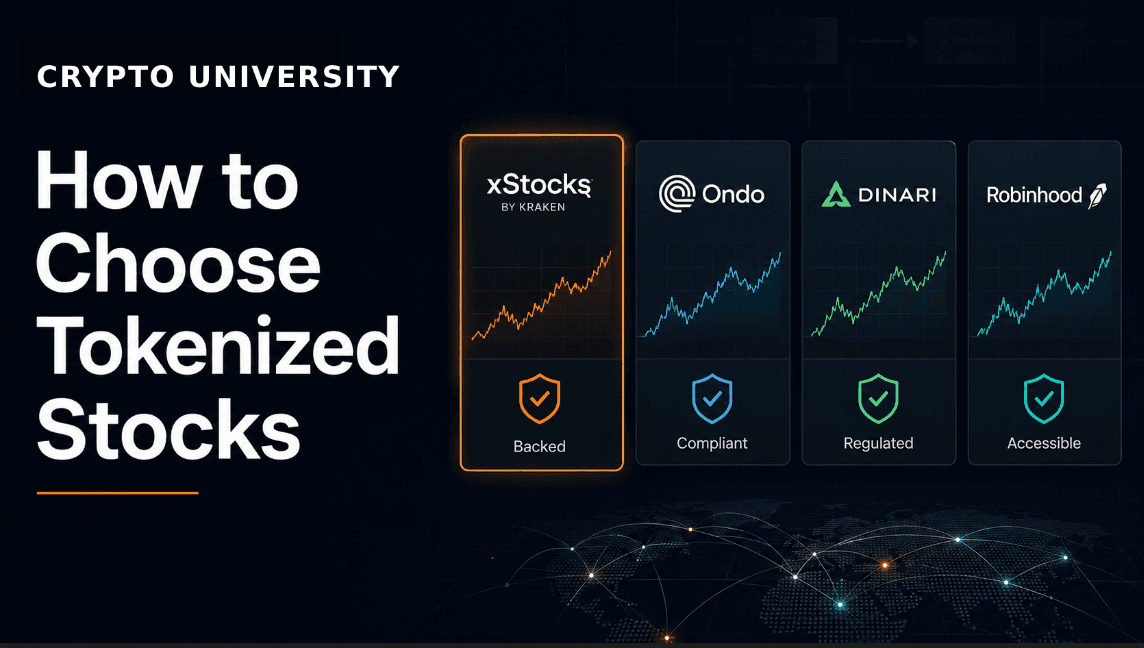
Not all tokenized stocks are the same under the hood. Here is a plain language comparison of the main types you will run into.
Product | How it is backed | Issuer |
|---|---|---|
xStocks | 1 to 1 backed tracker certificates. | Backed Assets |
Ondo Global Markets tokens | Notes secured by real shares held at US broker dealers. | Ondo Finance |
Robinhood EU stock tokens | Derivatives that follow the share price. | Robinhood |
Equity perpetuals | Hold no real shares at all. | Various exchanges |
A quick note on where you can buy
Eligibility is region specific and it changes, so always confirm on the platform itself. As a rough starting point: xStocks are not offered to US persons and are currently restricted in the UK, Canada, and Australia. OKX's unified tokenized stocks serve markets across Southeast Asia, Northeast Asia, the CIS, MENA, and Turkey, but not the US or EU. Robinhood's tokens need an eligible European or supported country account.
Route 1: Buying on a Centralized Exchange
This is the simpler path, and it is the right one for most first time buyers. You get clearer pricing, easy ways to add money, and customer support if something goes wrong.
Step 1: Pick a platform that serves your country
Here are the main venues as of July 2026. Always double check that your country is supported before you sign up.
Platform | Tokens offered | Who it serves |
|---|---|---|
Kraken | xStocks | Non US, most of the world outside the restricted list |
Bybit and Gate | xStocks | Supported regions per each platform |
OKX | Unified tokenized stocks | Asia, MENA, CIS, Turkey |
Gemini | Dinari powered tokens | EU customers |
Robinhood | Its own tokens | EU/EEA, and via newer products, 120 plus countries |
Step 2: Complete identity verification (KYC)
Every regulated venue will ask you to verify who you are, usually with a passport or ID, proof of address, and sometimes a selfie. Because tokenized stocks are linked to securities, this step can be a little stricter than for plain crypto. It is normal, so just have your documents ready.
Step 3: Add money to your account
You have three common ways to fund your account. Here they are, roughly from cheapest to most expensive for most non US users.
Funding method | Speed and cost | Best for |
|---|---|---|
Stablecoins (USDT, USDC, USDG) | Usually the cheapest and fastest. On Kraken, buying xStocks with USDG or USD has no trading fee, though a spread applies. | Anyone who already holds stablecoins |
Local fiat (bank transfer or card) | Convenient, but card deposits in particular can get pricey. | People funding in their own currency |
Crypto you already hold | Sell BTC or ETH into stablecoins first, or use an instant convert feature and watch the spread. | Existing crypto holders |
Step 4: Place your order
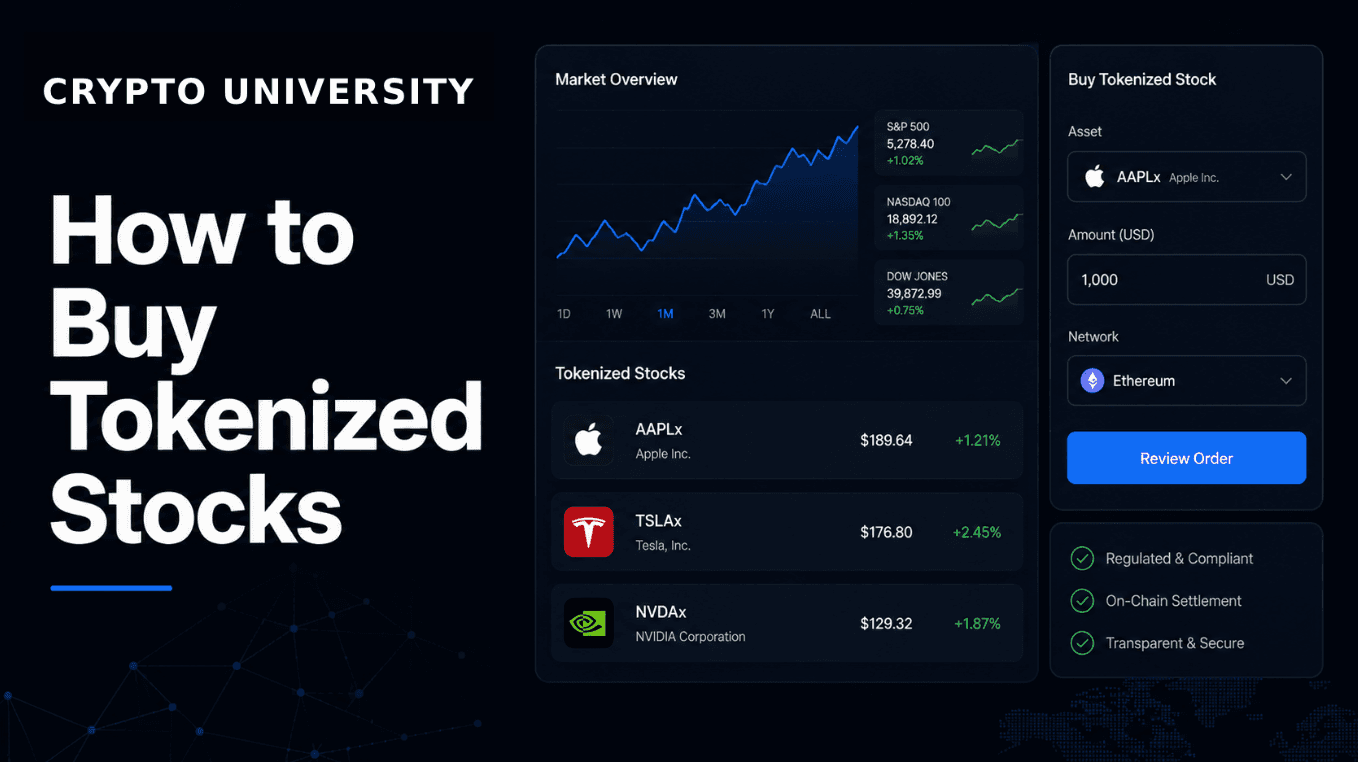
Find the market you want, for example TSLAx paired with USDT. As a beginner, prefer a limit order over a market order. Tokenized stock order books are thinner than the big crypto pairs, so a market order placed during a quiet hour can fill at a price well away from what you expected. Buying a fraction of a share is completely fine, and minimums are around one dollar on Kraken.
Step 5: Decide where your tokens live
You can leave your tokens in your exchange account, which is simple but means you rely on the platform. Or, where it is supported, you can withdraw them to your own self custody wallet. Kraken, for example, lets you withdraw xStocks as SPL tokens to a Solana wallet. Once tokens are in your own wallet, they can move and trade around the clock onchain.
Route 2: Buying Onchain
If you already use a wallet like Phantom or MetaMask and hold some stablecoins, you can buy tokenized stocks directly on a decentralized exchange (DEX). xStocks trade on Solana venues, with Jupiter pulling together most of the liquidity, and Ondo tokens are available to eligible non US users on Ethereum, including through MetaMask Swaps. Here is how the flow works, and what to watch at each step.
Step | What to do | Watch out for |
|---|---|---|
Verify the contract address | Copy it from the issuer's official docs. | Never trust a DEX search box or a message in a chat group. |
Check pool liquidity | Look at the quoted price impact before you confirm. | A small pool can move several percent on a large buy. |
Set your slippage | Half a percent is a fair starting point for liquid pairs. | If a trade needs 3 percent slippage to fill, the pool is too thin for your size. |
Mind network fees | Solana fees are tiny; Ethereum can cost real money at busy times. | Chain choice affects your total cost. |
Confirm you are eligible | Being able to swap is not the same as being allowed to hold. | The contract may be open to all, but the product's terms can still exclude your region. |
Fees: Where the Costs Actually Hide
The trading fee you see on screen is rarely the whole story. Your real cost is usually a mix of several smaller charges. Here is what to add up.
Cost type | When it applies |
|---|---|
Trading fee or spread | On the venue. Kraken builds a spread into xStocks pricing instead of charging a fee on USD or USDG orders. |
Currency conversion (FX) | When you fund with your local currency. |
Network fees | On every onchain transaction. |
DEX liquidity provider fees | When swapping on a decentralized exchange. |
Price impact | On thin order books, especially for larger trades. |
Issuer fees | On direct redemption with the issuer. |
A simple rule of thumb: for small, regular buys, spreads dominate your cost. For large buys, price impact dominates. Comparing the total cost across two venues with a small test order is well worth ten minutes of your time.
Selling and Cashing Out
Selling mirrors buying. You sell into USDT, USDC, or fiat on an exchange, or you swap out onchain. Two things are worth knowing before you exit.
Weekend pricing
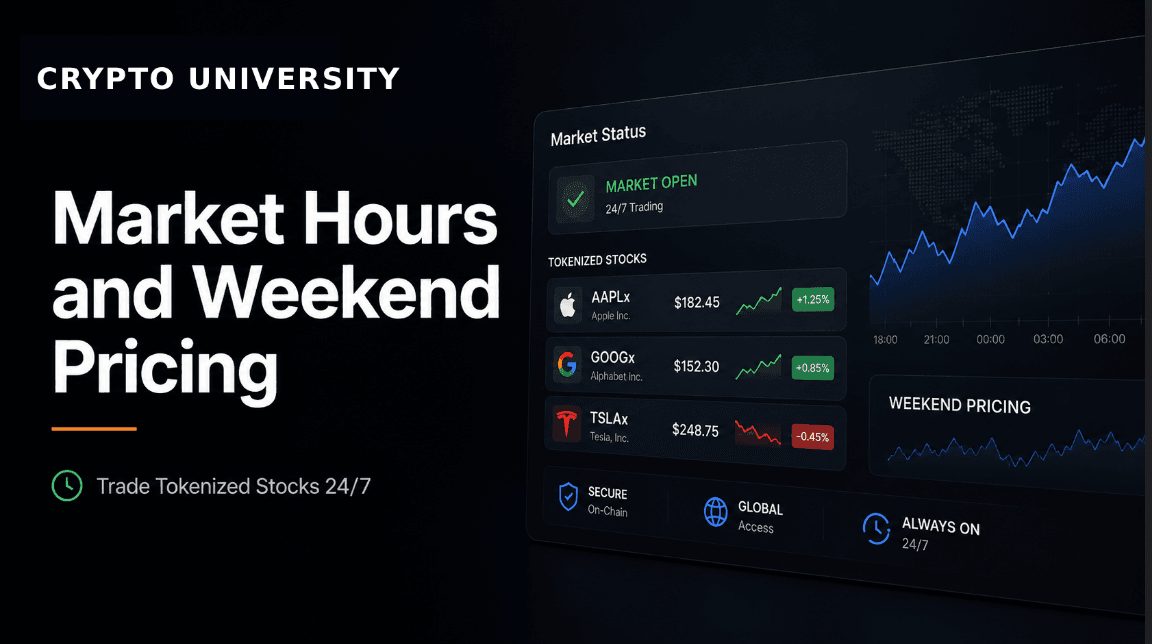
When US markets are closed, there is no live reference price, so quotes drift with supply and demand for the token. If you can choose, selling during US market hours usually means tighter spreads and a fairer price.
Redemption
Some products let you redeem directly with the issuer for share value or cash, but this is generally aimed at large or professional holders and comes with fees and its own verification. As a regular buyer, you will exit on the market, not through redemption.
Taxes and Keeping Records
In most places, selling a tokenized stock is a taxable event, and some countries tax these products differently from both regular shares and crypto. From day one, keep a record of dates, amounts, prices, fees, and wallet addresses for every buy, sell, transfer, and adjustment.
Exchange statements can disappear when accounts close, so export your records regularly. For advice tailored to your situation, speak to a local tax professional.
A Real World Example
Imagine a reader in Nairobi who wants 200 dollars of S&P 500 exposure. She buys USDT through a local on ramp, deposits it to an exchange that offers xStocks in Kenya, passes verification, and places a limit order for SPYx during US market hours.
Her total cost is the on ramp spread plus the exchange spread. There is no monthly account fee, no 500 dollar broker minimum, and no international wire. If she wants self custody, she can withdraw the tokens to a Solana wallet. The same purchase through an international broker would have needed a bigger deposit and a costlier funding chain, assuming the broker accepted her at all. That is exactly the situation where tokenized stocks earn their keep.
Frequently Asked Questions
What is the minimum amount to buy tokenized stocks?
On Kraken, you can buy xStocks from about one dollar. On a DEX, the minimum is really just the network fee. This makes it practical to own a small fraction of an expensive share.
Can I buy tokenized stocks without KYC?
Centralized exchanges require identity verification. DEX swaps do not ask for your identity, but the products' legal terms still restrict certain regions, and skipping the eligibility checks does not make you an eligible holder. We do not recommend using technical workarounds.
Should I buy on an exchange or a DEX?
Exchanges are better for beginners thanks to clearer pricing, easy funding, and support. A DEX suits people who want self custody and round the clock access, and who are comfortable verifying contracts and managing slippage themselves.
Which stablecoin should I use?
USDT has the widest pair support on exchanges that list tokenized stocks. USDC and USDG are also common, and Kraken's fee free xStocks pricing applies to USDG and USD.
Can I transfer tokenized stocks between platforms?
Where withdrawals are supported, yes. They move like any other token on their blockchain. Just make sure the destination supports that specific token before you send anything.
When is the best time to buy?
Liquidity and price tracking are best while US markets are open, roughly 14:30 to 21:00 UTC on weekdays. You can trade outside these hours, but expect wider spreads.
Disclaimer: This content is for educational and informational purposes only and is not financial advice. Nothing here is a recommendation to buy or sell any asset or use any platform. Do your own research and manage your risk.
How to Cash Out Crypto in Dubai in 2026
Best Robinhood Chain Trading Platforms in 2026: FOMO, GMGN, Uniswap and OpenSea Compared
RugCheck vs GoPlus: Which Token Security Tool Is Better?
RugCheck Score Explained in two minutes
Best Crypto Trading Competitions in 2026: OKX vs Bybit
How RugCheck Works: A Beginner's Guide to Checking Solana Tokens
Need deeper training?
Join our structured modules with live examples and expert checklists for effective implementation.
JOIN THE ACADEMY