
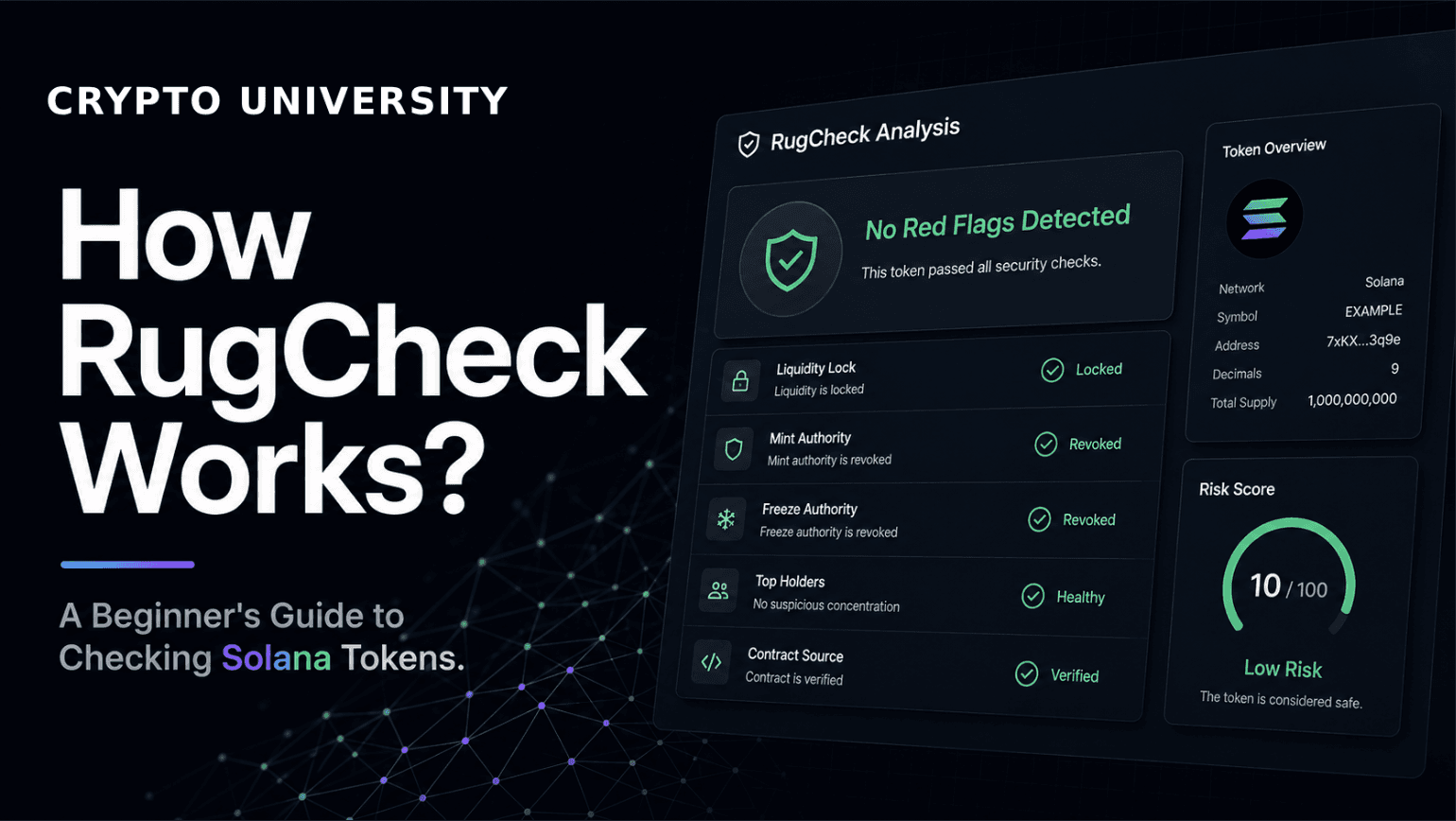
Key Takeaways
1. It is a fast on-chain scanner. RugCheck reads public Solana data such as token authorities, holders, and liquidity, then turns it into simple risk flags and a rating. 2. A pass does not mean safe. A clean result only means the tool did not spot its known warning signs right then. Insiders can still dump and crash the price. 3. Use it as a starting point. Open every flag, cross-check with other tools, and always test with a tiny amount before putting real money in. |
What RugCheck Actually Does
RugCheck is a token-risk scanner built mainly for Solana. You paste in a token's mint address, and it gathers on-chain information about that token: who controls it, who holds it, how much liquidity backs it, its metadata, and the activity around it. It then translates all of that into risk flags and a quick summary rating.
It is important to be clear about what it does not do. RugCheck does not predict price. It does not vouch for the team. It does not promise a token is safe. Think of it as an automated due-diligence shortcut that saves you hours of manual digging, not a crystal ball.
What RugCheck Reads
Solana tokens usually run on standardized token programs, so a scanner can inspect their key properties without reverse-engineering a brand-new smart contract for every meme coin. Here are the main areas RugCheck looks at and why each one matters to you.
What it checks | Why it matters to you |
|---|---|
Mint authority | Whether anyone can still create more tokens and dilute your holdings |
Freeze authority | Whether an operator can freeze accounts and trap holders |
Token supply | How many tokens exist and how they are shared out |
Metadata mutability | Whether the name, symbol, or image can still be changed |
Top holders | Whether a handful of wallets control most of the supply |
Liquidity and pools | Whether you can actually sell when you want to |
Liquidity locks or burns | Whether the team can pull liquidity out from under you |
Creator and deployer behavior | How the launch wallet is acting |
Bundled launches | Whether the launch was secretly split across many wallets |
Related wallets and markets | Hidden connections and where the token trades |
Mint and Freeze Authority: The Two Big Ones
These two are the most important controls to understand, so let us take them side by side.
Authority | What it can do | Why it is risky |
|---|---|---|
Mint authority | Create more tokens | Even if supply looks capped at one billion, an active mint authority can print more, dilute you, or set up a massive dump. Revoking it removes this specific risk, though not every risk. |
Freeze authority | Freeze token accounts | For a regulated token this can be intentional. For a meme coin it is dangerous, because an operator could lock holders in place while insiders quietly exit. RugCheck flags it because it creates control risk. |
Who Holds the Tokens
A token can look liquid while a few wallets quietly own most of the supply. RugCheck reviews the top holders and how concentrated ownership is. The catch is that known liquidity pools, burn addresses, treasury wallets, vesting contracts, and exchange wallets can throw off the raw percentages.
So the useful question is not simply whether one address owns twenty percent. The real question is who controls that address, what it is for, and whether those tokens can actually reach the market.
Liquidity: Can You Get Out?
Liquidity decides whether holders can sell. RugCheck may look at the size of the pool, who owns the liquidity, whether the liquidity provider tokens were burned, whether liquidity is locked, how long the lock lasts, and how spread out it is across pools.
Here is a trap for beginners: locked liquidity is not the same as a safe token. The team can still hold most of the supply, use hidden wallets, exploit mutable settings, or simply wait for the lock to expire before pulling out.
Bundled Launches
On Solana, launch transactions can be bundled so that many wallets buy at the very same moment or in the same block. A sneaky creator might split tokens across dozens of wallets to make the distribution look organic and healthy when it really is not.
RugCheck tries to spot this bundled activity and connected launch behavior, and it is one of its most useful features. Just know that sophisticated operators can stage and fund wallets in ways that are hard to detect.
Metadata and Impersonation
A token's metadata includes its name, symbol, image, and related details. Mutable metadata can be perfectly normal during a launch, but it also means whoever controls the token can change how it presents itself. This risk is usually milder than mint or freeze authority, but it still matters for impersonation and bait-and-switch tricks.
Markets and Price Data
RugCheck ties token-level risks to market information, including where the token trades and how active it is. A token can be technically clean and still be practically untradeable because there is barely any liquidity. A displayed market cap of five million dollars means very little if only twenty thousand dollars of liquidity is holding it up.
How the Final Rating Is Built
RugCheck gives different findings different weight. A serious authority or liquidity problem should count for far more than a minor metadata warning. The overall score gives you a quick signal, but the individual flags tell the real story.
Two tokens can end up with similar overall ratings for completely different reasons. One might have dangerously concentrated supply, while another has an active freeze authority. Those are not the same risk, so always read the details behind the number.
Where the Data Comes From
The core evidence is public Solana data: token mint accounts, token accounts, transactions, program instructions, liquidity pool accounts, ownership and authority fields, and wallet relationships. On top of that raw chain data, RugCheck layers its own risk interpretations.
Because the blockchain keeps changing, every report is really just a snapshot in time. A creator can transfer supply, add or remove liquidity, revoke authority, or change behavior right after you scan. That is why timing matters.
What RugCheck Cannot Know
RugCheck is strong at reading visible on-chain structure, but it is weak at reading human intent. Here is a simple way to picture what it can and cannot see.
What it can see (on-chain) | What it cannot know (human intent) |
|---|---|
Active mint or freeze authority | Whether a founder is lying |
Holder concentration | Whether an influencer is being paid |
Liquidity size, locks, and burns | Whether insiders control unrelated-looking wallets |
Bundled launch patterns | Whether the roadmap is real or the community is botted |
Metadata and market activity | Whether devs will quit or price is manipulated off-chain |
How to Use RugCheck the Right Way
A scan is only the first step. Follow this simple routine to get real value out of it.
Step | What to do |
|---|---|
1 | Copy the full mint address, not just the ticker |
2 | Run the scan |
3 | Open every high-risk flag and read it |
4 | Inspect the top holders |
5 | Check liquidity and any locks |
6 | Trace the creator wallet |
7 | Compare findings with Solscan and Bubblemaps |
8 | Check real trade activity on Birdeye or DEX Screener |
9 | Buy and sell only a tiny test amount first |
10 | Re-scan before you increase your position |
Why Beginners Misuse RugCheck
Beginners tend to scan a token, look for one word, and stop there. Experienced users do the opposite: they hunt for the exact reason the tool is worried. A token can pass every automated check and still collapse simply because insiders decide to sell.
It helps to think of RugCheck like an airport scanner. Passing through it does not prove you are a good person. It only means the scanner did not detect the specific things it was built to detect.
The Bottom Line
RugCheck works by turning public Solana token and market data into risk warnings you can actually understand. Its biggest strength is speed. Its biggest weakness is false confidence. Use the score to decide what to investigate next, not to hand over your final decision to a machine.
Frequently Asked Questions
Is RugCheck free to use?
You paste a token's mint address into RugCheck and it scans public on-chain data. Treat it as a free-to-check due-diligence shortcut, but always verify the current features and any limits on the official site.
Does a good RugCheck score mean the token is safe?
No. A clean result only means the tool did not detect its known risk patterns at that moment. Insiders can still sell, pull liquidity later, or manipulate price off-chain.
What is the difference between mint and freeze authority?
Mint authority lets someone create more tokens, which can dilute you. Freeze authority lets someone freeze token accounts, which can trap holders. RugCheck flags both because each gives an operator dangerous control.
Does locked liquidity mean I am protected?
Not on its own. The team can still hold most of the supply, use hidden wallets, or wait for the lock to expire. Locked liquidity reduces one risk, not all of them.
Which tools should I use alongside RugCheck?
Cross-check findings with Solscan and Bubblemaps for wallet and holder analysis, and Birdeye or DEX Screener for real trade activity. Then test with a tiny buy and sell before committing more.
How often should I re-scan a token?
Because a report is a snapshot, re-scan before you increase your position. A creator can change authorities, move supply, or alter liquidity soon after your first check.
Research Notes and Sources
Source | Link |
|---|---|
RugCheck platform | https://rugcheck.xyz/ |
RugCheck API schema | https://api.rugcheck.xyz/swagger/index.html |
SolRugDetector (2026 study of Solana rug pulls) | https://arxiv.org/abs/2603.24625 |
Community discussions | Reddit threads on missed scans, spotting rugs, and launch-bundle detection |
Disclaimer: This content is for educational and informational purposes only and is not financial advice. Nothing here is a recommendation to buy or sell any asset or use any platform. Do your own research and manage your risk.
RugCheck Explained: How Beginners Can Use This Free Solana Token Safety Tool
How to Cash Out Crypto in Dubai in 2026
How to Get Started on Robinhood Chain: A Complete Beginner's Guide
Best Robinhood Chain Trading Platforms in 2026: FOMO, GMGN, Uniswap and OpenSea Compared
Best RugCheck Alternatives Every Beginner Trader Needs
RugCheck vs GoPlus: Which Token Security Tool Is Better?
RugCheck API Guide: How to Scan Solana Tokens Programmatically
RugCheck Score Explained in two minutes
Need deeper training?
Join our structured modules with live examples and expert checklists for effective implementation.
JOIN THE ACADEMY