Key Takeaways
1 | DePIN (Decentralized Physical Infrastructure Network) uses crypto tokens to reward ordinary people for contributing real-world hardware, such as Wi-Fi hotspots, GPS sensors, and storage drives, to a shared network. |
2 | Helium is the leading DePIN example: its community-built wireless network had grown to over 300,000 mobile subscribers by mid-2025, with carrier partners including T-Mobile and AT&T offloading data traffic onto it. |
3 | The DePIN model depends on a working token economy: hardware operators earn tokens for providing real coverage, users burn tokens to pay for data, and the network only sustains itself if demand exceeds token inflation. |
What Is DePIN?
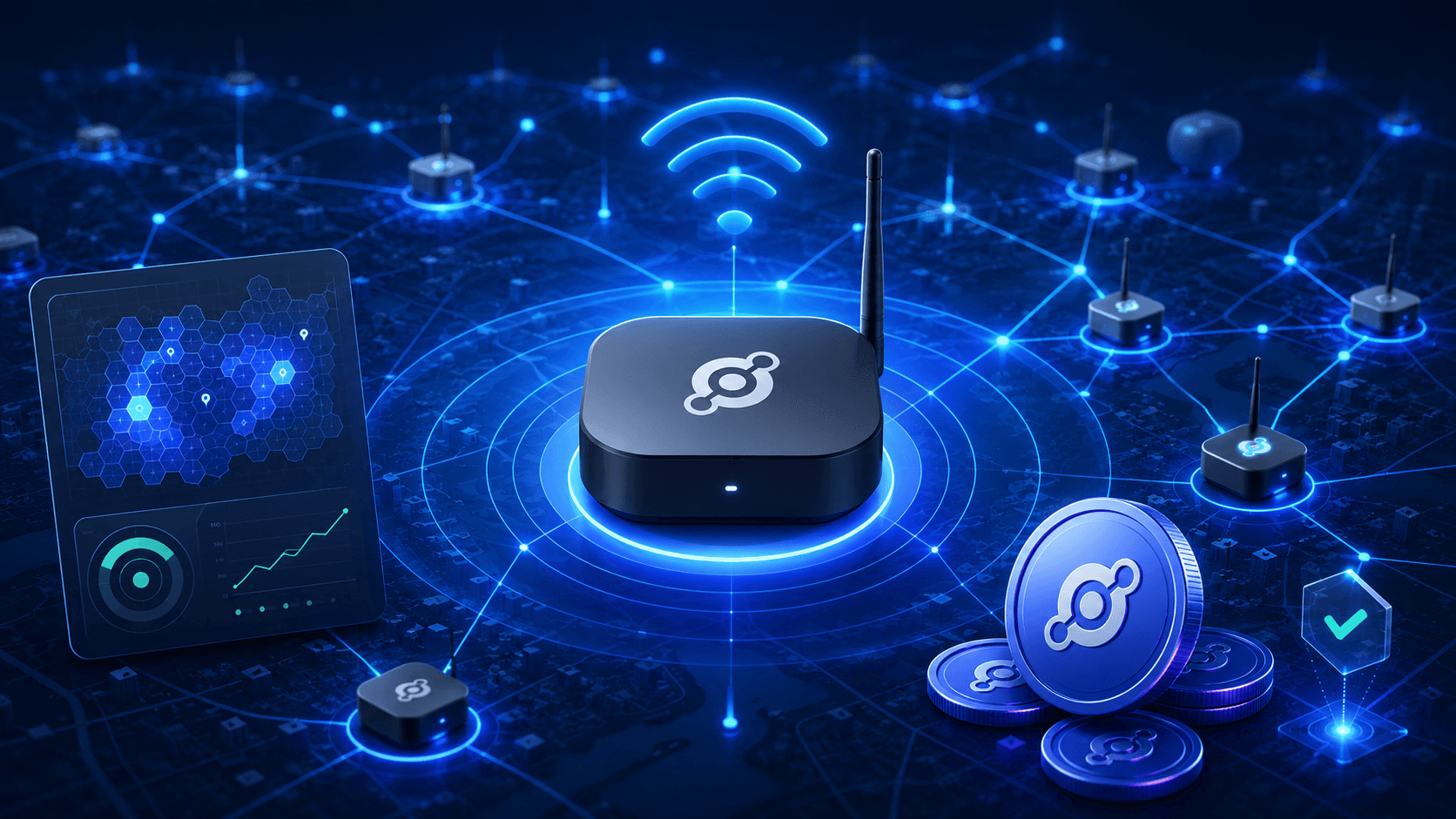
Decentralized Physical Infrastructure Networks, or DePIN, is a category of blockchain-based systems where people are paid in crypto tokens to contribute real-world hardware to a shared network. Instead of a corporation owning and operating the infrastructure, thousands of independent contributors do it, and get rewarded for their participation.
The idea sounds abstract until you see it in action. Consider what normally happens when a telecom company builds a mobile network: it spends billions of dollars on towers, spectrum licenses, and engineers. DePIN flips this model. Instead of the company owning the hardware, ordinary people install small devices in their homes or businesses, and the network pays them in tokens every time their hardware does useful work.
The term DePIN was coined in late 2022 by the research firm Messari and has since become one of the most-tracked categories in Web3. Common DePIN categories include:
Category | What It Provides | Example Projects |
Wireless Connectivity | Mobile and IoT coverage | Helium, XNET |
Compute / GPU | Processing power for AI and rendering | Render Network, Akash |
Storage | Decentralized file storage | Filecoin, Arweave |
Mapping / Data | Geospatial and sensor data | Hivemapper, WeatherXM |
Energy | Grid management, solar sharing | Energy Web, Powerledger |
The DePIN Flywheel: How the Economics Work
Every DePIN network runs on a version of the same economic loop, often called the DePIN Flywheel. Here is how it works in practice:
Step 1 – Bootstrap supply: The protocol offers token rewards to attract early hardware operators. This is how coverage gets built before there is any paying demand.
Step 2 – Attract users: Once coverage exists, users can pay for network services. In Helium's case, this means mobile subscribers or IoT devices transmitting data.
Step 3 – Burn tokens to pay: Users spend the network's native token (or a derivative of it) to pay for data transfers. This burning reduces circulating supply.
Step 4 – Reward operators: Hardware operators continue earning newly minted tokens for providing coverage. If real demand is high enough, the system becomes self-sustaining.
The critical test for any DePIN is whether real usage fees can eventually outpace token emissions. If they cannot, the network is effectively subsidizing itself with inflation, which is not a long-term model.
Helium: The DePIN Case Study
Helium is widely cited as the most advanced real-world DePIN example. Founded in 2013, it spent years building an IoT-focused wireless network before pivoting to mobile coverage in 2023. Its story shows both the potential and the complications of the DePIN model.
How Helium Mobile Works
Helium Mobile is a Mobile Virtual Network Operator, or MVNO. This means it does not own physical cell towers. Instead, it offloads data traffic onto two infrastructure layers: the broader US carrier network (T-Mobile acts as the backbone) and a growing base of community-owned Wi-Fi and 5G hotspots.
When a Helium Mobile subscriber uses data near a community hotspot, that data routes through the hotspot rather than the carrier backbone. The hotspot operator earns tokens as a result. The subscriber gets a cheaper plan. The network saves on carrier fees.
By mid-2025, Helium Mobile had grown to over 311,000 subscribers, up from around 100,000 in mid-2024. Major carriers including AT&T, T-Mobile, Movistar, and Google Orion had partnered with Helium to offload their own users onto the network as well.
Helium's Token System Explained
Helium uses two tokens. Understanding both is important:
Token | What It Is | What It Does |
HNT | The main network token (max supply: 223 million) | Earned by hotspot operators; burned to create Data Credits; used for governance |
Data Credits (DC) | A USD-pegged utility token created by burning HNT | Used to pay for data transfers; $0.00001 per DC; price is stable regardless of HNT market value |
The burn-and-mint structure is intentional. Because Data Credits are pegged to the US dollar, a business building on Helium knows what its data costs will be. Meanwhile, if demand grows and more HNT is burned, the token supply contracts, which theoretically supports token value for operators.
HNT follows a halving schedule similar to Bitcoin. The third halving in August 2025 cut annual issuance from 15 million to 7.5 million HNT per year, tightening supply over time.
Proof-of-Coverage: Preventing Cheating
One obvious problem with rewarding people for providing wireless coverage is that participants might lie about where they are or whether their hardware is actually working. Helium solves this with a verification system called Proof-of-Coverage, or PoC.
Under PoC, hotspots periodically challenge each other using radio frequency signals. A challenger hotspot transmits a signal, a target hotspot receives it, and nearby witness hotspots confirm the transmission happened. All of this is logged on-chain. Operators who pass challenges earn rewards; those who fail or cheat do not.
The Helium Network migrated from its own blockchain to Solana in April 2023, using Solana's high throughput and low transaction fees to handle the volume of PoC challenges and reward distributions at scale.
Helium by the Numbers (as of mid-2025)
Metric | Estimated Figure |
Mobile subscribers | 311,000+ (Q2 2025, per Messari) |
Mobile hotspots | ~25,000 (Q4 2024) |
IoT hotspots | ~33,000 (since Solana migration) |
Data offloaded (Q4 2024) | 576 TB (up 555% QoQ) |
Carrier partners | T-Mobile, AT&T, Movistar, Google Orion, Wefi |
HNT max supply | 223 million tokens |
Note: All figures are estimates based on reported data from Messari and public announcements. Subscriber and hotspot counts change regularly.
DePIN vs Traditional Infrastructure: The Structural Difference
To understand why DePIN matters, it helps to compare it directly to the incumbent model:
Factor | Traditional Telecom | DePIN (Helium Model) |
Who builds infrastructure | Corporations with capital investment | Thousands of individual contributors |
Who owns the network | The company / shareholders | Token holders and operators |
How operators are paid | Salary or licensing fees | Crypto token rewards |
How users pay for service | Monthly subscription fees | Monthly plans; data fees paid in Data Credits |
Coverage expansion speed | Slow, capital-intensive | Faster, crowdsourced, lower upfront cost |
Geographic flexibility | Driven by profit motive | Can reach underserved areas if operators deploy there |
What DePIN Gets Right, and Where the Risks Are
What Works
DePIN can scale coverage faster and cheaper in the early stages because operators fund their own hardware.
The model is permissionless: anyone can join, contribute, and earn.
Carrier partnerships (AT&T, T-Mobile) legitimize Helium's infrastructure in a way that pure Web3 projects have rarely achieved.
Data Credits create stable pricing for businesses building on top of the network.
Where the Risks Are
Token inflation is a real problem if demand does not grow fast enough to offset emissions. Early DePIN networks often pay operators more than the network earns from users.
Hardware quality is not uniform. A hotspot providing weak or intermittent coverage is hard to exclude from rewards without reliable verification.
Concentration of hotspots in high-population areas may leave rural regions underserved even under the DePIN model.
Regulatory questions around operating unlicensed wireless infrastructure vary by country and remain unresolved in many jurisdictions.
Other DePIN Projects Worth Knowing
Helium is the most prominent DePIN project, but the category is broader. A few others illustrate the range of applications:
Project | Category | What It Does |
Filecoin | Storage | Pays node operators to store files on a decentralized network, competing with cloud storage providers. |
Render Network | Compute (GPU) | Connects artists and AI developers with idle GPU capacity owned by individual operators. |
Hivemapper | Mapping | Rewards drivers with dashcams for contributing street-level imagery to a decentralized map database. |
WeatherXM | Data / Sensors | Pays individuals to operate home weather stations and contribute hyperlocal weather data to a shared network. |
Is DePIN Relevant in 2026?
The short answer is yes, but with caveats. Research firm Messari has estimated the total addressable market for DePIN infrastructure at over $2 trillion. The convergence of DePIN with AI is creating new demand: networks that can provide verifiable, decentralized compute for AI workloads are attracting developer interest precisely because centralized cloud providers are expensive and capacity-constrained.
Helium's subscriber growth, its SEC lawsuit dismissal in April 2025, and its carrier partnerships all represent meaningful validation of the model. But most DePIN projects are still in early stages, and the economics of token emission versus real revenue remain the defining challenge for the sector.
For anyone trying to understand Web3 infrastructure, DePIN is worth learning. It is one of the clearest examples of how blockchain incentives can coordinate real-world behavior at scale.
Frequently Asked Questions
What does DePIN stand for?
DePIN stands for Decentralized Physical Infrastructure Network. It refers to blockchain-based systems that use token rewards to incentivize individuals to contribute real hardware (hotspots, storage drives, GPS sensors, GPUs) to a shared network.
How does Helium make money?
Helium does not operate as a traditional company that collects revenue. Instead, the protocol earns from data transfer fees paid in Data Credits. Mobile subscribers pay monthly plan fees through Helium Mobile (a separate entity, Nova Labs), and a portion of those fees supports the network. Hotspot operators earn HNT tokens, not cash directly.
Can I make money running a Helium hotspot?
Earnings from Helium hotspots vary significantly based on location, network density, and coverage quality. In densely covered areas with many competing hotspots, rewards per device have declined since the network's peak in 2021. Anyone considering running a hotspot should research current reward rates and hardware costs before making a decision. This article does not constitute financial advice.
What blockchain does Helium use?
Helium migrated from its own blockchain to the Solana blockchain in April 2023. Solana was chosen for its high transaction throughput and low fees, which are necessary to handle the volume of Proof-of-Coverage challenges and token distributions at scale.
Is DePIN safe to invest in?
Like all crypto assets, DePIN tokens carry significant risk. Token values are highly volatile, project economics can change, and regulatory environments are still developing. This article is educational and does not constitute investment advice. Always conduct your own research before committing funds.
How is DePIN different from regular crypto mining?
Traditional crypto mining (like Bitcoin mining) earns tokens by performing computational work that secures a blockchain. DePIN mining earns tokens by providing a physical service, such as wireless coverage, data storage, or computing power, that real users need. The work being rewarded is practical and tied to real-world demand rather than abstract computation.
Ready to go deeper into Web3 infrastructure? Join the Crypto University Web3 Masterclass
Disclaimer: This content is for educational and informational purposes only and is not financial advice. Nothing here is a recommendation to buy or sell any asset or use any platform. Do your own research and manage your risk.
Read More
Best Crypto Cards in 2025: Top 10 Reviewed, Compared, and Explained
How to Revoke Token Approvals: A Beginner-Friendly Security Guide Using Revoke.cash
How to Verify a Smart Contract on Etherscan: A Beginner's Walkthrough
Need deeper training?
Join our structured modules with live examples and expert checklists for effective implementation.
JOIN THE ACADEMY