Key Takeaways
Takeaway | |
|---|---|
1 | A little price drift is normal, not a malfunction. Because a token trades around the clock while the real stock only prices for about six and a half hours a day, weekend gaps are usually the market guessing at Monday's open, not a broken product. |
2 | The peg holds because of arbitrage. As long as you can create and redeem tokens, the reference price exists, and money can move freely between venues, professional traders keep the token close to the real share price. |
3 | The danger sign is a gap that sticks around during US market hours. That usually points to a redemption freeze, issuer stress, or a shaky platform, and it deserves real caution. |
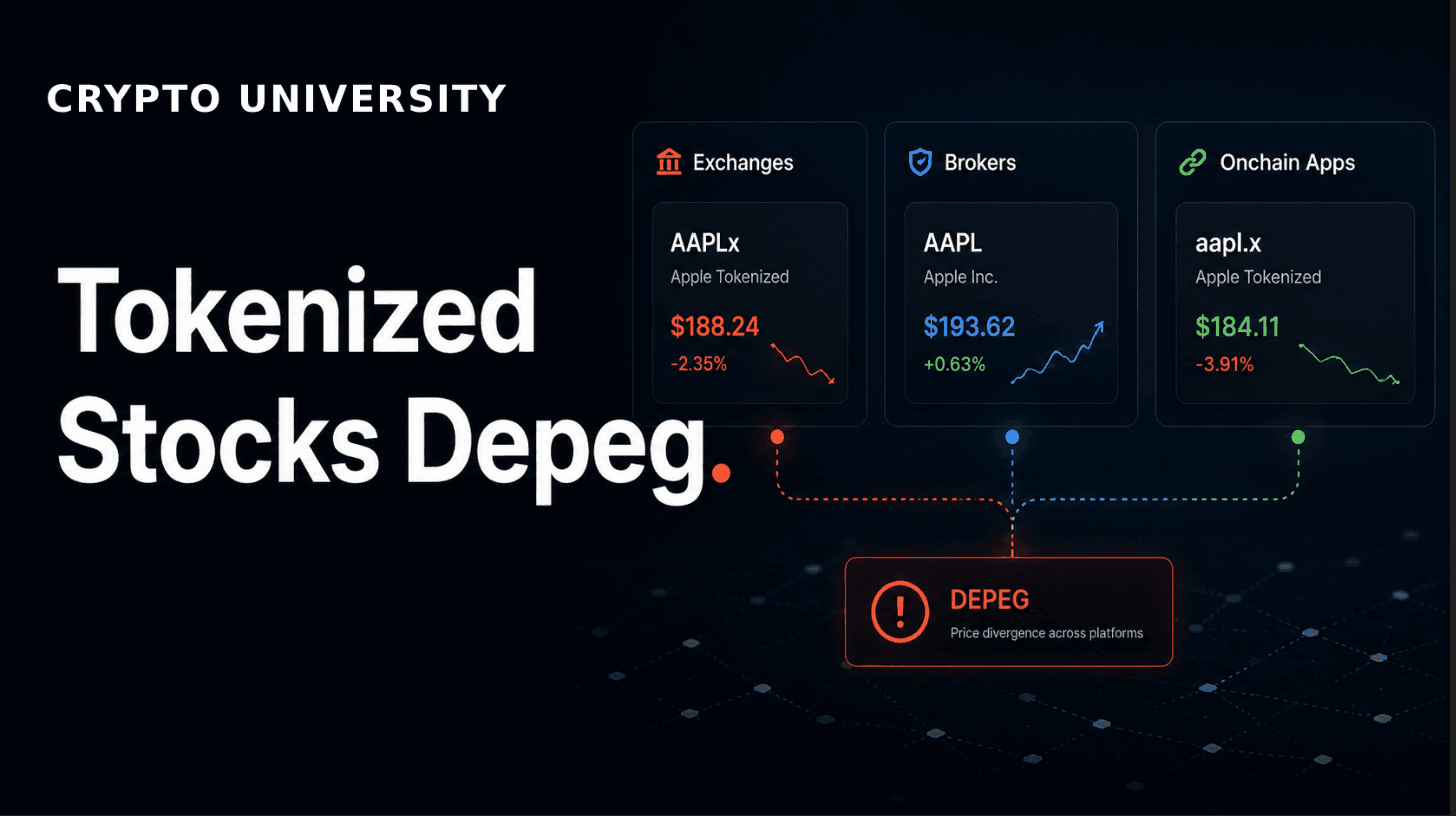
The short answer is yes, tokenized stocks can drift away from the real shares they represent. But here is the part that trips up newcomers. Unlike a stablecoin losing its dollar peg, a small gap in a tokenized stock usually is not a sign that something broke. It is the market doing exactly what it is supposed to do around an anchor that only works part of the time.
Think about it this way. A tokenized stock trades 24 hours a day, seven days a week, but the actual stock it tracks only prices during US market hours, roughly six and a half hours a day. For most of the week, the token has no live price to check itself against. The skill worth building is telling the difference between harmless drift and real trouble, and never being the person who pays a 3 percent premium at midnight on a Sunday for exposure they could buy at a fair price on Monday afternoon.
The Arbitrage Anchor
So why does a backed token usually stay close to its stock in the first place? The answer is arbitrage, which is just a fancy word for traders profiting from price gaps and closing those gaps in the process.
Here is the loop. If the token is trading richer than the real share, professionals step in. They buy the actual shares, hand them to the issuer, create new tokens, and sell those tokens until the premium disappears. If the token is trading cheaper than the share, they do the reverse. They buy the cheap tokens, redeem them for the share value, and pocket the difference. It is the same mechanism that keeps exchange-traded funds glued to their net asset value.
This anchor only holds when three things are working at the same time. When all three are in place, price gaps get closed fast. Take any one away, and the token floats on pure supply and demand until that piece comes back. The table below is your quick checklist whenever a price looks strange.
The three legs | What it means | What happens if it breaks |
|---|---|---|
Redemption works | You can still create and redeem tokens with the issuer at a reasonable cost. | There is no way to close gaps through the issuer, so the token drifts. |
The reference exists | The US market is open and the stock has a live, published price. | There is no live price to trade against, so the token free-floats. |
Arbitrage capital flows | Venues are connected and there are no withdrawal freezes. | Traders cannot move money in to close gaps, so venue-specific gaps appear. |
Normal Drift: The Weekend Float
During US market hours on busy, liquid venues, quality tokenized stocks track the real price closely, usually within the width of the normal buy-sell spread. Any gap gets arbitraged away within minutes. Nights and weekends are a different story, and that is completely expected. Here is what to look for when the market is closed.
What you will see | Why it happens |
|---|---|
A float, not a peg | Saturday's token price is the market's best live guess at Monday's open, shaped by crypto sentiment, news and money flows. When Bitcoin drops 10 percent on a Saturday, a related token moves right away while the underlying stock simply cannot. Comparing Saturday's token price to Friday's stock close and shouting depeg misreads the number. It is often information, not error. |
Wider spreads and thinner books | Fewer traders are active off-hours, so individual trades push the price around more than they would during the week. |
Reconvergence at the open | Monday's Nasdaq price is gravity. Gaps close quickly, in whichever direction leaves weekend traders looking silly. |
A simple rule of thumb: an off-hours premium or discount from a fraction of a percent up to the low single digits on thin pairs is just weather. It is not a broken product.
Dangerous Drift: When It Is Actually a Depeg
Now for the gaps that should get your attention. Watch for deviations that stick around during US market hours on liquid venues, or that line up with real structural news. These are the genuine warning signs.
Warning sign | What it is telling you |
|---|---|
Redemption interruption | If creating or redeeming tokens pauses because of operational, legal or banking problems at the issuer, the anchor is off. A discount that persists here is the market pricing real doubt about the collateral behind the token. |
Issuer or custodian stress | A token trading well below a live share price is the market charging a credit spread on the issuer. Respect that signal. |
Platform stress | Withdrawal freezes trap arbitrage money, so gaps appear on the troubled venue specifically. The history of exchange failures is a history of assets trading cheap on the failing platform. |
Corporate-action confusion | Stock splits and rebases can look like an overnight depeg but are usually just multiplier adjustments. Check the dividend and rebase mechanics before you panic. A token that appears to fall 90 percent on the day of a 10-for-1 split did not actually fall. |
A little history helps here. On older, now-defunct platforms, mirrored-stock tokens traded at wild dislocations when redemption broke, and synthetic equity tokens died alongside their collateral, as happened with Mirror Protocol in 2022. Modern backed products with daily verification are specifically designed against those failure modes, but designed against is not the same as immune.
Tracking Error Beyond Depegs
Even when the peg is holding perfectly, tiny return differences pile up between the token and the stock over time. This quiet gap is called tracking error, and for long-term holders it often costs more than the dramatic weekend wobbles everyone worries about.
Source of quiet tracking error | What it costs you |
|---|---|
Spread costs | The small cost baked into every entry and exit. |
Dividend withholding | A tax layer sits inside the dividend rebase process. |
Fee drag | Some product structures carry ongoing fees that chip away at returns. |
A good habit: once a year, compare your token's total return, including rebases, against the stock's total-return index. That is the honest way to see whether the product is doing its job.
How to Avoid Paying the Premium
You do not need to be a professional to trade tokenized stocks sensibly. A handful of habits do most of the work.
Habit | Why it works |
|---|---|
Trade during US market hours | The anchor is live and gaps close fast. This is the single highest-value habit you can adopt. |
Check the comparison before you buy | Look at the token price versus the underlying reference price. A visible premium is a visible cost. |
Use limit orders at or near the reference price | Let the market come to you rather than chasing it, especially off-hours. |
Treat persistent market-hours discounts as information | They are not bargains until you understand why they exist. |
Know your product's redemption status | Issuer status pages and terms tell you whether the anchor is even operating. |
Live premium/discount data per asset: Explore the Crypto University Tokenized Stocks Directory.
Frequently Asked Questions
Do tokenized stocks always trade at the exact stock price?
No. During US market hours on liquid venues they track very tightly. Off-hours they float on token supply and demand, usually within a small band that closes at the next market open.
Is a weekend premium a scam?
Usually not. It is normally the market pricing in expected Monday moves plus a liquidity cost. It is not fraud, but it is a real cost you can avoid by trading during market hours.
What is the biggest depeg risk?
Redemption interruption. Without the ability to create and redeem tokens, the arbitrage anchor is gone and the token trades on trust alone. A discount that persists during market hours is the warning sign to watch.
Can a depegged token recover?
If the cause is temporary, such as a market closure or a brief operational pause, history says yes, through arbitrage once things resume. If the cause is issuer failure, recovery becomes a legal question about the collateral rather than a trading one.
How do I check a token's premium right now?
Compare the token's price to the underlying stock's latest reference price. A tokenized stocks directory can surface this for each asset, and it will flag off-hours comparisons as not directly comparable.
Disclaimer: This content is for educational and informational purposes only and is not financial advice. Nothing here is a recommendation to buy or sell any asset or use any platform. Do your own research and manage your risk.
Explore the Crypto University Tokenized Stocks Directory.
Tokenized Stocks Explained: A Simple Guide for Beginner Traders
How to Buy Tokenized Stocks: A Step by Step Guide for Beginners
Need deeper training?
Join our structured modules with live examples and expert checklists for effective implementation.
JOIN THE ACADEMY