Introduction: When Software Starts Spending
For most of crypto's history, wallets have been tools for humans. You open an app, review a transaction, and tap to approve. The process is deliberate and manual by design. That is changing.
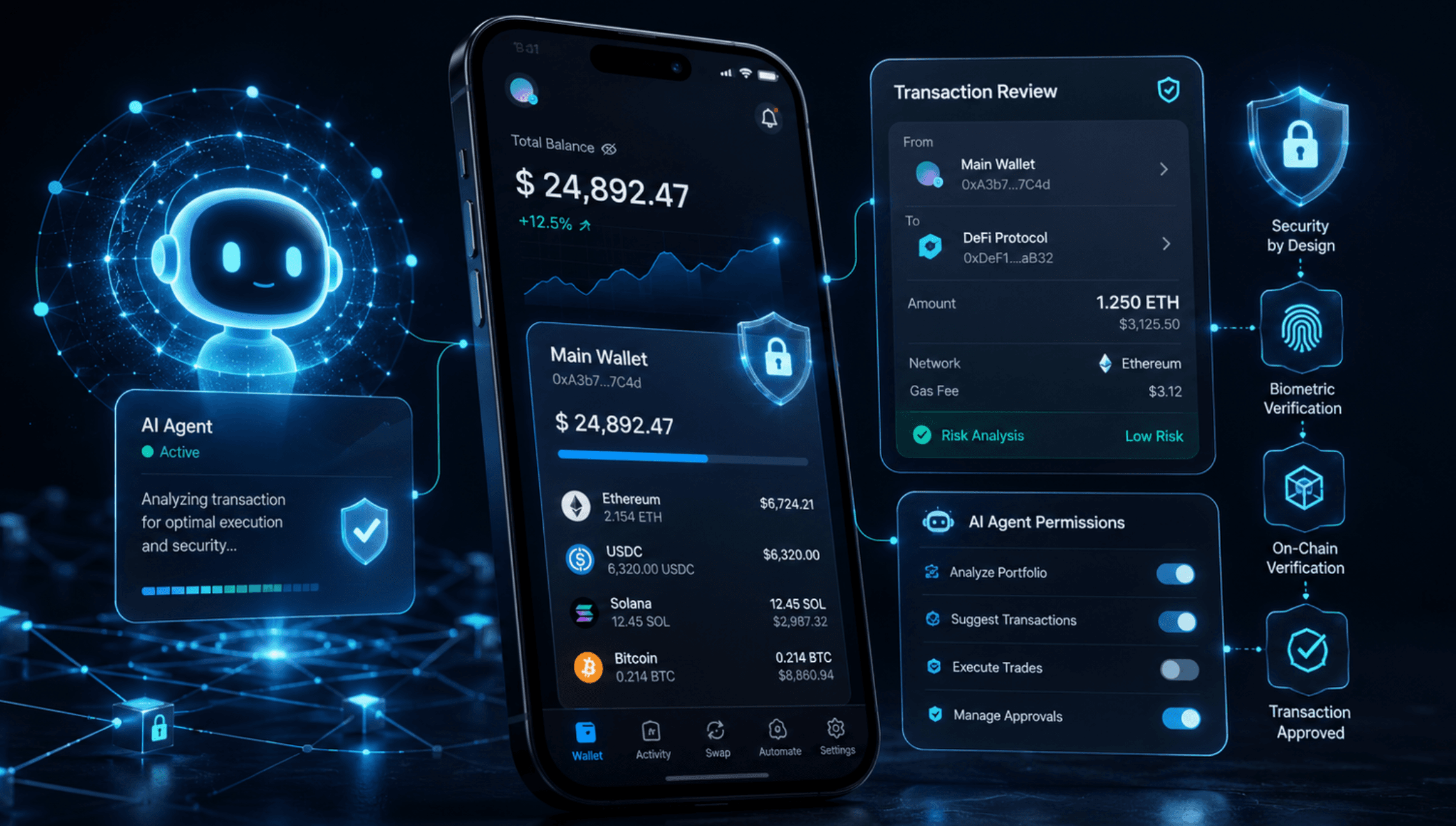
A new category of software called an AI agent can now hold its own wallet, connect to decentralized finance (DeFi) protocols, and execute transactions automatically, 24 hours a day, without a human approving every step. Major players have already shipped products in this space. MetaMask launched its Agent Wallet in June 2026, and Coinbase released its Agentic Wallets framework earlier the same year.
This article explains how AI agent wallets actually work under the hood, what makes them technically different from a regular wallet, and what risks users and developers need to understand before putting real funds in front of one.
What Is an AI Agent in Crypto?
An AI agent, in this context, is software that can perceive data from its environment, reason about it, and take actions, including blockchain transactions, without requiring a human to approve each step.
Think of it as a program that can read market conditions, decide what to do, and then actually do it, including moving funds. Earlier forms of this concept were called trading bots, but modern AI agents are more capable: they can interpret natural language instructions, adapt to changing conditions, and interact with complex multi-step DeFi strategies.
Common tasks AI agents perform with wallets today:
Swapping tokens across decentralized exchanges
Managing liquidity positions in yield-farming protocols
Executing perpetual futures trades
Rebalancing a portfolio based on algorithmic rules
Making automated payments to other services or agents
As one way to understand the scale of adoption: by some industry estimates, AI agents now account for roughly 19% of all on-chain activity, though the figure varies by source and methodology.
The Technical Foundations: How Agent Wallets Work
1. The Problem With Standard Wallets
A standard wallet, known as an Externally Owned Account or EOA, was designed for a human who holds a private key and manually approves each transaction. That model creates a bottleneck when a software agent needs to execute hundreds of transactions based on market conditions or pre-set rules.
Giving an AI agent direct access to a private key would be extremely dangerous. If the agent was compromised, all funds would be at risk. The crypto industry has developed several layers of architecture to solve this problem.
2. Account Abstraction: Making Wallets Programmable
The most important Ethereum upgrade enabling agent wallets is EIP-7702, which went live with Ethereum's Pectra upgrade in May 2025. It allows an EOA to temporarily delegate execution rights to a smart contract without changing the wallet's address or requiring a full migration. This effectively gives the wallet programmable logic, including spending caps, session keys, and batched transactions, while the user retains master control.
A related standard, ERC-4337, introduced the concept of Account Abstraction at a protocol level, enabling smart contract wallets that can batch operations, sponsor gas fees for users, and apply custom validation logic. EIP-7702 and ERC-4337 are designed to work together, not compete.
Standard / Upgrade | What It Enables for AI Agents |
|---|---|
EIP-7702 (Pectra, May 2025) | Lets EOAs delegate to smart contracts temporarily; enables session keys and spending caps without address migration |
ERC-4337 (Account Abstraction) | Enables smart contract wallets with batched transactions, gas sponsorship, and custom signing logic |
Session Keys | Time-limited, scoped signing permissions so agents can transact without accessing the master private key |
ERC-7521 (Intent Standard) | Lets an agent declare a desired outcome (such as swapping tokens at a target price) rather than constructing raw transaction code |
3. Key Management: MPC and TEE
Two technologies are central to keeping funds safe when an agent has signing authority:
Multi-Party Computation (MPC): The private key is mathematically split into multiple shares held by different parties or systems. No single party, including the agent itself, ever holds the complete key. A transaction can only be signed when enough shares cooperate. This prevents a single point of compromise.
Trusted Execution Environments (TEE): A TEE is a secure, isolated area inside a processor where code can run without being visible to the rest of the system. Private key material can be stored inside a TEE so that even the server hosting the agent cannot read it. Coinbase's AgentKit, for example, uses TEE-based custody for its agent wallets.
Together, these two systems allow an agent to sign transactions without ever having access to the underlying key material in plaintext.
4. Permission Layers and Guardrails
Rather than giving an agent unrestricted access, well-designed agent wallets operate within strict, user-defined permission boundaries. These are sometimes called a policy engine or guardrails.
Typical permission controls include:
Daily or per-transaction spending limits
Whitelisted contracts and wallet addresses the agent is allowed to interact with
Approved tokens and chains only
Time-based restrictions (for example, no trading on weekends)
Human approval required for transactions above a defined threshold
MetaMask's Agent Wallet, for example, offers two operating modes. One mode requires human confirmation for each transaction. A second mode, intended for more advanced users, allows fully autonomous execution within pre-set guardrails, including spending limits, approved assets, and whitelisted protocols. Any transaction flagged as suspicious triggers a two-factor authentication request regardless of mode.
Major Agent Wallet Platforms and Frameworks (2026)
Several well-known crypto companies have released infrastructure for AI agent wallets. The table below summarises the main options and what differentiates them.
Platform | Developer | Key Features | Custody Model |
|---|---|---|---|
MetaMask Agent Wallet | Consensys | Autonomous DeFi trading, mandatory transaction simulation, two modes (guided and autonomous), Blockaid threat scanning | Self-custodial (non-custodial) |
Coinbase AgentKit / Agentic Wallets | Coinbase | TEE-isolated keys, MPC architecture, programmable session caps, x402 protocol support for agent-to-service payments, CLI and MCP server | Non-custodial, TEE-based |
Cobo Agentic Wallet | Cobo | MPC-based, pre-signature policy checks, intent-based Pact system, multi-sig support | Enterprise MPC |
Safe (Gnosis) + Zodiac | Safe Global | Open-source multisig wallet, Zodiac module to constrain agent permissions, widely used in DAO treasury management | Multi-sig, open source |
Security Risks: What Users Need to Understand
The convenience of autonomous agents comes with new attack surfaces that do not exist with traditional wallets. Understanding these is essential before connecting an agent to any live funds.
Prompt Injection
Prompt injection is one of the most documented risks in AI agent security. It occurs when an attacker embeds malicious instructions inside content the agent is designed to read, such as a web page, a document, a social media post, or even a smart contract's description field.
The agent processes this content as part of its normal operation and may interpret the hidden instructions as legitimate commands, potentially redirecting funds or approving fraudulent transactions. Security researchers documented real-world prompt injection attempts targeting agent wallets in early 2026.
Memory Poisoning
More advanced AI agents maintain a memory layer, a database of past interactions and learned context, to improve their decision-making. Attackers can attempt to inject malicious data into this memory layer so that the agent acts on corrupted information over time. This is harder to detect than a single bad transaction because the behaviour appears to emerge gradually.
Malicious Smart Contracts
An agent that can interact with any smart contract is one that can be tricked into interacting with a malicious one. Fake contracts can be designed to drain approved token allowances or execute unexpected operations. Transaction simulation, where the outcome of a transaction is modelled before it is submitted to the blockchain, is one of the key defences against this.
Hallucination and Misinterpretation
AI models can sometimes misinterpret instructions or act on incorrect data, a behaviour often called hallucination. In a financial context, this is not merely inconvenient. An agent that misreads a price feed, misunderstands a user instruction, or incorrectly evaluates a smart contract risk score can lose real money quickly.
Supply Chain Attacks via Third-Party Plugins
Agent frameworks like ElizaOS allow third-party skill plugins to extend agent capabilities. Security researchers identified hundreds of malicious plugins in public marketplaces in early 2026. Because a plugin installed in a wallet-connected agent can inherit that agent's permissions, installing an unverified plugin is functionally similar to installing malware on a wallet.
Risk Type | Description | Primary Defence |
|---|---|---|
Prompt Injection | Malicious instructions embedded in content the agent reads | Separate read access from execution; validate inputs |
Memory Poisoning | Attacker corrupts the agent's memory or knowledge base over time | Immutable logs, periodic memory audits, limited memory scope |
Malicious Contracts | Agent is tricked into approving a contract that drains funds | Transaction simulation before submission; contract allowlisting |
Hallucination | Agent misinterprets data and executes an unintended transaction | Spending limits, human approval thresholds, simulation |
Plugin Supply Chain | Third-party extension carries malicious code | Only install audited plugins; restrict plugin permissions |
Privilege Creep | Agent accumulates more permissions over time than originally intended | Regular permission audits; time-limited session keys |
Verifiable Computation: Can You Trust What the Agent Did?
A legitimate question when delegating to an AI agent is: how do you know the agent actually did what it was supposed to do, and not something else?
This is the challenge of verifiable computation. On a blockchain, every transaction is recorded publicly and cannot be changed, but that only tells you what happened on-chain. It does not tell you why the agent made that decision, or whether the inputs it used were accurate.
Several approaches exist to address this:
Trusted Execution Environments (TEEs) can attest that a specific model ran specific code on specific inputs, providing a cryptographic proof of what occurred inside the agent's processing environment.
On-chain audit logs record every transaction the agent submitted, including which permissions were active at the time.
Simulation APIs allow users and developers to replay proposed transactions in a sandboxed environment before they hit the live blockchain.
Intent-based standards like ERC-7521 make the agent's intended outcome explicit and verifiable, rather than just recording the raw transaction.
Verifiable computation for AI agents is still an evolving area. No single solution currently provides end-to-end proof of an agent's reasoning process, but the tools for auditing outcomes are improving rapidly.
Best Practices for Users: Staying in Control
If you are considering using an AI agent with a crypto wallet, the following principles are widely recommended by security researchers and wallet developers.
Start with a dedicated, limited wallet. Never connect an AI agent to your main holdings. Create a separate wallet with only the amount of capital you are prepared to lose entirely.
Set the tightest spending limits you can tolerate. Most agent wallets support per-transaction caps and daily limits. Configure these before activating any autonomous mode.
Use allowlists, not blocklists. Specify exactly which contracts and addresses the agent is allowed to interact with, rather than trying to block bad actors after the fact.
Review activity logs regularly. Do not treat an agent as a set-and-forget system. Check transaction histories at least weekly.
Only use verified, audited plugins and frameworks. Avoid unaudited third-party extensions for any agent that has wallet access.
Understand the custody model. Know whether your keys are held in a TEE, managed via MPC, or controlled by a third party. Each model has different trust assumptions.
Keep a kill switch active. Most reputable agent wallet products include a master override or emergency freeze function. Know how to use it.
Summary: A Technology That Requires Active Oversight
AI agent wallets represent a genuine shift in how people can interact with crypto. The ability to automate complex DeFi strategies, execute trades around the clock, and delegate specific tasks to software is technically real and increasingly practical.
The underlying architecture, built on account abstraction standards, MPC key management, TEE isolation, and programmable permission layers, is designed with security in mind. But the attack surface is also new. Prompt injection, memory poisoning, and unverified plugins are not theoretical risks: they have already resulted in real financial losses.
The most important thing to understand is that delegating to an agent is not the same as setting up automatic savings. It is giving software the ability to move your money. The infrastructure is improving, but the degree of trust you extend to any agent should match exactly the controls you have put in place to constrain it.
Ready to go deeper? Enroll in the AI Bootcamp and learn how to build at the intersection of AI in one weekend.
Frequently Asked Questions
What is an AI agent wallet?
An AI agent wallet is a crypto wallet designed to be operated by automated software rather than a human. The agent can sign transactions, interact with DeFi protocols, and manage assets within rules set by the user, without requiring manual approval for every action.
Is it safe to use an AI agent with real crypto funds?
The safety depends almost entirely on the controls you put in place. Using a dedicated wallet with strict spending limits, allowlisted contracts, and regular monitoring significantly reduces risk. Connecting an agent to a primary wallet without restrictions is considered high risk. No agent system eliminates all risk.
What is EIP-7702 and why does it matter for AI agents?
EIP-7702 is an Ethereum upgrade that went live in May 2025. It allows a standard wallet (EOA) to temporarily behave like a smart contract, enabling features like session keys, spending caps, and batched transactions. This makes it possible to give an agent limited, scoped signing authority without exposing the master private key.
What is MPC key management?
Multi-Party Computation (MPC) is a method of splitting a private key into multiple mathematically related shares held by different parties. No single party holds the full key. A transaction can only be signed when enough shares participate, reducing the risk that any single compromise leads to total loss of funds.
What is prompt injection in the context of crypto agents?
Prompt injection is an attack where malicious instructions are hidden inside content the agent reads, such as a web page or document. The agent may interpret these hidden instructions as legitimate commands and act on them, potentially draining funds or approving fraudulent transactions.
What is MetaMask Agent Wallet?
MetaMask Agent Wallet is a product launched by Consensys in June 2026 that allows AI agents to autonomously trade and interact with DeFi protocols on EVM-compatible chains. Every transaction passes through mandatory security checks including simulation, threat scanning, and user-defined permission guardrails.
Can an AI agent access my regular MetaMask wallet?
Agent wallets like MetaMask's are separate products from the standard MetaMask browser extension. They require users to explicitly set up and configure an agent wallet with its own permissions and spending limits. An AI agent does not gain access to your existing wallet without your active setup and approval.
What is the difference between an AI agent wallet and a trading bot?
Traditional trading bots follow fixed rule sets (for example, 'sell if the price drops 5%'). AI agents can reason more flexibly, interpret natural language goals, adapt to new information, and interact with a broader range of protocols and services. The tradeoff is that they are harder to fully predict and audit.
Disclaimer: This content is for educational and informational purposes only and is not financial advice. Nothing here is a recommendation to buy or sell any asset or use any platform. Do your own research and manage your risk.
Read More
AI + Crypto Convergence in 2026: What It Means for Web3 Developers and Users
AI Meets DAOs: How Artificial Intelligence Is Changing On-Chain Governance in 2026
Beginner’s Guide to Decentralized AI (DeAI): Subnets, Bittensor Basics, and Safe Participation Tips
AI Agent Crypto Wallets and Regulation: What Developers and Users Need to Know in 2026
Need deeper training?
Join our structured modules with live examples and expert checklists for effective implementation.
JOIN THE ACADEMY